11 people, 900 days, and $16 billion wrested from the giants
TechFlow Selected TechFlow Selected
11 people, 900 days, and $16 billion wrested from the giants
Relive the legendary journey of Hyperliquid.
 Navigating Web3 tides with focused insights
Author: Cookie, Jaleel Jia Liu
In just over two and a half years, Hyperliquid has solidified its position as the market leader in decentralized perpetual contracts. If considering only the top 100 perpetual trading pairs, Hyperliquid’s perpetual trading volume last week reached an "8-2 split" compared to Binance's USD-denominated perpetual trading volume.
Remarkably, this achievement was accomplished by a core team of just 11 people. On August 20, data released by HyperliquidFR revealed that Hyperliquid generated $102.4 million in annual revenue per employee, making it the highest revenue-per-employee company globally.
Looking back at Hyperliquid’s development journey, there were periods of quiet incubation, stunning airdrop-fueled wealth creation, and even moments of crisis. As $HYPE recently hit a new all-time high for the third time this year, let’s revisit Hyperliquid’s legendary journey.
Hibernation
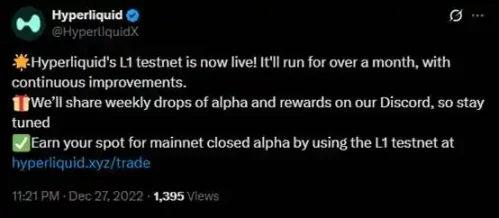
On December 27, 2022, Hyperliquid sent its first tweet, announcing the launch of the Hyperliquid L1 testnet.
During this nearly unnoticed hibernation period, Hyperliquid founder Jeff was deeply focused on building his foundational architecture. Previously engaged in quantitative and high-frequency trading research at Citadel, with a Harvard education and upbringing in Silicon Valley, Jeff understood how traditional financial systems maintain matching efficiency and capital security under extreme stress.
"How can on-chain trading achieve Wall Street-level execution experience?" This was the question constantly on Jeff’s mind. With this vision, rather than building a contract trading platform atop existing blockchains, Jeff insisted on constructing an entirely new Layer 1 chain, taking full control over the entire matching, clearing, and risk management system.
In the following months, Hyperliquid’s official Twitter account saw little traction. On April 20, 2023, Hyperliquid tweeted about distributing referral rewards to 81 addresses. One user in the comments expressed excitement over earning a $3 reward—likely unaware at the time that their early participation would later yield returns far exceeding those initial dollars. Did they envision such a bright future?

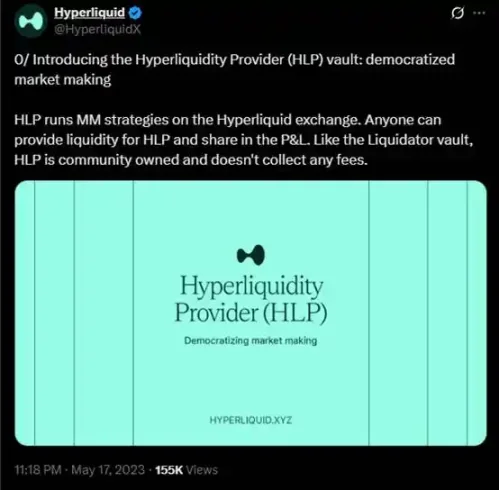
On May 17, 2023, Hyperliquid announced the launch of HLP, a community-owned native market-making treasury—the first tweet from Hyperliquid to receive significant attention. Today, HLP’s TVL has reached approximately $573 million.
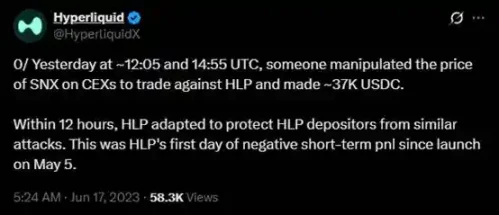
On June 17, 2023, HLP suffered its first attack. The attacker manipulated the price of $SNX on centralized exchanges (CEX), shorted $SNX on Hyperliquid, then closed positions on CEX, profiting around $37,000. Hyperliquid quickly adjusted its mechanisms, likely realizing that as the platform grew, HLP would face further tests.
On November 1, 2023, Hyperliquid launched its points system. On November 24, it announced that its total trading volume had reached $10 billion. By year-end 2023, Hyperliquid reported cumulative trading volume of $21 billion, over 31,000 users, and during the first week of 2024, weekly trading volume surpassed dYdX, claiming the top spot in the decentralized perpetuals market.
From that point onward, Hyperliquid entered a phase of rapid growth. The market leader was beginning to emerge—the hibernation period was coming to an end.
Sudden Breakout
If Jeff during the hibernation phase resembled a determined engineer, by 2024’s “breakout” phase he began showing clearer strategic ambition. Hyperliquid was no longer content with merely leading the derivatives market. In multiple interviews, Jeff emphasized his vision for Hyperliquid to become a “full-featured on-chain financial ecosystem,” not just a single-purpose Perp DEX.
Thus, on March 29, 2024, Hyperliquid announced support for native spot trading and introduced two native token standards: HIP-1 and HIP-2. HIP-1 is a native token protocol allowing users to issue custom tokens on Hyperliquid L1. HIP-2 serves as a liquidity solution, providing market-making strategies for HIP-1 tokens to ensure liquidity without relying on external platforms like Raydium.
Simultaneously, Hyperliquid announced that the first spot-listed token would be $PURR, a meme coin issued by Hyperliquid itself on Hyperliquid L1. $PURR was a gift to all users who participated in Hyperliquid’s points system. At its peak, the token reached a market cap exceeding $600 million; it currently maintains a $108 million market cap, remaining the largest native meme coin on Hyperliquid L1.
On May 20, 2024, Hyperliquid announced plans to support native EVM, signaling that the team was not satisfied with success in derivatives alone but harbored greater ambitions to build a comprehensive ecosystem—one where users could fully embrace the Hyperliquid ecosystem without needing CEXs or other blockchains.
On November 29, 2024, Hyperliquid’s native token $HYPE launched, closing its first day at $6.25. Early users reaped substantial rewards, but even bigger surprises followed—within less than two weeks, $HYPE surged over fivefold, peaking at $35.
X feeds filled with discussions about $HYPE. Whether or not someone was a derivatives trader, they now knew about Hyperliquid.
Trials
Success attracts scrutiny. After a seemingly smooth and rapid ascent, Hyperliquid faced its first major trial shortly after $HYPE’s launch.
On December 30, 2024, renowned security researcher Tay (@tayvano_) issued a warning on X—multiple known North Korean hacker addresses had traded on Hyperliquid between October 29 and December 18, 2024, incurring losses exceeding $700,000.
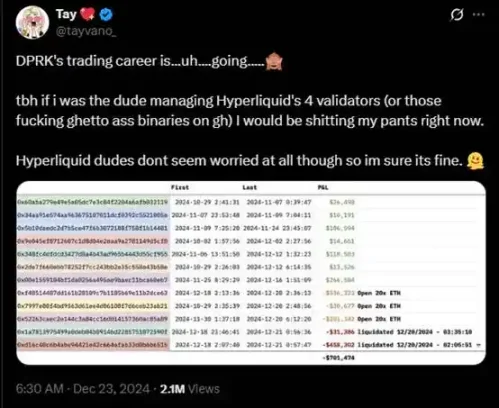
While Hyperliquid showed no signs of compromise at the time, this could mean it had already been identified as a potential target by North Korean hackers. Tay added, “If I were one of Hyperliquid’s four validators, I’d be shitting myself,” sparking market concerns about security risks stemming from Hyperliquid’s small validator set.
A day later, Hyperliquid Labs issued an official statement acknowledging reports about the alleged North Korean hacker activity. In reality, Hyperliquid had not suffered any attack by North Korean hackers—or any form of breach. All user funds remained secure.
On January 7, 2025, node operator Chorus One published an open letter on Twitter detailing multiple issues with Hyperliquid’s testnet, including frequent node shutdowns, operational difficulties due to closed-source code, and single-point-of-failure risks from centralized APIs. The letter proposed several improvements aimed at enhancing chain transparency and decentralization.
In response, Hyperliquid founder Jeff replied, emphasizing that validator selection criteria had already been disclosed. The official Hyperliquid account also posted separately on X, clarifying the issues raised and stating that node code would be open-sourced when safe to do so.
On March 27, 2025, Hyperliquid found itself in a highly publicized crisis. A whale established a large short position in JELLY on Hyperliquid, then a sudden sharp price movement triggered liquidation. Hyperliquid’s counterparty treasury took over the position but itself neared liquidation, putting the entire protocol treasury at risk of collapse. Meanwhile, CEXs seized the opportunity, listing JELLY futures to directly target and exploit Hyperliquid.
The incident ended with Hyperliquid delisting JELLY and settling the inherited short position at $0.0095 (far below market price), ultimately losing no funds. However, FUD persisted. Arthur Hayes commented on X that Hyperliquid failed to handle the JELLY incident properly, calling it anything but decentralized, and betting that $HYPE would soon return to zero. Bitget CEO Gracy Chen stated that Hyperliquid’s handling was immature, unethical, and unprofessional, suggesting it could become FTX 2.0.
Yet, this event did not halt Hyperliquid’s momentum. After the first week of April, $HYPE resumed its upward trajectory, repeatedly setting new all-time highs.
Favored by Whales
In March 2025, Hyperliquid first gained market attention due to whale activity. At the time, a “50x leverage whale on Hyperliquid” emerged, gaining widespread notice for consistently high win rates and massive profits from leveraged trades—earning him the nickname “Insider Guy.”
In May, James Wynn engaged in a bull-bear showdown with this “Insider Guy,” briefly holding over $1 billion in positions, ultimately emerging victorious.
But soon after, he suffered a major loss. By late May, James Wynn had accumulated $87 million in unrealized profit, but later gave back all gains and lost $21.77 million of principal. At his peak, he held a record-breaking $1.23 billion long BTC position on Hyperliquid.
Regardless of individual successes or failures, whale movements on Hyperliquid have become a key market indicator—an organic golden reputation for the platform.
Just two days ago, Arkham’s on-chain data analysis revealed that a whale—recently dubbed the “ancient BTC whale who slept for seven years before making a high-profile ETH swap”—re-staked $125 million worth of ETH. To date, this unknown whale has used Hyperliquid (via Hyperunit) to purchase and stake $255 million worth of ETH.
This amount ranks among the top 10 ETH holders on Etherscan, roughly 2.5 times the current ETH holdings of the Ethereum Foundation. The whale’s actions significantly impacted the Bitcoin market, triggering a 3% drop through BTC sales. Likely seeking privacy, the whale chose to operate via Hyperliquid.
Delivering CeFi-grade trading experience on a fully decentralized Layer 1—Hyperliquid has achieved this, and it’s precisely why whales favor it.
Conclusion
The crypto space truly is a place where miracles happen. Considering the giants Hyperliquid is challenging—CEX behemoths like Binance and OKX—and looking at Hyperliquid’s growth speed and revenue scale, few can resist marveling: Hyperliquid is yet another “crypto miracle.”
When reviewing Hyperliquid’s journey, it’s easy to focus on dazzling numbers and stories. But zooming in reveals that Hyperliquid’s essence mirrors Jeff’s own character.
Jeff is not a founder who frequently appears in public. He rarely gives interviews and avoids aggressive marketing. In his most recent interview, he mentioned that Hyperliquid has only 11 team members and no internal marketing team.
Beneath the beautiful narrative lies a story of quiet growth, enduring doubts and trials unknown to many. Yet today, they continue to persevere—and continue to succeed.
Join TechFlow official community to stay tuned
Telegram:https://t.me/TechFlowDaily
X (Twitter):https://x.com/TechFlowPost
X (Twitter) EN:https://x.com/BlockFlow_News
 BlockBeats