The Rise of Bitcoin's New High: Binance Retail Investors' Eight-Year Gold Rush
TechFlow Selected TechFlow Selected
The Rise of Bitcoin's New High: Binance Retail Investors' Eight-Year Gold Rush
By reviewing Binance's major innovative developments over the past eight years, and comparing traditional profit-seeking methods of early crypto users with the new pathways pioneered by Binance, this article helps users understand how to seize these wealth opportunities in a timely manner.
 Navigating Web3 tides with focused insights
Author: Viee, Core Contributor at Biteye
In the 2025 crypto market, if one were to identify a definitive "Alpha," the Binance ecosystem stands out as an unavoidable answer. Starting from the beginning of the year, Binance has rolled out a series of strategic initiatives—from Megadrop to Alpha Points—establishing a brand-new user pathway centered around “participation equals rewards.” Users now gain access to early-stage projects and profit-sharing opportunities directly within Binance, with significantly reduced costs and entry barriers.
Looking back over the past eight years, the ways in which cryptocurrency users generate returns have undergone revolutionary changes. Binance has evolved from initially providing a secure and reliable trading venue, to pioneering the IEO model, launching BSC to ignite on-chain mining, and then popularizing the concept of “earning yield by holding tokens” via Launchpool—culminating in the current frenzy around Alpha Points. Each major innovation by Binance has created entirely new profit opportunities for users, often setting industry-wide trends.
Therefore, this article will review Binance’s key innovations over the past eight years, comparing traditional earning methods used by early crypto adopters with the new pathways pioneered by Binance, helping users understand how to seize these wealth-generating opportunities. At the end, we’ll also provide practical guidance on participating in these innovative programs and offer insights into future trends.
1. The Early Crypto Era: Trading, HODLing, and Old-School "Rug Pulls"
Around 2017, the crypto market experienced its first major boom. The primary ways users generated profits were through buying low and selling high or long-term holding (HODLing) of mainstream cryptocurrencies like Bitcoin and Ethereum. Alternatively, traders profited from frequent short-term trades amid volatile price swings. However, this approach was highly dependent on market conditions, carrying both high risk and high reward. Meanwhile, 2017 marked the peak of the ICO (Initial Coin Offering) craze, during which numerous global projects raised funds—some even securing hundreds of millions of dollars.
Binance rapidly rose during this period. In July 2017, Binance raised $15 million through an ICO to launch its exchange. Leveraging advantages such as high-performance order matching, low trading fees, rapid listing of new coins, and superior user experience, Binance capitalized on the post-ICO market surge. Despite China's regulatory crackdown on ICOs in late 2017, Binance swiftly moved overseas and became the world’s largest cryptocurrency exchange by trading volume in under eight months.
From 2017 to 2018, most crypto users relied on high-risk speculation for income, lacking stable or sustainable models. It was against this backdrop that Binance began experimenting with new innovations, aiming to open up more transparent and efficient revenue paths for users.
2. Binance IEO Sparks the Exchange-Based Launch Trend
In 2019, a new token issuance model emerged—the IEO (Initial Exchange Offering). Binance launched its first IEO project, BitTorrent (BTT), enabling ordinary users to participate easily in early-stage token sales. This immediately captured market attention. Compared to the chaotic ICO landscape of 2017, where project quality varied wildly, IEOs introduced oversight: exchanges vetted projects, set subscription rules, and handled the entire process internally—from purchase to trading—greatly reducing complexity and risk. Regular users only needed to hold a certain amount of the platform token BNB to qualify for lottery-based allocations or guaranteed quotas.
The financial impact of Binance’s IEOs was immediate. The inaugural project BTT surged nearly tenfold (about 1000%) upon listing. This wealth-generation effect attracted many other exchanges to launch their own IEO platforms, sparking a wave of exchange-led token launches across the industry—and driving a mini bull run for exchange platform tokens.
For users, the IEO model increased the predictability of returns. For Binance, Launchpad brought massive user traffic, boosted trading volumes, and generated substantial revenue—including listing fees, transaction commissions, and increased demand for BNB. In essence, Binance used Launchpad to pioneer a new path for retail investors to earn first-market returns. Previously inaccessible to average investors, early-stage investments became democratized through Binance’s IEO framework, setting a benchmark for the industry. This innovation expanded user profitability beyond mere secondary-market trading into direct participation in project launches, further solidifying Binance’s leadership position.
3. Launching BSC Chain: Lowering the Barrier to On-Chain "Mining"
In 2020, the “DeFi Summer” sparked widespread interest in on-chain yield farming. Many participants earned significant returns by providing liquidity and mining tokens. However, Ethereum’s exorbitant gas fees and network congestion locked out many retail users—one interaction could cost tens of dollars in fees, making small-scale participation impractical. At this critical moment, Binance launched the Binance Smart Chain (BSC) in September 2020, dramatically lowering the barrier for everyday users to engage with DeFi.
BSC is compatible with Ethereum but offers ultra-low transaction fees, fast confirmation times, and low deployment thresholds. Gas fees on BSC are just a fraction of those on Ethereum, allowing users previously priced out by high costs to affordably conduct frequent on-chain activities. As a result, from late 2020 to early 2021, a large number of developers and users migrated from Ethereum to BSC.
Within BSC’s low-cost environment, on-chain earning methods quickly diversified. Projects flourished and iterated rapidly—PancakeSwap rose to prominence, while various blockchain games (like CryptoBlades) and meme coins (such as Safemoon) emerged one after another. Many small-capital players benefited from catching explosive price surges of newly launched tokens. By May 2021, BSC’s total value locked (TVL) surpassed $20 billion, making it the second-largest public blockchain globally after Ethereum.
The launch of BSC fundamentally changed how users make money—it extended opportunities from centralized exchanges into decentralized on-chain ecosystems. Binance Smart Chain lowered the threshold for ordinary users to participate in DeFi, enabling them to provide liquidity, mine tokens, claim airdrops, and earn autonomously—all at much lower cost. This once again demonstrated Binance’s foresight in innovating user monetization models—responding swiftly to shifting industry dynamics by creating accessible new pathways to reduce costs and capture emerging opportunities.
4. Launchpool: Introducing Yield-Bearing Holdings and New Token Airdrops
Also in 2020, Binance introduced Launchpool (New Coin Mining), targeting idle user assets and offering a novel, low-risk way to earn returns. By simply staking BNB or other designated tokens in Launchpool, users could earn newly issued project tokens proportional to their holdings—effectively turning passive holdings into income-generating assets, akin to “earning interest on your holdings,” while receiving free airdropped tokens.
Launchpool transformed what used to be a complex, multi-step process involving manual on-chain liquidity provision into a seamless, one-click experience within the exchange. It quickly became a highlight in the 2020 crypto market. According to official data, within six months of launch, Launchpool successfully rolled out 15 high-quality projects, achieving a TVL of $4.64 billion and distributing $529 million worth of new project tokens to 408,783 users. Most recipients saw substantial gains as these tokens surged during the broader DeFi rally.
Launchpool offered relatively stable and transparent returns, fundamentally changing how users viewed token holding—assets were no longer idle but productive tools capable of generating ongoing yields. Statistics show that projects launched via Launchpool between 2020 and 2021 delivered an average annualized return of approximately 24%. More strikingly, some tokens distributed for free through Launchpool exploded in value on secondary markets—for example, ALPHA appreciated 86x, while BTCST and LIT each gained over 30x. This proved that participating via Launchpool was effectively a zero-cost, high-return strategy—preserving original capital while acquiring high-potential new tokens.
In short, Binance’s Launchpool played a pivotal role in popularizing the “hold-to-earn” philosophy. Its success prompted other exchanges to roll out similar staking products, reshaping the entire industry’s incentive structure.
5. The "Alpha" Era: Task-Based Points Driving the "Participate-to-Earn" Model
In the early 2020s, airdrop models began gaining traction. Back then, many projects generously rewarded new users—simply connecting a wallet, following social media, or completing basic tasks could net users $10 to $100+ in free tokens. While risks like scams and phishing sites existed, 2020 remained the most active, diverse, and inclusive phase for airdrops.
By 2024–2025, airdrop mechanisms had evolved into more complex, task-driven formats. Increasingly, new projects required users to complete a series of specific actions—such as interacting with testnets, following social accounts, inviting friends—to accumulate points before qualifying for airdrops. While this boosted engagement, it also made participation time-consuming and labor-intensive, often yielding uncertain results for regular users.
Against this increasingly competitive backdrop, Binance launched its Alpha section and the accompanying Alpha Points system. Through this framework, Binance identifies promising early-stage projects within its Web3 wallet ecosystem and uses a point-based mechanism to incentivize user participation, granting eligibility for token pre-sales (TGE) or airdrop rewards. Thus, 2025 has been dubbed the “Year One of Binance Alpha Airdrops.” This model creates a win-win: users redeem points for valuable token allocations, while projects gain exposure and liquidity through Binance’s vast user base.
By June 2025, Binance Wallet introduced the “Pre-TGE + Booster” mechanism, further enhancing the Alpha-era “participate-to-earn” experience. The Pre-TGE model allows retail investors to enjoy institutional-grade access, purchasing tokens at preferential prices with locked staking delivering high-certainty returns. Meanwhile, the Booster mechanism enables users to earn free token airdrops simply by engaging in basic interactions, covering the full lifecycle from testnet activity to mainnet listing.
Going forward, token airdrops and initial distributions are expected to place greater emphasis on user behavior data, potentially incorporating AI algorithms to dynamically adjust incentives and improve efficiency. Exchanges may leverage such point systems to strengthen user retention and advance their own chain and multi-chain ecosystems. As an industry bellwether, Binance is likely to continue leading this transformation.
6. Practical Guide for Users
As reviewed above, Binance has introduced multiple innovative profit-making models over the past eight years—each with distinct characteristics suitable for different types of users. The table below summarizes several mainstream Binance launch and mining activities to help you choose the right strategy based on your circumstances.
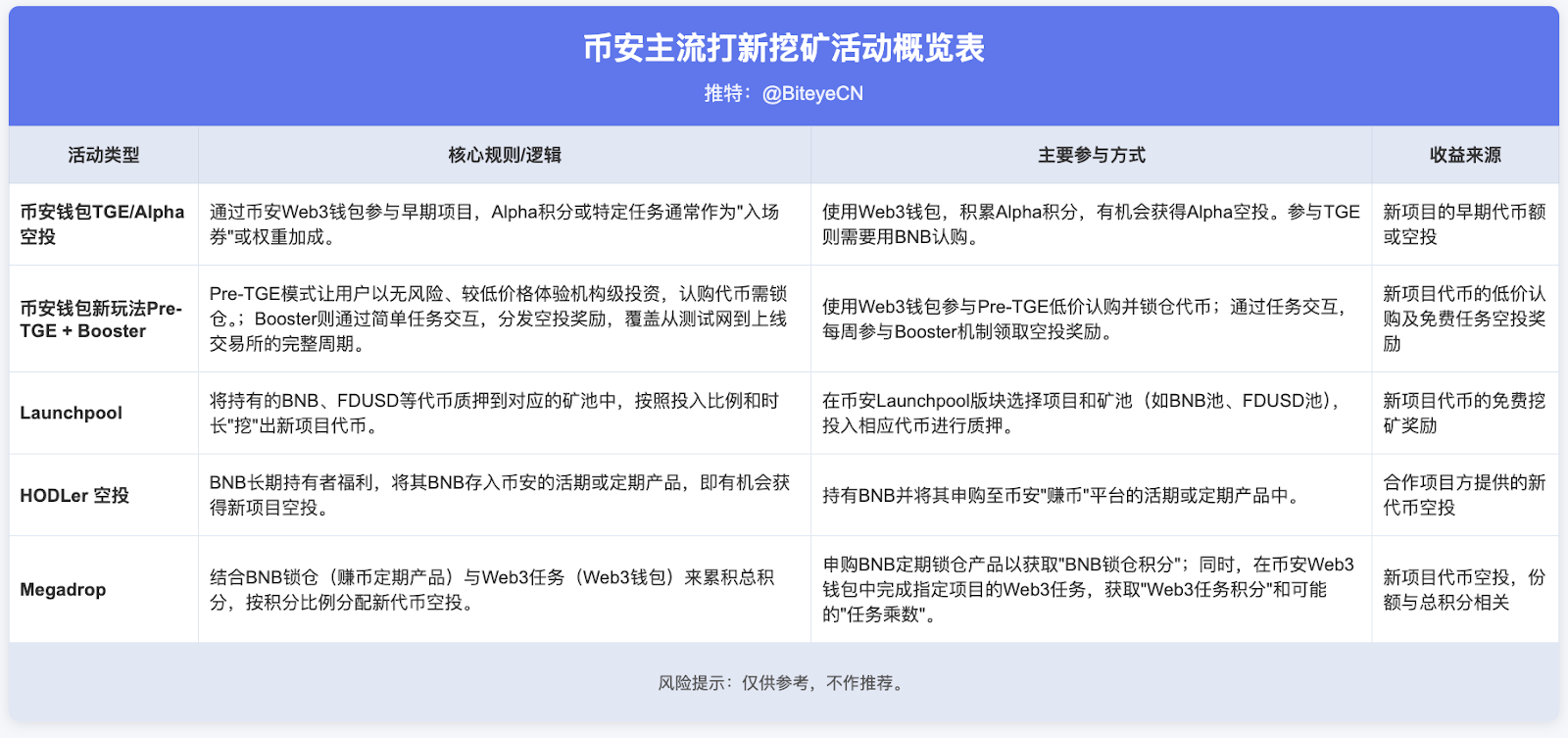
In general, Binance’s current main profit-generating activities can be categorized as follows: Wallet Alpha Airdrops/TGE (completing tasks to earn points for early access), Pre-TGE + Booster, Launchpool (staking to earn new tokens), HODLer Airdrops (holding specific tokens to receive periodic new coin giveaways), and Megadrop. Based on your capital size and available time, consider the following strategies:
-
Stable Holding Strategy: If you have substantial capital and prefer minimal effort, adopt the “BNB Holder” approach—long-term holding of BNB while actively participating in Launchpool and occasional HODLer airdrops. This strategy focuses on compounding growth: benefiting from both BNB appreciation and accumulated airdropped tokens. As the cornerstone of the Binance ecosystem, BNB’s long-term performance is closely tied to Binance’s innovation momentum. Holding BNB serves both as a gateway to various Binance activities and as a sound investment itself. That said, always manage position size carefully and remain cautious of market volatility.
-
Active Participation Strategy: If you have limited funds but ample time and technical ability, try the “Alpha Points Grinder” path—aiming to meet thresholds for airdrops, TGE, Pre-TGE, or Booster rewards. Use multiple accounts strategically to distribute tasks efficiently instead of relying on costly single-account grinding. Withdraw promptly after completing tasks to lock in profits. Crucially, always calculate costs—avoid scenarios where gas fees and slippage outweigh your earnings.
-
Hybrid Balanced Strategy: Most users should combine approaches. Allocate core funds to Launchpad and Launchpool for steady returns, while using smaller side funds to experiment with Alpha airdrops, TGE, Pre-TGE, etc., for potential upside. This ensures your principal grows securely while still leaving room to capture outlier gains.
7. Conclusion and Future Outlook
From simple trading and HODLing, to farm-style airdrops, exchange-based launches, on-chain mining, and now task-based point systems—Binance has been at the forefront of nearly every major evolution in how crypto users generate income over the past eight years. Each step taken by Binance has directly addressed user pain points. Whenever a new trend emerges, Binance consistently delivers timely innovations that create windows of opportunity and spark new industry waves—often emulated by competitors.
Looking ahead, platform-driven, participation-based earning models are likely to become mainstream. The success of Binance’s Alpha Points system shows how exchanges can tightly align the interests of users, projects, and themselves to achieve mutual benefit. We may soon see exchanges integrating SocialFi or InfoFi elements into task-based incentives—or even deploying AI assistants to help users optimize their earning strategies.
Regardless, the crypto industry has only just passed its first decade, and new opportunities continue to emerge. As individual users, staying attentive to developments at leading platforms like Binance and proactively learning about new products and mechanisms will be key to capturing value when the next wave arrives.
Join TechFlow official community to stay tuned
Telegram:https://t.me/TechFlowDaily
X (Twitter):https://x.com/TechFlowPost
X (Twitter) EN:https://x.com/BlockFlow_News
 @BiteyeCN