Opinion: Holding ETH is the best way to benefit from the stablecoin wave
TechFlow Selected TechFlow Selected
Opinion: Holding ETH is the best way to benefit from the stablecoin wave
For most retail and institutional participants, ETH offers the simplest access to the entire digital dollar ecosystem.
 Navigating Web3 tides with focused insights
Author: Maria Shen & Sanjay Shah, Electric Capital
Translation: TechFlow
*Note: In this article, "Ethereum" refers to the network, and "ETH" refers to the asset that powers it.
Global demand for the U.S. dollar is not declining—it's exploding. While headlines focus on "de-dollarization," a far more significant trend is emerging: over 4 billion people and millions of businesses are actively seeking access to dollars through stablecoins, representing the largest expansion of the dollar’s network effect in decades.
This creates an unprecedented opportunity for Ethereum. Stablecoins have provided global individuals with access to the dollar—growing 60-fold since 2020 to over $200 billion—creating millions of new dollar holders who need more than just digital cash. They need yield, investment opportunities, and financial services. Traditional finance cannot serve this vast new market due to regulatory and infrastructure limitations.
Ethereum is uniquely positioned to provide the global financial infrastructure for this new digital dollar economy—and ETH will benefit directly from this growth.
Millions of new dollar holders entering via stablecoins
There is massive latent demand for the U.S. dollar among individuals and enterprises worldwide.
People around the world seek safety in dollars:
-
Over 4 billion people face significant currency risk due to political instability, poor monetary policy, and structural inflation.(1)
-
An estimated 21% of the global population lives in countries with annual inflation exceeding 6%, rapidly eroding savings and purchasing power.(2)
-
For these populations, holding dollars means financial security. The dollar is seen as a store of value, a medium for cross-border transactions, and a hedge against local currency volatility.
Businesses need dollars to transact:
-
The U.S. dollar remains the dominant currency in global trade, involved in at least one leg of 88% of all foreign exchange transactions.(3)
-
Enterprises in emerging markets rely on dollar liquidity for international payments, imports, and supply chains, often hindered by limited or unstable local banking and FX markets.
-
Small and medium-sized businesses and freelancers increasingly require digital dollars for payment and to avoid currency mismatch risks.
For the first time in history, anyone in the world can hold dollars via stablecoins:
-
Anyone with internet access can hold and transact in dollars—no bank account, no government permission, available globally and 24/7.
-
As a result, stablecoin market capitalization has grown 60-fold since 2020.(4)
-
Adoption peaks are concentrated in emerging markets previously excluded from dollar-denominated finance. Nigeria has become the world’s second-largest cryptocurrency market, while China sees continued underground crypto use despite bans.(5)
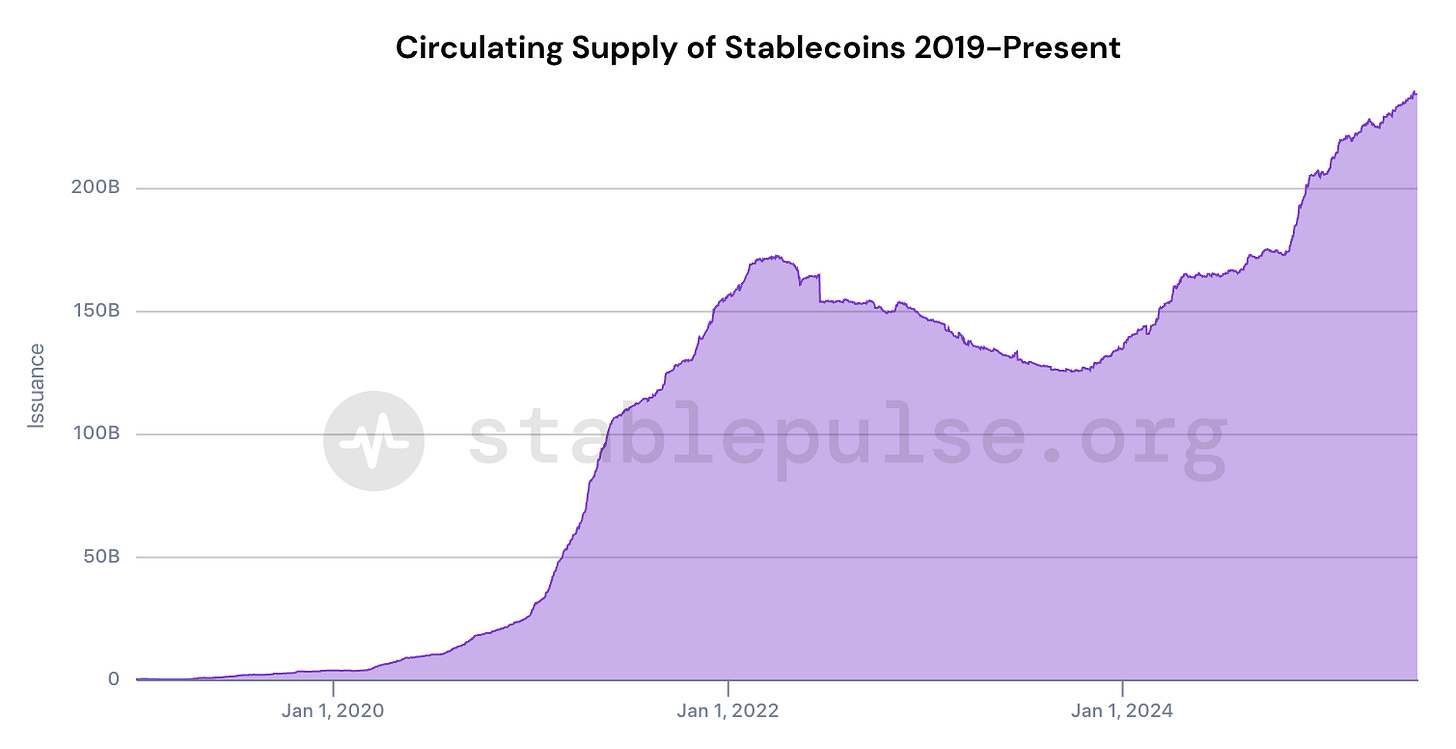
Stablecoins are creating a new cohort of dollar holders across the world’s largest populations—businesses pricing in USDT, households saving in USDC. They are driving a fundamental expansion of the dollar-based financial services market.
These new dollar holders seek yield, creating an opportunity for new global financial infrastructure
Stablecoin holders want their money to work.
Today, millions can already hold dollars via stablecoins. But their aspirations go beyond mere holdings. Individuals and businesses naturally want to deploy capital to earn yield, invest, and grow wealth.
Traditional finance cannot serve this new market:
-
The U.S. banking system imposes compliance requirements that exclude most global participants.
-
Cross-border financial services remain expensive, slow, and geographically constrained.
-
Traditional finance was built for institutions and high-net-worth individuals—not global retail users.
-
Geographic and regulatory barriers prevent billions from participating in dollar-denominated financing.
This creates demand for new financial infrastructure capable of serving billions of global stablecoin holders, enabling them to put their new dollars to work.
Only Ethereum meets all three requirements to serve global stablecoin holders
New financial infrastructure serving stablecoin holders must simultaneously meet three key criteria:
-
Global availability—must be accessible anywhere with internet connectivity, from New York to Nigeria to rural Nepal. Most of the world lacks access to dollar-based financing due to geography or regulation.
-
Institutionally secure—must offer the security, reliability, regulatory clarity, and customizability required for institutions to build multi-billion-dollar financial products.
-
Resistant to government interference—must be outside the control of any single government, as many governments prefer to restrict dollar circulation to protect local currencies and control capital flows.
Ethereum satisfies all three criteria:
-
Global access: Anyone with internet access can use Ethereum anytime, anywhere in the world.
-
Institutionally secure:
-
Secure—the most economically secure and decentralized among all programmable blockchains. Most mature security infrastructure—with the largest number of open-source developers, audited contracts, security auditors, and tools.
-
Reliable—maintains 100% uptime over 10 years, regardless of market crashes or geopolitical events.
-
Regulatory clarity—U.S. regulators classify ETH as a commodity, providing a clear framework.
-
Customizable—Ethereum’s L1+L2 architecture enables customization, allowing institutions to optimize for specific use cases and comply with regulations (e.g., both Coinbase and Robinhood are building L2s on Ethereum).
-
Proven track record—hosts the world’s largest digital financial economy: over $140 billion in stablecoins(6), over $60 billion invested in DeFi protocols(7), and over $7 billion in real-world asset tokenization.(8)
-
-
Resistant to government interference: No single point of control allows governments to seize or censor the network.
Ethereum uniquely satisfies these requirements thanks to its strong decentralization—a feature nearly impossible to replicate today.
-
Strong decentralization makes Ethereum globally accessible, secure, reliable, and resistant to government interference.
-
This level of decentralization is rooted in Ethereum’s origins and culture.
-
Ethereum began as a community-funded, proof-of-work blockchain, leading to highly distributed asset ownership. Today’s environment makes such launches impractical.
-
Its culture has always prioritized decentralization—maintaining costly client diversity and resisting centralized shortcuts—a culture nearly impossible to recreate.
-
-
The result is a decentralization advantage that other chains cannot easily replicate, giving Ethereum a durable moat.
No alternative currently meets all three criteria simultaneously:
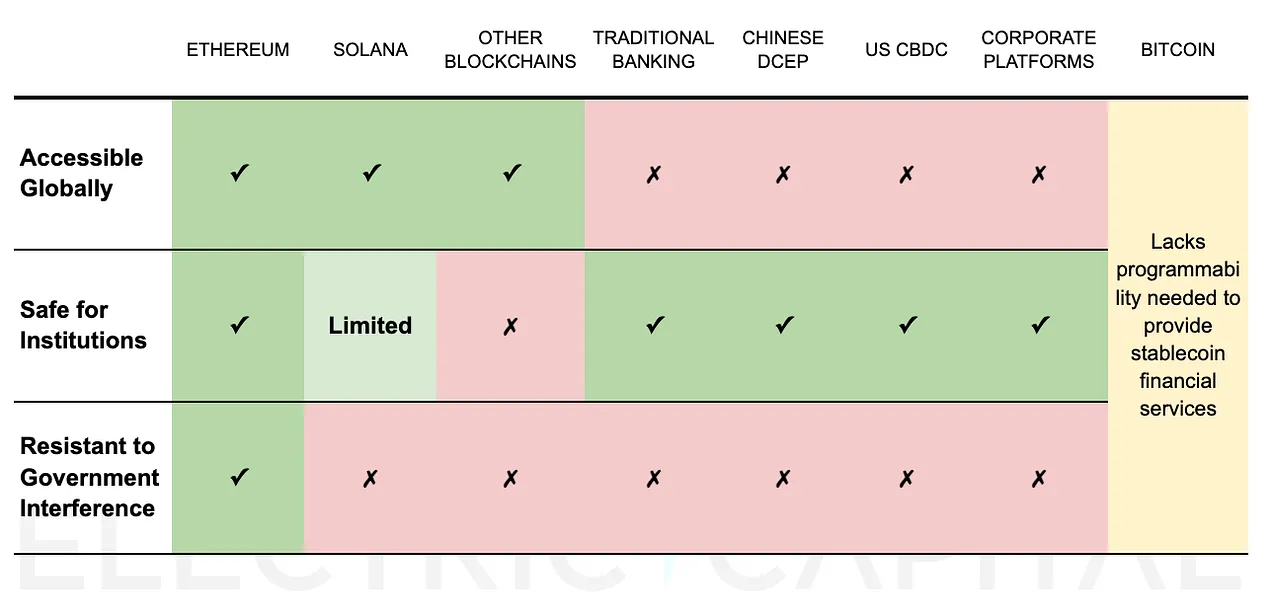
*Bitcoin may become more programmable in the future, but only if the Bitcoin community agrees to change opcodes to enable such functionality.
As ETH becomes the reserve asset for the new digital dollar economy, its demand could rise
What is a reserve asset?
In any financial system, the reserve asset is the trusted foundational layer underpinning everything. It is the collateral, savings, or liquid asset held by institutions, protocols, and users for value storage, loan backing, and transaction settlement.
In traditional systems, examples include the U.S. dollar, U.S. Treasuries, and gold—trusted, liquid, and widely accepted.
Why ETH naturally fulfills this role
As tens of billions flow through stablecoins on Ethereum, participants need a secure, permissionless, and efficient asset to support lending, staking, and yield generation. ETH is uniquely positioned because:
-
Scarce and trustworthy: ETH has predictable supply, low inflation, and is free from central control.
-
Productive: Unlike gold or static dollars, ETH earns yield through staking—similar to income from real estate or Treasury bonds.
-
Collateral utility: ETH is already the largest on-chain collateral asset in the Ethereum ecosystem, backing $19 billion in lending protocols(12). Institutions hold it because they need it to access DeFi markets.
-
Uncensorable and non-seizable: ETH cannot be frozen or seized by governments, making it more resilient than centrally issued assets.
-
Programmable and liquid: Deeply integrated into the entire on-chain financial system, ETH offers unmatched liquidity for large-scale transactions.
Why this makes ETH valuable
As more users hold stablecoins and require financial services, they need a reserve asset to back these activities. ETH earns yield, secures the network, and underpins DeFi lending—so as the system grows, demand for ETH naturally increases.
In short: More stablecoin adoption → More on-chain activity → Greater demand for ETH as collateral → Institutions and users hold more ETH.
L2s expand demand for ETH
Growth in Ethereum Layer-2s further drives demand for ETH. By reducing transaction costs, speeding up settlement, and enabling new use cases, L2s open new domains where ETH can serve as collateral. This expands ETH’s reach and strengthens its role as the reserve asset of the digital dollar economy.
As demand for ETH grows, it is also poised to become a global store of value
Rising demand for ETH also positions it to capture a significant share of traditional store-of-value (SoV) markets.
-
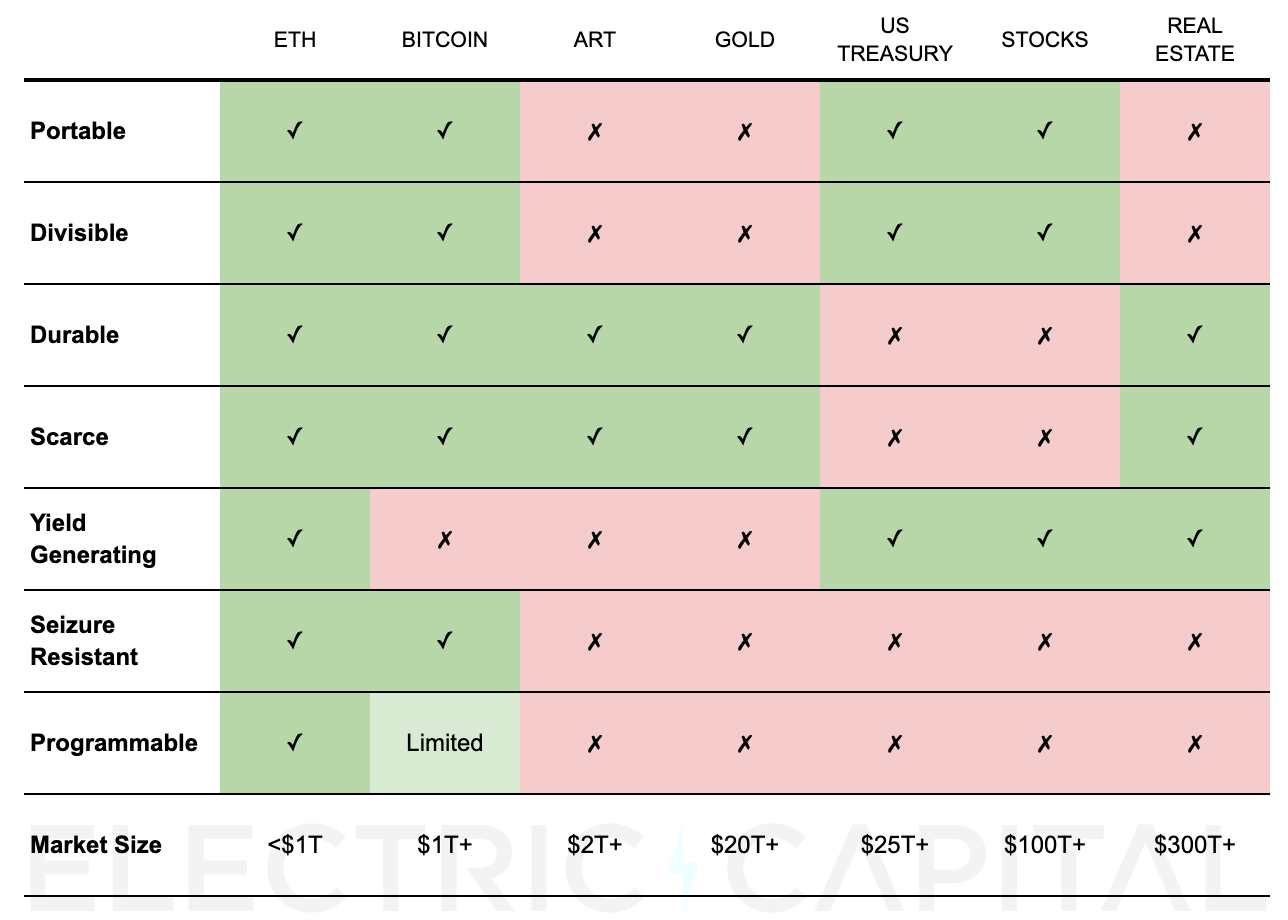
Like Bitcoin, Ethereum offers superior store-of-value characteristics compared to traditional assets like gold.
-
ETH and BTC do not compete—they may instead draw from the $50 trillion traditional SoV market (gold, Treasuries, stocks, real estate) in the coming years.
-
Beyond Bitcoin’s SoV traits, ETH provides yield to holders.
-
Yield generation is a major advantage, as investors generally favor income-producing assets. U.S. households hold about $32 trillion in dividend-paying equities.(13), while holding less than $1 trillion in gold.
ETH combines advantages over traditional SoV assets with yield generation:
Conclusion: Holding ETH may be the best way to participate in the growing stablecoin economy
Stablecoin economy growth creates a powerful flywheel for Ethereum and ETH.
As more stablecoins are deployed on Ethereum, demand for ETH increases. Higher ETH value and a more secure network attract more institutions and services, further accelerating stablecoin adoption.
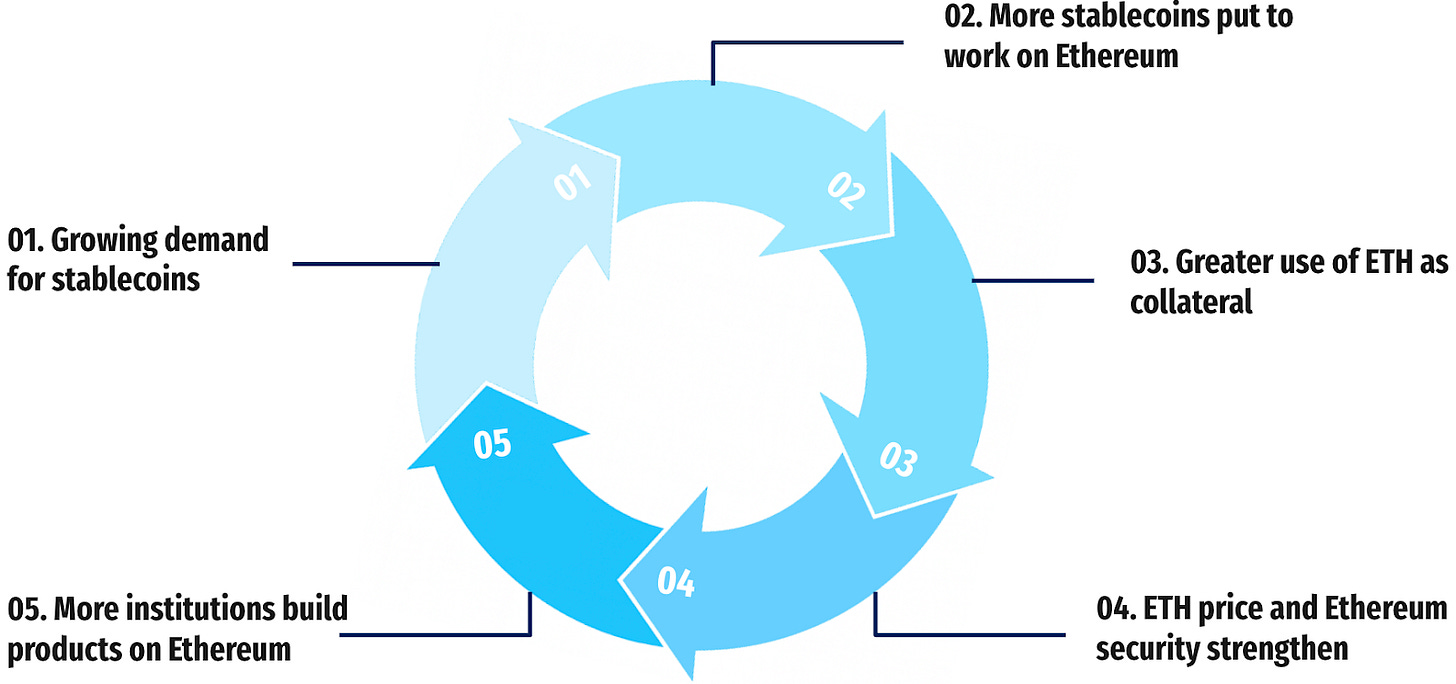
Alternatives face significant challenges replicating this flywheel:
-
Traditional finance cannot serve billions excluded due to geographic and regulatory barriers.
-
Government-controlled systems remain subject to political influence and jurisdictional limits.
-
Bitcoin lacks the programmability needed for sophisticated financial services.
-
Other blockchains lack the security, reliability, customizability, and resistance to government interference required by institutions.
The result: Holding ETH may be the simplest and most effective way to gain exposure to the growing stablecoin economy.
-
You could alternatively invest in specific DeFi protocols benefiting from stablecoin expansion. But this is riskier and requires expertise.
-
For most retail and institutional participants, ETH offers the easiest and broadest exposure to the entire digital dollar ecosystem.
Appendix
Risks to watch
Like any emerging global system, Ethereum faces significant risks. Among these, three pose the greatest threat to the thesis that “Ethereum will build a permissionless, dollar-based financial system with ETH as the reserve asset.”
-
Dollars, not ETH, become the reserve asset
If stablecoins like USDC or USDT dominate usage in lending, collateralization, and settlement, the dollar could displace ETH as the system’s reserve asset. In this case, ETH might be viewed primarily as “gas money” rather than a core store of value. However, given that ETH accounts for 44% of on-chain lending collateral on Ethereum mainnet and L2s and generates a 3–5% staking yield, displacing it seems challenging. Moreover, ETH is the only truly decentralized asset on Ethereum—stablecoins like USDC and USDT are centralized and can be frozen or seized, making them fundamentally unsuitable as censorship-resistant collateral. More likely, USD and ETH play complementary roles—USD focusing on stability and transaction efficiency, while ETH provides decentralized, non-seizable value storage and network ownership.
-
CBDC competition displaces private stablecoin adoption
Central bank digital currencies (CBDCs) could offer similar 24/7 digital dollar access with full sovereign backing, potentially crowding out private stablecoins and limiting the permissionless dollar system Ethereum supports. However, CBDCs are inherently national, often lack true cross-border interoperability, and may restrict open developer access due to compliance and identity requirements. In contrast, stablecoins have settled trillions annually by default, operate globally, and maintain greater flexibility for innovation—making them difficult to replace.
-
A competing chain overtakes Ethereum
A faster, cheaper blockchain with initially lower decentralization could attract users and developers focused on low fees and simple UX, building strong early liquidity and network effects. Over time, it might mature its validator set enough to achieve “sufficient decentralization,” undermining Ethereum’s dominance. Yet, given Ethereum’s current level of decentralization and over a decade of battle-tested security, replacing it would be extremely difficult.
Additional data
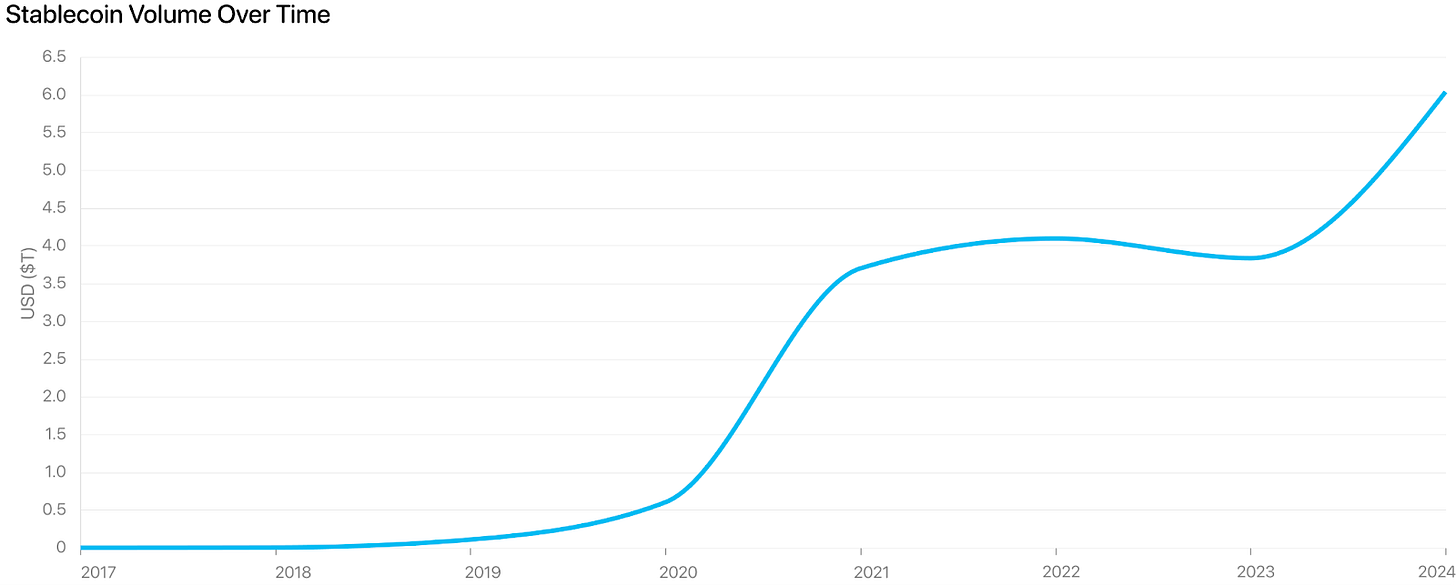
Annual stablecoin settlement volume exceeds $6 trillion (10x growth since 2020):(14)
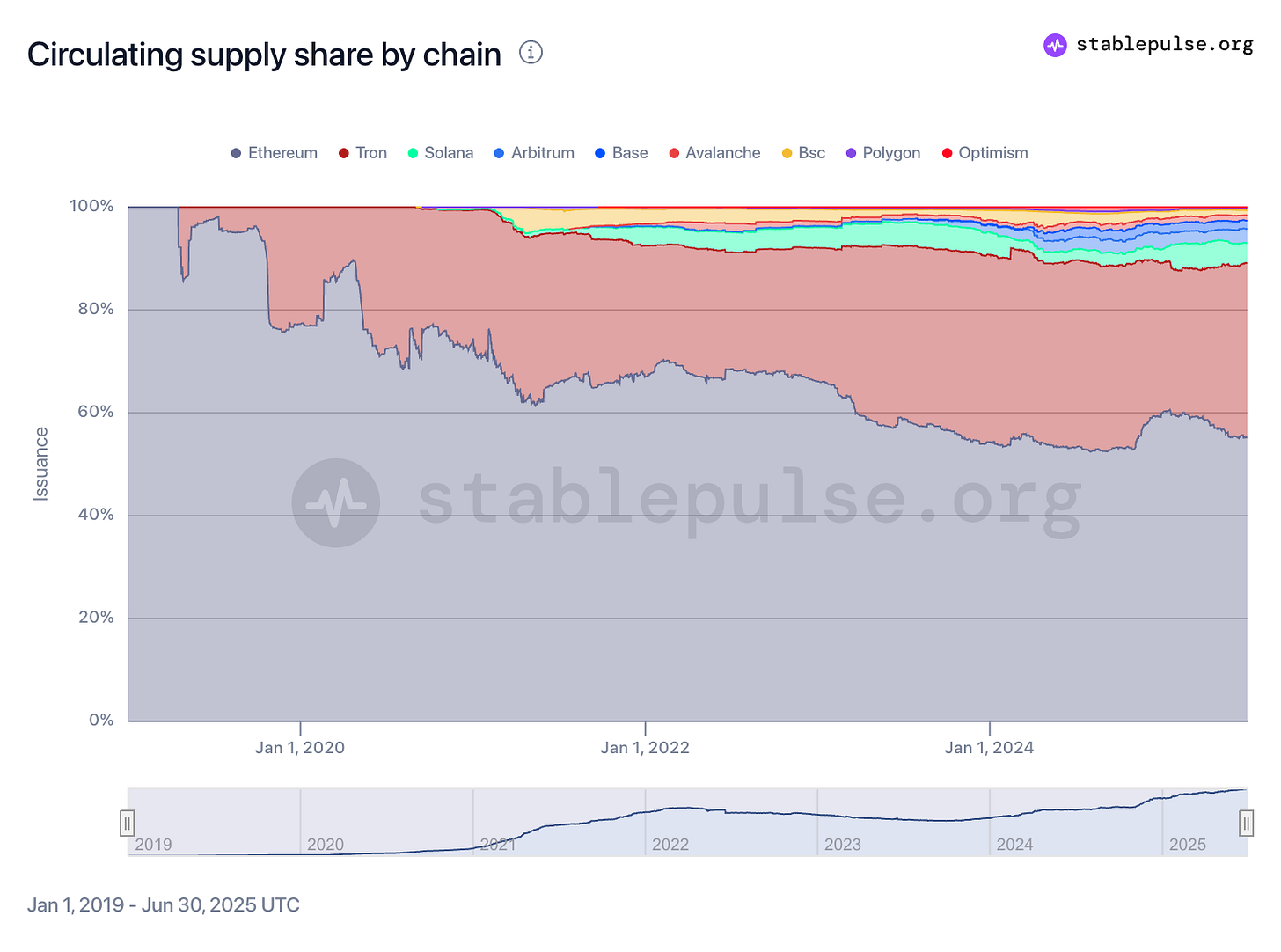
Ethereum holds over 55% of all stablecoins:(15)
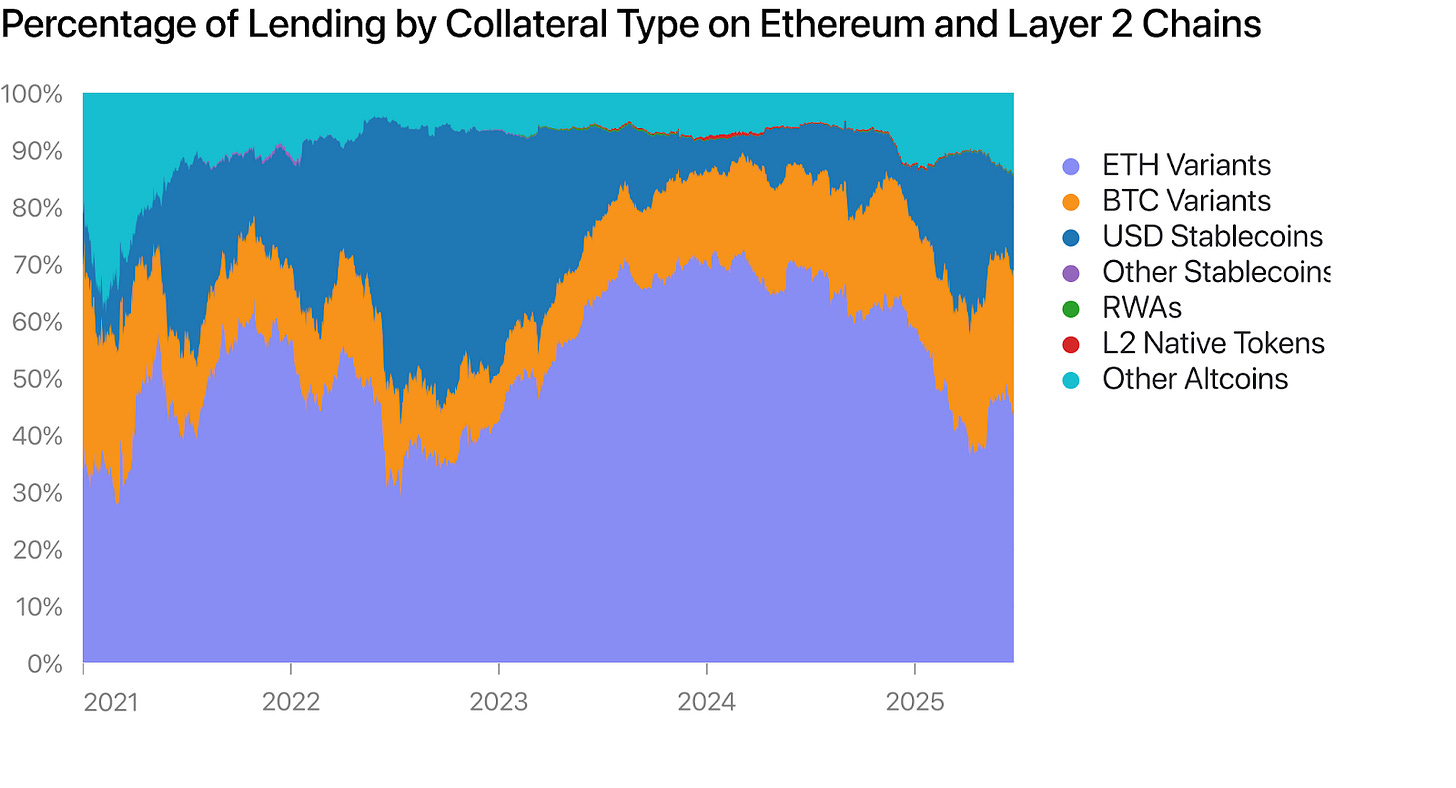
ETH may become the reserve asset of the new financial system. ETH accounts for 44% of lending collateral in the Ethereum ecosystem—making it the largest collateral asset ($19 billion):(16)
Join TechFlow official community to stay tuned
Telegram:https://t.me/TechFlowDaily
X (Twitter):https://x.com/TechFlowPost
X (Twitter) EN:https://x.com/BlockFlow_News
 @ElectricCapital