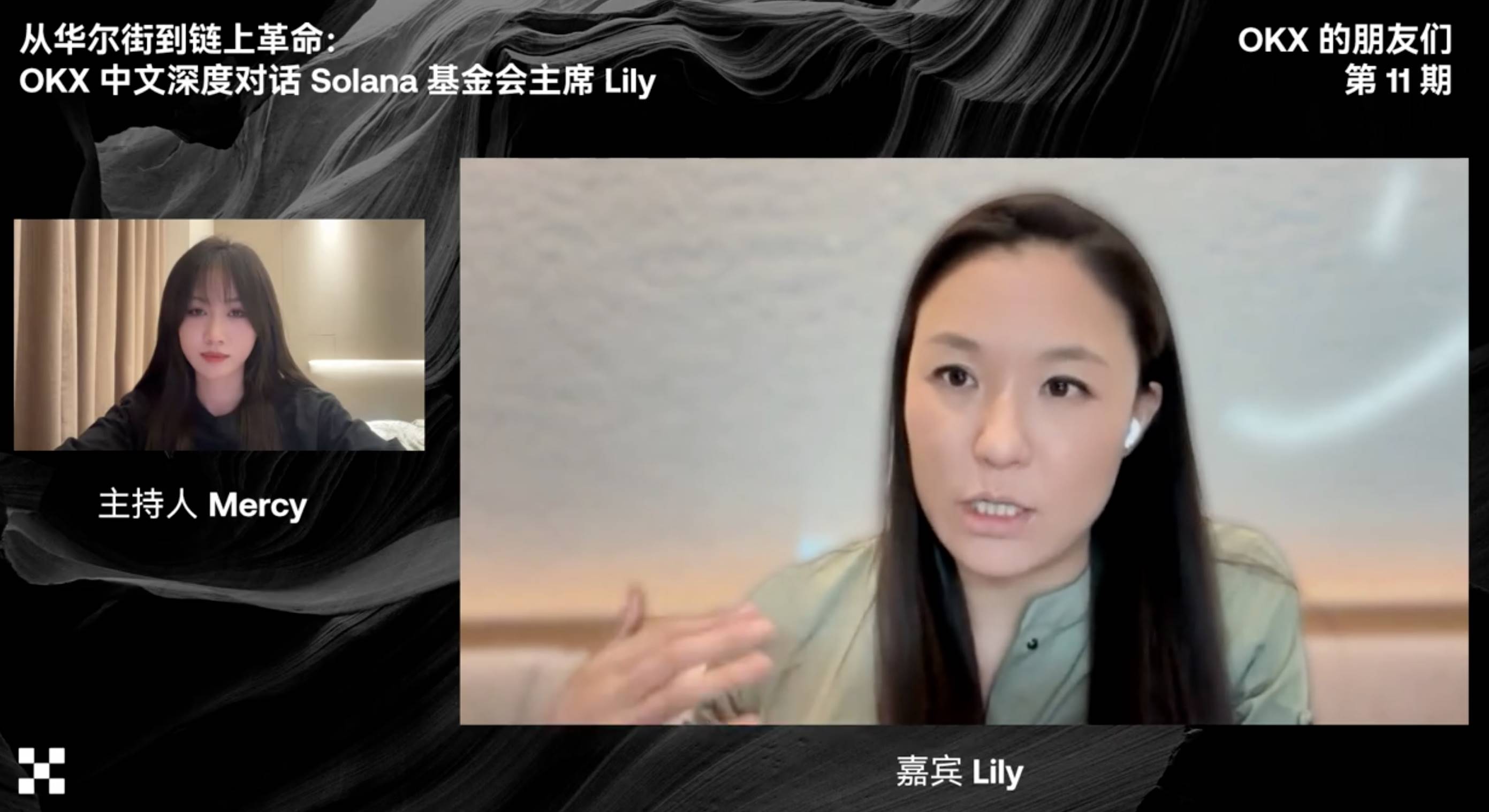
Lily Liu Guest at OKX Live Studio: Sharing Solana's Ecosystem Narrative, Core Competitiveness, and Talent Philosophy
TechFlow Selected TechFlow Selected
Lily Liu Guest at OKX Live Studio: Sharing Solana's Ecosystem Narrative, Core Competitiveness, and Talent Philosophy
Lily Liu stated that Solana's next core vision is to become the "Best Place for Capital."
 Navigating Web3 tides with focused insights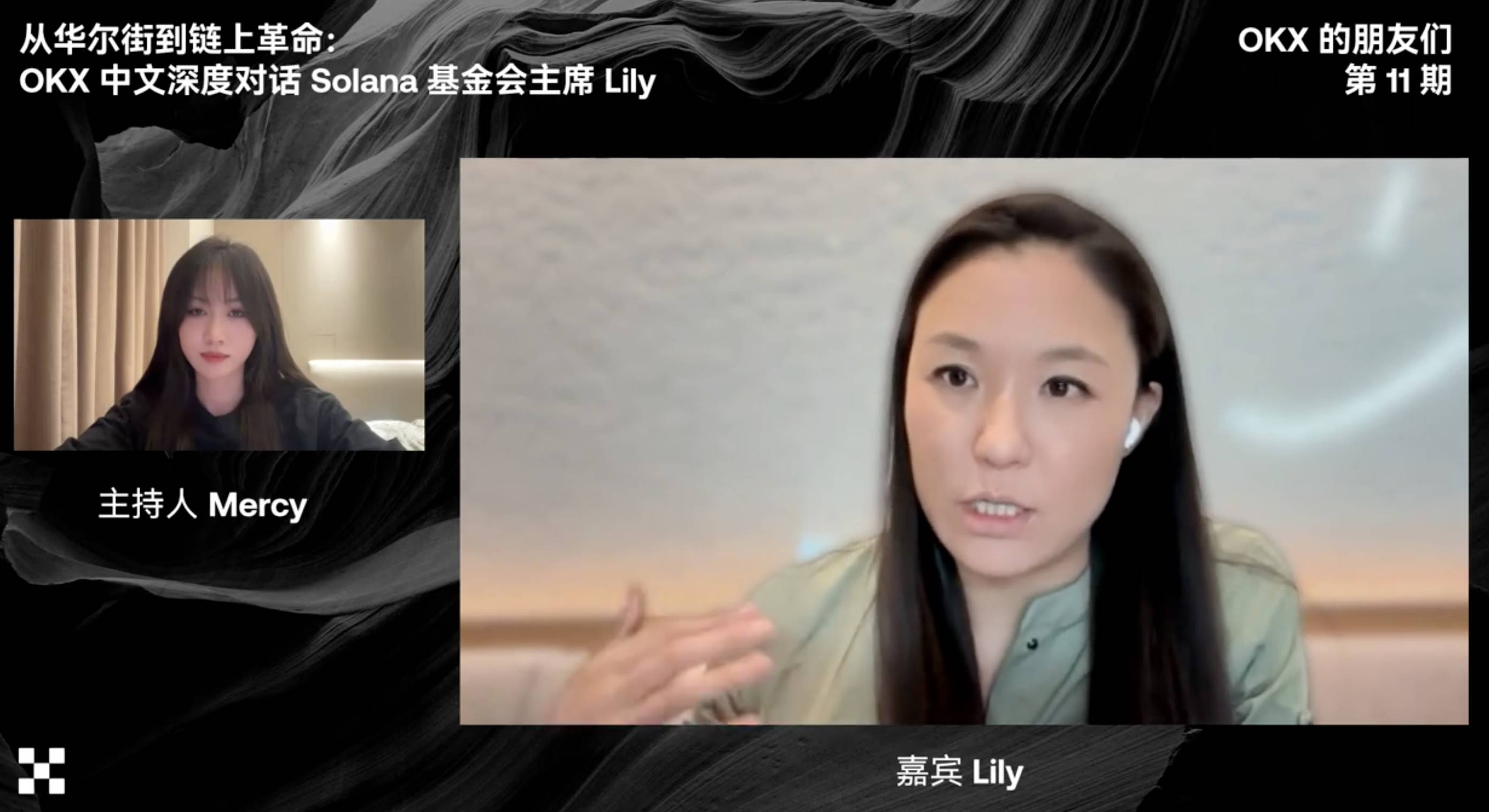
Big surprise! On the evening of June 16, Lily Liu @calilyliu, President of the Solana Foundation, made her video livestream debut with OKX Chinese, hosted by OKX Mercy @Mercy_okx.
Lily Liu shared insights on the rapidly advancing ICM narrative, the current state of PayFi, the evolution of Memecoins, and even revealed the team's talent philosophy... So many highlights we couldn't help but take notes—and now we're excited to share them with you!
Here’s a summary of the key points—enjoy!
Solana never promoted Memecoins—they emerged organically from the ecosystem
Looking back at the evolution of crypto assets—from ICOs and NFTs to today’s Memecoins—Lily Liu pointed out that Solana’s ability to foster innovation stems from its combined strengths in network performance, liquidity, user base, and community culture. Interestingly, Memecoins were not strategically encouraged or supported by the Solana Foundation; rather, they are a result of organic ecosystem evolution. It just so happens that Solana’s technical characteristics are best suited for such assets. From a technical standpoint, Memecoins have effectively become a "performance test" for the Solana network: a truly decentralized public chain must be able to reliably handle high-volume transactions 24/7. For example, Solana stood strong during the global trading surge around the TRUMP token. Memecoins are thus a prime use case for validating a blockchain’s real-world capabilities.
ICM isn’t just a 2025 trend—it’s the vision outlined in Bitcoin’s white paper
Lily Liu explained that ICM (Internet Capital Markets) is best translated as “Internet Capital Markets.” But ICM is far more than a new buzzword—it embodies the original mission of blockchain: expanding access to global financial resources. Over the past decade, blockchain has primarily empowered the “buy side,” enabling over a billion people in economically underdeveloped or financially underserved regions to manage wealth and access financial opportunities through Bitcoin or stablecoins. The needs of the “sell side,” however, have been relatively overlooked. In reality, countless businesses and issuers face challenges accessing global liquidity. Even in mature markets like the U.S., IPOs remain highly exclusive, costly, and often require one to two years of preparation.
ICM aims to solve this via blockchain infrastructure—enabling equal access to capital market liquidity for individuals and institutions worldwide, with trading available around the clock, unrestricted by geography or centralized gatekeepers. ICM isn’t merely a trend for 2025; it’s actually the very vision embedded in Bitcoin’s white paper: empowering all 5.5 billion internet users to participate in ICM through their wallets.
PayFi is still in its very early stages
Lily Liu emphasized that on-chain payments remain in an extremely early phase, despite being a foundational idea since Bitcoin’s inception. There are three main reasons why we haven’t achieved true on-chain payments in the past 15 years: First, lack of high-performance blockchains—if paying $1 costs $2 in gas fees, the experience is clearly unacceptable. Currently, only Solana offers real advantages in speed and cost. Second, insufficient developer engagement—without developers, there are no wallets, payment apps, or innovative product forms. Third, limited stablecoin adoption and on-chain integration—users still think in fiat terms, but real payment circulation requires mature stablecoin infrastructure.
Solana stays ahead because of its "versatility"
Lily Liu stressed that Solana’s greatest strength lies in its "versatility"—its ability to support multiple diverse application types simultaneously. Over the past four years, Solana has consistently ranked first or second in nearly every major sector that gained traction on-chain. From DeFi and NFTs to DePIN, consumer apps, payments, Memecoins, and gaming—no matter how industry focus shifts, Solana quickly adapts and maintains a leading position. This is precisely why Solana emphasizes the importance of foundational layer capabilities when advancing the ICM concept. Since 2018, Solana has stuck to a "no sharding" architectural path, despite widespread skepticism at the time. A key requirement for financial markets is "unified liquidity," and Solana is the only blockchain designed at the architecture level specifically for this purpose.
In "community capitalism," every contributor is a shareholder
Lily Liu noted that crypto companies are fundamentally different from traditional ones. Traditional firms typically define clear business goals centered on core products and profit maximization. In contrast, the starting point in crypto is entirely different. Bitcoin didn’t just disrupt money—it revolutionized ownership structures, giving rise to a new model: "community capitalism." Under this model, if you contribute to the ecosystem—whether through code, content, or product—that contribution can be converted into equity, not just compensated as salary. Every participant becomes both a contributor and a potential stakeholder, unlike traditional companies where investors invest and employees work.
Whether they’re foundation staff or community members, everyone is encouraged to adopt a "founder mindset." This spirit isn’t enforced through processes but rooted in the culture of "community capitalism." Lily Liu doesn’t want people waiting passively for tasks; she wants everyone to act like entrepreneurs in their domain—proactively identifying breakthroughs and driving initiatives end-to-end. That’s why the Solana Foundation team remains small, at around 70–75 people. They handle tech, growth, and operations—not as a corporate "headquarters" or parent company, but more like a city hall: a coordinator of the ecosystem, not a controller.
Hiring “10X People”
There’s a common term in tech: “10X Engineer,” referring to an engineer who delivers ten times the value of an average one. When hiring, Lily Liu looks for “10X People”—not limited to engineers. She seeks 10X Growth, 10X BD, 10X Product, and even 10X Community Leaders. These are the kinds of talents she values. Because “10X people” are essentially “founders,” not “employees.” A team of ten such individuals may outperform a team of 100 average workers. This is why she favors a “small but strong” team structure—faster execution, simpler coordination, clearer accountability, and greater potential for breakthroughs.
Global expansion powered by Superteam and Solar local organizations
With rich international experience—studying in Chile and working in China, Europe, South Africa, Indonesia, and Singapore—Lily Liu brings deep cultural understanding and a multidimensional perspective. She believes that while blockchain technology is inherently borderless, cultural backgrounds, usage habits, and adoption levels vary greatly across regions. To bridge this gap, Solana created localized organizational models like Superteam and Solar. Unlike traditional companies that expand globally via a “headquarters + branches” model, Solana adheres to the principle of “Founders, not employees.” Instead of outsourcing or setting up offices, they activate and empower local ecosystems. Their focus is on culture, media, community, developers—and especially individuals with a founder mindset.
The next core vision: becoming the “Best Place for Capital”
Lily Liu stated that Solana’s next major vision is to become the “Best Place for Capital.” This manifests in two ways: first, aggregation of all asset types—whether Memecoins, traditional financial assets, Bitcoin, Dogecoin, or DePIN tokens—all finding a home on Solana. Second, universal usability—supporting everything from high-frequency arbitrage trades to basic payment applications. She sees strong alignment between OKX and Solana’s trajectories: OKX is evolving from a trading-centric platform toward broader use cases like payments. She hopes for deeper collaboration in the future—such as bringing more high-quality assets from OKX onto Solana via wrapped tokens, and jointly exploring new applications including DeFi, payments, and RWA scenarios.
Disclaimer
This article is for informational purposes only. The views expressed are those of the author and do not necessarily reflect the official position of OKX. This article does not constitute (i) investment advice or recommendation; (ii) an offer or solicitation to buy, sell, or hold digital assets; or (iii) financial, accounting, legal, or tax advice. We do not guarantee the accuracy, completeness, or usefulness of the information provided. Holding digital assets (including stablecoins and NFTs) involves high risk and may result in significant price volatility. You should carefully consider whether trading or holding digital assets is suitable for you based on your financial situation. Please consult your legal/tax/investment professional regarding your specific circumstances. You are solely responsible for understanding and complying with applicable local laws and regulations.
Join TechFlow official community to stay tuned
Telegram:https://t.me/TechFlowDaily
X (Twitter):https://x.com/TechFlowPost
X (Twitter) EN:https://x.com/BlockFlow_News
 OKX
OKX