
When companies rush to bet big on BTC, can Strategy's success be replicated?
TechFlow Selected TechFlow Selected
When companies rush to bet big on BTC, can Strategy's success be replicated?
poses a greater systemic threat to companies heavily reliant on debt.
 Navigating Web3 tides with focused insights
By: Nick D. Garcia, Partner at Breed Investment
Translation: Bitpush News
Key Takeaways
The next phase of Bitcoin's evolution has arrived: corporate adoption on balance sheets. As of May 2025, 199 entities collectively hold 3.01 million BTC (approximately $315 billion), a number that continues to grow rapidly.
Companies whose primary purpose is holding Bitcoin will be viewed as Bitcoin holding companies, with valuations resembling that of the largest such firm, Strategy. To survive, these firms must focus on one key premium metric: the Multiple on Net Asset Value (MNAV)—the most critical measure.
MNAV premium hinges on market trust in the core team and their execution capability. These teams must carry out Strategy’s playbook: increasing Bitcoin holdings per share through debt financing, equity issuance, and reinvestment of cash flow. New entrants are now expanding upon this model.
The biggest threat is an extended bear market eroding MNAV premiums just as debt maturities approach. Newly formed Bitcoin treasury firms face greater risks due to stricter capital-raising conditions and higher leverage.
Once failures begin emerging across the sector, the strongest players may acquire distressed companies and consolidate them. Fortunately, because most funding is equity-based, systemic contagion risk remains limited—though firms heavily reliant on debt pose a larger systemic threat.
A New Era: The Corporate Bitcoin Adoption Race
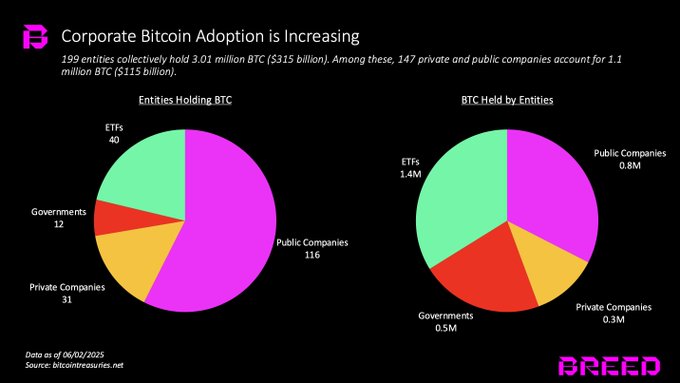
We have witnessed Bitcoin’s rise in recent years—not only in price but also in adoption and legitimacy, crossing a critical threshold. Key milestones include:
-
September 2021: El Salvador adopted Bitcoin as legal tender;
-
January 2024: BlackRock launched the IBIT ETF;
-
The U.S. President prioritized Bitcoin as a strategic economic asset;
-
And summer 2025: surging corporate balance sheet adoption of Bitcoin.
According to Bitcointreasuries.net, 199 entities currently hold 3.01 million BTC ($315 billion). Among them, 147 private and public companies hold 1.1 million BTC ($115 billion).
Recently, a wave of companies has announced new Bitcoin treasury strategies. These include diversified businesses adding Bitcoin to their balance sheets and newly established firms dedicated solely to Bitcoin treasuries, spanning countries and industries, led by trusted teams.
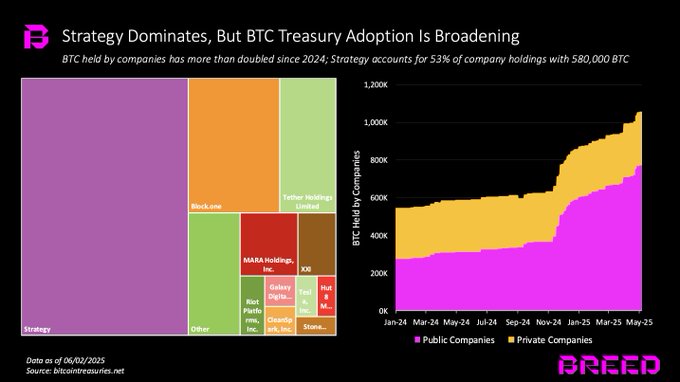
Since early 2024, the amount of Bitcoin held by corporations has more than doubled. Strategy holds over 580,000 BTC, accounting for 53% of total corporate holdings. Other companies holding over 10,000 BTC include:
-
Block.one (164,000 BTC)
-
Tether (100,500 BTC)
-
MARA Holdings (49,140 BTC)
-
Twenty One (31,500 BTC)
-
Riot Platforms (19,200 BTC)
-
Galaxy Digital (12,800 BTC)
-
CleanSpark (12,100 BTC)
-
Tesla (11,500 BTC)
-
Hut 8 (10,300 BTC)
Due to its scale, reputation, and countercyclical resilience, Strategy is poised to remain the leader among Bitcoin-holding companies. More significantly, its model is being widely replicated. The growing number of firms adopting Bitcoin on their balance sheets—and the emergence of new dedicated Bitcoin treasury firms—carries profound implications for Bitcoin.
How It Works and How It's Valued

Firms that add Bitcoin to their balance sheets while maintaining core operations are still valued primarily based on their main business. However, once a company’s sole purpose becomes holding Bitcoin, its valuation centers on the Bitcoin it holds.
To attract investors to buy shares rather than hold Bitcoin directly, these companies must deliver returns exceeding Bitcoin’s own performance. This excess return is known as the "Multiple on Net Asset Value" (MNAV).
For example, Strategy holds 580,250 BTC, worth approximately $60 billion, yet its market cap stands at $104 billion—an MNAV of 1.7x.
MNAV fluctuates based on factors like company size, market experience, and other operations. Historically, Strategy’s long-term benchmark of a 2x MNAV has served as the gold standard.

The market won’t grant an MNAV premium simply for holding Bitcoin—it requires investor confidence that management can consistently grow “Bitcoin per share.”
Since 2020, Strategy has demonstrated this ability using three forms of capital leverage:
-
Convertible bonds: issuing low-interest convertibles that only convert into equity when the stock price rises 30–50% above issuance price, enabling large-scale, low-cost financing without immediate dilution.
-
At-the-market (ATM) offerings: continuously issuing new shares via ATM programs when the stock trades above MNAV, effectively dollar-cost averaging into Bitcoin.
-
Reinvestment of operating cash flows: allocating all free cash flow from traditional operations toward purchasing spot Bitcoin.
Newer entrants are adopting and innovating on this strategy. Some novel approaches include:
-
Allowing Bitcoin holders to exchange their BTC for shares tax-free, avoiding capital gains triggers;
-
Acquiring undervalued companies trading below net cash value and converting their assets into Bitcoin;
-
Purchasing distressed Bitcoin-related litigation claims;
-
Leveraging media and events to build influence;
-
Raising capital through PIPEs (Private Investments in Public Equity);
-
Exploiting regulatory arbitrage.
Who Are the Players?
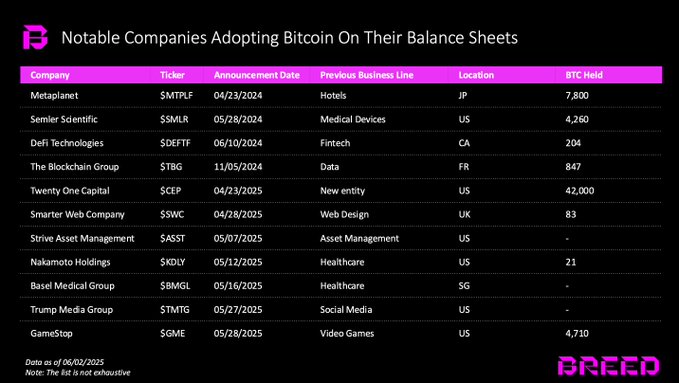
As of mid-2025, over 40 companies have publicly announced Bitcoin treasury initiatives, collectively raising tens of billions of dollars to execute these strategies. They vary widely in industry, geography, execution models, and listing paths.
Notable examples include:
-
Metaplanet (Japan): An early international participant leveraging Japan’s ultra-low interest rate environment;
-
Semler Scientific and GameStop (U.S.): Their Bitcoin treasury moves attracted mainstream media attention;
-
Twenty One Capital: A dedicated firm backed by Tether and Cantor;
-
Strive and Nakamoto: Went public quickly via reverse mergers.
Refer to the chart above for a comprehensive list of companies that had announced Bitcoin treasury strategies as of May 2025.
Is the Model Sustainable?
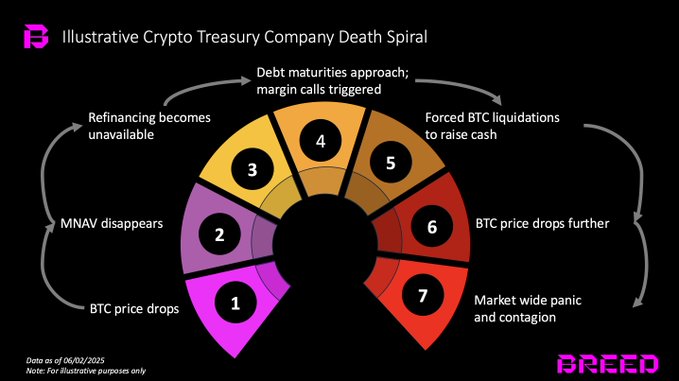
No financial strategy is foolproof—and Bitcoin treasury firms are no exception.
Strategy faced a major test during the 2022–2023 bear market:
Bitcoin dropped 80%, MNAV premiums vanished, and new capital dried up. Still, the company survived—though Saylor may have lost some sleep.
The greatest survival risk is a prolonged bear market eroding MNAV premiums just as debt obligations come due. If the stock price falls to or below net asset value and lenders refuse to refinance, companies may be forced to sell Bitcoin to repay debt—triggering a downward spiral of falling prices and forced liquidations.
New treasury firms face even higher risks. Without Strategy’s scale, reputation, or passive index inflows, they operate under worse funding terms and higher leverage. In downturns, these structures could quickly trigger margin calls and fire sales of Bitcoin, further amplifying market declines.
What Comes Next?
The expansion of Bitcoin treasury firms is still in its early stages—but the model is already spreading to other crypto assets:
For example, Solana: DeFi Development Corp (market cap $100M, holding over 420,000 SOL), Upexi, and Sol Strategies; Ethereum: SharpLink Gaming raised $425 million in a Consensys-led funding round.
More companies globally are expected to adopt this model, diversify into additional assets, and employ higher leverage in pursuit of success.
Most will fail. Fortunately, since much of the funding is equity-based, systemic contagion risk remains low. However, firms overly dependent on debt represent a systemic threat.
In the end, only a few companies will sustainably maintain MNAV premiums over time—requiring strong leadership, disciplined execution, savvy market timing, and unique strategic advantages to keep growing Bitcoin per share regardless of market conditions.
Join TechFlow official community to stay tuned
Telegram:https://t.me/TechFlowDaily
X (Twitter):https://x.com/TechFlowPost
X (Twitter) EN:https://x.com/BlockFlow_News
 @breed_vc