The man who bought a pizza with 10,000 bitcoins lost far more than you see
TechFlow Selected TechFlow Selected
The man who bought a pizza with 10,000 bitcoins lost far more than you see
"Bitcoin Pizza Day" always reminds him that he once traded a fortune worth billions of dollars in the future for a few ordinary pizzas.
 Navigating Web3 tides with focused insights
Author: Colin Harper
Compiled by: TechFlow

Laszlo Hanyecz and the legendary pizza transaction
For Bitcoin users, May 22—also known as "Bitcoin Pizza Day"—is a day of feasting.
Today, Bitcoin enthusiasts around the world celebrate by eating pizza to commemorate the famous pizza order made on May 22, 2010, by Bitcoin developer and miner Laszlo Hanyecz. On that day 15 years ago, Hanyecz exchanged 10,000 Bitcoins for two large Papa John's pizzas with another early Bitcoin user.
This transaction marked the first time Bitcoin was used to purchase real-world goods, at a time when the cryptocurrency was barely one year old.
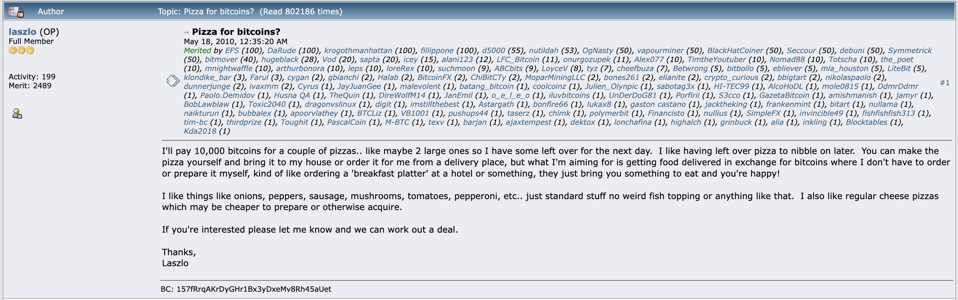
Laszlo Hanyecz posted his original Bitcoin Pizza Day request on May 18, 2010
His request was fulfilled four days later by another Bitcointalk user
The Bitcoin community commemorates this "greasy" holiday every year with both celebration and reflection, as those 10,000 Bitcoins are now worth over $1 billion.
However, most people don't realize that Hanyecz may have spent as much as 79,000 Bitcoins on pizzas that year—worth over $8.7 billion today. Amid widespread astonishment at his "spending" of billions of dollars, one question often gets overlooked: How did Hanyecz originally acquire so many Bitcoins in the first place?
The lesser-known Bitcoin pizza transactions
In 2019, I interviewed Hanyecz, who mentioned he had nearly spent 100,000 Bitcoins on pizzas in 2010. At the time, he didn’t think much of it, since Bitcoins were practically worthless back then.
Hanyecz noted that the forum Bitcointalk was filled with users freely giving away hundreds or thousands of Bitcoins to newcomers.
Hanyecz has no regrets about this period. He described himself as having “won the internet that day,” because his “hobby bought him dinner.”
In fact, he was so satisfied with the arrangement that he kept his pizza trade offer open from May 22, 2010, until August 4. On August 4, he posted on Bitcointalk: “I can't do this anymore because I can't mine thousands of bitcoins per day anymore.” (We'll go into more detail shortly about why he could no longer mine.)
In the same post, he also thanked “those who have already bought me pizzas,” indicating that he indeed conducted additional pizza transactions between May and August.
Four years later, Hanyecz recalled his former Bitcoin wealth in another post. He wrote: “I spent it all on pizza,” and attached the Bitcoin address from his original Bitcointalk post as proof.
This wallet shows that from its creation on April 10, 2010, until he closed the trade offer on August 4, Hanyecz transferred out over 79,000 Bitcoins. Today, the wallet holds only enough Bitcoin to buy a large pizza, with its last major outflow occurring in June 2011, totaling approximately 81,432 Bitcoins.
How did Hanyecz acquire these Bitcoins?
In 2009 and 2010, the Bitcoin block reward was 50 Bitcoins per block (plus transaction fees), with a new block generated roughly every 10 minutes. Hanyecz’s 81,432 Bitcoins represent about 1.5% of all Bitcoins mined at that time. So how did he accumulate such a fortune?
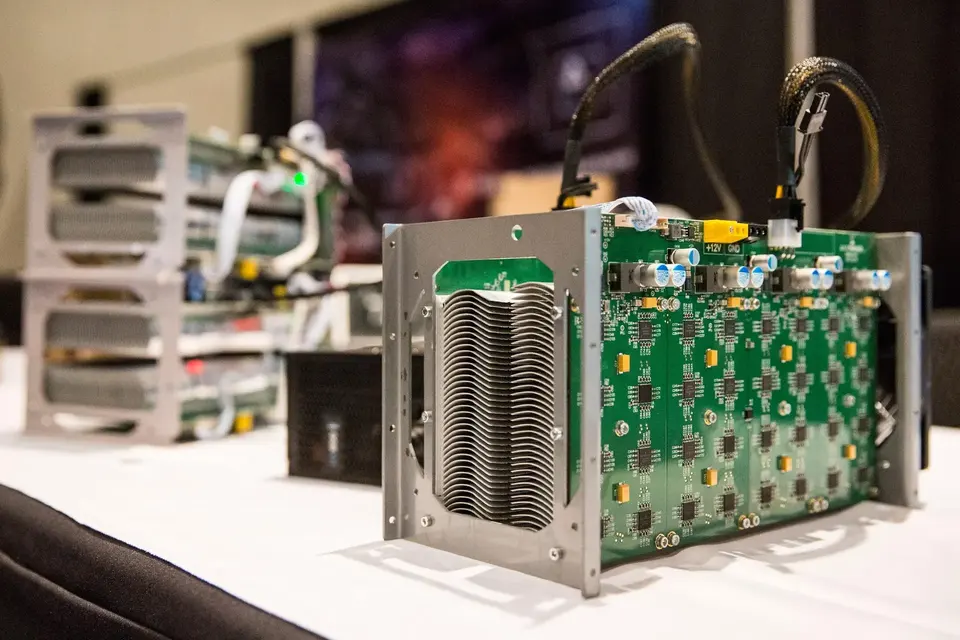
Hanyecz was one of Bitcoin’s most prolific early developers. Not only did he design Bitcoin’s first MacOS client, but he also became the first person after Bitcoin’s anonymous creator Satoshi Nakamoto to discover that graphics processing units (GPUs) could be used for mining.
Hanyecz announced this discovery in May 2010. Before that, Bitcoin miners typically used central processing units (CPUs) from laptops or desktop computers. The introduction of GPUs increased computing power tenfold, dramatically improving Bitcoin mining efficiency.
This breakthrough opened a "Pandora's box." By the end of 2010, the Bitcoin network's computing power had increased 1,300-fold. However, the resulting surge in competition is precisely why Hanyecz lamented in his August 2010 Bitcointalk post that he “could no longer mine thousands of Bitcoins per day.”
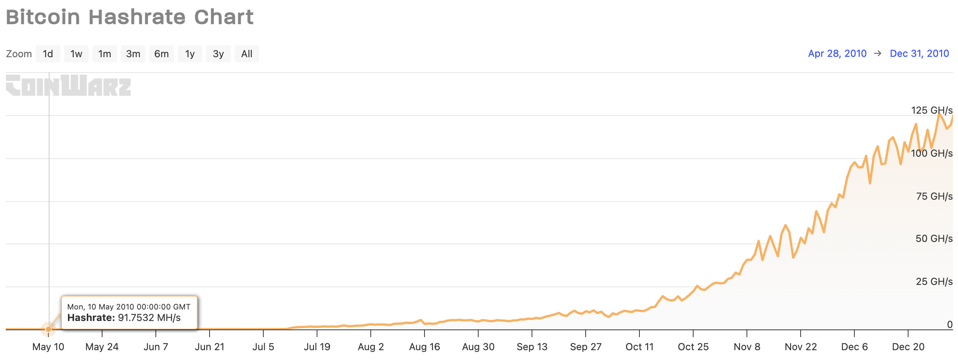
Bitcoin's computing power rapidly grew after Laszlo Hanyecz, the figure behind Bitcoin Pizza Day, discovered GPU-based Bitcoin mining
Bitcoin Pizza Day and communication with Satoshi Nakamoto
Hanyecz’s discovery also drew a polite “criticism” from Satoshi Nakamoto. As Nathaniel Popper recounts in his book *Digital Gold*, Nakamoto had “mixed feelings” about the early introduction of GPU mining, seemingly foreseeing the consequences.
Nakamoto wrote in an email:
“One of the big attractions for new users is that anyone with a computer can generate some free Bitcoins. When we reach 5,000 users, this incentive might diminish, but it still works for now. GPUs will prematurely limit this incentive to only those with high-end GPU hardware. GPU computing clusters will eventually monopolize all generated Bitcoins, but I don't want to accelerate that day.
If difficulty becomes very high, it could instead increase the value of each Bitcoin, as supply becomes more constrained. The supply remains the same: 50 Bitcoins every 10 minutes. But GPUs are far less evenly distributed than CPUs, so newly generated Bitcoins would only reward 20% of people, not 100%.
I'm not trying to sound like a socialist—I don't mind wealth concentration—but right now, distributing these coins among 100% of people rather than 20% gives us greater growth potential.
Moreover, the longer we delay the GPU arms race, the more mature OpenCL libraries will become, and more people will own OpenCL-compatible graphics cards. If we see excessive GPU use reflected in difficulty adjustments, we can reconsider this OpenCL matter. Maybe my effort to maintain GPU 'purity' is nearing its end, but so far, it's worked.”
This raises an intriguing question: Did Hanyecz give up his Bitcoin fortune as a form of atonement, knowing he accelerated the centralization of Bitcoin mining?
Only Hanyecz knows the answer—but he likely won’t tell us, as he rarely gives interviews anymore. After all, why bring it up? “Bitcoin Pizza Day” forever reminds him that he once traded billions of dollars in future value for a few ordinary pizzas.
Join TechFlow official community to stay tuned
Telegram:https://t.me/TechFlowDaily
X (Twitter):https://x.com/TechFlowPost
X (Twitter) EN:https://x.com/BlockFlow_News
 Forbes