On-Chain Liquidity Migration: 15 Months of Rises and Falls—Who Stands Tall After the Hype Subsides?
TechFlow Selected TechFlow Selected
On-Chain Liquidity Migration: 15 Months of Rises and Falls—Who Stands Tall After the Hype Subsides?
The future of DeFi does not lie in multi-chain expansion, but in protocols that can transform industry narratives into user habits.
 Navigating Web3 tides with focused insights
Author: Stacy Muur
Translation: Tim, PANews
Over the past 15 months, DeFi's liquidity landscape has been reshaped across chains. Projects driven by hype have gradually exited the stage, while liquidity has quietly concentrated in areas with strong fundamentals rather than market speculation.
Key Insights
-
After DEX trading volume hit a record high of $380 billion in January 2025, it dropped by 35% over the following two months—suggesting January may have marked a short-term peak.
-
Currently, the top ten DEXs account for nearly 80% of total trading volume; Uniswap and PancakeSwap alone capture about 40% of the market share.
-
DEXs built on Solana have quietly taken dominant positions, occupying five of the top ten spots. Their market growth is primarily fueled by meme coin-driven trading volumes.
-
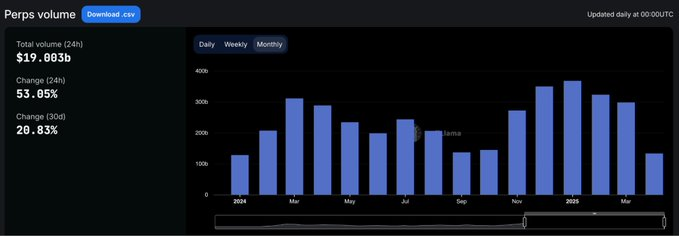
Hyperliquid has completely transformed the perpetual contracts landscape, rising from an industry newcomer to capturing over 60% of the market share by March 2025.
All insights in this article are based on publicly available data. Special thanks to DefiLlama for its consistently high-quality statistical reporting.
A Cycle Defined by Surges and Slowdowns
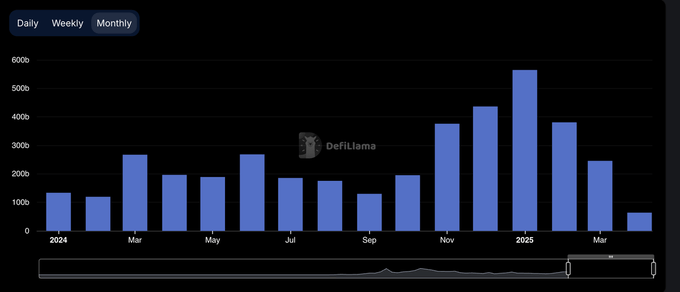
In early 2024, DEX trading volumes showed strong performance in March and May, then gradually slowed before mid-year.
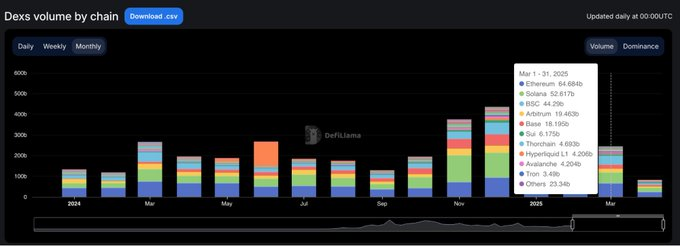
The situation changed dramatically in Q4: trading volumes surged in November and December, carrying momentum into January 2025 and peaking at an explosive $380 billion.
However, this rebound proved fleeting. By February, market volume had plummeted to $245 billion—a 35% cliff-like drop that ended three months of vertical growth. This pullback set a more cautious tone for Q2.
DEX Dominance: Top Protocols Hold the Reins
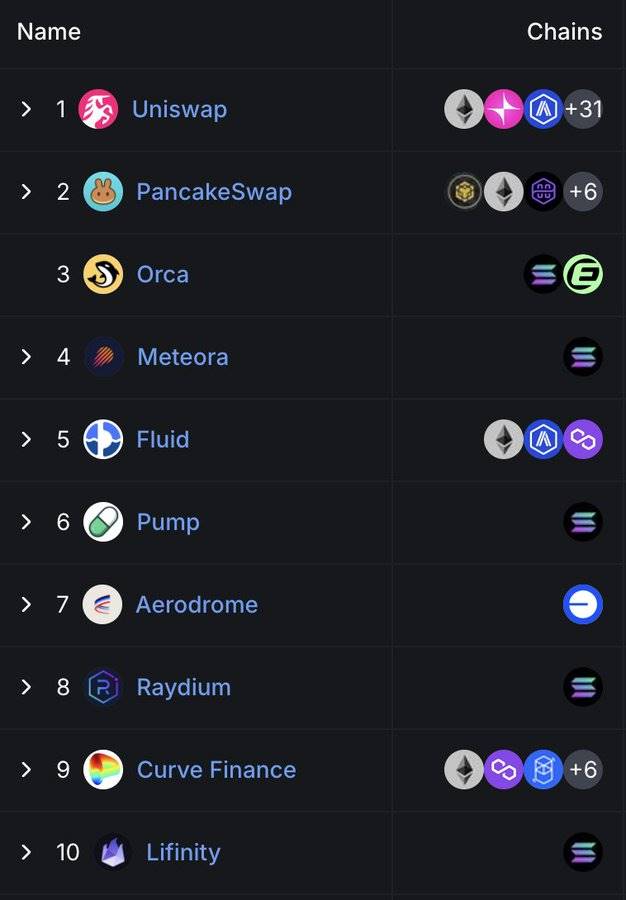
The DEX market remains highly concentrated. Currently, the top ten protocols account for 79.5% of daily trading volume, with the top five alone capturing 59.1%.
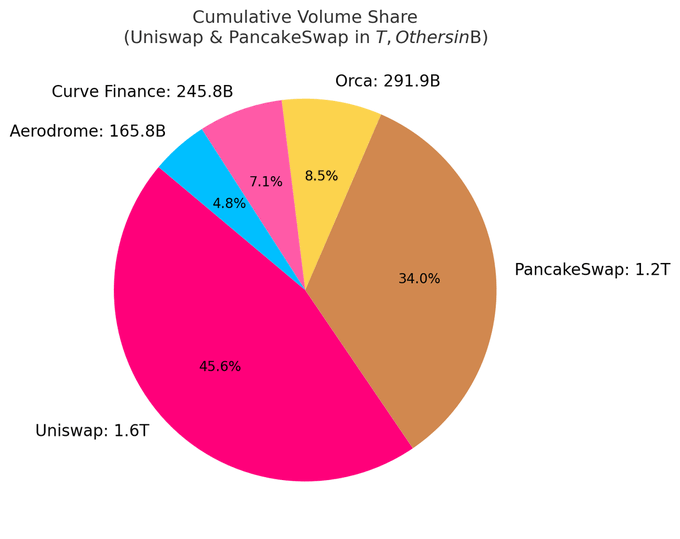
Uniswap and PancakeSwap together handle approximately 40% of DEX trading volume—the only two platforms to date with cumulative trading volumes exceeding $1 trillion. Their leadership stems from first-mover advantage, broad multi-chain ecosystem support, and deep liquidity.
Uniswap Labs has also launched Unichain, an Ethereum Layer 2 network built on the Optimism Superchain. The chain aims to enable fast, low-cost transactions through native multi-chain interoperability.
Solana’s Quiet Rise
Notably, Solana’s position in the DEX space has become increasingly prominent. Five of the current top ten DEXs—Orca, Meteora, Raydium, Lifinity, and Pump.fun—are natively built on Solana.
Orca (8.02%) and Meteora (6.70%) alone account for roughly 15% of global decentralized exchange activity.
This growth is driven by low gas fees, fast block times, and the surge in Solana meme coin trading. Pump.fun’s rise into the top ten is clear evidence of this fervor.
Emerging Protocols: Fluid and Aerodrome
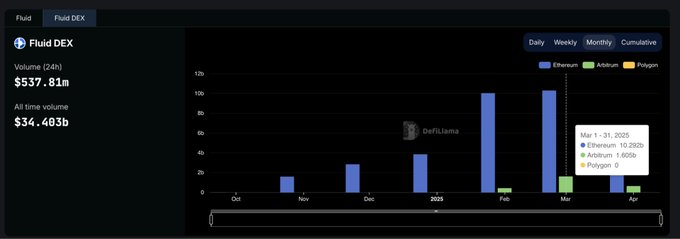
Fluid (7.09%) is the most capital-efficient platform among the top five DEXs. Active on Ethereum, it clears over $10 billion monthly. Its launch within the Arbitrum ecosystem was particularly impressive: trading volume surged from $426 million in February to $1.6 billion in March, indicating adoption far outpacing industry averages.
Aerodrome, as Base’s native project, demonstrates sustained liquidity growth on the Base L2.
Although Hyperliquid does not rank highly in the spot market, it dominates the perpetual contracts market with over 60% market share.
DEX Market Share by Chain: Growth Is Easy, Retention Is Hard
The past 15 months clearly reveal one truth: most blockchain projects can attract attention, but only a few sustain user engagement. From January 2024 to March 2025, DEX market shares across chains shifted rapidly, with very few projects demonstrating genuine user stickiness.
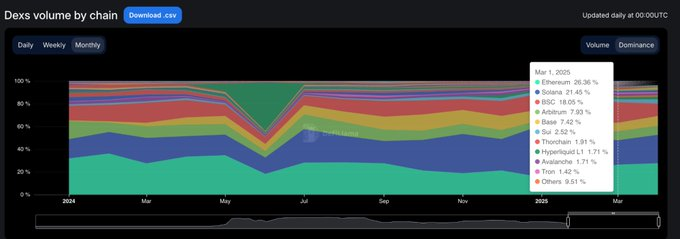
Solana achieved the most significant breakthrough. It steadily climbed throughout 2024, propelled by TRUMP and MELANIA meme coins, reaching a peak market share of 45.8% in January 2025. However, by March, its share halved to 21.5%, though it still maintained the highest average share among public chains at 25.1%.
Ethereum followed the opposite trajectory. Starting 2024 with around 32% share, it fell to 15.3% by January 2025, then rebounded to 26.4% by March. Even as Ethereum lost growth momentum, its ecosystem resilience remained evident.
Base emerged as the most consistent challenger. Growing steadily from 3% in March 2024 to 12.4% by December, it dipped to 7.4% by March 2025, maintaining an average share of 6.6%. Without hype, it achieved slow yet sticky growth.
BNB Chain remained stable with an average share of 14.7%—neither surging nor collapsing, consistently retaining retail capital flow.
Arbitrum started strong (16% share) but faltered, sliding to 4.8% by January 2025, overtaken by both Base and Solana.
Blast peaked at 42.3% market share in June 2024, then vanished the next month. A classic case of incentive-driven volume with zero user retention.
In summary: DEX dominance across public chains is highly volatile. Solana surged, Ethereum recovered value, Base steadily expanded its ecosystem, and market hype cycles exhibited sharp rises and falls. Ultimately, the dominant chains are not those with the loudest voices, but the networks with the highest actual usage.
Centrailzed Exchanges Still Dominate Spot Trading Volume
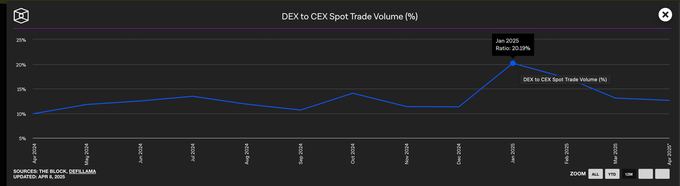
Despite explosive DEX growth in early 2025, centralized exchanges (CEXs) still dominate the spot market. Even during January—the month when DEX volume peaked—CEXs captured nearly 80% of total trading volume.
Although CEX dominance declined from 90% at the start of 2024 to a low of 79%, the broader trend is clear: while DEXs continue growing, CEXs remain the default choice for most traders.
Perpetual Protocol Market Share
The landscape of on-chain perpetual contracts underwent a fundamental shift in 2024.
After dYdX held the top spot for over two years, Hyperliquid emerged to redefine what dominance means. The platform first claimed the lead in February, briefly lost it to SynFutures mid-year, then reclaimed the top position in August and pulled away decisively. By March 2025, Hyperliquid captured nearly 59% of total perpetual contract trading volume, solidifying its status as the go-to platform for professional traders.
This rise attracted significant market attention, offering a product experience closer to centralized exchanges than any previous decentralized platform. In contrast, dYdX’s market share rapidly declined—from 13.2% at the start of 2024 to just 2.7% by March 2025—as users migrated to faster, cleaner, and more modern alternatives.
Jupiter Perps took a different path, leveraging native Solana liquidity and traffic from its spot DEX to climb to second place with 8.8% market share. Despite rapid ascent, it ultimately plateaued behind Hyperliquid. Others like SynFutures, Vertex Protocol, and Paradex also briefly emerged.
Perpetual Contract Chains: Execution Layer Restructured Within One Cycle
The biggest shift in perpetual contract infrastructure over the past year wasn't about which protocols users preferred, but which chains they trusted to execute trades.
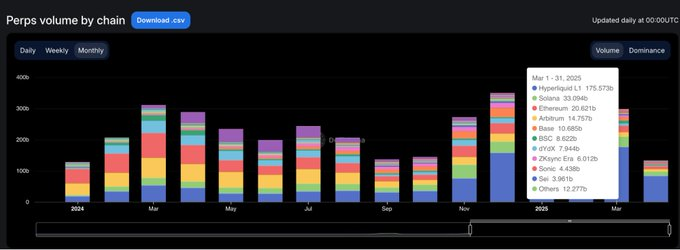
By March 2025, Ethereum and Arbitrum’s combined share of perpetual trading volume had collapsed to 11.8%, a stark contrast to their combined dominance of over 65% in January 2024. Faster, newer execution layers now fully dominate.
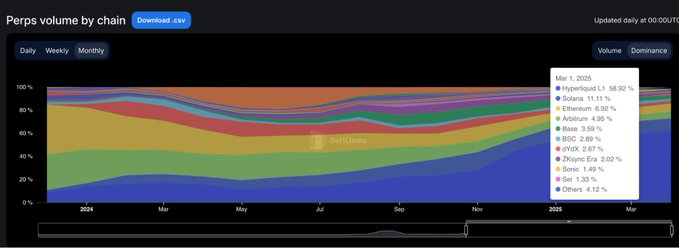
The driving force behind this shift is Hyperliquid’s proprietary blockchain. Over the same period, its market share surged from 13.6% to 58.9%, displacing once-standard Layer 1 and Layer 2 solutions within less than a year to become the default execution environment for perpetual trading. Its advantage lies not only in faster transaction speeds but, more importantly, in delivering the reliability and low latency demanded by professional traders.
Solana also experienced a strong rally, pushed by Jupiter and Phoenix in late 2024, briefly climbing to nearly 16% market share. However, it eventually stabilized between 10–11%, failing to sustain breakout momentum. Base and ZKsync showed promise (reaching 6–7% peaks), but never broke into the top tier.
Meanwhile, Blast became a cautionary tale: this flash-in-the-pan project reached 18.8% market share in June 2024, only to vanish just as quickly. In a domain driven by product quality and user retention, pure hype cannot last. The new industry standard is clear: performance-centric blockchains have redefined competitive benchmarks, and traditional infrastructure no longer holds default superiority.
The future of DeFi does not lie in multi-chain expansion, but in protocols that transform industry narratives into lasting user habits.
Join TechFlow official community to stay tuned
Telegram:https://t.me/TechFlowDaily
X (Twitter):https://x.com/TechFlowPost
X (Twitter) EN:https://x.com/BlockFlow_News
 @stacy_muur