1confirmation founder: Social scalability and the potential of Ethereum
TechFlow Selected TechFlow Selected
1confirmation founder: Social scalability and the potential of Ethereum
In the long run, the most successful cryptocurrency will be the one that achieves social scalability by providing the greatest practical value through credible neutrality.
 Navigating Web3 tides with focused insights
Author: Nick Tomaino, Founding Partner at 1confirmation
Translation: Luffy, Foresight News
Social scalability refers to an institution's ability to enable as many people as possible to participate and benefit. This characteristic is precisely the core driver behind cryptocurrencies becoming an asset class with a total market capitalization of $2.9 trillion today. In this article, I will explain what it is and why it matters so much.
In 2017, Nick Szabo published an essay titled "Money, Blockchains, and Social Scalability," describing Bitcoin as a social breakthrough. Most people view cryptocurrency purely through a technological lens, focusing on technical scalability, but I align more closely with Szabo’s perspective. While technical scalability plays a role within social scalability, it is not the primary factor. In the long run, the most successful cryptocurrencies will be those that achieve the greatest social scalability by providing practical value through credible neutrality.
1. Bitcoin’s Social Scalability
Bitcoin is the first credible-neutral, internet-native store of value. "Credible neutrality" means fairness, impartiality, and immunity from influence by small interest groups. Credible neutrality is a social construct—often rooted in technology, but ultimately based on numerous dynamic factors that shape trust among people.
This credible neutrality was gradually earned over time through Bitcoin’s protocol, which originated from grassroots efforts. Bitcoin launched as open-source software, accessible for anyone to read, run, write, and own under fair conditions. Its launch was equitable—no private deals for insiders, no prominent individuals, companies, or nations involved. The rules were set from the beginning and have never changed. The community openly discussed everything about Bitcoin on forums like Bitcointalk. To understand its spirit, one can read Hal Finney’s early writings.
Bitcoin’s credible neutrality and utility are the main reasons for the explosive growth of the crypto industry. What began as a grassroots movement initiated by an anonymous founder (Satoshi Nakamoto), without insiders holding equity or a clear jurisdictional origin, has evolved into a $1.7 trillion asset actively adopted by some of the world’s largest governments and corporations as a store of value. The difficulty of changing Bitcoin’s system rules remains a key reason for its sustained adoption.
Bitcoin’s development has been remarkable. However, early cultural decisions within the community to focus solely on monetary use cases limited new developers and companies from applying Bitcoin beyond money. Although Bitcoin maximalists have claimed infinite potential over the past 15 years, decentralized systems indeed hold vast opportunities to bring greater freedom and progress to the world beyond just currency.
2. Does Social Scalability Really Matter?
Social scalability has been a crucial factor in Bitcoin’s success. But in 2025, every investor must ask: does social scalability actually matter? Today, among the top nine cryptocurrencies by market cap, four are effectively “corporate tokens” (XRP, BNB, SOL, TRON). These four tokens have a combined market cap exceeding $312 billion.
These tokens have strong narratives, but lack credible neutrality. They were launched by small teams within known jurisdictions (Silicon Valley and China), allocating over 50% of their tokens to insiders (founders and venture capital firms). They ran highly coordinated marketing campaigns, engaged in government lobbying, and executed many top-down, corporate-style initiatives. These protocols have yet to prove their resilience, security, or resistance to single points of failure. They made aggressive trade-offs for performance at the expense of decentralization.
Then there's utility. Some find these four protocols useful, but they haven’t spawned novel use cases or achieved broader adoption. Regardless, these four tokens have seen astonishing success, leading some to reasonably conclude that the concept of social scalability I describe may be irrelevant. If you can craft a compelling narrative and get enough people to believe it, that might seem to be what truly matters.
Yet I believe that in the long term, social scalability is critical—and will drive over $2 trillion in value accumulation over the next decade. That’s why we pay attention to it. If you focus on shorter timeframes, I understand why you might disagree. But I encourage you to take a broader view.
Time will tell, and circumstances may change. But if you believe social scalability is essential and examine the facts objectively, it becomes clear that only two cryptocurrencies possess both credible neutrality and sufficient utility to achieve lasting social scalability: Bitcoin and Ethereum.
Bitcoin dominates the crypto space, but Ethereum may have greater social scalability than Bitcoin. Here's why:
3. Ethereum’s Credible Neutrality
Like Bitcoin, Ethereum’s credible neutrality existed from the start. Ethereum doesn’t have the legendary “fair launch” story of Bitcoin, but during its initial phase, only 9.9% of the token supply was allocated to insiders. Anyone in the world could easily obtain Ether by sending Bitcoin to the ICO address—no backroom deals for VCs, no involvement from famous individuals, companies, or nations.
Ethereum initially operated as a proof-of-work (PoW) chain and maintained PoW for its first seven years. This ensured a more balanced token distribution before transitioning to proof-of-stake (PoS). Initially, you didn’t need to own or purchase Ether to participate in consensus and earn rewards—you only needed to contribute computing resources. Native PoS chains often suffer from early concentration of rewards among large initial holders. This helped Ethereum build a large and diverse base of stakeholders early on, enabling broader participation in consensus and reward earning even today.
Vitalik Buterin is Ethereum’s founder. Critics point to Vitalik’s leadership role, arguing that having such a powerful, well-known figure undermines Ethereum’s credible neutrality. But those who’ve observed Vitalik from the beginning know he has led transparently and authentically, establishing a culture that emphasizes credible neutrality.
You won’t see Vitalik promoting investment narratives on social media, chasing money, attention, or power—behaviors common among many prominent figures in crypto. For over a decade, he’s been one of the easiest people in this industry to gain all three, yet he chose not to. Instead, he acts according to his own principles, emphasizing values like censorship resistance, inclusivity, and transparency, while primarily focusing on setting optimal technical architecture and long-term values for developers.
In practice, Bitcoin and Ethereum share similar governance models. Changes to either protocol require rough consensus among miners, users, and developers. As a result, Ethereum upgrades proceed far slower than many venture-backed entities would prefer. But in the long run, this strengthens credible neutrality—an intentional trade-off made consciously by Ethereum’s leadership.
The Ethereum mainnet now has four active execution clients (Geth, Nethermind, Besu, and Erigon) and five consensus clients (Prysm, Lighthouse, Teku, Nimbus, and Lodestar). Client diversity and avoiding single points of failure have always been priorities. Moreover, Ethereum mainnet and Layer 2s have become the most trusted platforms for developers and companies to build upon.
Today, the amount of Bitcoin owned by Michael Saylor’s company represents a significantly larger share of total Bitcoin supply than the combined holdings of Vitalik and the Ethereum Foundation do of total Ether supply. Bitcoin’s leaders have moved faster toward alliances with governments through political support and lobbying. This may reflect Bitcoin’s more mature stage and broader stakeholder base compared to Ethereum.
However, the risk that Saylor and government lobbying could damage Bitcoin’s credible neutrality is real. In contrast, it’s encouraging to see Vitalik and the Ethereum Foundation resist the temptation to chase investment narratives in response to market conditions. Ethereum’s leadership remains developer-focused, and Ethereum itself has long since transcended any single individual or group. The most important people shaping Ethereum’s future are likely still unknown developers working quietly today.
4. Ethereum’s Utility
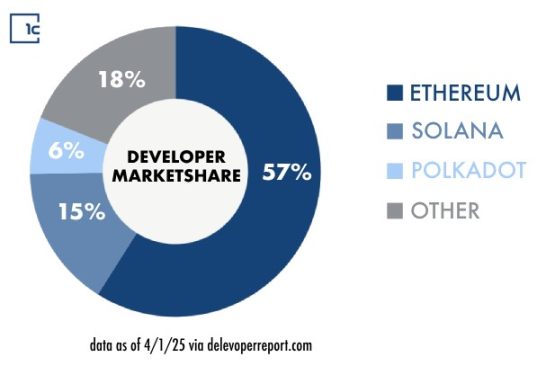
The Ethereum Virtual Machine (EVM) holds dominant market share and enjoys strong network effects. Since Bitcoin introduced the world to a credible-neutral, internet-native store of value, Ethereum has captured the primary mindshare among developers and has served as the birthplace for nearly every innovation that brings significant new users into crypto beyond money. Ethereum is where decentralized finance (DeFi), non-fungible tokens (NFTs), prediction markets, decentralized social networks, decentralized identity, real-world assets (RWA), stablecoins, and more were first created. All these new use cases promote EVM wallets and position Ethereum as the credible-neutral, internet-native store of value.
Some of these use cases originated on Ethereum mainnet and are now migrating to Layer 2 blockchains built atop Ethereum. Many top-tier companies and developers in crypto prefer a trustworthy development environment that offers them greater control and better economics—exactly what Ethereum’s Layer 2 architecture provides. Developers building on L2 or L3 not only capture more value themselves but also benefit from Ethereum’s security, EVM network effects, and help promote Ethereum as a credible-neutral, internet-native store of value. Some L2s will thrive; others may not. For certain applications, developers may realize that the mainnet offers substantial liquidity advantages unavailable on L2s. Whichever way it unfolds, Ethereum benefits.
There’s been extensive debate over whether L2s contribute to Ethereum’s value or instead erode mainnet fees and diminish Ethereum’s worth. Recently, Standard Chartered reduced its Ethereum price target from $10,000 to $4,000, citing Coinbase’s L2 (Base) as fee-dilutive to the mainnet. This view misses the forest for the trees.
The primary benefit of L2s isn’t contributing fees to the mainnet—it’s introducing EVM wallets to new users and promoting Ethereum as a credible-neutral, internet-native store of value. Usage across the Ethereum ecosystem (including mainnet and L2s) reduces the circulating supply of Ether—a beneficial feature that has already made Ethereum more deflationary than Bitcoin. But fees aren’t the main advantage offered by apps and L2s.
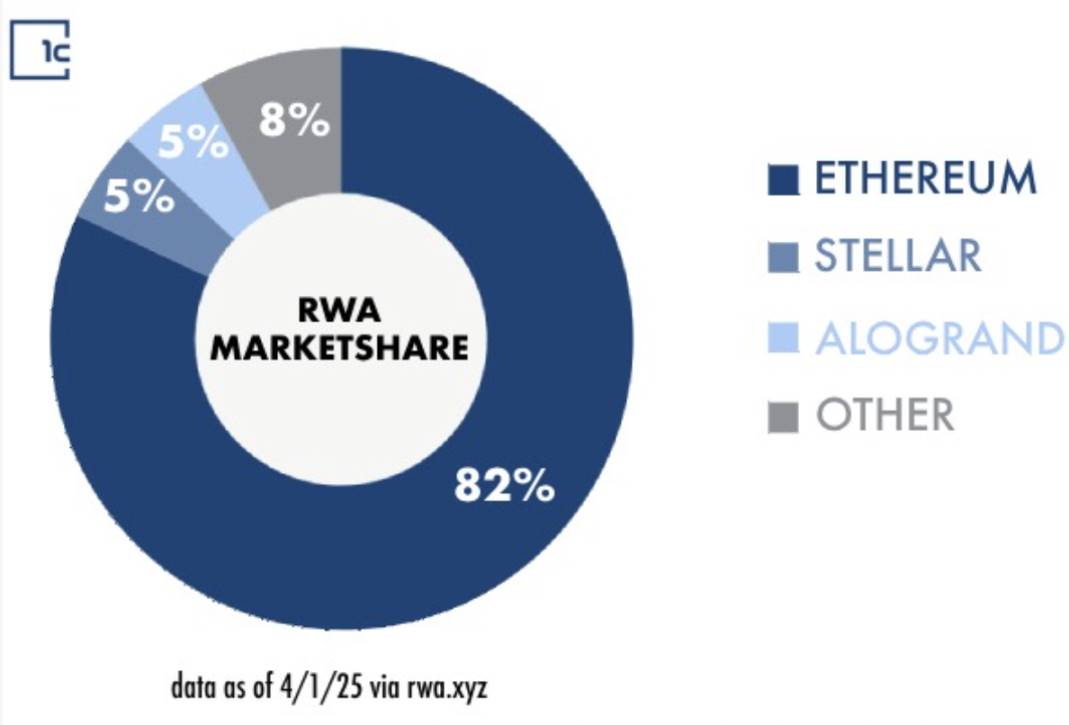
Ethereum holds dominant market share in stablecoins, real-world assets, and NFTs. Ethereum is now the primary ecosystem for new developers and major companies like JPMorgan, BlackRock, Coinbase, and Robinhood to tokenize assets. This trend began with crypto-native assets like fungible tokens and NFTs, but is increasingly extending to dollars, treasury bonds, stocks, bonds, private credit, and real estate. Whether these activities occur on mainnet or L2, and how much fees L2s ultimately pay back to mainnet, affects the amount of Ether burned. But even if all such activity happens on L2s paying minimal fees to mainnet, widespread adoption of these use cases still promotes Ethereum as the credible-neutral, internet-native store of value.
5. A $100+ Trillion Opportunity
A credible-neutral, internet-native store of value represents the largest market opportunity in the world today. Gold has a total market cap of around $20 trillion, and global broad money supply (M2) is approximately $100 trillion—making this a market opportunity exceeding $100 trillion.
Cryptocurrencies that achieve social scalability through credible neutrality and utility are best positioned to capture this opportunity. Currently, there isn’t a strong narrative around this idea—but from my experience in life and crypto, I’ve learned that the stronger the narrative, the further it often is from the truth. Those who stay focused on core goals and resist the urge to chase short-term gains will ultimately be rewarded.
Join TechFlow official community to stay tuned
Telegram:https://t.me/TechFlowDaily
X (Twitter):https://x.com/TechFlowPost
X (Twitter) EN:https://x.com/BlockFlow_News
 @1confirmation