TechFlow
TechFlow Selected TechFlow Selected
TechFlow
With just a team of around one hundred people serving hundreds of millions of users worldwide and generating tens of billions of dollars in profit, Tether's "money-printing machine" is operating at astonishing efficiency.
 Navigating Web3 tides with focused insights
Author: Nancy, PANews
In the crypto world, a "money printer" is operating at astonishing efficiency: Tether, the stablecoin giant. With only a team of about a hundred people serving hundreds of millions of users globally, it has leveraged its position to generate billions of dollars in profit. Behind this powerhouse stands Giancarlo Devasini—the man who transformed himself from a plastic surgeon into a key figure in crypto finance—and whose strategic vision has propelled Tether from a fringe innovation to the center of the global financial stage.
Today, Tether not only dominates the stablecoin market but is aggressively expanding into mining, media, agriculture, and other sectors through bold investments, launching an ambitious global expansion campaign.
A 100-Person Team Generating Billions in Profit, Seventh-Largest Buyer of U.S. Treasuries
As the world’s largest issuer of stablecoins, Tether has evolved from a niche financial experiment into a dominant force in the crypto industry, demonstrating extraordinary profitability and market influence.
Over the past decade, Tether's publicly disclosed net profits have reached tens of billions of dollars. While detailed financial disclosures were limited during its early years, since 2022 the company has enhanced transparency by releasing comprehensive financial reports. According to aggregated public data, between Q4 2022 and the end of 2024—just over two years—Tether accumulated at least $19.9 billion in net profit.
In 2024 alone, with a lean team of approximately 150 employees, Tether generated more than $13 billion in total profit—averaging around $93 million per employee. This makes it one of the most profitable companies per capita globally, outperforming traditional financial giants like BlackRock and rivaling Visa in transaction volume.
From a revenue composition perspective, U.S. Treasury bonds are clearly Tether’s core profit engine. Since the Federal Reserve began raising interest rates in 2022, Tether has allocated substantial reserve funds into U.S. Treasuries, becoming one of the major institutional buyers. In 2024 alone, Tether purchased $33.1 billion worth of U.S. Treasuries, ranking it as the seventh-largest buyer worldwide—surpassing countries such as Canada, Mexico, Norway, South Korea, Germany, and Saudi Arabia. As of the quarterly reserve report released last December, Tether held U.S. Treasury securities valued at $94 billion.
Beyond asset allocation, widespread adoption of its stablecoin USDT remains another critical pillar for profit generation. Pegged to the U.S. dollar, USDT transcends limitations of traditional financial instruments and plays multiple roles across global markets. In high-inflation economies like Venezuela and Turkey, USDT has become the preferred tool for residents to hedge against local currency depreciation and circumvent capital controls, offering a vital lifeline amid economic turmoil. Meanwhile, in restricted or gray-market environments, USDT functions as a flexible and hard-to-track financial medium.
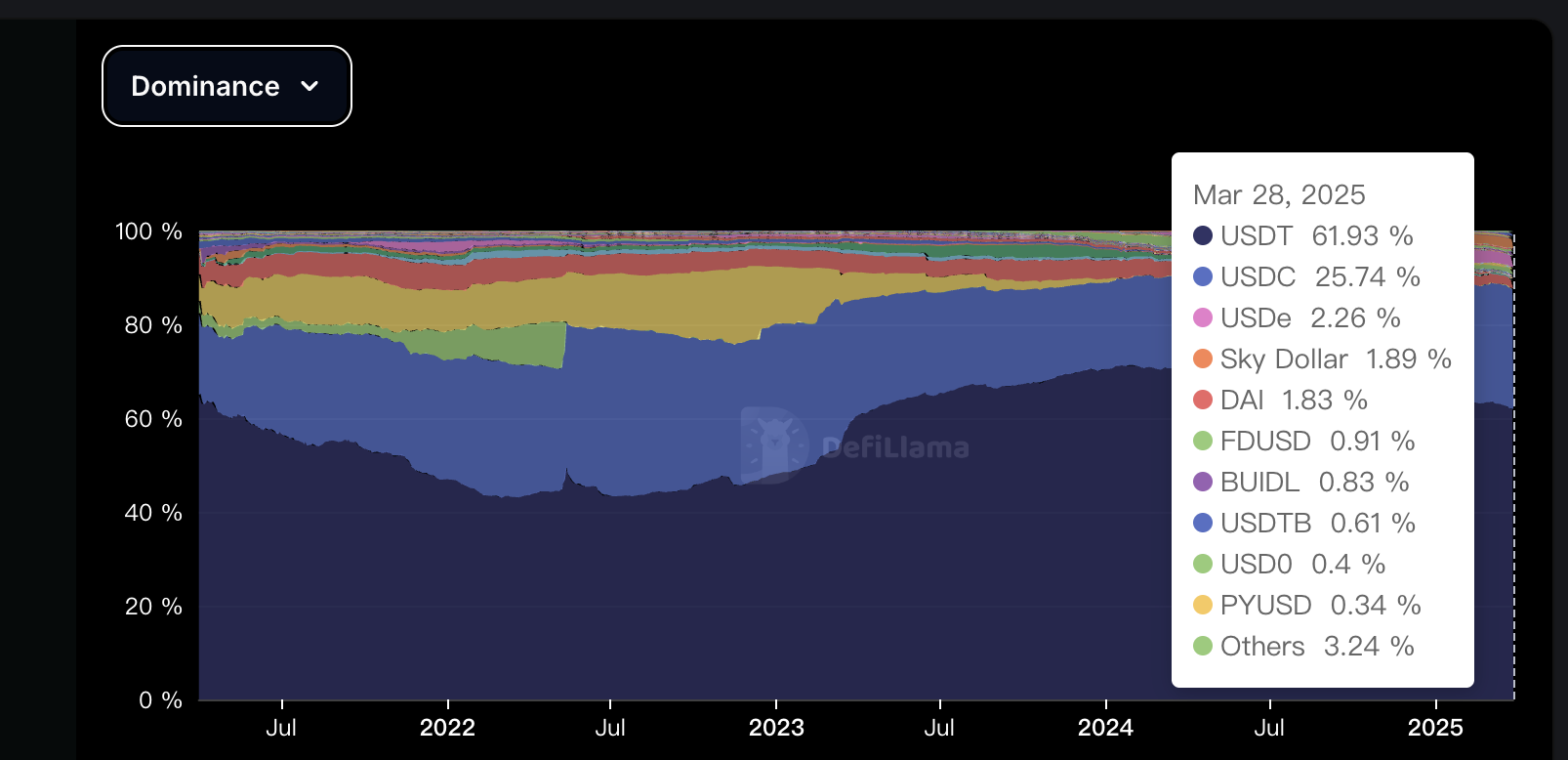
Today, USDT leads the global stablecoin market and is the most widely used stablecoin. Data from DeFiLlama shows that as of March 28, 2025, USDT’s circulating supply exceeded $143.7 billion, with a market capitalization surpassing $144.8 billion, capturing approximately 61.9% of the stablecoin market share. According to Tether CEO Paolo Ardoino, USDT already has a conservative estimate of over 400 million users worldwide—with rapid growth momentum suggesting it could reach 1 billion users soon.
From Behind the Scenes to Center Stage: The Real Leader Was Once an Italian Plastic Surgeon
The mastermind behind this largest crypto “printing press” is widely recognized as Tether’s former CFO, Giancarlo Devasini. Forbes estimates that Devasini owns 47% of the company—potentially making him Tether’s largest shareholder—with a net worth reaching $9.2 billion. Yet this central figure maintains a low profile in Lugano, Switzerland’s Bitcoin hub, rarely giving interviews and listing his business card title as “no title, no job, nothing.”

Devasini’s journey is nothing short of legendary. As previously reported by The Wall Street Journal, Giancarlo Devasini was born in Turin, Italy, originally working as a plastic surgeon before moving into electronics import-export in Hong Kong. In 1995, Italian prosecutors accused him of involvement in a software piracy ring and fraud charges. Later, he founded the tech company Solo in Italy, which once achieved annual revenues exceeding €100 million before being sold by Devasini just prior to the 2008 financial crisis. Today, this 60-year-old Italian national has emerged as one of the pivotal figures in cryptocurrency finance.
The turning point came in 2012 when the Bitcoin whitepaper sparked Devasini’s interest in digital currencies. He even posted on Bitcoin forums asking if anyone would buy DVDs or CDs for 0.01 BTC each (then worth about 11 cents), promising free shipping for bulk orders.
It was during this period that Devasini connected with Bitfinex co-founder Raphael Nicolle. Leveraging his extensive business experience and network, he established crucial banking relationships for Bitfinex, helping drive its international expansion—including relocating its registration to the British Virgin Islands and setting up headquarters in Hong Kong—gradually positioning himself as a core figure within the exchange. In 2014, he co-founded Tether alongside Bitfinex executives and launched USDT.
Devasini has been deeply involved in Tether’s issuance decisions and capital management, particularly playing a key role in partnerships with major clients. For instance, Alameda Research secured tens of billions of dollars in USDT support from Tether, with Devasini believed to be the driving force behind the scenes. Bloomberg cited chat logs submitted by former Alameda CEO Caroline Ellison showing Devasini telling Alameda traders: “We are a family... We will conquer the world.” FTX founder SBF also publicly defended Devasini, stating: “Devasini is very proud of what he built at Bitfinex and Tether. He responds around the clock—not just to crises or incredible opportunities, but also to day-to-day operations. Those ‘unwarranted criticisms’ of Tether are reckless.”
Additionally, reports suggest Devasini actively seeks political allies to secure regulatory “protection” for Tether. The Wall Street Journal previously reported that Devasini privately stated last year that Howard Lutnick, chairman of Cantor Fitzgerald and U.S. Secretary of Commerce, would use his political clout to mitigate threats facing Tether. Senator Elizabeth Warren had pressed Lutnick during his nomination process to clarify his ties to Tether. Notably, Cantor manages part of Tether’s reserves and holds a 5% stake in the company. However, Tether denies any suggestion that Lutnick influences regulatory actions on its behalf.
Now, as Tether expands at breakneck speed, Devasini is stepping further into the strategic spotlight, transitioning into the role of Group Chairman focused on macroeconomic strategy aimed at deepening USDT’s integration into the global digital asset ecosystem.
Accelerating Diversification Strategy: Major Bets Placed on Mining and Media
Facing increasing regulatory scrutiny and intensifying market competition, Tether is building a cross-industry commercial network through diversified investments.
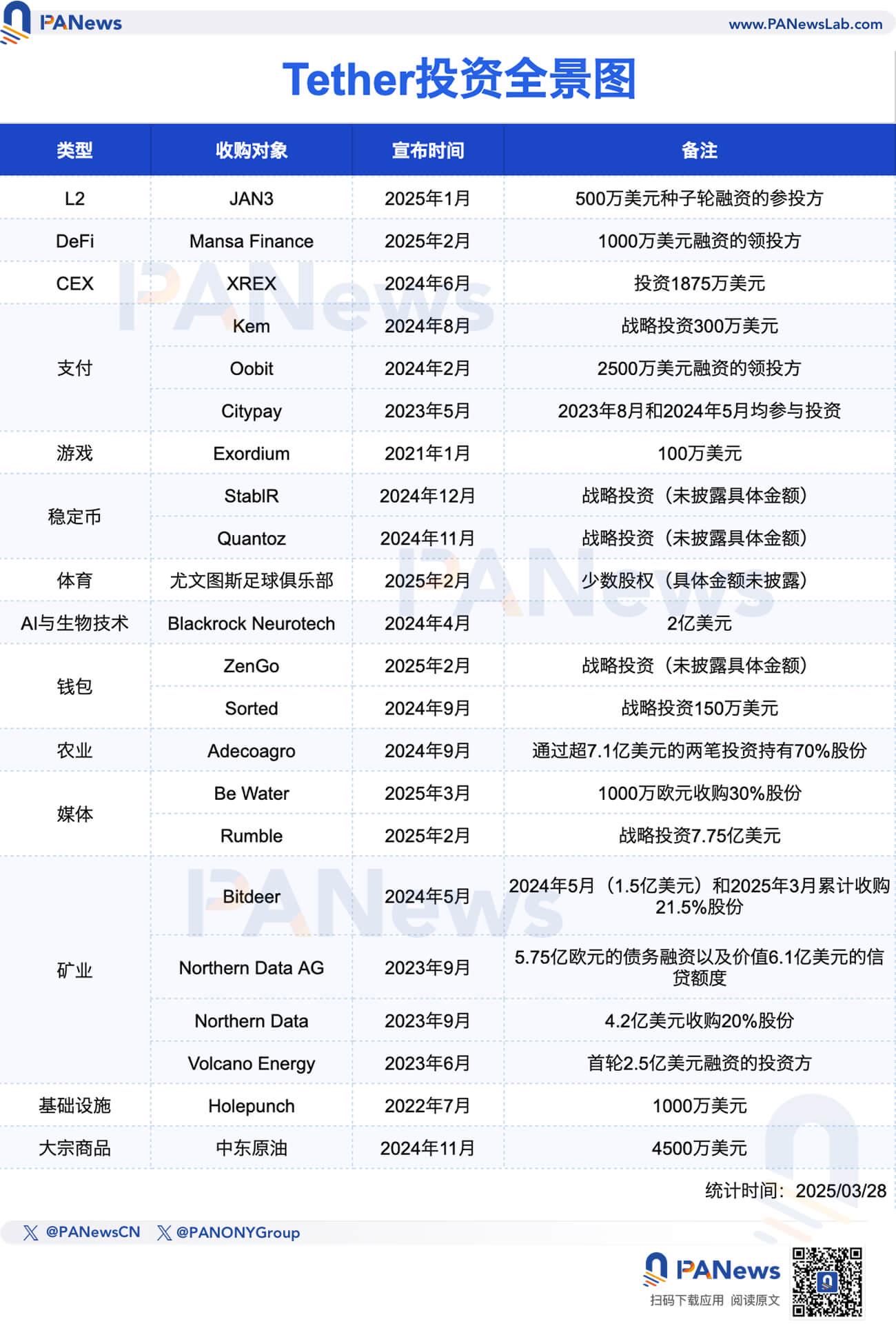
According to incomplete statistics compiled by PANews, since 2021 Tether has publicly disclosed 22 investment projects spanning crypto, media, sports, agriculture, commodities, biotechnology, and more. The crypto sector remains Tether’s primary focus, especially active in mining, payments, stablecoins, and wallets—accounting for over half of all its investments.
In terms of funding scale, Tether has committed the largest sums to mining, investing over $2.1 billion cumulatively—far exceeding allocations to other sectors. Its biggest single commitment was to German mining firm Northern Data AG, providing $575 million in debt financing and a $610 million credit line. Volcano Energy, Northern Data, and Bitdeer each received hundreds of millions in funding. The second-largest recipient is the media sector, where Tether has invested a total of $780 million, mostly directed toward Rumble ($775 million). As previously reported by PANews, this significant investment carries strong political overtones, appearing more like a business play aligned with Trump-affiliated circles. Rumble enjoys close ties with former U.S. President Donald Trump and is often dubbed the “Trump stock,” while Vice President J.D. Vance’s venture fund Narya Capital Management has also participated in Rumble’s financing rounds. In agriculture, Tether acquired stakes in Argentine agribusiness giant Adecoagro through two deals, holding up to 70% ownership for over $710 million. Additionally, Tether acquired majority control of neurotechnology firm Blackrock Neurotech for $200 million, valuing the company at $350 million.
From a timeline perspective, between 2021 and September 2024, Tether primarily concentrated on crypto infrastructure, particularly mining and payment systems. Afterward, its investment pace accelerated significantly, with strategy broadening from a narrow focus into a diversified, multi-sector global footprint.
Although Tether has successfully constructed a powerful crypto empire through diversification and dominance in the stablecoin market, as the crypto landscape matures and regulations evolve, it faces increasingly complex challenges ahead—its future hinging on how well it can balance innovation, compliance, and expansion on an unpredictable global stage.
Join TechFlow official community to stay tuned
Telegram:https://t.me/TechFlowDaily
X (Twitter):https://x.com/TechFlowPost
X (Twitter) EN:https://x.com/BlockFlow_News
 PANews