VCs Find a New Marketing Angle for "VC Coins"
TechFlow Selected TechFlow Selected
VCs Find a New Marketing Angle for "VC Coins"
Inheriting ICO's open DNA while balancing efficiency and fairness through technological means, a new golden age of compliance and refined operations may be dawning.
 Navigating Web3 tides with focused insights
By BUBBLE, BlockBeats
Recently, prominent blockchain venture capital firm HackVC announced the launch of a community investment syndicate on Echo, positioning itself as one of the first regulated U.S.-based major crypto fund managers to introduce a "community round" on the platform. This move aims to transform Hack VC into a truly community-driven venture capital firm. As trust in traditional VCs continues to erode within the crypto market, venture firms appear to be exploring new models to become more closely aligned with the broader ecosystem.
HackVC founder Alexander Pack made his first cryptocurrency investment at age 22 while working at a fintech venture capital firm in Hong Kong. At that time, the crypto market was still in its infancy, but Pack believed it represented the future. He later returned to the U.S. and joined Bain Capital, where he helped lead investments in the crypto sector. In 2018, Alexander co-founded the crypto-focused venture fund Dragonfly Capital alongside Feng Bo, serving as its first managing partner—a firm that has since grown into one of Asia’s largest crypto funds. In 2020, Alexander left Dragonfly Capital to establish Hack VC.
The name HackVC clearly signals a strong technical focus. As Pack puts it, HackVC is essentially “a group of hackers investing in another group of hackers.” Managing Partner Ed Roman founded the well-known hackathon event hack.summit(), while research partners Christopher Maree and Sean Brown come from the team behind the oracle protocol UMA. Maree previously participated as an Ethereum Foundation Devcon V Scholar, and Brown served as a senior blockchain advisor at IBM. It's evident that HackVC places significant emphasis on the technical feasibility and scalability of the projects it backs.
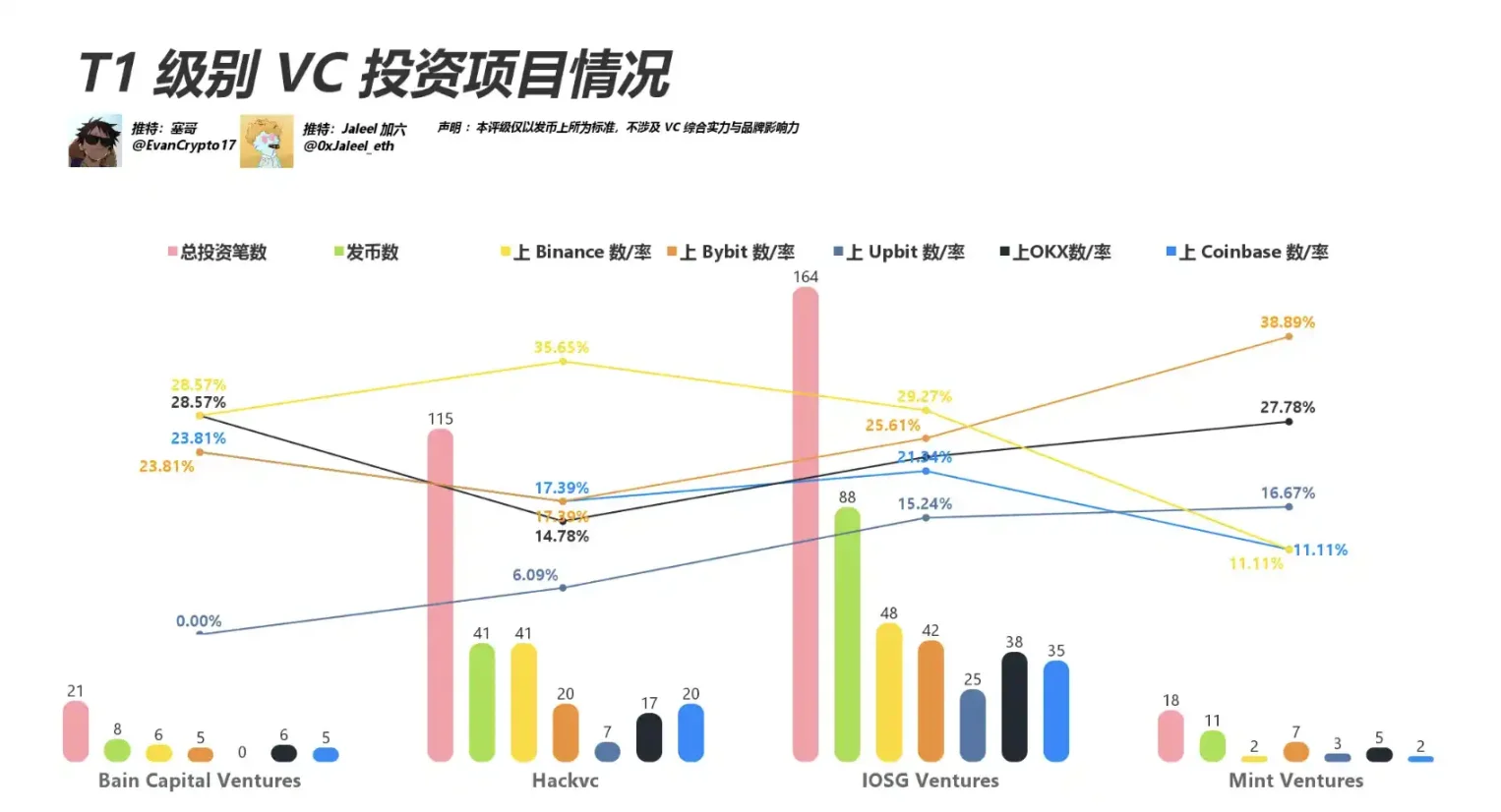
This approach has yielded impressive investment results, with early stakes in high-potential projects such as Berachain, EigenLayer, Morpho, Grass, and Soon.
Read more: Everyone Is Criticizing VC Coins—So How Have VCs Performed This Cycle?
The "Echo Model": Returning to Roots
With the emergence of agency-led research groups and KOL-led investment rounds, newer funding ecosystems now offer shorter fundraising cycles, deeper project involvement, and higher success rates. Traditional VCs are thus under pressure to evolve and adopt more effective investment frameworks.
A conversation between Pack and Echo founder Cobie reveals their shared vision. Cobie argues that the crypto community’s disdain for VCs isn’t really about venture capitalists per se—it's about opposition to unfair systems. When individual investors can participate early, projects backed by high-signaling VCs naturally attract greater demand. Cobie envisions a new type of community-friendly VC that enhances its own investment strategy through community rounds or community access mechanisms. If genuine alignment with communities contributes to a project’s success, then VCs could enable communities to positively select founders who are themselves community-aligned.
This idea resonates deeply with Pack, who entered the crypto space 11 years ago driven by a belief that cryptocurrency could democratize access to tech investing. Early in his career, he joined crowdfunding platform AngelList as their first analyst and played a key role in helping pass the CROWDFUND Act in 2012, which legalized equity crowdfunding. However, the outcome fell short of his expectations—regulatory complexity hindered progress, and most Web2 founders and venture investors failed to recognize the value of involving their communities in funding rounds.
Echo operates differently from traditional ICO platforms. Founded in March 2024 by crypto influencer Cobie (@echodotxyz), who formerly led growth at Lido and hosted the popular Web3 podcast *UpOnly*, Echo centers around a “lead investor referral mechanism.” Users can act as lead investors, forming investment groups, sharing deals with members, and earning a share of profits.
In contrast to Coinlist, where investors directly support projects and receive token allocations in return, Echo focuses on fostering community-based capital formation within token economies. It enables native on-chain users to collectively invest in startups. The process involves lead investors creating syndicates; group members may choose to follow along, with funds flowing indirectly to the company via intermediary investment vehicles. These investments may include not only tokens but also potential equity stakes. In simple terms, Coinlist facilitates direct investment in project tokens, whereas Echo enables indirect investment into companies through intermediaries.
Since launch, over 30 crypto projects have raised funds via Echo, including notable names like Ethena, Morph, Usual, Hyperlane, Dawn, Monad, Initia, and MegaETH. Collectively, these efforts have raised $100 million within a year. Notably, in December 2024, MegaETH completed two separate $10 million raises on Echo—$4.2 million raised in just 56 seconds during the first round, followed by $5.8 million raised in 75 seconds in the second.
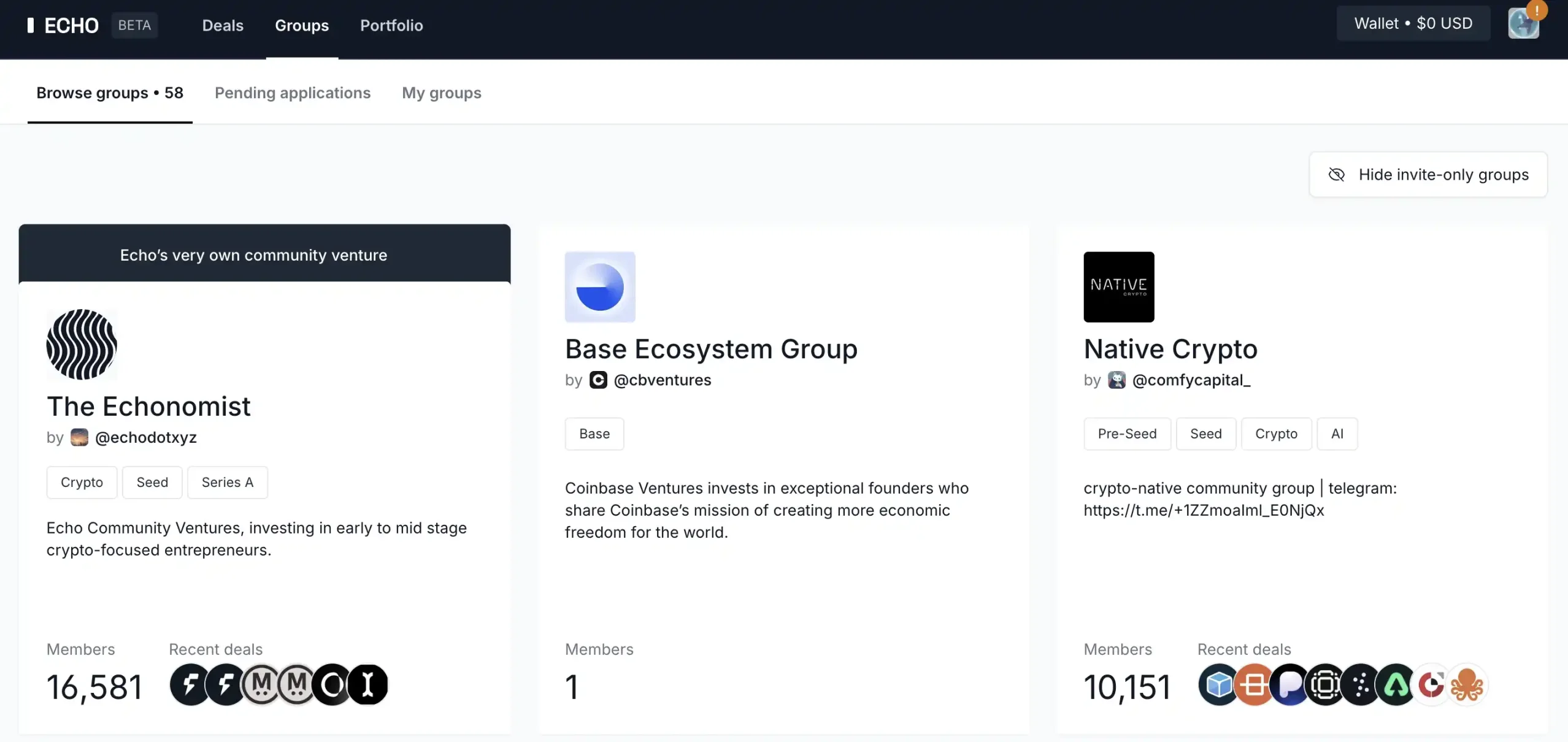
The model resembles an “elite alliance” for crypto investors, favoring high-potential projects endorsed within tight-knit circles. Prominent figures such as The Block CEO Larry Cermak and Aave founder Marc Zeller have already launched their own Echo communities. To join, users must answer screening questions and complete KYC verification. Some groups impose additional eligibility criteria for specific investment opportunities. Currently, there are 58 community leaders who have established groups on Echo.
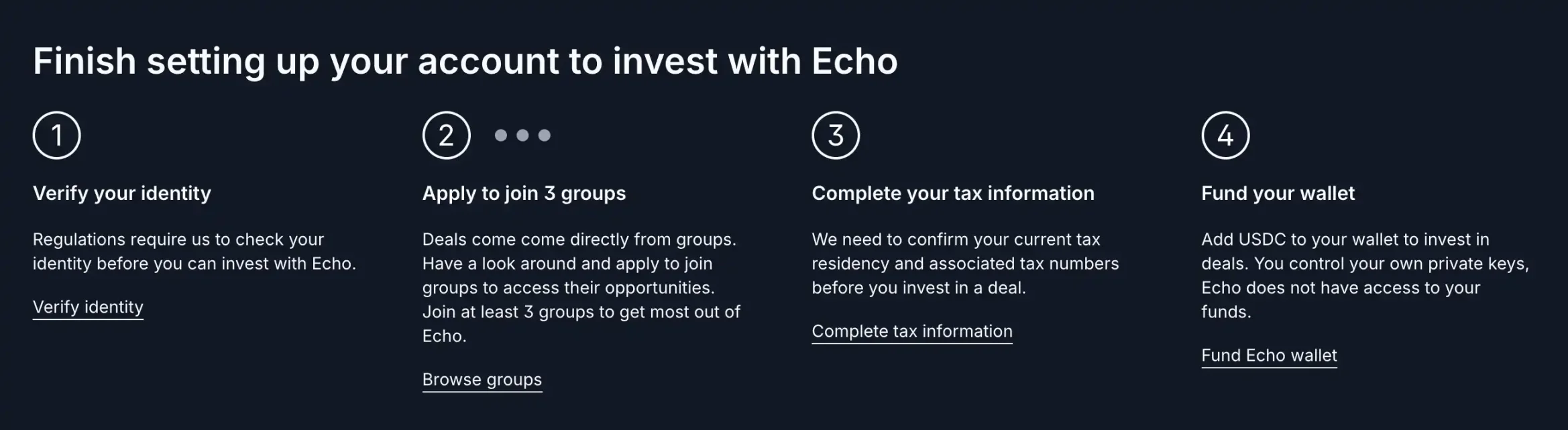
This community-driven model uses smart contracts to manage investments, ensuring lead investors never directly handle followers’ funds and allowing participants full control over when they sell their tokens. Successful lead investors earn a percentage of followers’ profits, incentivizing the sharing of high-quality opportunities. While the elite orientation limits user base size, the curation mechanism ensures project quality and appeals to trust-conscious investors.
Shan Aggarwal, VP of Corporate Development at Coinbase, and Jesse Pollak, founder of Base, stated: “On-chain investing allows accredited investors to participate in ways previously impossible, while enabling founders to tap into a broader, more dynamic capital base. We’re excited to expand capital access for builders on Base and enable more people to participate in the next wave of innovation.”
Some industry experts suggest that a more lenient regulatory environment in the U.S. could spark a revival of public sales. Matt O'Connor, co-founder of Legion—a rising ICO platform—said, “Once ICOs regain momentum, they may shift focus away from the memecoin frenzy.” Today, fewer real products are being built, while increasing wealth accumulates behind the scenes.
HackVC’s First Step Toward Community Collaboration
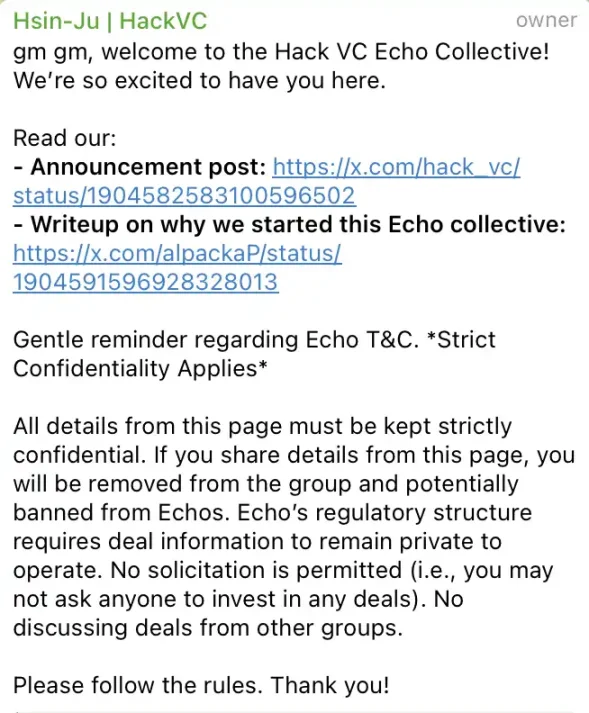
HackVC has officially launched its Echo group, adopting a private, invite-only model to grant select community members access to core project resources. For the first year, HackVC will waive performance fees entirely. Additionally, portfolio companies are required to include a dedicated community funding round and adhere to a “community-first protection” principle in valuation: if it’s the project’s initial raise, the community round valuation must be lower than concurrent institutional rounds; if subsequent, it must remain below the latest VC entry valuation. This structural design ensures community investors receive pricing advantages.
Despite ongoing debates about whether this model qualifies as having “governance tokens” or constitutes a DAO, HackVC’s experiment sets a precedent for how VCs and communities might collaborate in the future. The evolution of crypto financing reflects a continuous innovation in community coordination mechanisms—from Bitcoin’s PoW-enabled fair mining era, to Ethereum’s $18 million crowdfunding campaign in 2014 that pioneered on-chain fundraising, to the ICO boom of 2017, with community-driven participation at its core.
In the post-ICO era, two distinct paths emerged: centralized platforms like CoinList successfully executed high-profile projects such as Solana, though scalability remains limited; meanwhile, on-chain airdrops and yield farming lowered barriers to entry but struggled with issues of user commitment.
Today, amid maturing infrastructure and clearer regulatory frameworks, Echo is redefining crowdfunding through its non-custodial syndicate model, while Legion introduces on-chain reputation systems to improve investor curation. These developments mark the beginning of a new phase in community fundraising—one that preserves the open ethos of ICOs while using technology to balance efficiency and fairness. A new golden age of compliant, precisely operated community finance may be dawning.
Join TechFlow official community to stay tuned
Telegram:https://t.me/TechFlowDaily
X (Twitter):https://x.com/TechFlowPost
X (Twitter) EN:https://x.com/BlockFlow_News
 BlockBeats