The U.S. Vice President Also Uses Signal's "Group Chat" for Warfare: The Encryption Legacy of Privacy King Signal
TechFlow Selected TechFlow Selected
The U.S. Vice President Also Uses Signal's "Group Chat" for Warfare: The Encryption Legacy of Privacy King Signal
Signal is a ship carrying all kinds of passengers.
 Navigating Web3 tides with focused insights
By TechFlow
The world is one big makeshift stage, now with fresh evidence (and punchlines).
We’re all used to creating groups on various social apps to discuss work, life, and gossip. But have you ever imagined that the top U.S. officials wielding the world’s most powerful military might also operate via a form of “WeChat group office”?
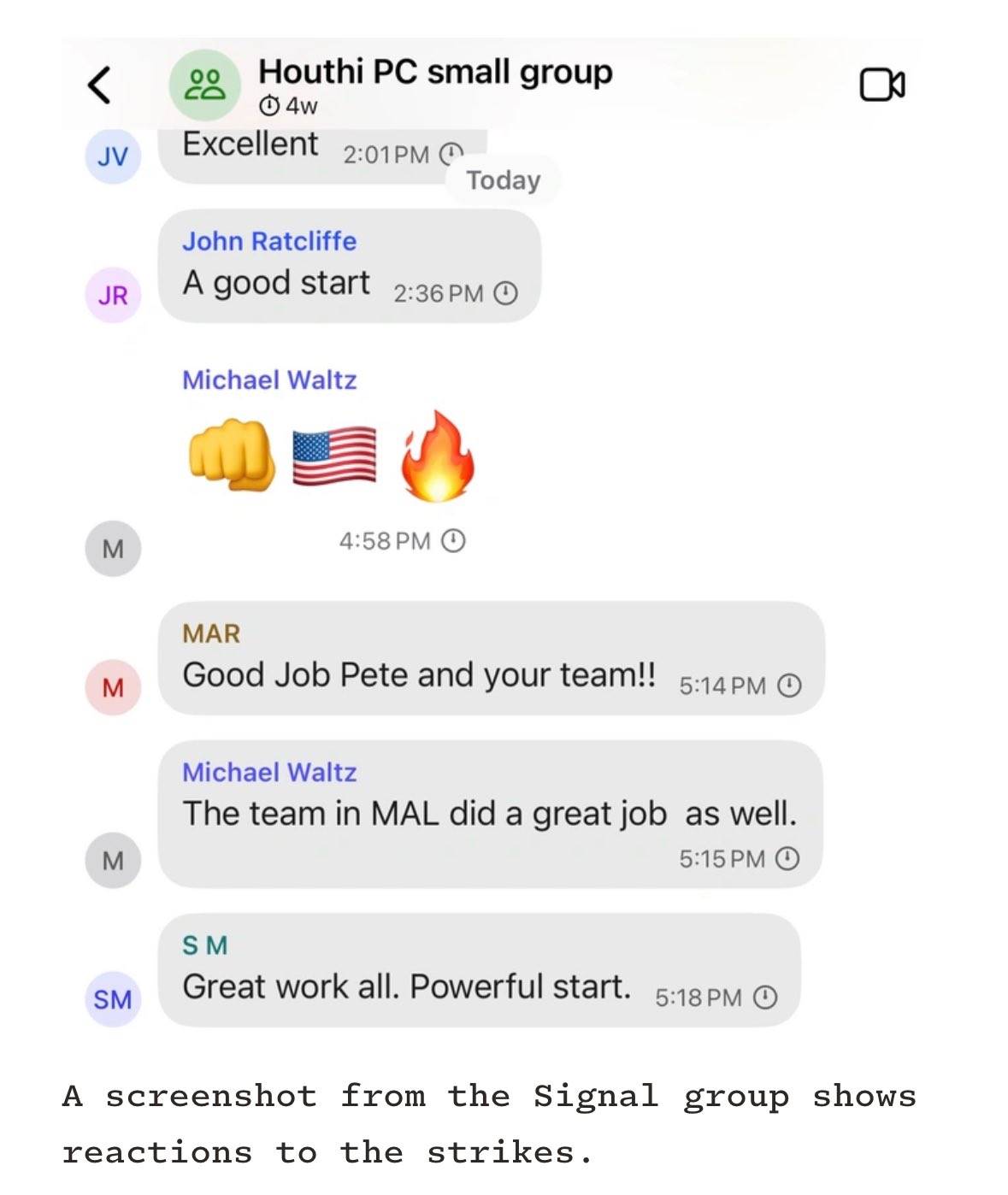
Recently, Jeffrey Goldberg, editor-in-chief of The Atlantic, revealed an absurd story: he was mistakenly added by senior U.S. national security officials into a Signal group chat named "Houthi PC," where he witnessed Vice President Vance and others mocking Europe, and observed high-level discussions about military strikes against Yemen's Houthi militants just two hours before actual operations commenced.
The veteran journalist was initially skeptical. He couldn’t believe that top-tier U.S. national security officials would discuss such classified military actions on a commercial instant messaging app. Nor could he fathom that the National Security Advisor would recklessly add a media editor-in-chief into such a sensitive conversation.
But when he saw Defense Secretary Hegseth detailing the imminent operation—including targets, deployed weapons, and attack sequence—and those actions unfolded exactly as described shortly afterward, he had no choice but to accept this ridiculous reality.
After the incident went public, high-ranking officials including Vice President Vance, Defense Secretary Hegseth, Secretary of State Rubio, and CIA Director Ratcliffe became targets of widespread mockery. The emojis they used in the chat—👊🇺🇸🔥—also turned into viral internet memes.
This episode perfectly illustrates the so-called "makeshift stage theory"—the idea that institutions perceived from the outside as orderly and authoritative may internally be far more chaotic and improvised than we imagine. Even the world’s most powerful government conducts business through online group chats, and can still commit basic blunders like “adding the wrong person.”
And then there’s the messaging app they used: Signal. Unexpected? Perhaps. But also strangely fitting.
Signal isn’t experiencing its first wave of fame.
Long before becoming an accidental witness to U.S. military operations, this messaging app had already earned wide acclaim among tech experts and privacy advocates for its exceptional data protection capabilities. Notable figures like Tesla CEO Elon Musk and NSA whistleblower Edward Snowden have publicly endorsed Signal.
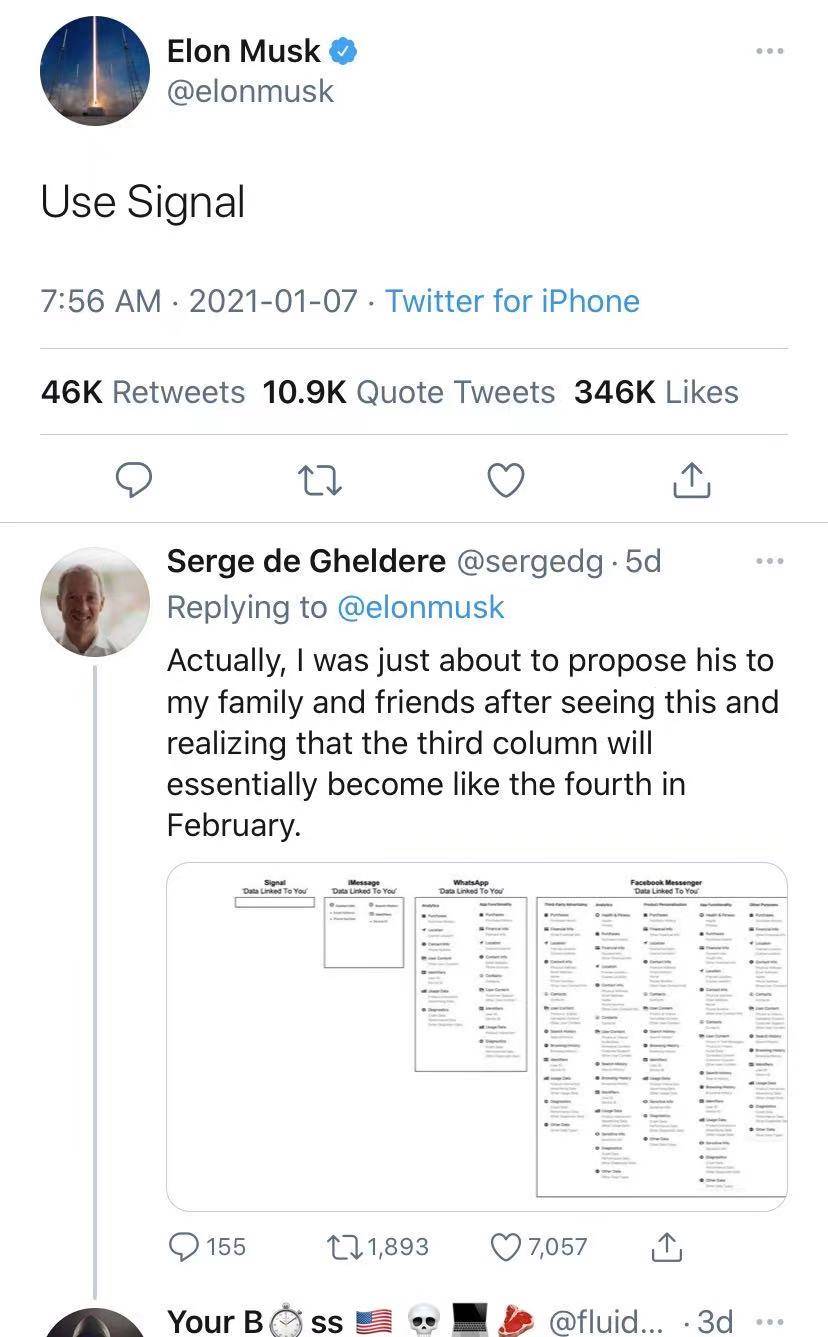
In early 2021, when WhatsApp announced updates to its privacy policy, Musk simply tweeted “Use Signal,” triggering a massive surge in downloads that temporarily crashed Signal’s verification system.
Snowden, a longtime champion of digital privacy, stated back in 2015: “I use Signal every day.” He considers it one of the most secure communication tools available.
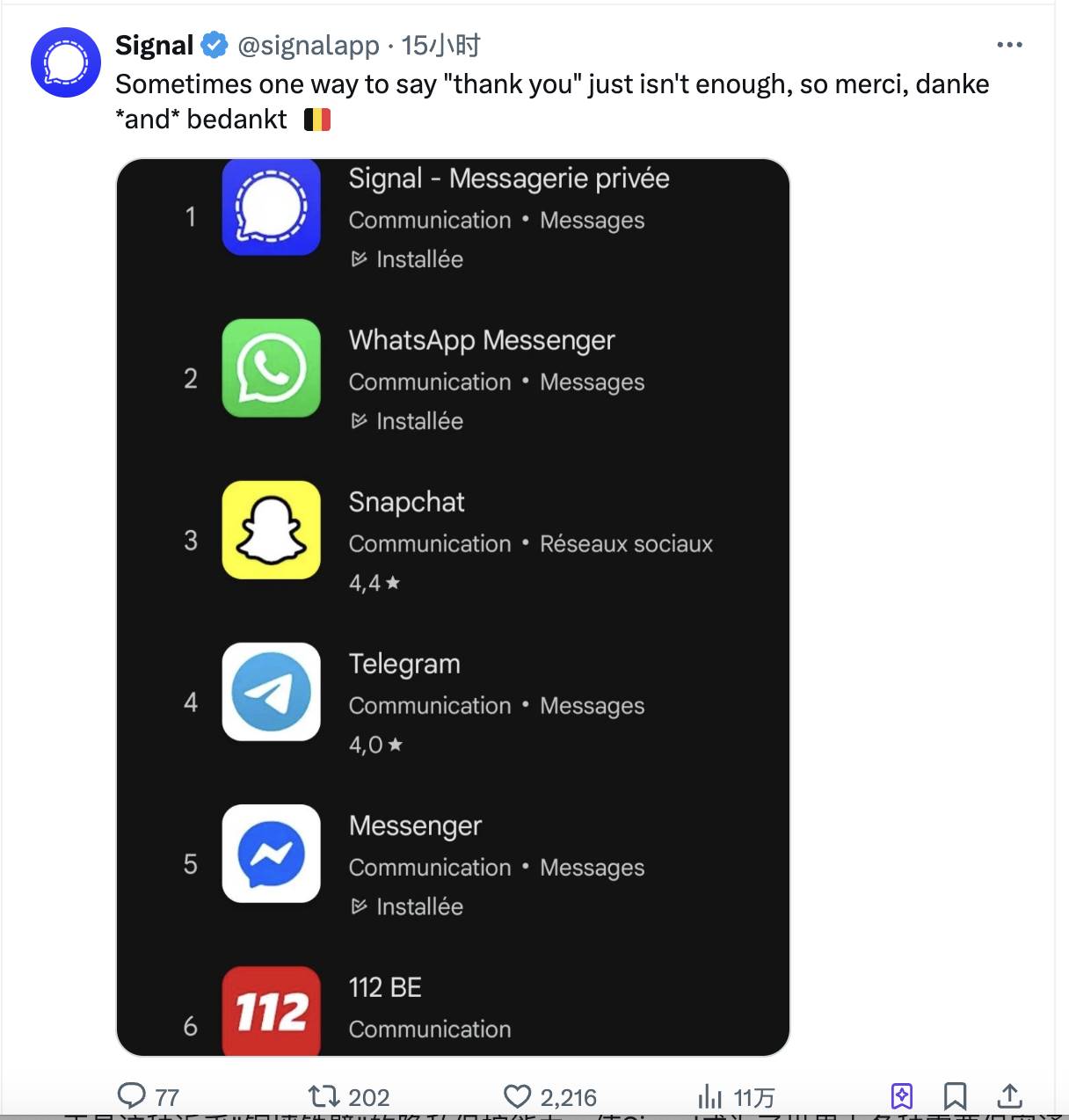
The recent leak has brought even greater exposure to Signal. Its Android store download count surpassed WhatsApp and briefly reached number one. Signal’s official X account posted: sometimes saying “thank you” in just one language isn't enough—so merci, danke, and bedankt.
Signal’s core strength lies in its advanced end-to-end encryption technology. All communication content—including text, voice, video, and emojis—can only be deciphered by sender and recipient. Even if intercepted, eavesdroppers see nothing but meaningless strings.
This encryption mechanism ensures that not even Signal itself can access user messages. It collects no metadata, saves no call logs, and performs no cloud backups—eliminating the possibility of data leaks at the root level.
It is precisely this near-impenetrable privacy protection that makes Signal the go-to tool for individuals requiring confidential communications.
From journalists and human rights activists to political dissidents, many in sensitive positions rely on Signal to protect their conversations. Latin American activists helping women access abortion rights, North Korean defectors evading surveillance, lawyers from national bar associations, leaders of the Black Lives Matter movement, and even former terrorist organization ISIS—all have used Signal. Now, another user group joins them: senior Trump administration officials.
When a government and its enemies are using the same communication platform for “online office,” it creates a surreal, cyberpunk-style irony: those who wield immense power are using a tool created by an anarchist to exercise that power.
That anarchist is Moxie Marlinspike.
The Most Interesting Man in the World
Moxie Marlinspike, founder of Signal, is a legendary and enigmatic figure in the tech world.
Born Matthew Rosenfeld, this cryptography prodigy not only built the world’s most secure messaging app but also lived an extraordinarily adventurous life—one that Snowden described as making him one of “the most interesting people on Earth.”
Growing up in central Georgia, Marlinspike showed early disdain for conventional education and a natural talent for technology. He hated the dull tasks schools imposed that stifled curiosity, yet discovered joy in programming on a crude library computer with no hard drive—where code couldn’t even be saved.
Before turning ten, he found the hacker magazine 2600 at a local bookstore, launching his hacking journey. After his mother bought him a cheap desktop, young Marlinspike could already plant pranks on friends’ computers—making messages suddenly pop up to scare them.
In 1999, driven by visions of a cyberpunk future, Marlinspike moved to Silicon Valley after high school—only to find it filled with “office parks and highways,” far removed from the futuristic landscapes painted by William Gibson’s novels.
He quickly landed a programming job at Web-Logic, but almost immediately grew tired of spending “40 hours a week typing at a keyboard.” In the years that followed, Marlinspike lived a near-punk existence in the Bay Area—squatting in abandoned buildings, moving into old post office warehouses, participating in political protests, and reading works by anarchist thinkers like Emma Goldman.
These experiences deeply shaped his critical views toward authority.
Unwilling to live conventionally, Marlinspike embraced a life full of incredible adventures.
He once biked across San Francisco carrying a 12-meter sailboat mast; taught himself hot air ballooning, only to crash in the desert and walk with crutches for a month; and reportedly played rock-paper-scissors for hundreds of dollars in bets without ever losing, according to friends.
In 2003, he decided to learn sailing, spent all his savings on a dilapidated 27-foot Catalina sailboat, and set off solo from San Francisco to Mexico, teaching himself navigation through trial and error.
The next year, he co-directed a DIY sailing documentary titled Hold Fast, chronicling a voyage with three friends aboard a leaky vessel dubbed “Plague Ship” from Florida to the Bahamas, ultimately abandoning the boat in the Dominican Republic.
Perhaps it was this relentless pursuit of freedom and skepticism toward authority that eventually led Marlinspike to create Signal.
In 2010, he launched TextSecure—the precursor to Signal—kicking off his revolutionary work in encrypted communications. When Snowden met Marlinspike in Moscow in 2015, he described the cryptographer as “incredibly fun, totally awesome, wildly entertaining, utterly wild.”
Marlinspike has always guarded his personal privacy fiercely, rarely speaking about his age, hometown, or even real name. This obsession with privacy is mirrored in Signal—a messaging tool that collects no user data, stores no message records, and offers full end-to-end encryption.
Unlike many tech entrepreneurs, Marlinspike never pursued commercial success. The Signal Foundation operates as a nonprofit, funded primarily through donations—including a $50 million initial contribution from WhatsApp co-founder Brian Acton.
Signal Meets Cryptocurrency: FTX Loses Hundreds of Millions
As a committed anarchist and privacy advocate, Marlinspike also crossed paths with cryptocurrency.
The decentralized, censorship-resistant, and privacy-preserving nature of Bitcoin and other cryptocurrencies aligns philosophically with Signal’s founding mission—to provide communication tools free from government or corporate surveillance. Both stem from the cypherpunk movement, aiming to protect individual freedom and privacy through cryptography.
In April 2021, Signal announced integration with MobileCoin, a privacy-focused payment project, enabling users to make payments via MOB tokens. Following the announcement, MOB’s price surged—up sixfold in 14 days and eightfold within 30 days.
The reason behind the spike later emerged: an FTX client had placed massive leveraged bets on MobileCoin (MOB), driving its price from $6 to nearly $70, then used large holdings as collateral for loans.
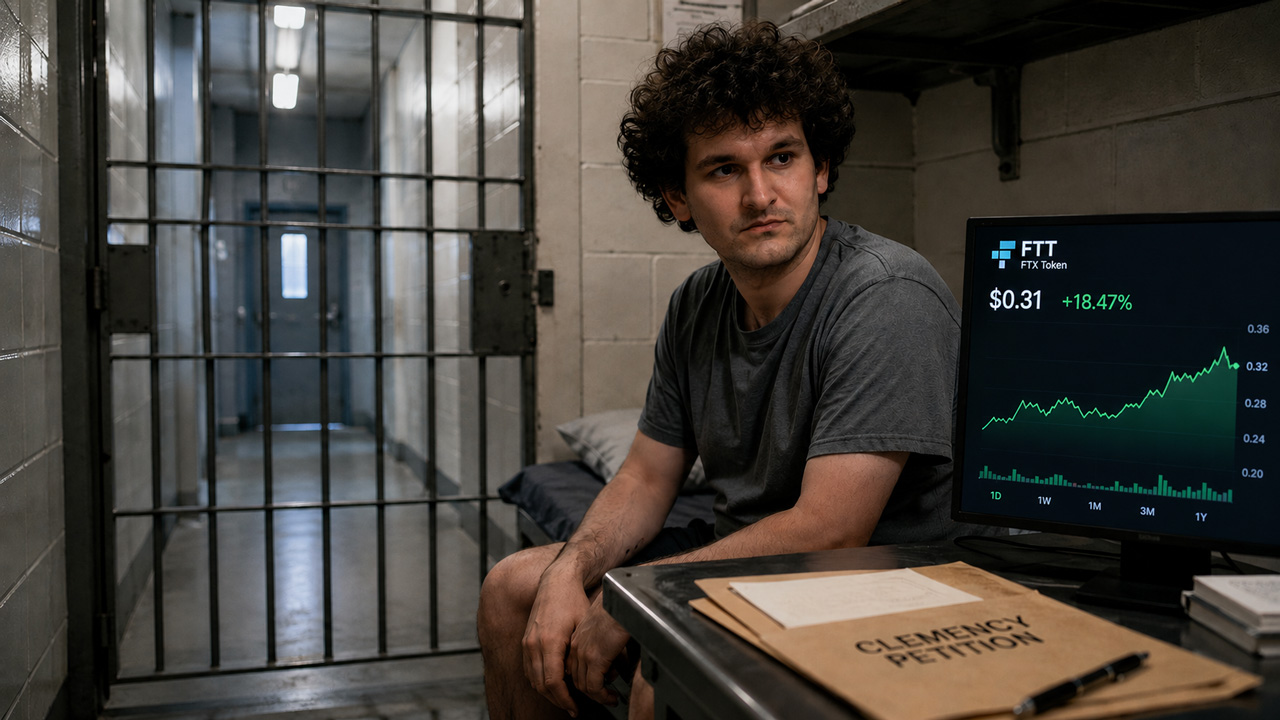
But MOB’s price soon plummeted back to pre-surge levels, forcing Alameda Research—the market maker owned by FTX founder SBF—to intervene and stabilize liquidity, resulting in hundreds of millions of dollars in losses.
The MobileCoin integration sparked major controversy for Signal. Reports suggested Marlinspike had served as a technical advisor for MobileCoin and might hold a significant amount of the token. Some users questioned whether Signal was straying from its nonprofit roots toward commercialization.
Marlinspike responded that Signal chose MobileCoin because it offered the best combination of privacy and user experience—not due to personal financial interests.
Despite these ties, Marlinspike remains a critic of the broader cryptocurrency space.
In early 2022, he published a widely circulated blog post titled *My First Impressions of Web3*, challenging claims of decentralization in Web3 and blockchain technologies.
He argued that while blockchain protocols themselves may be decentralized, users often access them through highly centralized means—such as MetaMask wallets or infrastructure services like Infura.
Marlinspike even conducted an experiment: he minted an NFT that changed appearance depending on where it was viewed. On OpenSea or Rarible, it looked like abstract art. But once purchased and viewed in a wallet, it transformed into a pile-of-poo emoji!
Later, the NFT was mysteriously taken down by OpenSea. What frustrated him further was that after delisting, the NFT actually disappeared from his own wallet—even though he had transferred it to himself.

Marlinspike believes true decentralization means systems “people can participate in directly, without needing permission or mediation from any third party.”
Ethereum co-founder Vitalik Buterin quickly responded on Reddit, largely agreeing with Marlinspike’s critique as a fair assessment of current conditions. Buterin acknowledged that while today’s ecosystem relies on centralized shortcuts for speed and simplicity, many developers and researchers are actively working to improve decentralization through cryptography. Though progress is slow due to limited resources and technical hurdles, he remains optimistic about the future.
While Marlinspike maintains a critical stance toward crypto, Signal’s relationship with the cryptocurrency world continues to evolve. Both share a common mission: protecting user privacy and resisting centralized control.
In this ongoing battle between encryption and decryption, privacy and surveillance, Signal has become a unique entity—it is both a symbol of resistance and a tool of power; a fortress of privacy and a stage for accidental leaks.
The ship called Signal carries a diverse crew—from government officials to anarchists, from crypto enthusiasts to ordinary users—sailing toward an increasingly chaotic future.
Join TechFlow official community to stay tuned
Telegram:https://t.me/TechFlowDaily
X (Twitter):https://x.com/TechFlowPost
X (Twitter) EN:https://x.com/BlockFlow_News
 深潮TechFlow