Ethereum's Comeback? Can Bitwise's ETF Staking Proposal Save ETH?
TechFlow Selected TechFlow Selected
Ethereum's Comeback? Can Bitwise's ETF Staking Proposal Save ETH?
The story of Bitwise Ethereum ETF gaining approval for staking unfolds like a slowly unfurling scroll.
 Navigating Web3 tides with focused insights
Author: Luke, Mars Finance
In an era where cryptocurrency intertwines with traditional finance, market trends are ever-changing. Recently, the New York Stock Exchange (NYSE) filed a proposal with the U.S. Securities and Exchange Commission (SEC), requesting permission for the Bitwise Ethereum ETF to participate in staking. This news swept through the market like a spring breeze, opening new revenue opportunities for investors and adding a brighter outlook for Ethereum’s future.
Yet, sentiment toward Ethereum in today’s crypto market is far from optimistic. Ethereum spot ETFs have experienced net outflows for four consecutive weeks, with approximately $120 million withdrawn during the first week of March 2025 alone—reflecting weakening investor confidence.
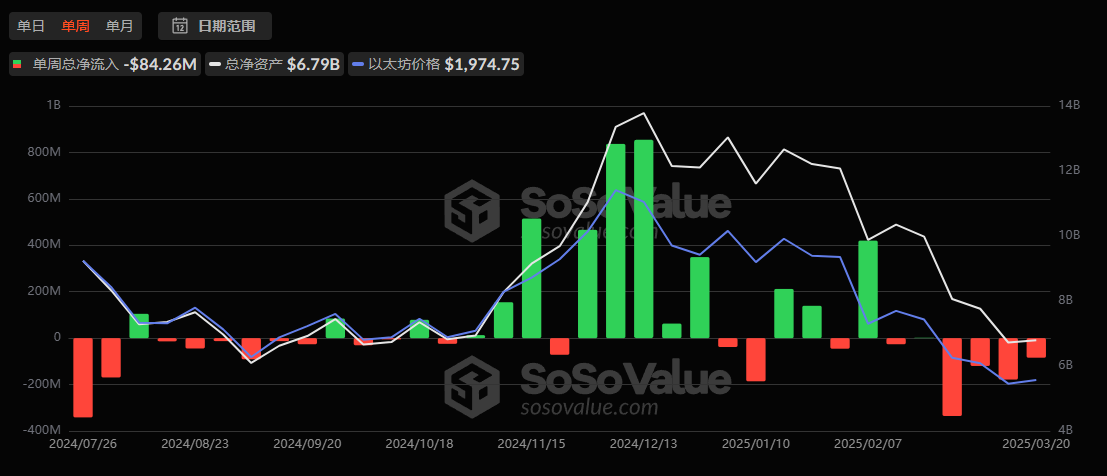
Meanwhile, persistent negative headlines—soaring gas fees and intensifying Layer 2 competition—have dimmed Ethereum's luster. With challenges mounting on all sides, can this proposal turn the tide?
The Beginning of a Proposal: The First Handshake Between Staking and ETFs
The Bitwise Ethereum ETF is an exchange-traded fund designed to give investors easy exposure to Ethereum via traditional stock markets. Staking, on the other hand, has been central to Ethereum since its 2020 transition to proof-of-stake (PoS). Holders lock up ETH to support network operations and earn annualized rewards of around 4%–6%. Now, NYSE proposes combining the two—allowing ETF managers to stake on behalf of investors—preserving fund security while delivering additional yield to shareholders.
The proposal was officially submitted on March 20, 2025. According to crypto.news, Bitwise plans to use a "point-and-click" staking method—enabling simplified ETH locking while ensuring assets remain under full control of the fund, avoiding complex technical risks. This design reflects careful consideration, lowering entry barriers while addressing regulators’ concerns about safety.
Market anticipation is high. Some predict that if the incoming SEC chair approves swiftly, this feature could go live by April 2025. However, the approval path isn’t smooth. The SEC has historically taken a cautious stance toward cryptocurrencies, especially under former chair Gary Gensler. Yet CoinDesk notes that as the U.S. government gradually becomes more crypto-friendly, industry consensus holds that approval is merely a matter of time.
Ethereum’s Potential Upside: Multi-Layered Benefits From Supply-Demand to Ecosystem
If the Bitwise Ethereum ETF gains staking approval, it would mark a multidimensional transformation for Ethereum. Let’s unpack these benefits step by step.
1. Subtle but Meaningful Pressure on Supply and Demand
At its core, staking locks up ETH, directly reducing circulating supply. Over 32 million ETH are already staked across the network—about 27% of total circulation. If ETFs join staking, their managers will need to purchase and lock even more ETH, further tightening supply. For example, a $1 billion ETF allocating 50% to staking would lock roughly 250,000 ETH—0.2% of current supply. Though seemingly small, such moves can trigger ripple effects in sentiment-driven markets. Coingape.com reported that when news broke, ETH prices oscillated near $1,977, with traders expecting reduced supply to push prices past $2,100. Looking back at Ethereum 2.0’s launch in 2020, surging staking volumes helped drive ETH from $400 to $1,400—a precedent that may repeat itself.
2. A Steady Stream of Liquidity
An ETF’s essence lies in bridging crypto with traditional finance. By enabling staking, conventional investors can indirectly earn ETH staking yields through stock accounts—without needing crypto wallets or mastering blockchain intricacies. This convenience could attract more institutional and retail participation. FXStreet noted that after Fidelity filed a similar proposal, ETH rose 3% in one day—from $1,950 to $2,008—demonstrating strong market enthusiasm. In the long run, improved liquidity won’t just stabilize ETH price swings but may also secure Ethereum a seat at Wall Street boardrooms. Data shows that trading volume for spot Ethereum ETFs surpassed $5 billion in 2024; with staking enabled, this figure could reach new highs.
3. A Win-Win for Network and Investors
Staking doesn't just affect market dynamics—it brings tangible benefits to both Ethereum’s ecosystem and investors. First, it strengthens network security. The Ethereum Foundation has stated that every 10% increase in staked ETH significantly enhances resistance against attacks. ETF participation would boost total staking further, reinforcing decentralization and stability. Second, investors benefit directly. With typical annual staking yields between 4% and 6%, a $1 billion Bitwise ETF generating 5% returns could deliver ~$50 million in annual earnings to shareholders—all without requiring active management. These returns could be distributed via dividends. Robert Mitchnick, BlackRock’s head of digital assets, told The Block: “If Ethereum ETFs offer staking functionality, they’ll unlock pent-up demand from traditional markets.” This symbiosis between network health and investor gain embodies the appeal of merging staking with traditional finance.
4. Regulatory Winds Shifting Favorably
SEC approval of this proposal would signal growing openness to crypto innovation. Under Gensler, the SEC faced criticism for strict enforcement actions, including lawsuits against Coinbase and Binance in 2023. But early 2025 brought political change, potentially ushering in a new era. Notably, a new SEC chair is expected to take office in April 2025—their stance on crypto likely shaping final approval outcomes. CoinDesk analysis suggests that the incoming administration’s pro-crypto leanings, combined with the new chair’s appointment, may prompt the SEC to shift policy and greenlight similar products. This wouldn’t just benefit Ethereum—it would reinvigorate confidence across the entire crypto sector. Bitwise’s proposal might just be the opening note of this broader movement.
Market Reactions and Lingering Concerns
Markets didn’t stay quiet after the announcement. Coingape.com observed increased trading volume around ETH prices hovering near $1,977, indicating heightened attention to staking expectations. FXStreet recorded ETH’s immediate 3% jump—from $1,950 to $2,008—after Fidelity’s related filing, underscoring market sensitivity. Expert voices echoed widely. Crypto analyst James Seyffart tweeted: “If approved, ETF staking could become a milestone moment for Ethereum going mainstream.” Grayscale, 21Shares, and others have also filed similar proposals, showing broad industry alignment. Robert Mitchnick’s optimism adds further confidence, suggesting staking integration could solidify Ethereum’s position within traditional finance.
Still, risks lurk beneath the surface. While staking offers yield, it also exposes holders to price volatility. Should ETH drop sharply during the staking period, ETF net asset value could suffer. In 2022, ETH fell from $3,000 to $1,000; despite earning staking rewards, many investors couldn’t offset capital losses. Additionally, SEC guidelines on staking remain unclear—such as potential disclosure requirements or tax treatment of staking income. These issues must be resolved before implementation. That said, these risks aren’t insurmountable. Ethereum has proven resilient over years of operation, and Bitwise’s “point-and-click” approach aims to minimize operational risk. With regulators and market participants working together to balance yield and safety, the outlook remains promising.
Conclusion
The story of Bitwise Ethereum ETF gaining staking approval unfolds like a slowly unfurling scroll. It promises tighter supply, enhanced liquidity, stronger network security, and deeper integration with traditional finance. While regulatory approval hasn’t yet arrived, market anticipation is already sprouting like spring buds, ready to bloom.
Perhaps, as James Seyffart suggested, this could indeed become a milestone in Ethereum’s journey toward the mainstream. Whether you're an investor, network participant, or industry observer, there’s good reason to hold your breath and await this moment. At the intersection of crypto and traditional finance, Ethereum is writing a new chapter—and this proposal is merely the prelude. Let us wait patiently for warmer days ahead, and see how beautifully it blossoms.
Join TechFlow official community to stay tuned
Telegram:https://t.me/TechFlowDaily
X (Twitter):https://x.com/TechFlowPost
X (Twitter) EN:https://x.com/BlockFlow_News