








Hotcoin Research | Comprehensive Analysis of Popular Crypto Asset ETFs: Who Will Be the First to Secure an ETF Approval?
TechFlow Selected TechFlow Selected
Hotcoin Research | Comprehensive Analysis of Popular Crypto Asset ETFs: Who Will Be the First to Secure an ETF Approval?
The development of cryptocurrency ETFs will profoundly impact the landscape of crypto investment.
 Navigating Web3 tides with focused insights
Author: Hotcoin Research

1. Introduction
With Trump's return to the White House and his pledge to make America the "crypto capital," does this mean the SEC will open the floodgates for crypto ETFs? Bitcoin and Ethereum ETFs have already been approved, attracting massive inflows from traditional finance. Assets like SOL, XRP, ADA, and DOGE are now vying for attention—so which one will become the next ETF star? Amid policy easing and market uncertainty, the future landscape of crypto ETFs is becoming increasingly complex. This article dives deep into regulatory shifts and market trends to help you understand where crypto ETFs are headed next!
2. Understanding ETFs and Approval Criteria
1. What Is an ETF?
An ETF (Exchange-Traded Fund) is an investment instrument traded on stock exchanges, designed to track the performance of a specific index, sector, or asset class—such as gold, the stock market, or cryptocurrencies. It allows investors to gain exposure to a diversified portfolio of assets by purchasing shares in the ETF, without having to directly own each individual asset. While similar to mutual funds, ETFs can be bought and sold throughout the trading day like stocks, offering greater flexibility.
Crypto ETFs serve as a bridge between the digital asset world and traditional financial markets. They allow investors to access cryptocurrencies through conventional brokerage accounts, eliminating the need to manage private keys or digital wallets. This lowers entry barriers while enhancing market liquidity and transparency.
2. Spot ETF vs. Futures ETF
-
Spot ETF: Directly holds the underlying physical asset it tracks. For example, a spot Bitcoin ETF (such as iShares Bitcoin Trust IBIT) owns actual Bitcoin, with its price closely mirroring the current spot price. Spot ETFs offer direct exposure, tighter price tracking, and are better suited for long-term holders.
-
Futures ETF: Invests in futures contracts linked to the underlying asset rather than holding the asset itself. For instance, a gold futures ETF holds gold futures contracts whose performance may deviate from the spot price due to contango or backwardation. Futures ETFs provide indirect exposure through derivatives, appealing more to traders seeking short-term volatility.
Futures ETFs primarily influence markets via contract dynamics, whereas spot ETFs involve actual buying and selling of assets, thus exerting a more direct impact on cryptocurrency prices. Spot ETF approval signals broader capital inflows and demand, reflecting regulators’ growing confidence in the maturity and integrity of the crypto spot market. As such, market anticipation around crypto ETFs largely centers on the prospect of spot ETF approvals.
3. U.S. SEC’s ETF Approval Standards

As the gatekeeper of crypto ETFs, the U.S. Securities and Exchange Commission (SEC) maintains strict standards focused on risks related to market manipulation, liquidity, and transparency.
-
Market Manipulation Risk & Surveillance-Sharing Agreements: The SEC has long expressed concern that crypto spot markets are vulnerable to manipulation, especially given that many exchanges operate outside the U.S. or lack sufficient oversight. Without effective monitoring of suspicious activity, ETFs could be exploited for price manipulation. To mitigate this, the SEC requires exchanges to establish Surveillance-Sharing Agreements with “large regulated markets” to access transaction data from underlying markets and detect manipulative behavior promptly.
-
Liquidity of the Underlying Asset: The SEC evaluates whether the target asset has sufficient market capitalization and trading volume to support ETF creation and redemption without causing significant price swings. High liquidity ensures that large trades have minimal market impact, reducing both manipulation risk and tracking error. For example, Bitcoin—the largest cryptocurrency by market cap—is traded 24/7 across major global exchanges, making it highly liquid. In contrast, smaller-cap tokens are more susceptible to price manipulation. Therefore, top-ranked coins with high daily trading volumes are more likely to meet the SEC’s liquidity requirements.
-
Transparency and Custody: ETFs must have transparent pricing mechanisms and secure custody solutions. For pricing, regulators prefer composite indices derived from multiple compliant exchanges to avoid distortions from any single source. On custody, the crypto assets held by the ETF must be safeguarded by trusted custodians using robust security measures such as multi-signature wallets and cold storage to prevent hacking or loss. Overall, the SEC expects applicants to demonstrate comprehensive plans for market surveillance, fraud prevention, and investor protection to ensure the ETF’s launch won’t compromise market fairness or investor interests.
Notably, the SEC’s stance on crypto ETFs is not static but evolves with market and regulatory developments. During Gary Gensler’s tenure as chairman (2021–2023), the SEC repeatedly rejected spot crypto ETF applications—citing market manipulation and inadequate investor protection—including at least two Solana ETF proposals. However, starting in 2024, with changes in leadership and improved market conditions, the SEC began re-evaluating these criteria, gradually accepting certain crypto ETF applications under stricter surveillance requirements. While standards haven’t loosened, the SEC’s judgment of when they are met has shifted over time.
3. Approval Journey and Performance of Bitcoin and Ethereum ETFs
1. Bitcoin ETF
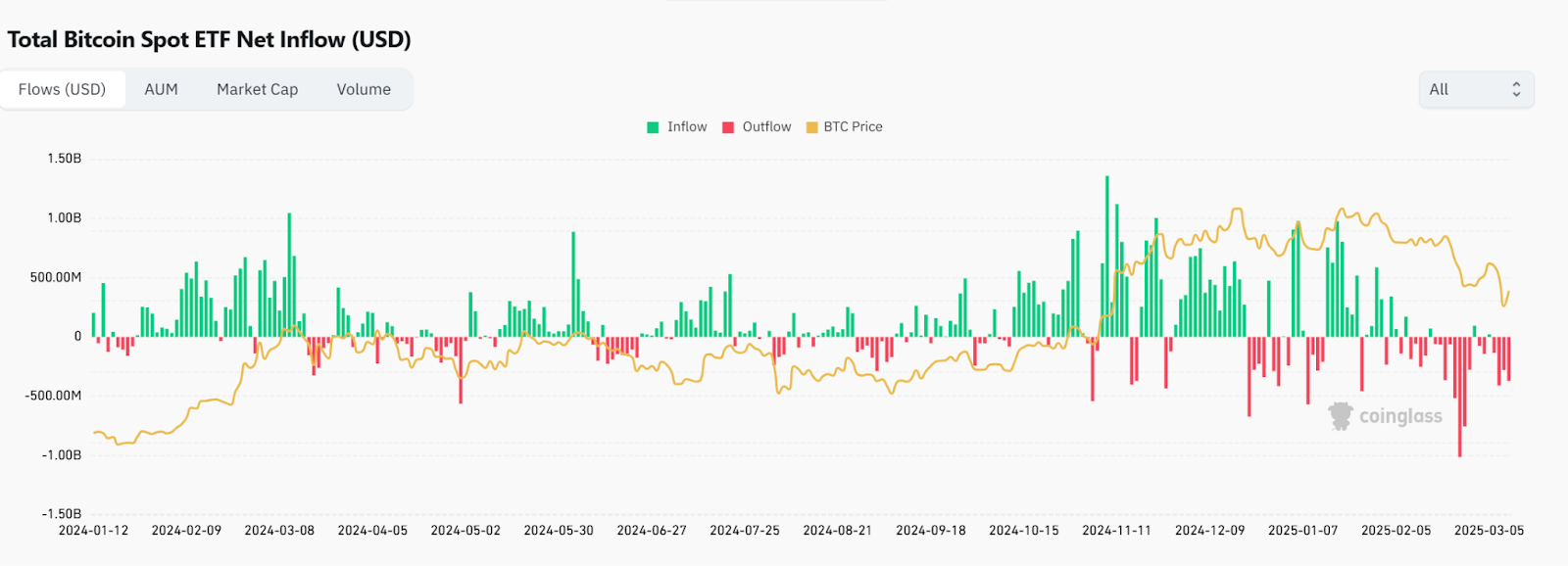
Source: https://www.coinglass.com/bitcoin-etf
Bitcoin ETF Approval Timeline:
-
Early Attempts (from 2013): The crypto industry first pushed for a Bitcoin ETF in 2013, with the Winklevoss Bitcoin Trust submitting the initial application. However, the SEC repeatedly denied it due to concerns over market manipulation and insufficient regulation. While Bitcoin futures ETFs were approved in October 2021, spot ETFs remained blocked. The situation began changing in 2023–2024, when several major asset managers filed new applications, drawing intense market attention.
-
Key Progress (2023–2024): In 2023, growing interest followed filings from firms like BlackRock. In December 2023, the SEC approved 19b-4 filings (exchange rule changes) from multiple institutions—a critical step toward spot Bitcoin ETF approval.
-
Final Approval (January 2024): On January 10, 2024, the SEC officially cleared S-1 registration statements for 11 spot Bitcoin ETFs, which began trading on Nasdaq, NYSE, and other traditional exchanges the next day.
The 11 currently approved spot Bitcoin ETFs include:
- BlackRock iShares Bitcoin Trust (IBIT)
- Grayscale Bitcoin Trust (GBTC)
- Fidelity Wise Origin Bitcoin Fund (FBTC)
- ARK 21Shares Bitcoin ETF (ARKB)
- Bitwise Bitcoin ETF (BITB)
- Invesco Galaxy Bitcoin ETF (BTCO)
- Valkyrie Bitcoin Fund (BRRR)
- Franklin Bitcoin ETF (EZBC)
- WisdomTree Bitcoin Fund (BTCW)
- VanEck Bitcoin Trust (HODL)
- Hashdex Bitcoin ETF (DEFI)
As of March 11, 2025, the total net asset value of these 11 Bitcoin spot ETFs stands at approximately $100 billion, down slightly from a peak of $125.7 billion on January 31. The top three are: IBIT (BlackRock) with $46.3 billion, FBTC (Fidelity) with $16.2 billion, and GBTC (Grayscale) with $15.8 billion.
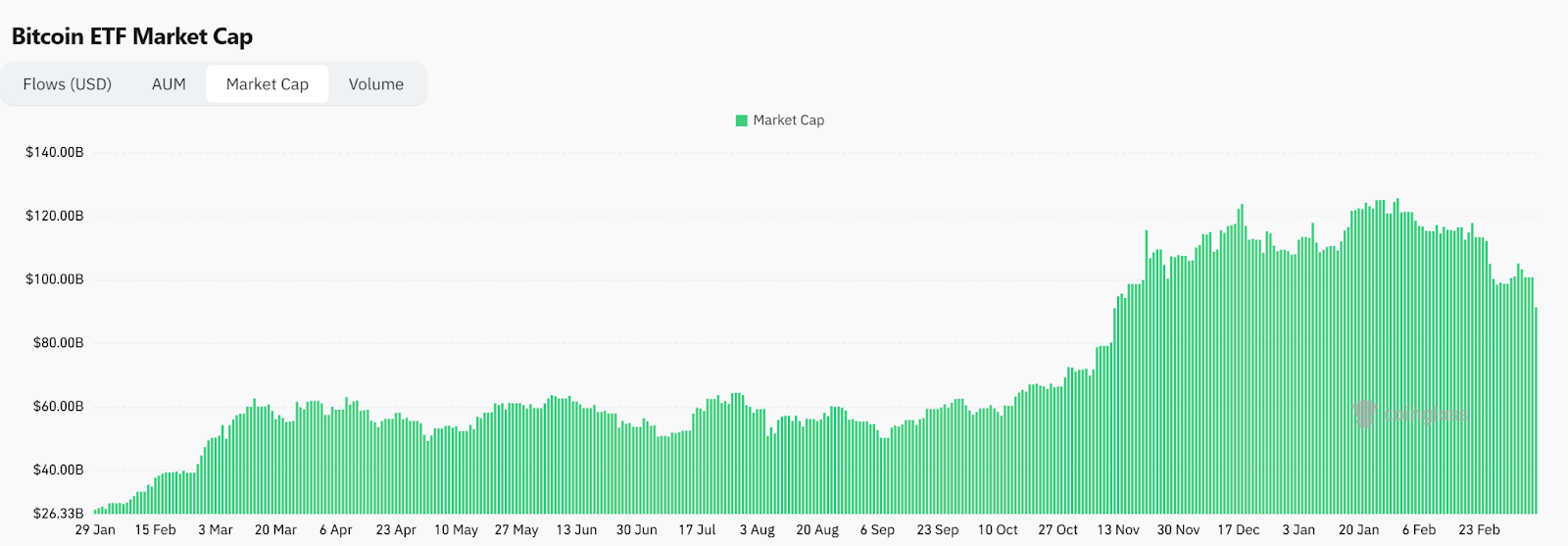
Source: https://www.coinglass.com/bitcoin-etf
2. Ethereum ETF
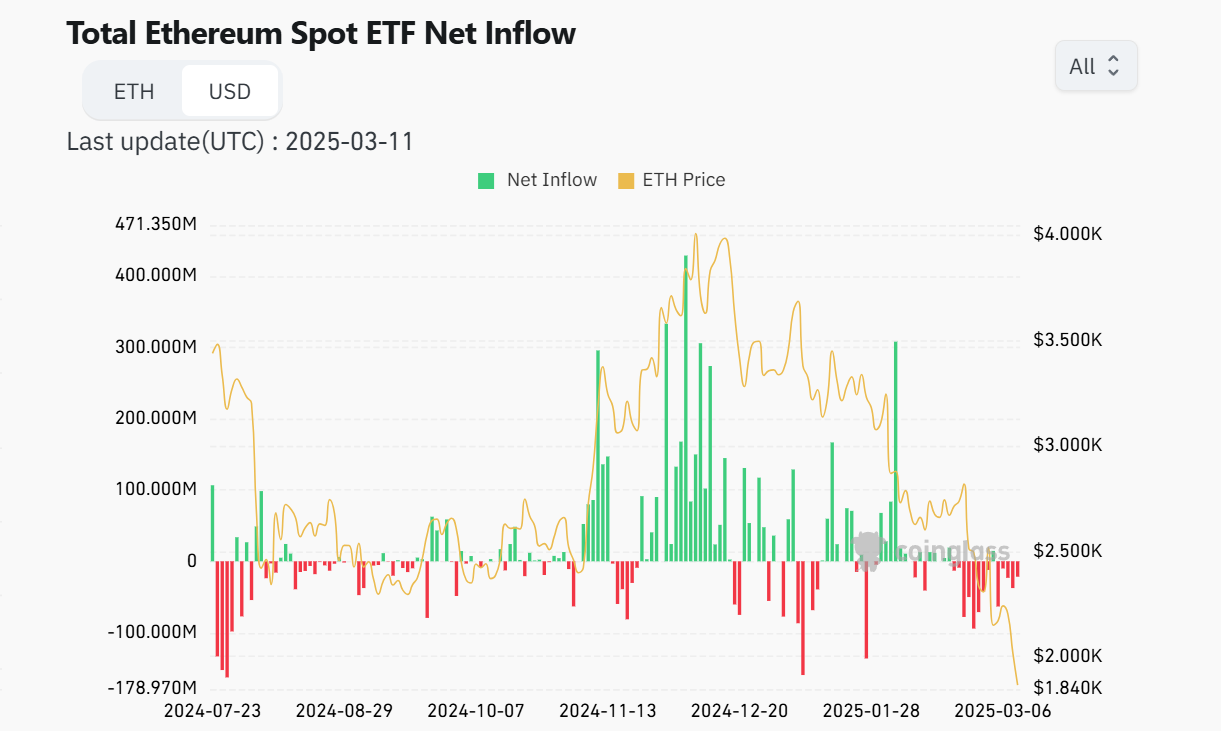
Source: https://www.coinglass.com/eth-etf
Ethereum ETF Approval Timeline:
-
Initial Filings (from 2023): Following progress on Bitcoin ETFs, multiple firms submitted applications for spot Ethereum ETFs, leveraging the established regulatory framework.
-
Key Milestone (May 2024): On May 23, 2024, the SEC approved 19b-4 filings from several exchanges, allowing them to list spot Ethereum ETFs.
-
Final Approval (July 2024): On July 23, 2024, the SEC approved the S-1 registration statements, formally permitting spot Ethereum ETFs to launch. The process from 19b-4 to S-1 took about two months—slightly longer than for Bitcoin—possibly due to complexities surrounding Ethereum, such as staking-related regulatory questions.
-
Trading Launch: The first batch of spot Ethereum ETFs went live on major U.S. exchanges by the end of July 2024.
The nine spot Ethereum ETFs approved by the SEC are:
- Grayscale Ethereum Trust (ETHE)
- BlackRock iShares Ethereum Trust (ETHA)
- Fidelity Ethereum Fund (FETH)
- 21Shares Core Ethereum ETF (CETH)
- VanEck Ethereum ETF (ETHV)
- Bitwise Ethereum ETF (ETHW)
- Invesco Galaxy Ethereum ETF (QETH)
- Franklin Ethereum ETF (EZET)
- WisdomTree Ethereum Fund (ETHF)
Ethereum ETFs remain significantly smaller in scale compared to Bitcoin ETFs. As of March 11, 2025, the total assets under management for Ethereum ETFs amount to roughly $6 billion, led by Grayscale’s ETHE (~$2.5 billion) and BlackRock’s ETHA (~$2.4 billion).
4. Potential Analysis of Popular Cryptocurrencies for ETF Approval
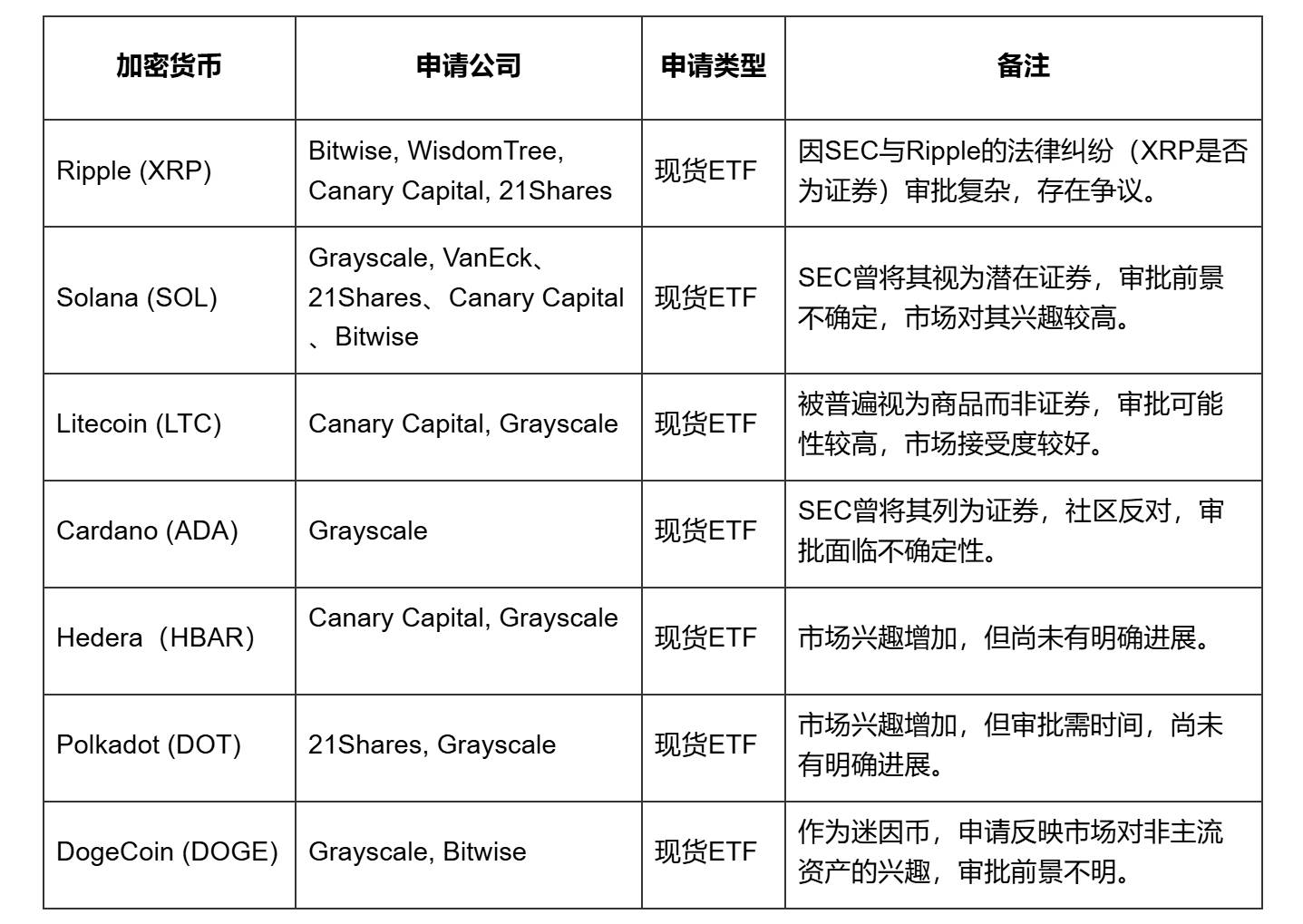
Following the successful approval of spot Bitcoin and Ethereum ETFs, demand for ETFs on other cryptocurrencies has surged. As of March 11, 2025, multiple digital assets beyond BTC and ETH have filed ETF applications with the SEC, including Ripple (XRP), Solana (SOL), Litecoin (LTC), Cardano (ADA), Hedera (HBAR), Polkadot (DOT), and Dogecoin (DOGE).
Below is an overview of current ETF applicants and key details:
1. Ripple (XRP)
XRP ETF applications have been filed by Bitwise, WisdomTree, Canary Capital, and 21Shares, with the first submission in October 2024. Ripple operates RippleNet, a network enabling banks and financial institutions to conduct fast, low-cost cross-border payments, with XRP serving as a liquidity bridge. Major entities such as American Express, SBI, and Siam Commercial Bank have tested or integrated XRP into their payment systems. However, ongoing legal disputes between Ripple and the SEC over whether XRP qualifies as a security could delay approval. In July 2023, a court partially ruled against the SEC’s claims, but the matter remains unresolved. Internal SEC analysts have indicated that approving an XRP ETF before the case concludes is unlikely.
2. Solana (SOL)
SOL ETF applications have been submitted by VanEck, 21Shares, Canary Capital, Bitwise, and Grayscale. Due to its market cap and ecosystem influence, Solana is widely considered one of the most promising candidates for an ETF after Bitcoin and Ethereum. The recent meme coin frenzy on Solana has drawn massive attention, but also raised concerns about scams, rug pulls, and bot exploitation, casting doubt on its sustainability. The SEC previously included SOL in a list of tokens suspected of being securities. Until the SEC clarifies its stance or clear legislation emerges, SOL ETF approval remains uncertain.
3. Litecoin (LTC)
LTC ETF applications have been filed by Canary Capital and Grayscale. Widely viewed as a commodity rather than a security, Litecoin has favorable approval prospects. Created in 2011 by former Google engineer Charlie Lee, Litecoin is a clear offshoot of Bitcoin with strong commodity characteristics. Dubbed “digital silver,” it is seen as a natural successor to BTC and ETH ETFs. Bloomberg estimates a 90% chance of approval, with a potential listing as early as mid-July 2025.
4. Cardano (ADA)
Grayscale filed an ADA ETF application in February 2025, which the SEC has now officially accepted. Led by former Ethereum co-founder Charles Hoskinson, Cardano is a third-generation blockchain platform emphasizing academic research and security, upgrading features through peer-reviewed studies. However, the SEC has previously classified ADA as a security. Additionally, Cardano has faced criticism for slow development, earning the nickname “ghost chain.” According to DefiLlama, as of March 12, Cardano’s DeFi ecosystem has only $340 million in total value locked (TVL), ranking 18th globally.
5. Hedera (HBAR)
On March 12, Cointelegraph reported that the SEC has officially accepted Grayscale’s spot ETF application for Hedera (HBAR). Built on a directed acyclic graph (DAG) architecture, Hedera claims high throughput and low latency. Governed by a council of major corporations—including Boeing, Google, and IBM—Hedera combines enterprise-grade use cases with decentralized governance. Notably, HBAR has not been designated a security by the SEC. Analysts suggest that following BTC and ETH ETFs, Litecoin and Hedera could be next in line for ETF approval.
6. Polkadot (DOT)
21Shares and Grayscale filed DOT ETF applications in February 2025. Interest in Polkadot is rising, though no clear progress has been made yet. Founded by Ethereum co-founder Gavin Wood, Polkadot is a cross-chain platform designed to solve interoperability issues among blockchains, often described as the “internet of blockchains.” DOT was initially distributed via an ICO, placing it in a gray area regarding securities classification. However, the SEC did not include DOT in its 2023 enforcement actions, suggesting it may not be a current priority.
7. Dogecoin (DOGE)
Grayscale and Bitwise filed DOGE ETF applications in early 2025, and the SEC has formally accepted them—an encouraging sign that reflects a more open attitude toward altcoin ETFs. As a leading meme coin, DOGE boasts a highly active social media community known for organizing charitable initiatives, contributing to its positive public image. Elon Musk’s repeated endorsements since 2020 have further boosted its visibility and price. However, critics argue that DOGE lacks utility and sustained development, making it overly speculative.
5. Outlook: Which Cryptocurrencies Are Most Likely to Get ETF Approval?
Near-Term Outlook (2025–2026)
2025 is being hailed as the “Year Zero” for altcoin ETFs. With Bitcoin and Ethereum ETFs successfully launched, regulators are now assessing other crypto assets. Litecoin (LTC), with its strong commodity profile and low regulatory risk, is widely expected to be the first non-BTC/ETH ETF approved, potentially within 2025. Close contenders include Hedera (HBAR) and Solana (SOL). HBAR benefits from lacking a security designation and strong corporate backing, giving it high approval odds. Despite past regulatory scrutiny, Solana’s vibrant ecosystem and strong market demand make it a top candidate, with approval probability estimated around 70%. Dogecoin (DOGE) cannot be overlooked—even as a grassroots project, it has entered the race under new regulatory thinking, with some analysts assigning a 75% chance of approval. However, DOGE’s fate hinges on the SEC’s tolerance for extreme price volatility. For XRP, if Ripple wins its lawsuit or reaches a settlement in 2025, the SEC might swiftly approve one or more XRP ETFs in response to evolving legal and market conditions. Projects like Cardano (ADA) and Polkadot (DOT), burdened by past ICOs and securities debates, may rank lower in near-term approval queues.
Optimistically, by the end of 2025, we could see 2–3 new crypto asset ETFs enter the market—likely combinations of LTC, SOL, XRP, or HBAR—opening a compliant gateway for diversified crypto investing.
Long-Term Outlook (2027 and Beyond)
Looking further ahead (2027+), crypto ETFs are poised for broad expansion, with far-reaching implications for global finance.
1. More second-tier cryptocurrencies may qualify for ETF status. Beyond those discussed, projects with substantial ecosystems—such as Polygon, Avalanche, and Cosmos—could join the ETF universe if they demonstrate compliance and market maturity. As regulatory frameworks mature, agencies like the SEC will develop clearer classifications distinguishing “commodities” from “security tokens,” removing legal hurdles for wider ETF adoption. By 2027, most of the top 20 cryptocurrencies by market cap could have corresponding ETF products.
2. Innovative ETF strategies may emerge in crypto. Active management ETFs (where fund managers dynamically adjust holdings), yield-bearing ETFs (holding stakable assets and distributing rewards), and derivatives-based ETFs (using futures and options to hedge or amplify exposure) could all appear. Their launch depends on the maturity of crypto derivatives markets and regulatory green lights. Concepts like Ethereum staking yield ETFs or Bitcoin options-enhanced income ETFs are already under discussion. If approved, they would diversify how investors earn returns from crypto, marking the arrival of sophisticated crypto asset management.
3. Global market integration will deepen. Crypto ETFs won’t be limited to the U.S.—if Europe, Asia, and other regions follow suit, U.S.-approved ETFs could be listed overseas and vice versa. Compliant ETFs from major financial centers will increasingly shape price discovery, potentially influencing spot market pricing power. Over time, as trading volume shifts toward regulated channels like ETFs, the crypto spot market’s historical disorder and susceptibility to manipulation may ease, leading to lower volatility and more efficient, credible price formation.
4. From an investor perspective, crypto assets will become a standard part of portfolio allocation. As diverse crypto ETFs emerge, financial advisors and institutional investors will find it easier to include digital assets for purposes such as inflation hedging, capturing tech growth, or improving Sharpe ratios. It will become commonplace for retail investors to indirectly hold crypto ETFs through pensions or wealth management products. This blurring of lines between crypto and traditional finance means crypto market movements may increasingly correlate with macroeconomic trends and traditional financial markets.
6. Conclusion
As more institutions file for crypto ETFs, Wall Street’s interest continues to grow, signaling increasing mainstream acceptance of digital assets. At the same time, the U.S. Securities and Exchange Commission (SEC) has shifted its stance—from initial caution and rejection, to gradual openness starting in 2024, to Trump’s promise of pro-crypto policies during a potential second term. These developments suggest that crypto ETFs may be on the verge of a breakout, ushering the crypto market into a new phase of growth.
For retail investors, crypto ETFs are a double-edged sword. On one hand, they lower the barrier to entry and simplify participation, allowing even non-technical investors to access this emerging asset class with reduced operational risks. Through ETFs, investors no longer need to worry about losing private keys or exchange hacks—holding crypto becomes as simple as owning a stock. This facilitates portfolio diversification and enables participation in blockchain innovation. On the other hand, crypto markets remain highly volatile and subject to policy uncertainty. ETF prices will still mirror market swings, so investors must do their homework and fully understand the risks involved.
In summary, the evolution of crypto ETFs will profoundly reshape the investment landscape. At this pivotal moment, we are witnessing regulatory transformation and the successful launch of pioneering products. Looking ahead, a richer array of crypto ETFs will continue to emerge, bringing digital assets deeper into the global financial system.
About Us
Hotcoin Research, the core research hub of the Hotcoin ecosystem, is dedicated to providing professional, in-depth analysis and forward-looking insights for global crypto investors. We offer a “triple-pillar” service model combining trend analysis, value discovery, and real-time tracking. Through deep dives into industry trends, multidimensional evaluation of promising projects, and round-the-clock market monitoring—alongside our weekly strategy livestreams “Top Coin Selection” and daily news digest “Blockchain Headlines”—we deliver precise market insights and actionable strategies for investors at all levels. Leveraging cutting-edge data models and an extensive industry network, we empower beginners to build foundational knowledge and help institutional clients capture alpha, together seizing value-growth opportunities in the Web3 era.
Risk Disclaimer
The cryptocurrency market is highly volatile and inherently risky. We strongly advise investors to fully understand these risks and invest only within a rigorous risk management framework to protect capital.
Website: https://lite.hotcoingex.cc/r/Hotcoinresearch
Mail: [email protected]
Join TechFlow official community to stay tuned
Telegram:https://t.me/TechFlowDaily
X (Twitter):https://x.com/TechFlowPost
X (Twitter) EN:https://x.com/BlockFlow_News
 @HotcoinAcademy






