








Exploring the Mechanism Advantages and 5 Drawbacks of the DeFi Platform Infinex
TechFlow Selected TechFlow Selected
Exploring the Mechanism Advantages and 5 Drawbacks of the DeFi Platform Infinex
Infinex, as a portfolio management platform, aims to achieve the security and usability of CEXs and on-chain wallets.
 Navigating Web3 tides with focused insights
Author: c4lvin, Analyst at ChainLight
Translation: Felix, PANews
Most people may have first heard of Infinex through Kaito Connect voting. It has been nearly a month since the Infinex dashboard was added to Kaito AI, yet there still hasn't been much research coverage on Infinex. This article aims to analyze Infinex's architecture and its project vision.
What is Infinex?
Infinex is a wallet (or portfolio management) platform designed to deliver superior user experience (UX), focusing on seamless cross-chain operations across various computing environments—though the number of supported chains remains limited for now. For EVM chains, it supports Ethereum, Arbitrum, Optimism, Polygon, Unichain, Base, Blast, and Berachain. For non-EVM chains, only Solana is currently supported.
Infinex can be roughly divided into two parts: Wallet and Vault. The Wallet is often referred to as a "Burner Wallet." (Note: A Burner Wallet is typically used to hold just enough cryptocurrency for one or a few interactions—a temporary holding place for liquidity.) In contrast, the Vault functions more like a standard wallet where funds can be passively stored without requiring actions such as swapping.
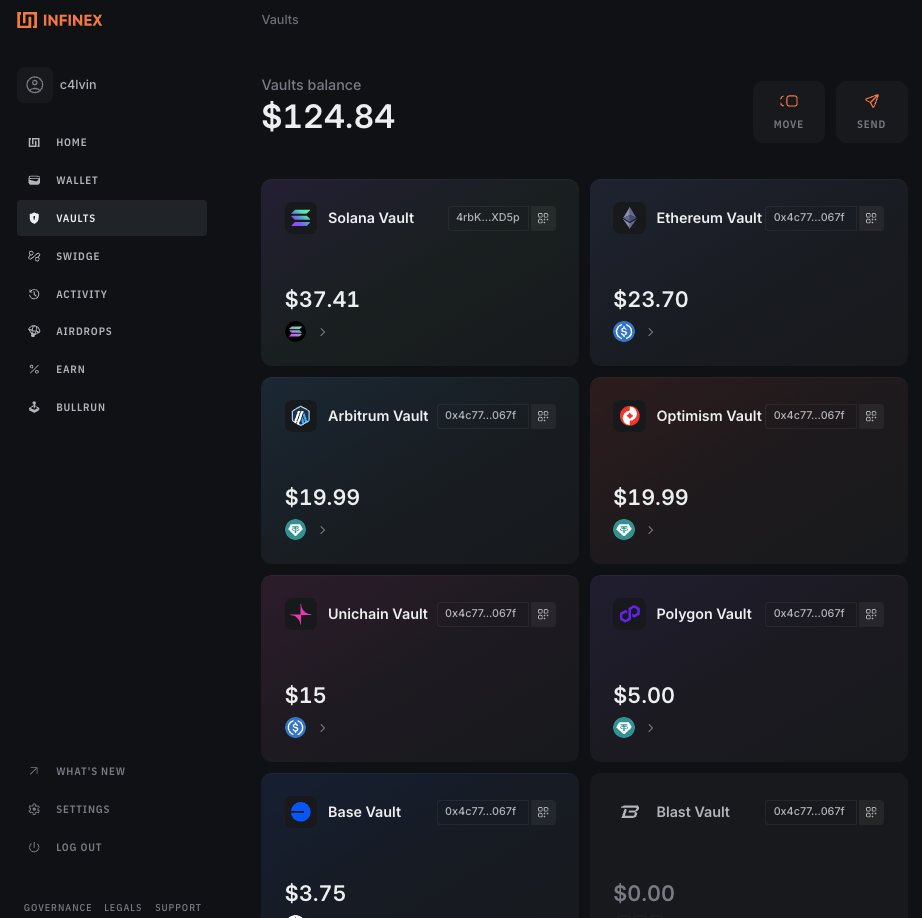
Infinex is implemented as a web application optimized for PC environments. As seen in the left-side menu of the screenshot, beyond basic wallet features such as Wallet, Vault, and activity tracking (e.g., transactions), it also includes Swidge (multi-chain swap), exclusive airdrops for Infinex users, and an Earn feature to check deposit points or interest.
Why Choose Infinex?
If we consider Infinex purely from a wallet perspective, it's difficult to identify standout features compared to other wallets. Multi-chain wallets like Phantom and OKX Wallet are already highly functional for both EVM and non-EVM chains, offering built-in airdrop checkers, Earn trackers, and multi-chain swap capabilities. Even centralized exchanges (CEXs) like Binance and Bybit offer these functionalities plus additional benefits such as dedicated Earn programs. So what actual advantages does using Infinex provide?
Security
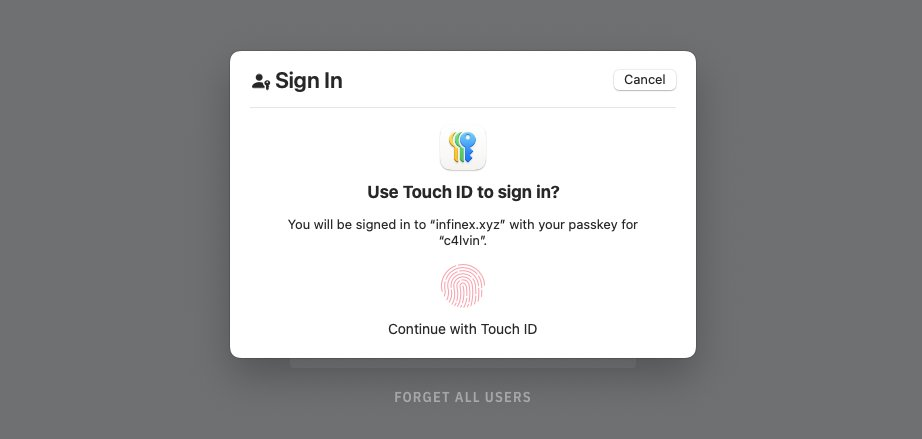
For users relying on CEXs as their liquidity hub, fund theft due to SIM-swapping attacks or email hacking is not uncommon. Similarly, with on-chain non-custodial wallets, many have been compromised due to leaked mnemonics or private keys. Infinex appears to have invested significant effort into its architecture to mitigate these risks. By restricting login access to device-bound keys, it elevates wallet security to the same level as user biometric data and physical device protection. As shown in the screenshot below, attempting to log in on a Mac triggers a Touch ID request. Most importantly, it supports 2FA via authenticator apps, making it significantly harder for attackers to gain control.
In addition, Vaults can be recovered via smart accounts.
Since Vaults are implemented using custom smart accounts, they can be recovered through pre-registered on-chain addresses and email verification. Each Vault is initially deployed on Base and Solana. For example:
https://basescan.org/address/0x4c77dD4e616FaDF448a8D3F22D5FeC81402A067f
https://solscan.io/account/4rbKc2pMpQeFw1QupJ8f7VRJda9WkFmRsqFmBC8DXD5p
For other chains, the Vault will be deployed onto the requested chain when a transaction or recovery is needed. Regarding recovery, it won’t appear directly on the dashboard, but the team provides a link with an interface to perform this action, or users can initiate recovery directly on-chain upon request. From the user’s standpoint, this offers better security compared to both CEXs and other non-custodial wallets.
No Transaction Fees
Some might not be aware that using built-in Swap/Bridge functions in on-chain wallets usually incurs high fees. For instance, MetaMask charges 0.875%, Phantom charges 0.85%, and Rabby charges 0.25% on its integrated Swap/Bridge features. In contrast, Infinex does not charge any fees for Swap/Bridge operations, making it as appealing as depositing funds into a CEX or using a CEX-backed wallet.

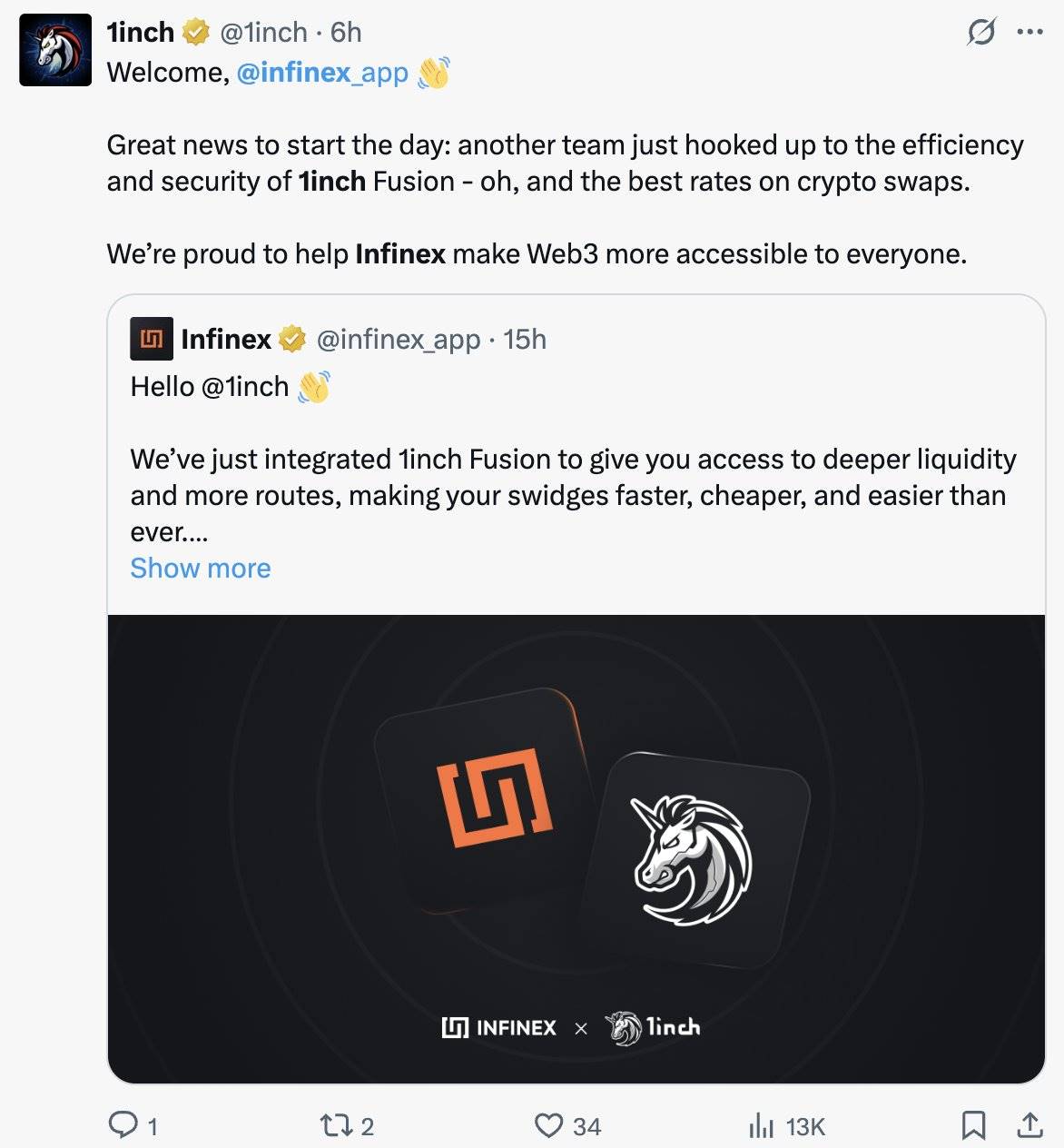
Infinex seems to position its Swidge (Swap + Bridge) functionality as a key highlight. To this end, it recently integrated 1inch Fusion as an aggregator, signaling its commitment to delivering the best possible Swidge experience.
Passive Airdrops for Users
Receiving airdrops might be one of the most compelling reasons to use Infinex. Recently, Infinex distributed $PENGU tokens to all users, and given its active ecosystem integrations, more passive airdrops are highly likely in the future.

Notably, Infinex’s vision is to achieve—and even replace—the user experience offered by CEXs. As shown in the tweet below, the Infinex team consistently compares its platform’s UX with that of CEXs, emphasizing its competitive advantages.

Beyond simple deposits, why do users keep funds in CEXs? Primarily because CEXs offer Earn programs like Launchpool and Launchpad—deposit stablecoins or specific tokens to earn newly listed ones. This could be considered a core use case for CEXs.
Given that Infinex claims to offer advantages “superior” to CEXs, it may introduce similar or even better airdrop or Earn programs. This is something worth monitoring long-term, and it would be ideal if the official team could share more information on this front.
Suggestions for Improvement
After brief usage of Infinex, several areas for improvement stand out:
Support More Chains
The number of supported chains remains very limited. Especially given the increasing frequency of new L1 launches, rapid integration with various L1s and non-EVM chains beyond EVM L2s seems necessary. Supporting DeFi-focused chains like Sui and Mantle could help accelerate user growth. Additionally, support for Bitcoin and Ordinals should also be added.
Whitelist Address Support
The Wallet/Vault includes a "Move" function, which enables asset transfers between Wallet and Vault. However, whitelisted transfers should also be supported in the "send" function—not only for Wallet ↔ Vault interactions but also for transfers to other known wallets owned by the user.
Swidge User Experience
Currently, Swidge only supports swaps between addresses within the user’s own wallet and does not allow specifying a recipient address. The ability to designate a recipient address during cross-chain transactions is a powerful feature; its absence creates inconvenience when moving funds from Wallet to Vault.
Lack of Incentives
As mentioned above, Infinex may soon launch attractive Earn programs, but currently, incentive offerings do not fully match its usability. While the team is investing heavily in user acquisition, it is hoped that Infinex will quickly establish a more compelling environment for users.
Limited Usability
Infinex still lacks the full versatility required to completely replace on-chain wallets. For example, it cannot be used with external web services via WalletConnect API, limiting its practicality. A proposal addressing this issue was submitted in June 2024, but due to certain unresolved issues, it remains unimplemented.

Conclusion
Infinex is a new comprehensive portfolio management platform aiming to combine the security of on-chain wallets with the usability of CEXs. Although still in its early stages—with some shortcomings in community building and user experience—it remains a promising project worth watching.
Join TechFlow official community to stay tuned
Telegram:https://t.me/TechFlowDaily
X (Twitter):https://x.com/TechFlowPost
X (Twitter) EN:https://x.com/BlockFlow_News
 @SiwonHuh






