Trading surpasses $1 trillion, with $400 million in daily clearing volume—Hyperliquid becomes a giant whale "casino" on-chain
TechFlow Selected TechFlow Selected
Trading surpasses $1 trillion, with $400 million in daily clearing volume—Hyperliquid becomes a giant whale "casino" on-chain
Hyperliquid, a decentralized exchange established less than two years ago, is eroding centralized exchanges' derivatives markets with a series of disruptive data points.
 Navigating Web3 tides with focused insights
Author: Frank, PANews
Trillion-dollar trading volume, 60% market share in perpetual contracts, $400 million in daily on-chain liquidations—Hyperliquid, a decentralized exchange launched less than two years ago, is eroding the futures markets of centralized exchanges with a series of disruptive metrics.
Whales are staging 50x leverage "life-or-death bets" here, institutional capital is aggressively placing orders thanks to low fees, while retail traders remain hesitant due to limited token offerings. While Binance and Coinbase still dominate industry discourse, Hyperliquid has carved out a new battlefield for DEXs through an ultra-efficient yet risk-laden model. However, the platform's slow Dutch auction listing mechanism and its governance token HYPE's halving struggles add uncertainty to this disruption.
Breaking the Trillion-Dollar Barrier: Hyperliquid Emerges as the "Dark Horse" in Derivatives
After its 2024 airdrop ignited market interest, Hyperliquid’s derivatives trading volume surged exponentially, completely breaking the industry curse of “post-airdrop decline.” Amid recent extreme market volatility, Hyperliquid has firmly established itself among the top-tier exchanges.
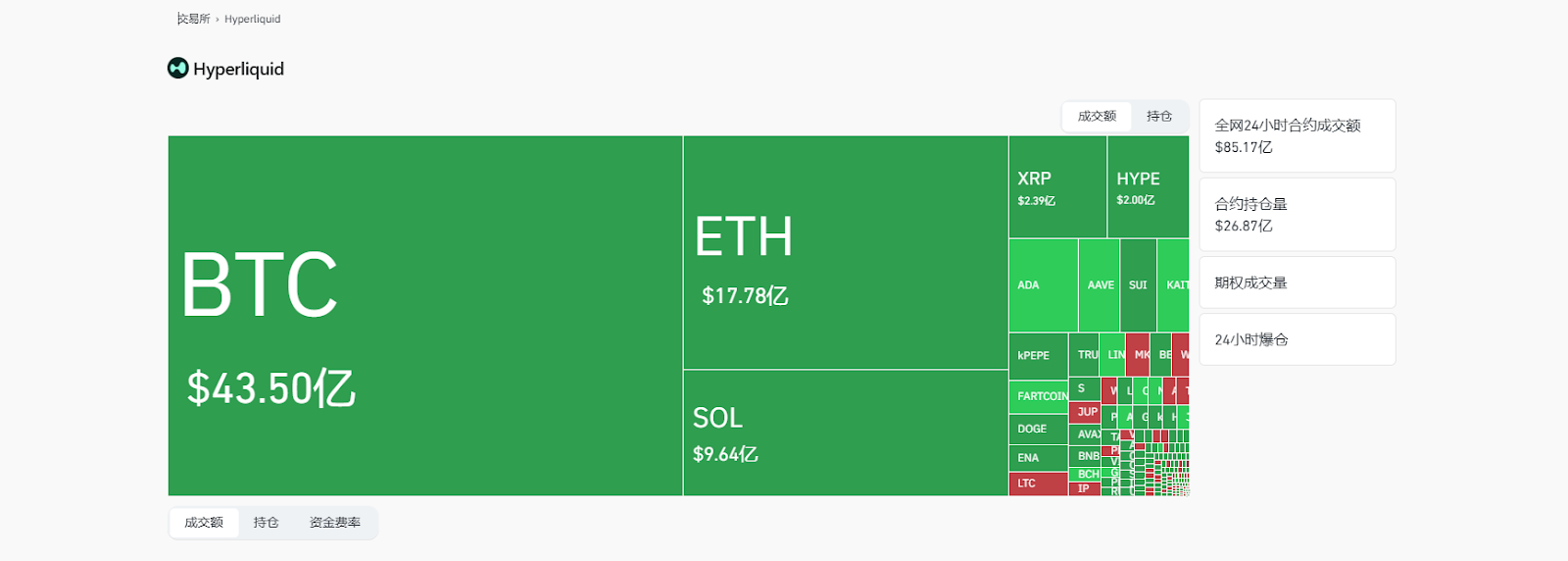
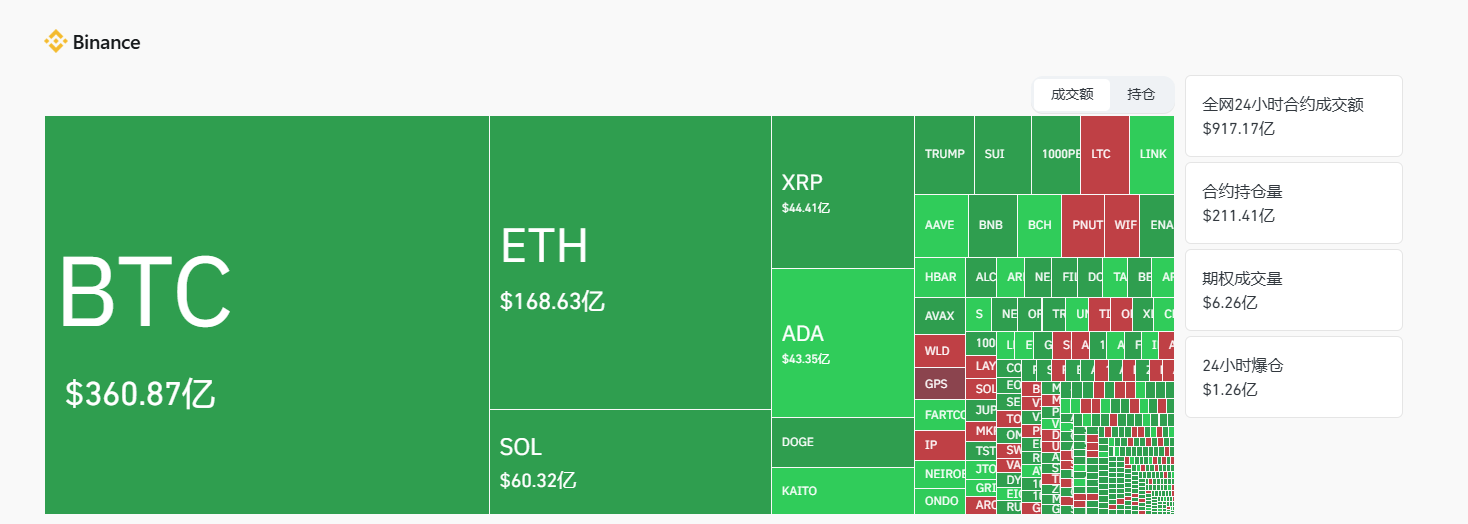
On March 5, data showed that Hyperliquid’s cumulative trading volume surpassed $1 trillion for the first time. According to Coinglass, Hyperliquid’s daily derivatives trading volume reached approximately $8.5 billion, ranking sixth among all exchanges—just behind five centralized platforms: Binance, OKX, Bitget, Bybit, and Gate.io. Binance’s derivatives volume stood at around $91.7 billion, a significant gap, but Hyperliquid appears to have become a force Binance can no longer ignore.
According to Hypurrscan, Hyperliquid’s annualized fee revenue has reached $746 million. In comparison, Coinbase’s total trading revenue for 2024 was $4 billion.
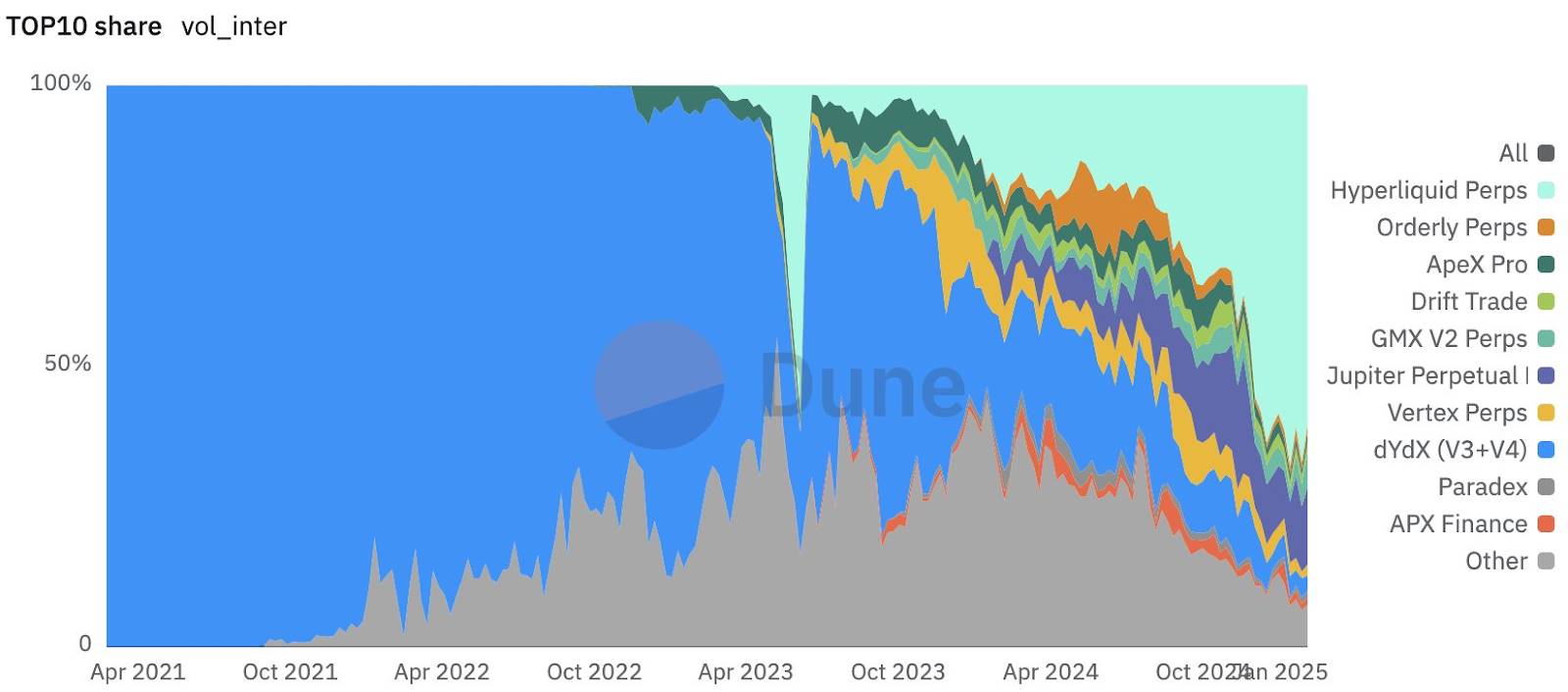
Among decentralized exchanges, Hyperliquid has become dominant in the perpetual contract market. According to analyst WarDaddyCapital on February 8, Hyperliquid’s market share in perpetual contracts reached 60.5%. This compares to just 33.2% on November 1, 2024, and less than 2% in March 2023—an unprecedented growth rate in the DEX space.
Trump Trades Fuel the Whales’ New Casino
Hyperliquid’s rise has been driven by institutions and high-net-worth traders. Recently, frequent whale activity has sparked widespread discussion, positioning Hyperliquid as a public arena for large-scale live trades—including both reckless gambles and sophisticated smart-money plays.
On March 2, before Trump announced plans to include BTC, ETH, SOL, ADA, and XRP into a crypto strategic reserve, a whale deployed $6 million at 50x leverage to go long on ETH and BTC, opening ETH at $2,197 with a liquidation price of approximately $2,149. ETH briefly dipped to $2,171 shortly after, narrowly avoiding liquidation. Fortunately, within minutes, positive sentiment from the Trump news triggered a sharp rally, ultimately netting the trader over $6.8 million in profits that day. Some on social media speculated this might have been an insider close to Trump. However, Coinbase executive Conor Grogan later debunked this claim, revealing the funds originated from phishing activities—the user was linked to Roobet, a crypto gambling site. This high-risk move thus turned out to be merely a gambler’s thrill-seeking play.
Beyond such extreme speculation, some whales have drawn attention for long-term profitable positions. According to on-chain analyst @ai_9684xtpa, a whale opened a 50x leveraged short position on Ethereum in January at $3,169, reaching a peak unrealized profit of over $78 million. As of March 5, the position remained open, still up $69 million. This user has since become Hyperliquid’s most profitable trader. Social media reports suggest the address belongs to Resolv, a new stablecoin protocol, possibly representing a hedge fund position.
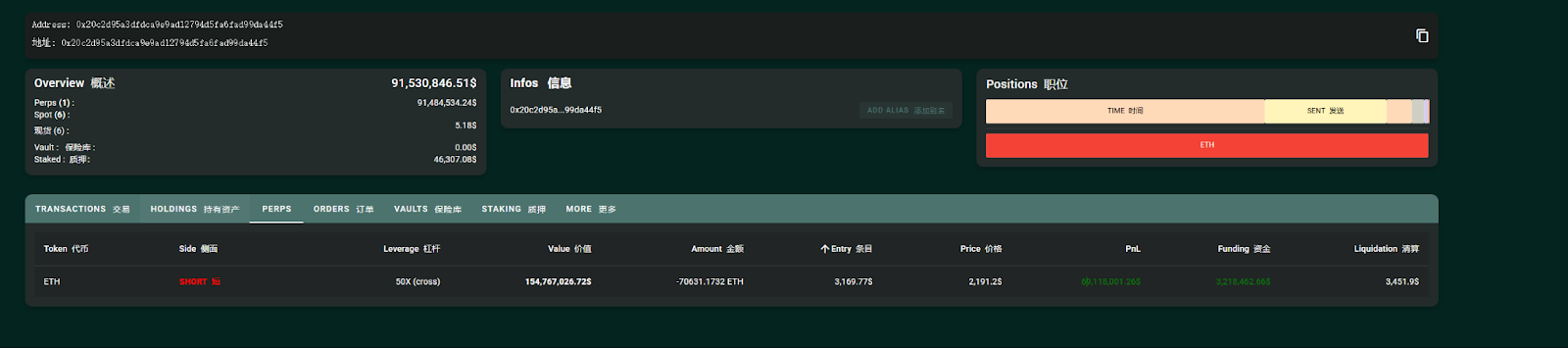
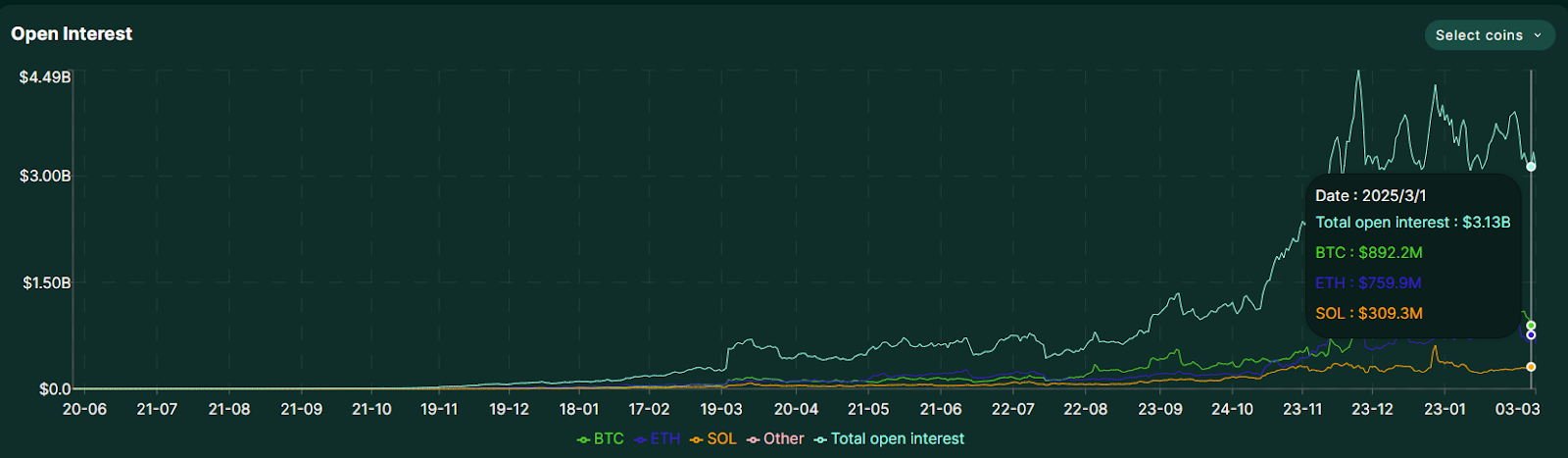
Additionally, headlines about whales spending millions to build positions on Hyperliquid have become commonplace. Data shows that the average user contributes roughly $2.56 million in trading volume, underscoring the platform’s unique user composition. Amid recent market turbulence, whale participation has intensified, with Hyperliquid’s open interest consistently exceeding $3 billion since December 2024.
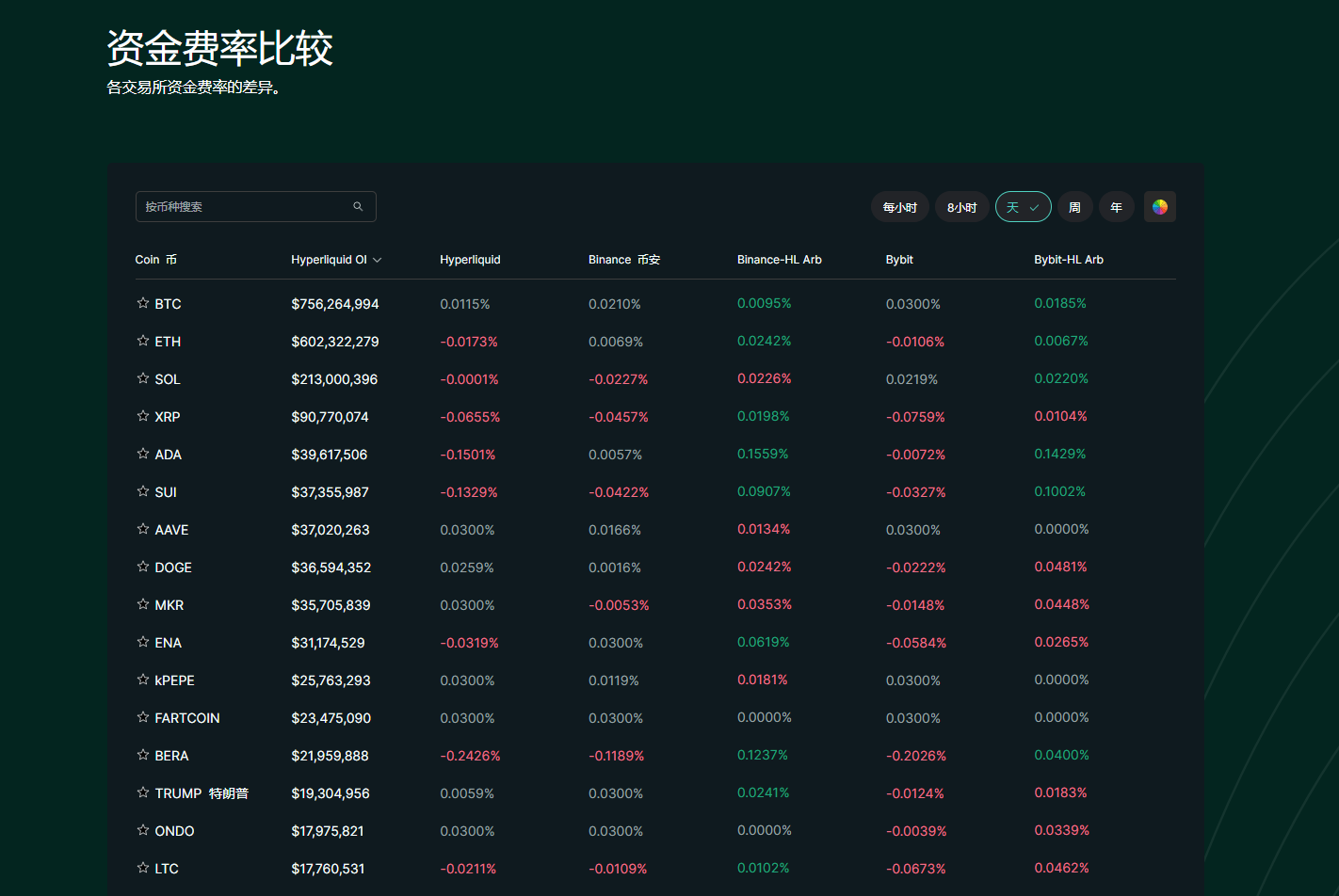
This trend is closely tied to Hyperliquid’s low-fee strategy. On March 5, funding rates for major tokens like BTC, ETH, and SOL were significantly lower in absolute value compared to Binance and Bybit—a critical factor for large-volume traders. Transaction fees on Hyperliquid are also generally lower than those on most mainstream exchanges. Moreover, the transparency and fairness of on-chain contracts make it an attractive choice for many big players.
With increasing whale activity, Hyperliquid has also become the largest on-chain liquidation venue. Since late February, its daily liquidation amount has consistently exceeded $400 million. Exchanges like Binance and OKX do not disclose full liquidation data to Coinglass, making direct comparisons difficult. On March 6, Bybit—which does report full data—recorded only $80.61 million in 24-hour contract liquidations, far below Hyperliquid.
The Dutch Auction Dilemma: Ecosystem Narrowness and Retail Apathy
While whale trading brings substantial visibility to Hyperliquid, attracting retail users requires different strategies—such as listing more new tokens or creating wealth-making stories. As of March 5, Hyperliquid had only 390,000 cumulative users and offered just 82 spot trading pairs, far fewer than other major exchanges. Limited tradable assets appear to be the main barrier preventing broader retail adoption.
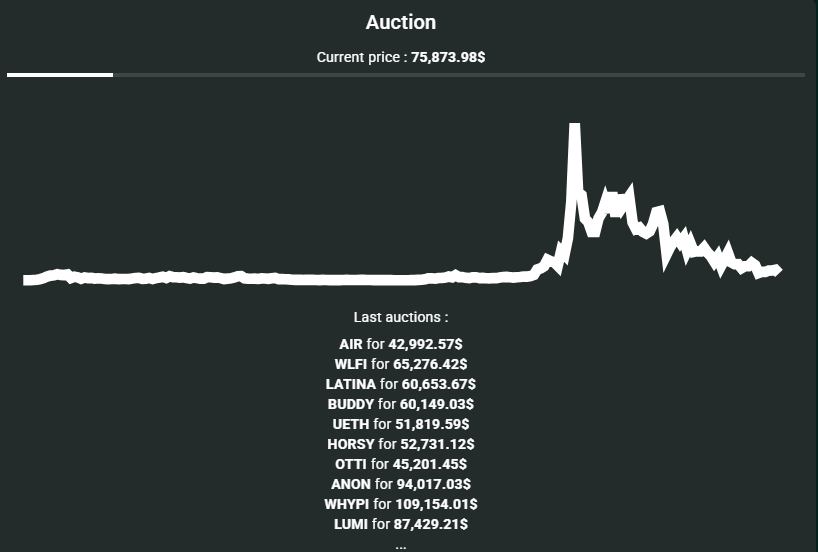
As a decentralized exchange, Hyperliquid’s token listing mechanism differs significantly from others. It uses a Dutch auction model, which greatly reduces listing costs for projects and could theoretically attract more promising ones. However, it also has notable drawbacks: well-known projects lack incentives to initiate auctions, resulting in few available spot trading pairs.
Moreover, each auction lasts 31 hours, allowing a maximum of 282 listings per year. Time-sensitive tokens often struggle to enter the market quickly via this method.
Hyperliquid attempted to expand its on-chain token variety by launching HFUN, a product similar to Pump.fun, but results have been minimal—the highest-valued token reached only $245,000 in market cap.
Within this relatively thin token ecosystem, Hyperliquid’s own governance token HYPE stands out as the sole standout offering. On March 5, HYPE’s trading volume was approximately $320 million, accounting for about 3.7% of the platform’s total volume. However, HYPE’s price has continued to hit new lows amid broader market weakness, dropping as low as $15.30 on March 4, with a market cap of $5.59 billion—down roughly 56.5% from its peak.
Additionally, Hyperliquid faces criticism regarding decentralized governance. Critics frequently label it a “single-player mode” operation. This critique stems partly from HYPE being listed exclusively on its own exchange, and partly because, despite being a blockchain, it still employs a permissioned validator access model, undermining its “public” nature. However, on March 5, the Hyperliquid Foundation announced that following the next network upgrade, validators will be able to join the mainnet without permission—a direct response to the centralization criticism.
Overall, Hyperliquid has secured a strong foothold in the whale-dominated derivatives market. Yet, expanding retail user growth remains a significant challenge. Perhaps with increased network decentralization, new proposals for listing process reforms, and operational innovation, this emerging exchange can push further ahead.
Join TechFlow official community to stay tuned
Telegram:https://t.me/TechFlowDaily
X (Twitter):https://x.com/TechFlowPost
X (Twitter) EN:https://x.com/BlockFlow_News
 PANews