








Using encryption technology in Myanmar
TechFlow Selected TechFlow Selected
Using encryption technology in Myanmar
Similar to the development of the internet, Myanmar has skipped the credit and debit card phase, moving directly from cash to mobile payments.
 Navigating Web3 tides with focused insights
Text: 7k
Editor: Fangting
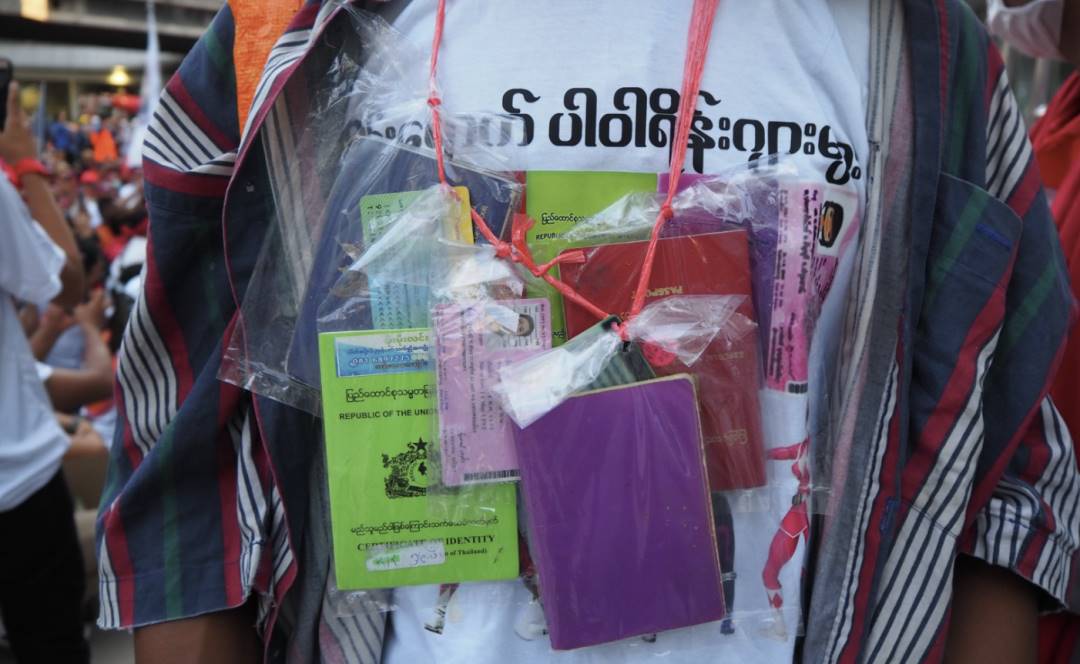
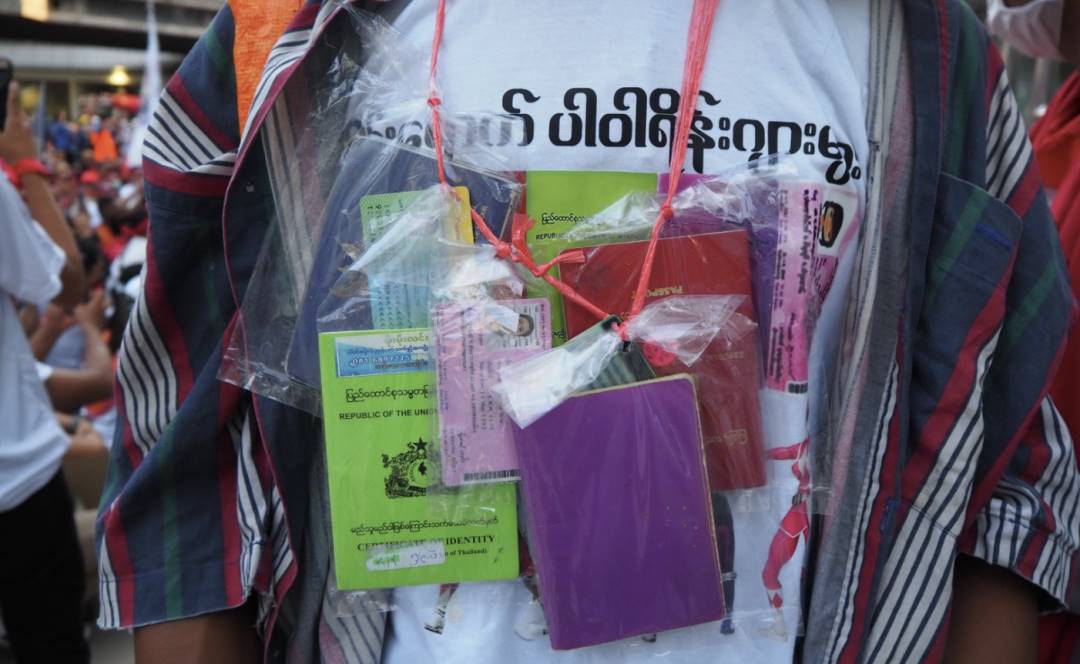
A woman from Myanmar carries a set of identity documents to ensure her safe and legal residence in Thailand.
Image source: Visual Rebellion, cited by Exile Hub
Introduction
I met Htway, a tech consultant from Myanmar, during the pop-up city event in Chiang Mai. Often dressed in a polo shirt tucked into jeans, he looked like a young STEM student moving between book clubs, workshops, and Demo Days. During discussions or Q&A sessions, he would raise his hand and say: "I'm from Myanmar. Due to the civil war, many of my compatriots are facing severe hardships. I wonder if these technologies could help..." The room would usually fall silent.
Since the 2021 military coup, news about Myanmar has been rare on Chinese social media, with scam centers being the only widely reported topic. Although the disappearance and rescue of actor Wang Xing in Myawaddy earlier this year briefly drew public attention back to Myanmar, overall awareness remains extremely limited. This prompted me to get to know Htway. After one event, I saw him talking with another Myanmar national, Kha. I learned they were long-time friends who had completely lost contact after the coup but unexpectedly reunited at this gathering.
Kha works in crypto. In November 2024, Ethereum's developer conference Devcon took place in Bangkok, bringing together blockchain practitioners from around the world in Southeast Asia for the first time. Many attendees, including Ethereum founder Vitalik Buterin, spent the month before Devcon living and working together in Chiang Mai as digital nomads—this was the pop-up city initiative. Htway was drawn in by these events despite having no prior experience with cryptocurrency or digital currencies. He used to work at a tech consultancy and startup incubator in Yangon until the 2021 military coup forced him to relocate to Chiang Mai. Kha, however, traveled specifically to attend Devcon while still based inside Myanmar. Because the junta declared cryptocurrencies illegal, crossing borders is unsafe for him. Still, he tries to leave Myanmar once a year to maintain connections with the outside world. Together with many others like them, they hope to find practical applications of crypto technology amid worsening conditions back home.
While in Chiang Mai, I wrote a short piece introducing the situation and needs of these Myanmar individuals. Then I met more people who are using technology to alleviate humanitarian crises caused by inflation and internet surveillance, exploring possibilities for decentralized international aid and refugee identification, all while facing numerous real-world challenges. So I wanted to write another story about Myanmar—not focused on crime, armies, or war (though everything connects back to them)—but centered on ordinary people striving to make a difference in their homeland.
It All Began With the Military Coup
At 3 a.m. on February 1, 2021, Bradley was awakened by a call from a friend: "Look up in the sky!" Standing confused at his window, it took him several seconds to realize this was the coded warning that the coup had begun. That day, Myanmar's military announced the overthrow of the country’s first democratically elected government since independence—the National League for Democracy (NLD), led by Aung San Suu Kyi. A new military regime was formed, declaring a state of emergency nationwide. The coup erased nearly a decade of progress in openness and development, escalating humanitarian crises and economic decline, plunging the nation into chaos that continues today.
On the day of the coup, Bradley saw people rushing to buy rice, ATMs failing due to severed network lines, and phone signals quickly going dark. In the following days, protesters faced armed crackdowns by military and police forces. Within weeks, violence against civilians intensified—journalists wearing vests became direct targets, private homes were raided, and by March 22, at least 2,682 people had been confirmed arrested and 261 killed by soldiers. Protesters began arming themselves, resistance groups emerged across regions, and civil war began.
Bradley worked in internet literacy training and education, collaborating with parliament and government departments, so he had heard rumors of an impending coup before February. "No one believed it would actually happen—even people within the military didn’t believe it." Still, he and his colleagues agreed on secret codes and discussed contingency plans in case communications were cut off. In the early days of the coup, they met in the same park to share information: where protests were happening, whether anyone had been arrested, whether troops had opened fire. They didn't know then that this struggle against the junta's censorship policies would last four years.
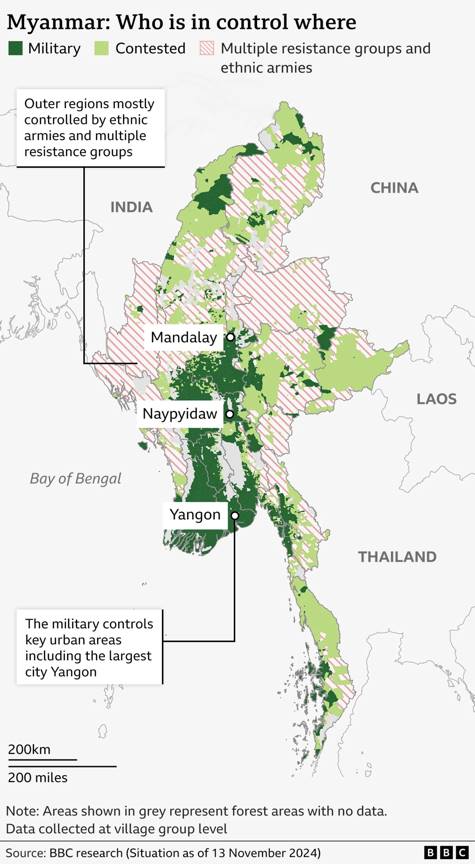
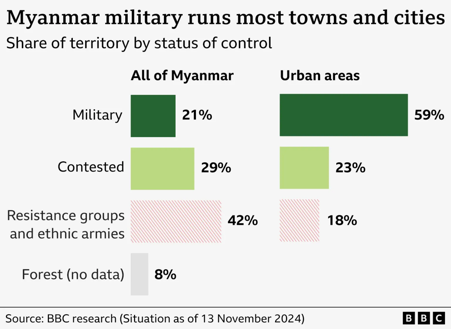
Control of territory in Myanmar (as of December 13, 2024)
Image source: BBC
According to reports from late last year, ethnic armed organizations (EAOs) and various resistance groups now control 42% of the country. The military still holds major cities, while the remaining areas remain contested, resulting in stalemates across regions. For ordinary people, even basic communication with family and friends is difficult—the military enforces its so-called "four-cut" policy in areas it doesn’t control, cutting off food, funding, information, and recruitment. Internet connectivity is highly unstable due to damaged infrastructure and deliberate signal jamming. Even in areas under military control, frequent power outages lasting half a day are common due to energy shortages caused by foreign companies withdrawing from energy and telecom sectors, forcing people to adjust daily schedules around electricity availability.
After a colleague was arrested, Bradley fled Myanmar. In relative safety, he decided to continue monitoring internet restrictions inside the country with his team, founding the Myanmar Internet Project. Bradley told me internet censorship extends beyond signal disruption—mainstream social media platforms have also become inaccessible since the coup. More dangerously, constant surveillance poses serious risks: posting anti-junta content online can lead to personal tracking and arrest. About six months ago, access to proxy services started being blocked, suggesting the regime may have adopted more advanced surveillance tools. Early this year, new laws imposed prison sentences of one to six months or fines for installing or providing such services, although the junta had already declared their use illegal back in 2021.
Another channel under surveillance and restriction is financial transactions: the military altered regulations and enforced mandatory KYC requirements, bringing mobile payment accounts (like KBZ Pay or Wave Money) under surveillance. Suspicious accounts are frozen without notice, and military raids often target account registration addresses within six months. There are documented cases of journalists, dissidents, and fundraising resistance groups falling victim to these measures. The depreciation of the kyat fuels rampant inflation: while the official exchange rate is artificially maintained at 2,100 kyats per dollar, black market rates soar to 5,000 kyats per dollar, and banks have long restricted withdrawal limits. Oil and gas revenues flow directly to the military rather than essential public services. Prices of necessities like medicine keep rising. Capital continues fleeing Myanmar, indirectly reflected in Myanmar nationals becoming the second-largest foreign buyers of condos in Thailand after Chinese nationals.
Mobile wallets and bank accounts must now be linked to new electronic IDs (e-ID) and SIM cards with mandatory registration. Under the Anti-Terrorism Law and Cybersecurity Law, authorities can investigate and control digital platforms and electronic data, intercept, block, and restrict mobile communications, and obtain location data—beyond SIM registration, these policy tools were gradually introduced and passed after the coup. Identity systems form a crucial link in the surveillance chain: some people unable to obtain or who’ve lost their government-issued ID—a flimsy, foldable paper card—cannot access communication or banking services, while others face danger due to race, occupation, or address details listed on their ID.
Bradley shared all this with me while we sat in a hallway during a Devcon side event. Behind us, speakers discussed entirely new societal models enabled by crypto: on-chain identities, on-chain wealth, on-chain sovereignty. The world seemed to be moving forward, while Myanmar sinks deeper into civil war, with the junta tightening control over civilians—an agonizing, ultimate FOMO (fear of missing out). "I feel spiritually we (Myanmar people and the global crypto community) resonate, but maybe not practically," Bradley laughed. "At least when I talk with friends here, our conversations always end with: 'We’re still dealing with blackouts back home.'"
The History of Myanmar's Internet
In narratives dominated by disaster, people may forget Myanmar in the previous decade: starting from democratic reforms in late 2010, internet blocks were lifted and telecom industries liberalized, transforming Myanmar from a country with lower mobile phone ownership than North Korea into one of the developing nations with the highest mobile internet and smartphone penetration. SIM card prices dropped from $2,000 to $1.50, smartphones could be bought for around $20. Norwegian company Telenor and Qatar-based Ooredoo became licensed telecom providers, breaking the monopoly of state-owned MPT (Myanmar Posts and Telecommunications). Thousands of cell towers rose from forests and remote rice fields. Within just six years, nearly everyone gained access to mobile internet. Since most people had little prior exposure, many equated Gmail with email and Facebook with the internet itself.
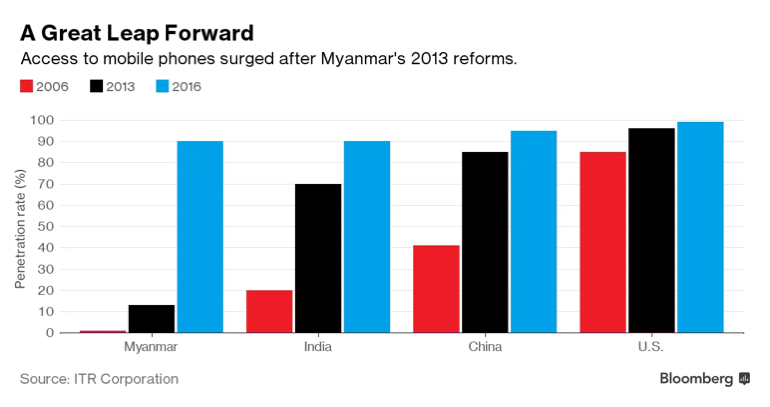
Mobile phone usage in Myanmar before and after telecom reform, nearly matching India, China, and the US
Image source: Bloomberg
At the time, Myanmar was widely seen as a fresh, opportunity-rich testing ground for the internet. It was then that Htway returned from abroad to work at an ICT startup center in Yangon. In a 2016 public speech, he expressed confidence in Myanmar’s internet future: "Hacking means solving problems innovatively... In this sense, Myanmar has always belonged to hackers." He said, "We need to become citizens empowered by technology. We remain divided by class, privilege, wealth, language, belief—but we're all hackers making things more useful." Many developers tried leveraging the internet to solve real problems arising from Myanmar’s rapid transformation.
Despite the vast opportunities brought by internet openness, struggles over digital rights persisted between citizens and governments. In 2019, the NLD government implemented widespread internet shutdowns in Rakhine State to combat ethnic armed groups—an action widely reported as the world’s longest-running internet blackout, affecting about 1.4 million people. During the pandemic, lack of connectivity hindered access to basic healthcare and emergency information. Bradley and colleagues filed appeals and protests; when confronting officials, one simply replied: "They still have 2G." More dishearteningly, many did not support their efforts—"A friend told me those in Rakhine are terrorists, 'trouble-making people,'" he recalled.
The coup halted Myanmar’s internet progress: amid strong opposition, Telenor and Ooredoo sold their Myanmar subsidiaries in 2021 to companies potentially linked to military officials, exposing massive user data to surveillance. The remaining operators, MPT and Mytel, fell under junta control. Resistance forces destroyed telecom towers to disrupt military communications and revenue, while the military escalated its own internet blocking and surveillance. By July last year, Myanmar had experienced 291 separate internet shutdowns, with 80 out of 330 townships completely cut off from the outside world.
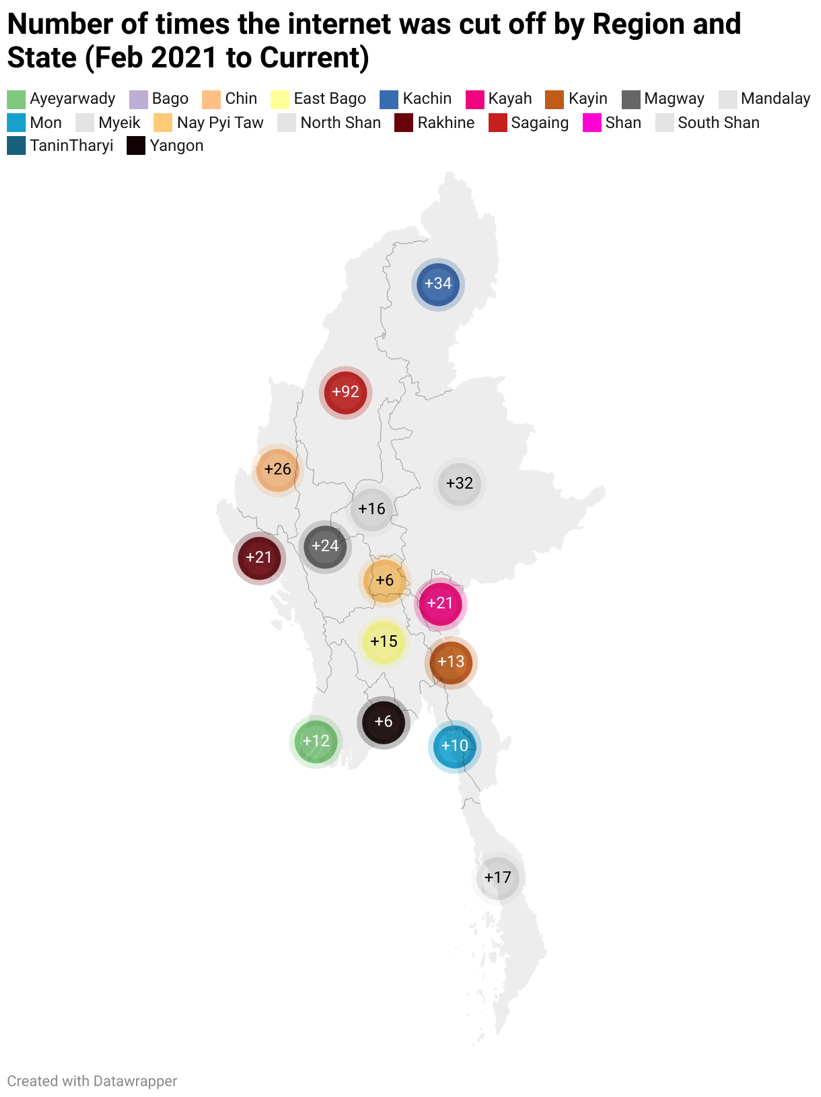
Statistics on internet shutdowns in Myanmar after the coup
Image source: Myanmar Internet Project
Despite infrastructure damage and military blockades, people persist in maintaining basic internet access. Some local ISPs refuse to comply with military shutdown orders due to financial losses. Additionally, Starlink-enabled cybercafés (using Elon Musk’s SpaceX satellite internet system) provide basic connectivity for many, priced at roughly 500–1,000 kyats ($0.10–$0.20) per hour. The Myanmar Internet Project estimates over 3,000 active Starlink antennas nationwide, used not only by civilians but also rebels and scam operators. Insiders say a tweet from David Eubank—an aid worker active along Myanmar’s border thanking Elon Musk—helped spread awareness of Starlink. However, since Myanmar isn’t on Starlink’s authorized country list, SpaceX could potentially cut roaming access, as previously done in countries like South Africa and Cameroon.
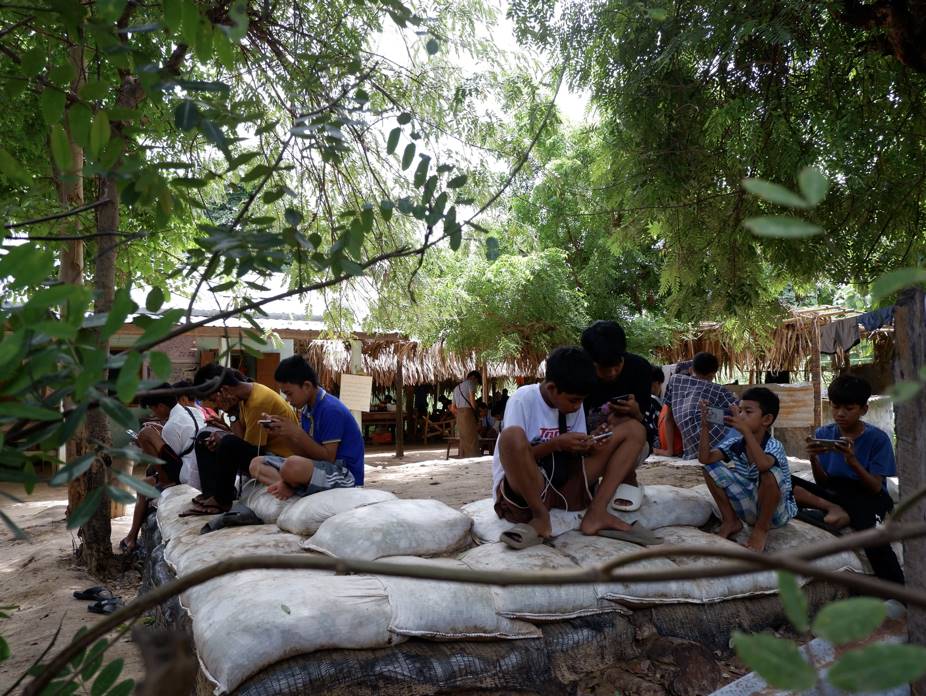
A Starlink café in Sagaing Region equipped with bomb shelters
Image source: Nyein Chan May, Myanmar Internet Project
Living in Exile
"Once, while reporting in Myanmar, a bomb landed just 100 meters away from me," Mar, a Myanmar photojournalist, told me. "But no media wants photos of airstrikes anymore—they’re too common." Many independent journalists fled abroad to escape targeted repression by the military, yet frequently return to report. Mar sends his stories and images via Starlink cafés. When we spoke, he had just recovered from malaria contracted in the jungle. Their impactful work—from warfronts to scam hubs—earned consecutive awards at the World Press Photo Contest in 2022 and 2023. Yet their lived reality reflects the broader plight of exiled Myanmar citizens.
Shortly after the coup, the junta began revoking media licenses, arresting journalists, and raiding newsrooms. Since the coup, seven reporters and media workers have been executed, at least 150 arrested or imprisoned, and amendments to Section 505(a) criminalize spreading “false or fear-inducing” information. In Reporters Without Borders’ 2024 World Press Freedom Index, Myanmar ranks among the ten most dangerous countries for journalists. These conditions drove mass exile to neighboring countries. Mar typically alternates between Myanmar and Thailand every three months due to regular immigration check-ins.
A few with resources pay $12,000–$13,000 for two-year student visas or obtain tourist visas elsewhere. Lay, a university dropout, fled to Laos to avoid forced conscription by the military in March 2024 and, with help from a Myanmar agent, secured a Thai tourist visa. He now works as a waiter earning $300 monthly. "That agent used to be a doctor, but now makes good money processing visas," Lay told me.
For most Myanmar journalists arriving in Thailand, only two options exist: register as refugees, surrendering passports and relocating eventually to countries like the U.S. or Australia; or pay unreasonable fees for temporary work permits (pink cards). Due to needing local employer sponsorship, some journalists end up as waiters or manual laborers. "We have a veteran reporter with 15 years of experience now working as a welder," said Kyi from Exile Hub. Exile Hub is an NGO dedicated to supporting exiled journalists and activists, having assisted 2,100 individuals with funding, short-term housing, training, and mental health counseling.
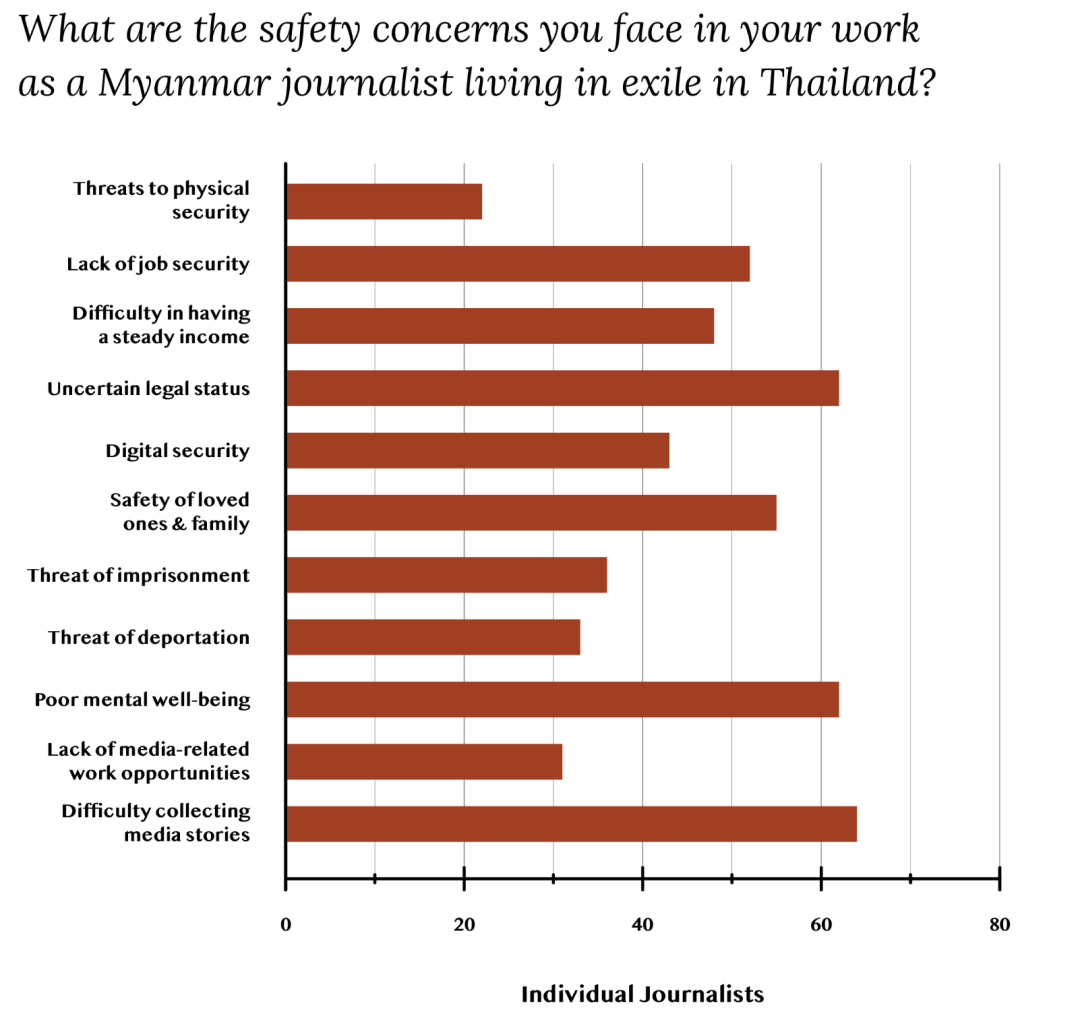
Survey: Security concerns among exiled journalists
Image source: Exile Hub
Exile Hub originated from the coup: Kyi, formerly a media producer in Myanmar, began with her peers sourcing and distributing safety helmets, press vests, and foreign SIM cards with data roaming. After police opened fire on demonstrators and specifically targeted journalists for attack and arrest, she shifted focus to safety and first-aid training. As increasing numbers were forced to flee Myanmar, they began raising funds to cover flight tickets, quarantine hotels, and temporary accommodation during the pandemic.
In the months following the coup, before the junta’s customs, immigration, and local police databases were synchronized, some journalists took their chances leaving through airports. "But anyone over 30 needs to update their ID, and many journalists have their profession listed—that’s the end of them," Kyi said. "Many don’t have passports, and after the coup, couldn’t apply for them. Passports require renewal every five years, and if yours expires within six months, you can’t travel internationally," Htway added. Thus, most must cross borders on foot, risking arrest each time they return to Myanmar, leading to prolonged family separations. On top of this looms the constant threat of deportation.
Beyond ID-related hardships, another issue lies in money and its transfer channels. Multiple interviewees and reports indicate exiled Myanmar journalists in Thailand earn an average of $200 per month. Anti-money laundering policies also make it nearly impossible for Myanmar nationals to open Thai bank accounts. Independent media outlets and NGOs like Exile Hub rely on donations and international aid, but such funding often comes with strings attached, passes through lengthy bureaucratic processes, and rarely reaches individual journalists directly. Moreover, although many journalists willingly remain anonymous to protect themselves, aid programs require proof of journalistic work—creating an unsolvable paradox.
"I truly wish someone could develop tools tailored to Myanmar using zero-knowledge proofs (ZK), or end-to-end encrypted cryptocurrency systems—anything that would simplify my work. But right now I can’t convince donors to adopt these technologies because they aren’t operational yet," Kyi said. "Fundraising is hard now because globally, fewer people believe in the importance of journalism... People do journalism to ensure truthful, accurate information escapes Myanmar—they risk their lives and their families’ lives, not for profit. I don’t want their contributions to go uncompensated."
Transferring Money: The Hundi System and Cryptocurrency Use
With banking services unavailable and financial transfers tightly controlled, much of Myanmar’s monetary flow—including international aid—relies on the "Hundi" system. This term, lacking a Chinese translation, refers to an informal financial sector originating in 12th-century India—a trust- and relationship-based network for payments and remittances. "If I want to send money to my father, I find a Hundi in Chiang Mai, give them my dad’s details, and pray the money arrives," Htway said. "Usually, it does."
Hundi has long existed in Myanmar life; "everyone knows a Hundi" is a common sentiment among interviewees. A "typical" Hundi is often a seemingly wealthy middle-aged or elderly person of Indian descent running other businesses like restaurants, grocery stores, or shopping services. "But there are also many ethnic Burmese and Chinese-Heritages acting as Hundis, including young people advertising their services on Facebook—you can even borrow from them. They’re like banks... In fact, anyone with a foreign bank account can become a Hundi. And now they’re using cryptocurrency too," Ni, a Myanmar researcher specializing in financial consulting, told me.
Ni helps organizations and businesses transfer funds into Myanmar, so he knows many Hundis. "But the Hundi system is notorious for opacity and sometimes charges service fees as high as 8%... You have to negotiate with different people; competition among Hundis is fierce now," Ni shared. He recounted a well-known incident: traditional Hundis often refused to handle NGOs' extensive paperwork and terms, so a French Hundi took on many international organization transfers—and then disappeared while handling a large aid sum.
The junta constantly tries to regulate non-bank financial flows—acting as a Hundi (providing unauthorized financial services) or trading/buying/selling cryptocurrency is illegal. Meanwhile, the opposition National Unity Government (NUG) recognized Tether (USDT) as legal tender by late 2021. "The military keeps trying to control money flows, but they haven’t succeeded much," Ni said. Still, some people have had bank accounts frozen for buying crypto—"intelligence agents pose as P2P traders."
About nine months ago, Binance apps and websites were blocked by the junta—just like Facebook before, many ordinary users equate Binance with cryptocurrency itself. Similar to internet development, Myanmar skipped credit and debit cards entirely, jumping straight from cash to mobile payments. Mobile wallet market penetration reached an astonishing 80% in 2019. These factors lead people like Ni to believe cryptocurrency could gain wider adoption in Myanmar. "One of my regular tasks is urging sponsors to use crypto, training people to use this cheaper, more efficient, stable-cost payment method... My friends translate wallet software into Burmese."
In fact, Myanmar’s chaotic environment has already spurred many crypto-related projects: in 2022, the NUG launched a digital kyat (DMMK) and payment wallet NUG Pay based on Stellar. Coala Pay is another tool developed by a Myanmar team aiming to deliver international aid directly to local groups and facilitate daily transactions using stablecoins and simple interfaces. Unrelated to currency but notable, at last year’s Devcon, a project called the "Rohingya Project" received brief attention—it aims to verify and grant on-chain identities to Rohingya communities through social networks.
Sin, a crypto industry tech consultant, helps overseas companies pay salaries to their Myanmar employees via cryptocurrency. "These companies have no other channels, so they must use crypto," Sin said. "My clients typically earn around $400 monthly... With digital currency, they can save money toward eventually leaving Myanmar." He hopes not only to enable access to crypto but also encourage actual usage. Yet some still associate crypto with crime and scams. "Early in the coup, many desperate people bought crypto—I heard lots lost heavily on Luna," Htway said. Recent reports also show crypto is increasingly used in scam operations along Myanmar’s borders.
"Crypto offers many benefits, but who’s willing to act? Companies see insufficient profits, NUG’s projects aren’t practical, NGOs use crypto only minimally. They seem not to grasp crypto’s potential—it’s not just technical, but political and capital-related too—who has both the capability to drive adoption and the willingness to bear political risks?" Ni countered.
Conclusion
February 1, 2025 marks the fourth anniversary of Myanmar’s military coup. As usual, the junta extended its six-month state of emergency for the seventh time, pushing the election deadline to February 1 next year. "One possible ending is that people win the revolution, establish democracy, and we all live happily ever after," Kyi said. "But if that doesn’t happen—and it might not—we still need better, more democratic ways of organizing and operating."
Amid the wounds of civil war and oppressive junta policies, Myanmar people are naturally drawn to cryptographic technologies. Despite infrastructural barriers, Myanmar presents abundant use cases for crypto: missing financial services, hyperinflation, censorship resistance, identity or credential verification. Many already use end-to-end encrypted messaging apps and show strong enthusiasm for practical crypto applications, tempered by a pragmatic, clear-eyed, and cautious mindset born from the margins.
With exceptionally high digital penetration, digital technology fuels optimistic visions of the future for many Myanmar citizens, as Bradley put it: "How much worse could it get?" He recalled his friend who once opposed his activism: after the civil war began and ethnic armed groups—including those from Rakhine—became key anti-junta forces, that friend sought out Bradley to apologize for his past words. Ethnic divisions seemed to dissolve in the face of a common enemy. "We will become Asia’s Wakanda," Bradley said.
During our interview, Mar showed me recent photos taken in Myanmar. I saw a makeshift village built from wood deep in the jungle, where people huddle together nightly in bomb shelters carved from rock. "Everything there keeps getting worse. Those people have nothing," Mar said, swiping to another image showing him playing cyanotype (a simple, traditional photographic technique using sunlight) with a group of children. I remembered Bradley’s phrase "look up in the sky": over four years of civil war, people look to the skies for signs of coups, bombings, surveillance, signals, satellites, messages from loved ones, news, freedom—just as those children discover sunlight on fabric. Even when the sky appears empty, to their eyes it may hold an entirely different picture.
Join TechFlow official community to stay tuned
Telegram:https://t.me/TechFlowDaily
X (Twitter):https://x.com/TechFlowPost
X (Twitter) EN:https://x.com/BlockFlow_News
 @Un__commons









