
Messari Report Analysis: Memecoins Account for Over Half of Trading Volume—Can Solana's Growth Myth Continue?
TechFlow Selected TechFlow Selected
Messari Report Analysis: Memecoins Account for Over Half of Trading Volume—Can Solana's Growth Myth Continue?
If demand for Memecoins cannot be sustained, Solana's economy may face certain challenges.
 Navigating Web3 tides with focused insights
Author: MONK
Translation: TechFlow
(This article summarizes the key points from Messari's latest report.)
Recently, discussions have intensified about whether Memecoins have "died" and if this could put Solana in trouble. Next, I'll answer with data.

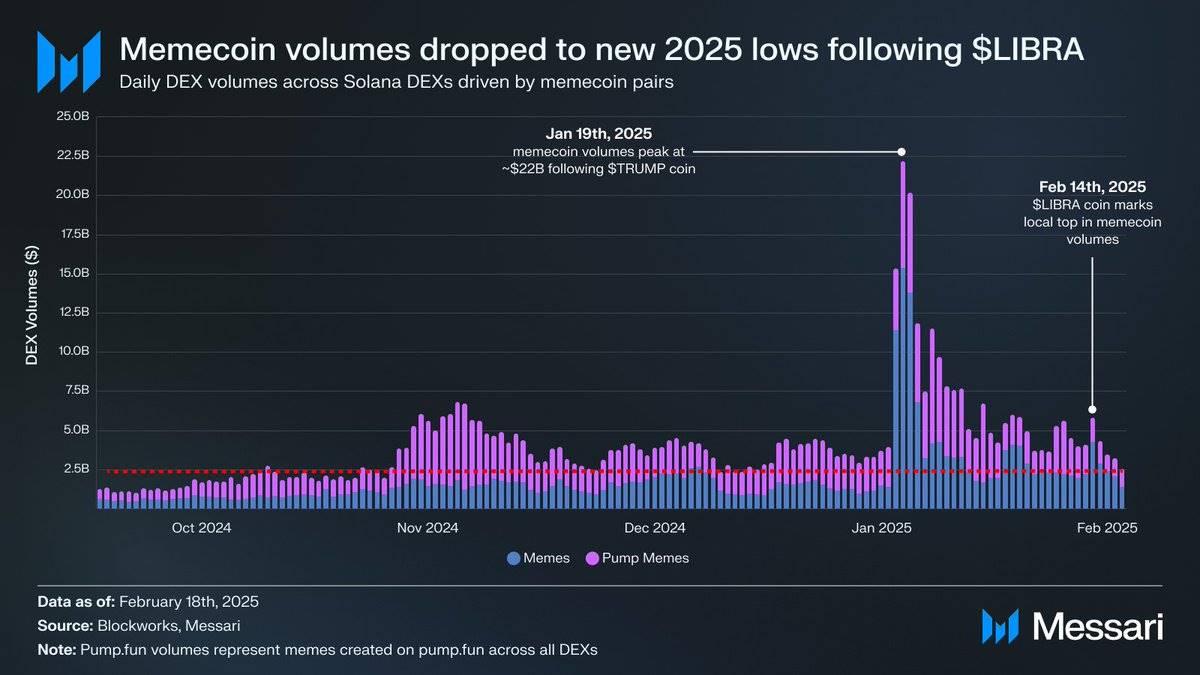
Since the $LIBRA incident, Memecoin trading volume on Solana has dropped to its lowest level of the year.
However, note that current trading volumes are still higher than at the beginning of 2024—this does not mean Memecoins have exited the stage.
What I really want to emphasize is how heavily Solana’s economy relies on support from Memecoins.
Solana's Economy Relies on Memecoins: Risks and Current State
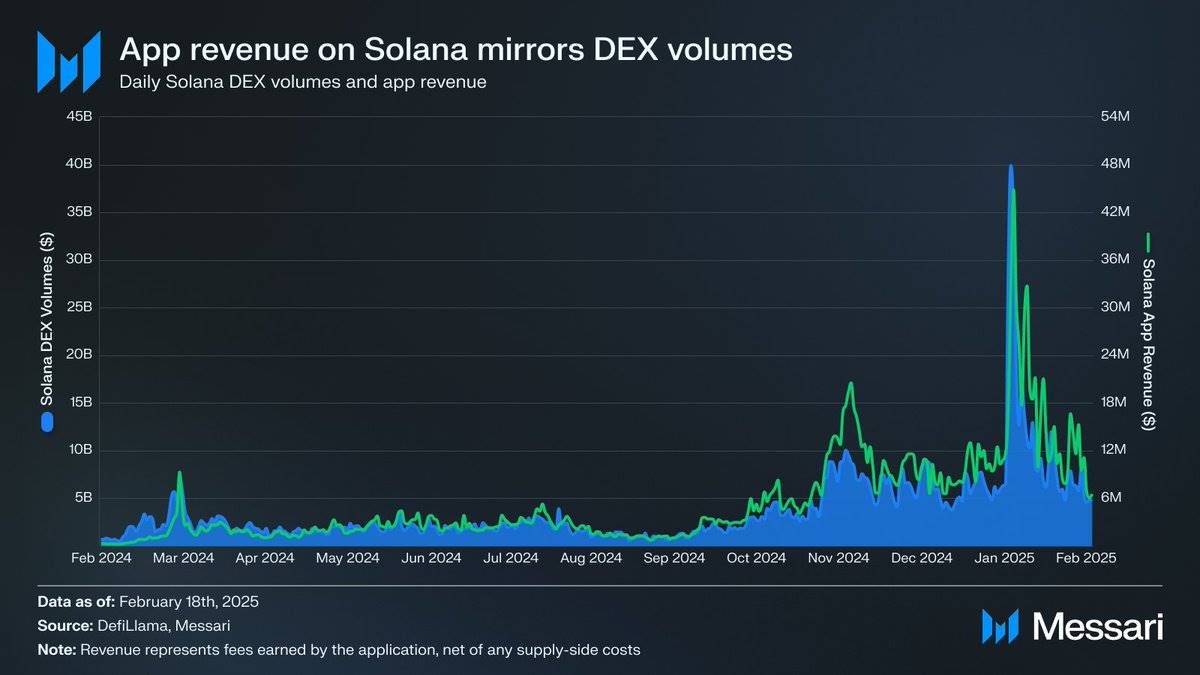
Solana’s economy is fundamentally driven by transaction volume.
If we look at leading applications ranked by revenue on Solana, we find these apps are almost all protocols facilitating trading activity in some way.
This pattern is confirmed by the strong correlation between daily DEX trading volume and application revenue.
This model isn't uncommon among high-throughput blockchains today. For example, Base’s economy also largely operates based on trading volume.
In contrast, Ethereum mainnet generates more revenue from TVL-driven applications such as lending and yield farming, primarily because transaction activity on the mainnet has significantly decreased.
However, it's important to consider what exactly drives these transaction volumes.
On Solana, a large portion of transaction activity stems from Memecoins.
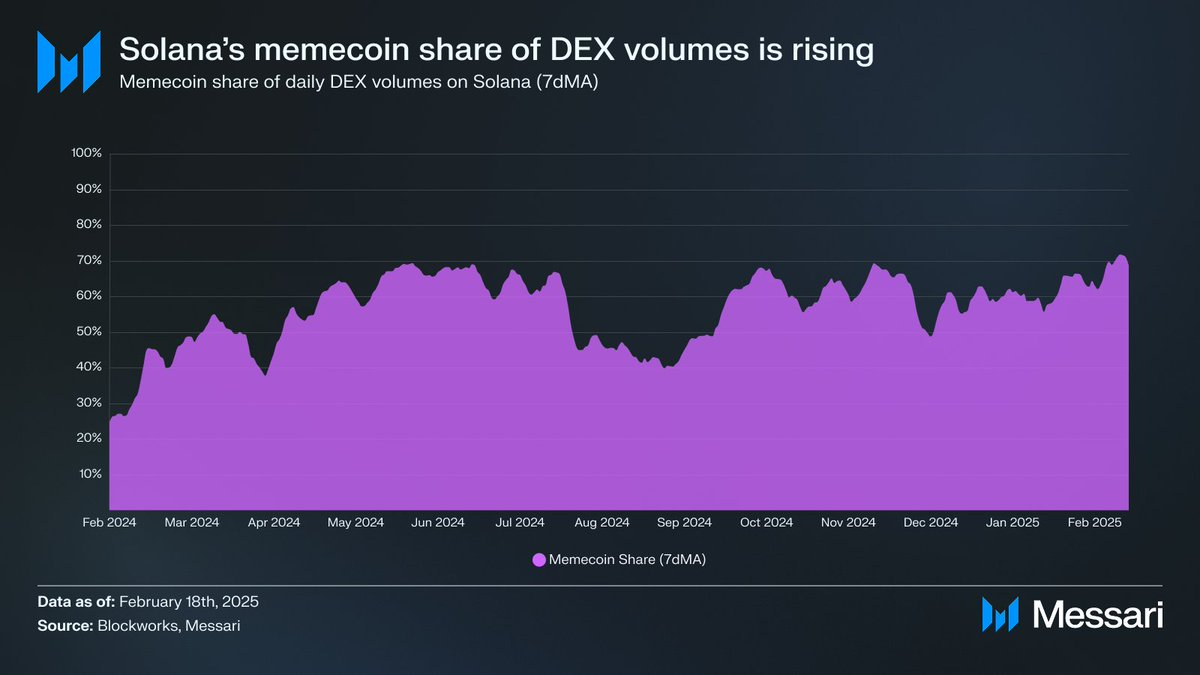
More concerningly, the share of Memecoin trading volume has become abnormally high. In February 2025, for instance, Memecoin trading volume accounted for 70% of total DEX trading volume on Solana.
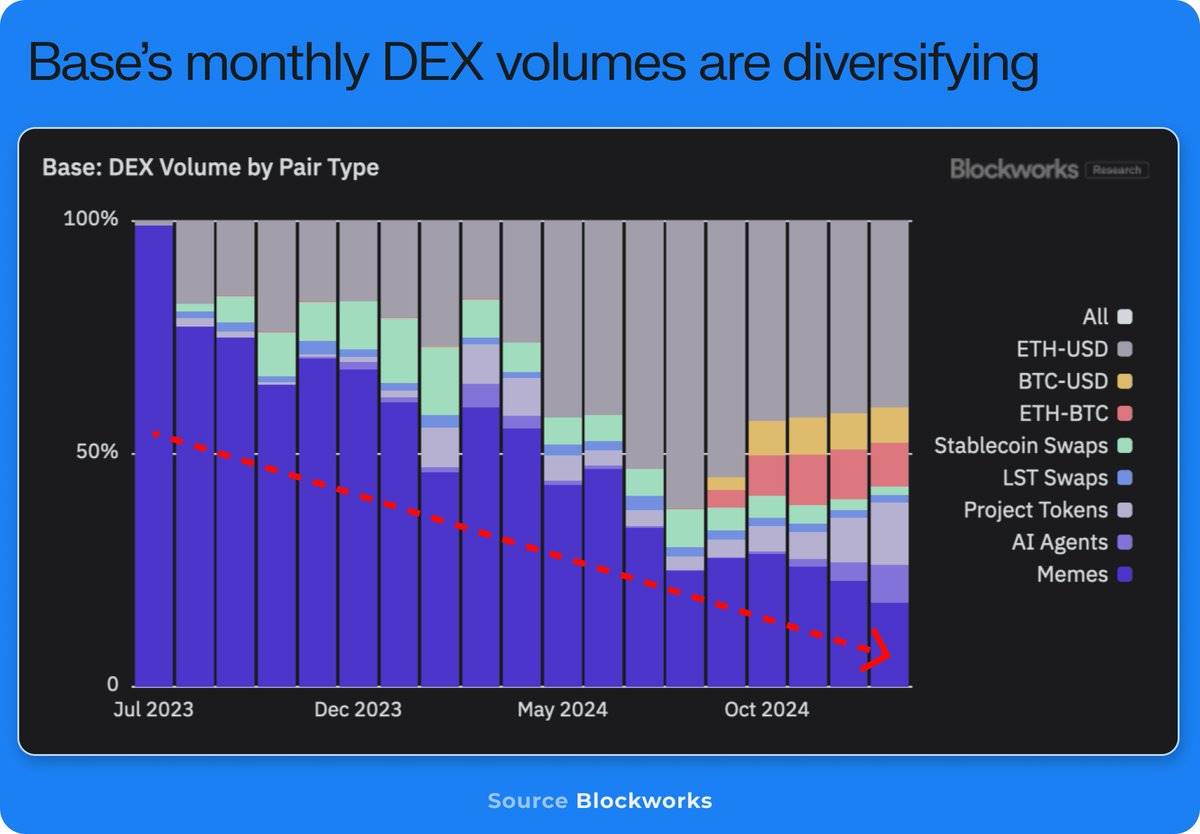
In contrast, Solana’s competitor Base is gradually reducing its reliance on Memecoin trading volume, shifting toward more project tokens and trading pairs denominated in mainstream assets:
Why Is This a Problem?
First, Memecoins on Solana are extremely volatile, and their sustainability remains questionable.
More importantly, researchers, investors, and the Solana Foundation have consistently emphasized growth in application revenue and "on-chain GDP." Indeed, Solana’s application revenue has grown rapidly and remains one of the best indicators of user engagement.
Yet, when analyzing the primary sources of this revenue, we find that Solana’s most profitable businesses are actually profiting from Memecoins.
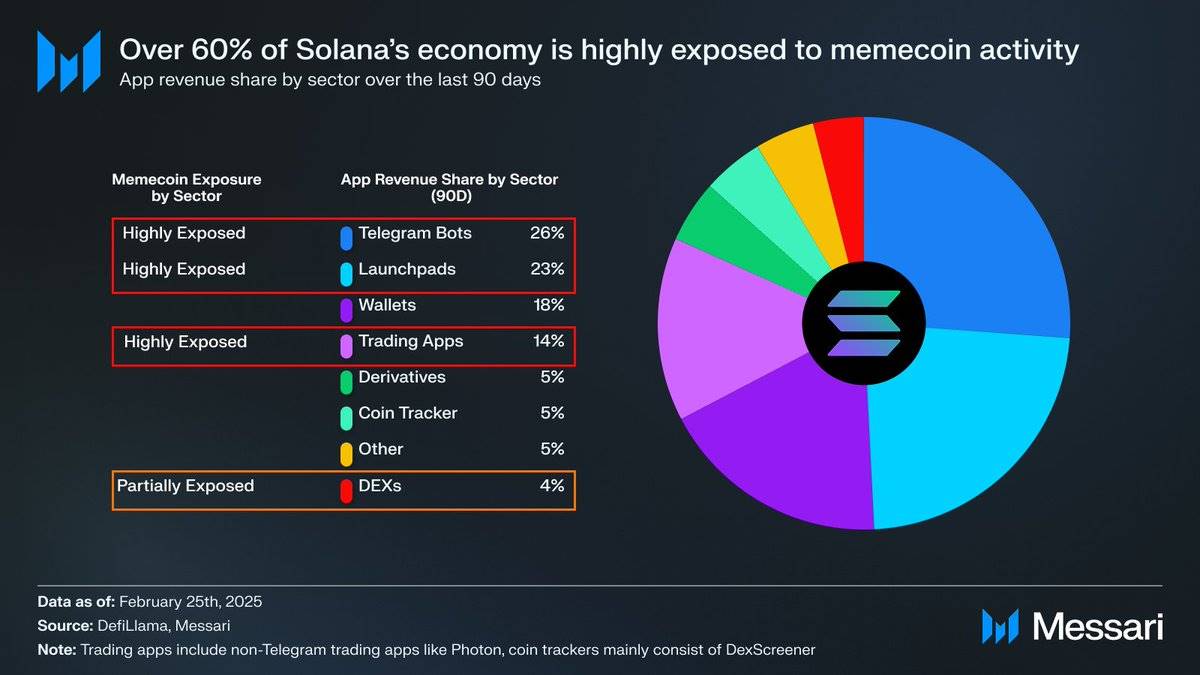
For example, the two highest-revenue sectors on Solana are Telegram trading bots and launchpads (e.g., pump.fun).
Together, these two sectors contribute over 60% of Solana’s application revenue, with annualized revenue exceeding $3.3 billion.
The core of these businesses is precisely Memecoins.
The interdependence within Solana’s application economy further amplifies the risks associated with Memecoin transaction volume.
For example, Pump depends on Raydium, which in turn depends on Jupiter, followed by Photon and Jito.
This means a single Memecoin trade can generate revenue for five different applications simultaneously.
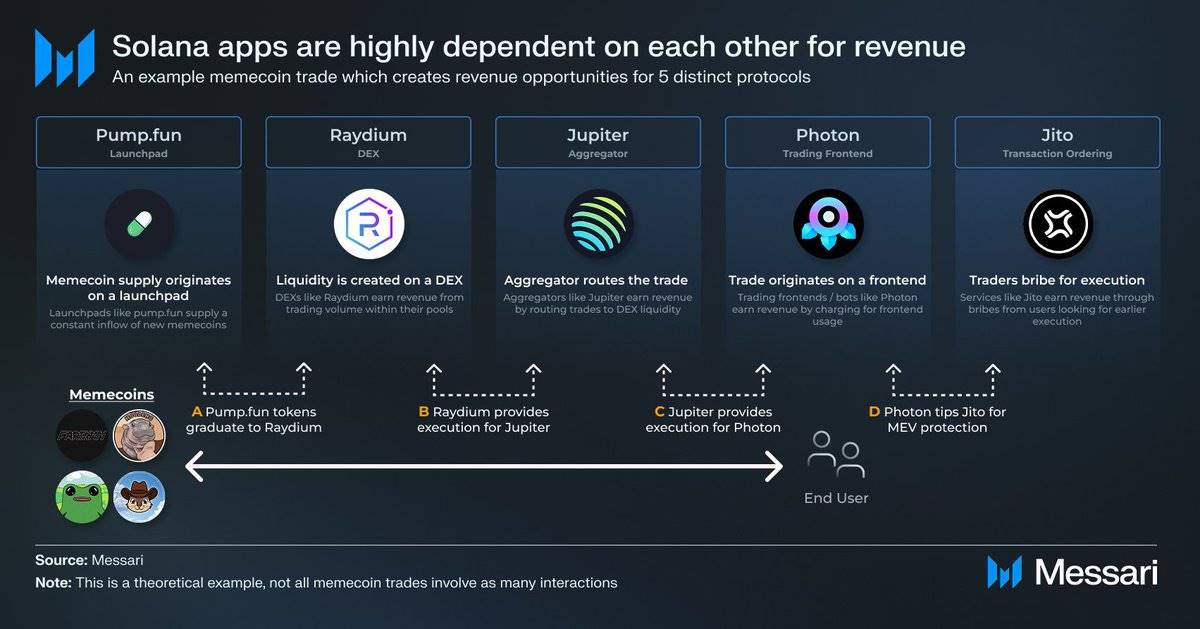
Thus, although these appear to be independent businesses, their revenues are in fact highly interdependent.
However, this cross-sector revenue is built upon the current reality where 50%-70% of transaction volume comes from Memecoin activity.
From a blockchain perspective, there's nothing inherently wrong with Memecoins. For Solana, this phenomenon is a natural result of its low-cost block space and early leadership in on-chain user experience (UX).
Blockchains should essentially remain neutral regarding types of activity.
Building ecosystems around Memecoins is profitable, so many protocols have seized this opportunity.
In the future, other asset classes—such as decentralized physical infrastructure networks (DePIN), real-world assets (RWAs), stablecoins, and mainstream assets—may gradually replace Memecoin trading volume.
But right now, it's not an exaggeration to say Solana is a “Memecoin economy.”
This also means that a significant contraction in Memecoin trading volume could trigger a cascading decline in revenue.
Why Does This Matter?
Solana’s development narrative has long centered on growth in fundamental metrics, which have supported the performance of the $SOL asset.
But in reality, these metrics are highly dependent on the Memecoin sector—a domain characterized by strong reflexivity (where changes in trading volume amplify market volatility).
If we use these metrics to evaluate Solana’s progress, then a collapse in Memecoin trading volume could transform a “growth story” into a “rebuilding story.”
This would lead to a sharp shift in market sentiment, and recovering this economic activity could take considerable time.
Of course, Murad might be right. If so, disregard the concerns above.
In the long term, I remain bullish on Solana’s ecosystem. But in the short to medium term, if demand for Memecoins cannot be sustained, Solana’s economy may face certain challenges.
Join TechFlow official community to stay tuned
Telegram:https://t.me/TechFlowDaily
X (Twitter):https://x.com/TechFlowPost
X (Twitter) EN:https://x.com/BlockFlow_News
 Messari