Xiao Feng HashKey Chain Web3 Voyage Event Speech Full Text: "Blockchain: From the Origin"
TechFlow Selected TechFlow Selected
Xiao Feng HashKey Chain Web3 Voyage Event Speech Full Text: "Blockchain: From the Origin"
We are entering a new era from "off-chain to on-chain."
 Navigating Web3 tides with focused insights
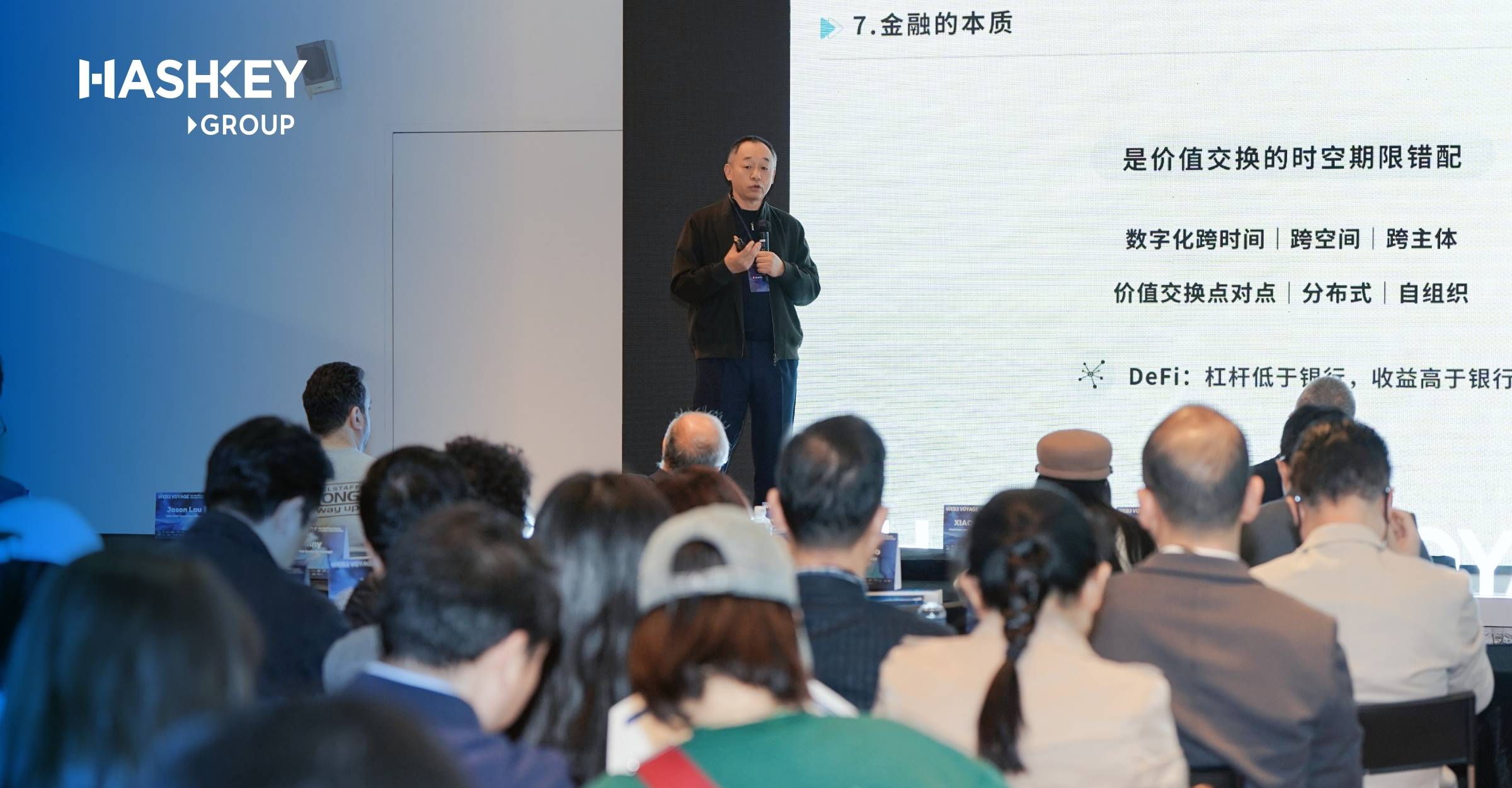
On February 20, Dr. Xiao Feng, Chairman and CEO of HashKey Group, delivered a keynote speech titled "Block Chain: From the Origin" at the Web3 Voyage event hosted by HashKey Chain. Below is the full text of the speech, transcribed from the live recording with minor edits that do not affect the original meaning.
Hello everyone, and welcome to our on-site event today.
On August 28, 2023, we held the launch ceremony for our Hong Kong exchange, HashKey Exchange, at this very location—the Hong Kong Maritime Museum. As Hong Kong is a port city, we deliberately chose this symbolic venue for our opening. Today marks the second time our group has hosted an event here. HashKey Exchange is one wing of HashKey; HashKey Chain is the other wing of HashKey Group. In today's talk, I will explain in detail why HashKey Chain is so important to us.
Blockchain: New Financial Infrastructure
Starting from the origin of blockchain, looking through first principles and fundamentals, we must re-examine the much-discussed crypto assets, or virtual assets. All of this rests upon blockchain technology. Therefore, we must return to our original intent and explore what blockchain truly is.
Three Elements of Human Social Evolution
Before beginning, I'd like to reference the research of a Nobel laureate in economics. His long-term study of the Industrial Revolution led him to conclude that "The Industrial Revolution had to wait for a financial revolution." His findings cover the first three industrial revolutions, and now we are entering the fourth—the era of intelligence and digitization. He argues that every industrial revolution depends on new forms of financial services to emerge, grow, and thrive. Conversely, without a financial revolution, human industrial revolutions may not succeed.
Many hesitate to admit that blockchain is the infrastructure supporting the fourth industrial revolution, which is why we often hear about "consortium chains" or "tokenless blockchains." But a decade of practice has shown that most such attempts don't work. We must bravely acknowledge that as a tool for reshaping production relationships, blockchain's core entry point is finance. Without financial needs, we wouldn't need blockchain at all. This means that as humanity enters the fourth industrial revolution—driving innovation in digital and intelligent production relations—a new financial revolution is indispensable. Otherwise, none of this may happen or succeed.
Four Industrial Revolutions
This economist further points out that each industrial revolution is an overlay of energy revolution, industrial revolution, and financial revolution—with the financial revolution often being the prerequisite.
This reminds me of research in physics: social development and technological progress cannot be separated from the transformation of energy, power, and information. Such transformations align, in certain contexts, with energy, industrial, and financial revolutions. Following this framework, let us review the past three industrial revolutions:
The first, marked by the steam engine, occurred in Britain;
The second, represented by electricity and wireless communication, emerged in the United States;
The third, symbolized by computers, code, and the internet, also arose in the United States.
Another scientist once mentioned that humans have experienced three cognitive revolutions:
The first was the invention of language, enabling human-to-human communication;
The second was the invention of writing, allowing experience to be recorded and passed down;
The third was the invention of code in the last century. As a new language, code has expanded the scope of human interaction, coordination, and communication exponentially.
Without code, there would be no AI, blockchain, or internet. Code created a language between humans and machines, and between machines themselves, vastly expanding the space for information, survival, and economic activity. This explains why today’s public companies can reach market caps of $3 trillion, whereas in the industrial economy, the highest was only $600 billion—as seen with ExxonMobil and General Electric. Now, trillion-dollar companies are common, and some even predict Nvidia could reach $5 trillion or even $10 trillion.
The Fourth Industrial Revolution
The fourth industrial revolution began in the early 21st century, represented by blockchain, AI, and cloud computing. If I said this in January, I might not have dared claim China’s involvement—but now I can say that China and the U.S. are jointly driving this wave. From the internet to AI, nearly all top ten platforms and large models are concentrated in these two countries, with Europe and Japan barely visible. China has boarded this fast train.
Yet, the fourth industrial revolution requires financial revolution as its foundation. Britain relied on credit and bond markets, America on investment banks and capital markets, and the third on venture capital (VC) to spawn Silicon Valley and Chinese internet platforms. Can the fourth industrial revolution really proceed without a new financial model?
The greatest value of AI lies in embodied intelligence and spatial intelligence, both requiring vast numbers of robots. So, what currency will robots use to pay each other—or humans pay robots? The U.S. dollar or RMB? Only programmable currencies based on smart contracts can fulfill this role. This means the fourth industrial revolution inevitably demands a new financial revolution—otherwise, its potential will be severely limited.
The Fourth Financial Revolution
The fourth industrial revolution is inseparable from blockchain, smart contracts, digital wallets, and programmable money. Blockchain is a transparent, global public ledger. Human computation methods have changed only three times in millennia: single-entry bookkeeping in Sumerian times, double-entry bookkeeping introduced in Italy around 1300 AD, and distributed ledger technology brought by Bitcoin in 2009. Distributed ledger emerged due to the cross-time, cross-space, and cross-organizational nature of digital existence, forming the financial foundation of the fourth industrial revolution.
Compared to traditional finance, new finance brings three major changes:
First, accounting shifts from double-entry to distributed ledger;
Second, accounts evolve from bank accounts to digital wallets;
Third, the unit of account moves from fiat currency to digital currency. This gives rise to crypto assets—a new asset class built on distributed cryptographic algorithms and ledgers.
The First Principles of Blockchain
What are the first principles of finance? It's the temporal and spatial mismatch of value—this essence hasn’t changed in thousands of years. But service methods have evolved: from no banks to banks, from no central banks to central banks. Some say finance’s essence is unchanged, but banks and exchanges are merely tools. Digital activities transcend time and space; payments have become peer-to-peer, distributed, and self-organized. A remittance from Hong Kong to the U.S. now settles in minutes, without five institutions reconciling records. Which method better aligns with human nature? Isn't near-instant settlement with almost zero fees clearly superior?
The Essence of Finance
DeFi (decentralized finance) on blockchain offers high yields—10%-20%, even 30%-40%. Traditional finance often claims returns above 7% are likely scams, accusing DeFi of being Ponzi schemes. After years of reflection, my conclusion is: compliant DeFi projects offer risk-free returns with leverage lower than banks (banks’ capital adequacy ratio is only 12%), yet achieve high yields through over-collateralization. The key lies in capital turnover efficiency—banks struggle to turn capital more than 12 times a year, while DeFi can reach tens of thousands, with flash loans completing in seconds. This leap in efficiency is the allure of new finance.
From Digital Native to Digital Twin
Let’s touch on a few hot topics, starting with RWA (real-world assets). Ten years ago, stablecoins (like USDT in 2015) initiated the tokenization of money. In 2024, they achieved $16 trillion in trading volume with just a $300 billion scale—far surpassing traditional finance’s $300 trillion in transaction volume in efficiency. Starting in 2024, financial asset tokenization is rising, with U.S. asset managers minting fund shares on public blockchains—soon to exceed stablecoin scale. The third wave is physical asset tokenization, which requires solving oracle problems to achieve digital twins from offline to on-chain.
Five Types of Tokens
Tokens come in many forms, serving different functions, and can be categorized into five types: payment tokens (e.g., stablecoins), reserve tokens (e.g., Bitcoin), utility tokens (e.g., Ethereum ETH), security tokens (e.g., ETF shares), and meme coins (e.g., Trump-themed tokens).
Finally, I want to emphasize that we are entering a new era—from "off-chain to on-chain." In 2025, this trend will arrive in full force, driven by U.S. legislation and presidential support. Once the U.S. grants legitimacy and compliance to the crypto industry, other nations will follow—Hong Kong has already taken legislative steps. Then, global financial institutions will enter the crypto space en masse, building new payment and settlement systems on blockchain, or issuing new financial assets via token economies. The "on-chain" world will truly enter its explosive phase.
That concludes my remarks. Thank you all.
Join TechFlow official community to stay tuned
Telegram:https://t.me/TechFlowDaily
X (Twitter):https://x.com/TechFlowPost
X (Twitter) EN:https://x.com/BlockFlow_News