








Web3 Connect 2025 Observations: Challenges and Opportunities for Institutional Investors in Hong Kong's New Era of Digital Assets
TechFlow Selected TechFlow Selected
Web3 Connect 2025 Observations: Challenges and Opportunities for Institutional Investors in Hong Kong's New Era of Digital Assets
Institutions are no longer asking whether to enter crypto, but are more focused on how to enter crypto.
 Navigating Web3 tides with focused insights
By OSL
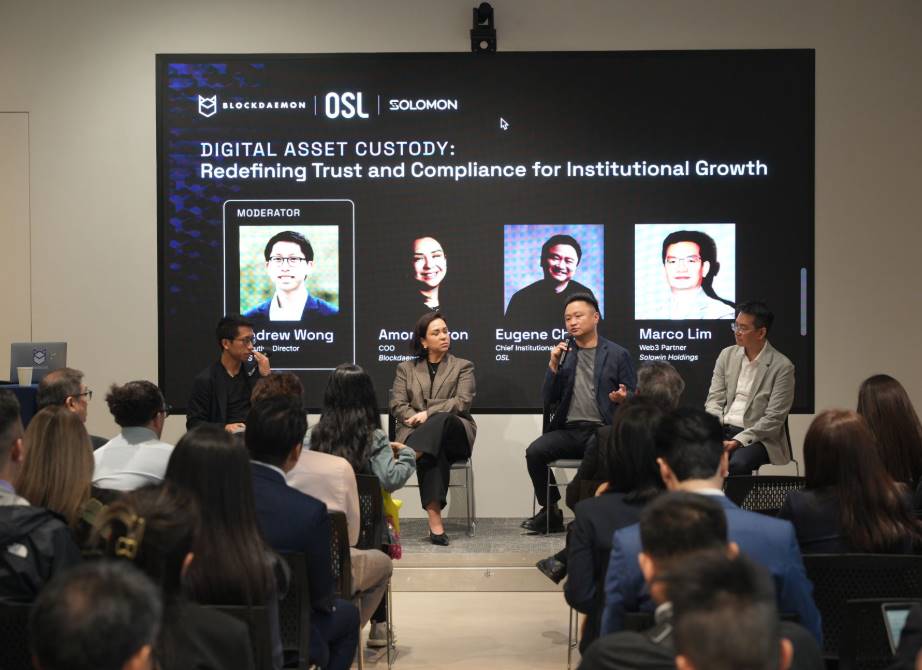
On February 17, the Web3 Connect: An Institutional-Focused Forum, co-hosted by OSL, Blockdaemon, and Solomon, successfully concluded in Hong Kong. The summit brought together global regulatory experts, representatives from financial institutions, and technology pioneers to engage in in-depth discussions on digital asset custody, institutional blockchain applications, and compliance trends.
During the first panel session, Peter Zhang, Chief Institutional Business Officer (CIBO) at OSL, shared insights into the latest upgrades in Hong Kong’s digital asset regulatory framework and analyzed the new challenges and opportunities these changes present for institutional investors.
Blockchain "Infiltrating" Traditional Trade Systems: Stablecoins Driving an Efficiency Revolution
First, Peter Zhang of OSL pointed out that with the growing adoption of stablecoins, an increasing number of international trading companies are choosing them as cross-border payment tools to reduce exchange rate volatility risks as well as settlement costs and time.
For enterprises, in scenarios involving frequent but low-value payments—such as retail transactions or payroll settlements—there is a strong demand for payment systems that offer both efficient fund transfer and low costs. However, current blockchain technology architectures often require customized development to integrate with various business processes and legacy system interfaces.
In practical applications, stablecoins like USDT have already gone beyond serving only cryptocurrency users and trading scenarios, deeply penetrating broader financial use cases such as currency exchange, goods payments, remittances, and salary disbursements. In this context, there is an urgent market need for a universal, cost-effective, integrated development solution that reduces technical complexity and implementation costs, enabling businesses—especially small and medium-sized participants—to more easily access blockchain-based payment networks and Web3 payment services.
From this perspective, market players like OSL, which offer compliant, secure, efficient, and diversified services—whether it's integrating Web3 payments into platform options or providing custody, trading, clearing, and settlement for digital assets such as stablecoins and Bitcoin—can deliver crucial support that is low-cost, secure, and convenient.
Moreover, deploying PayFi requires not only technological and compliance support but also collaborative innovation across multiple industry partners. Therefore, in December last year, OSL announced an investment of up to $30 million to accelerate the development of the PayFi ecosystem, working closely with partners including credit card issuers, payment service providers, cross-border e-commerce platforms, and logistics companies to comprehensively enhance the PayFi ecosystem.
From "Whether" to "How": A New Paradigm for Institutional Participation
At the same time, Peter Zhang noted that institutional investors' focus has shifted from “whether to enter the crypto space” to “how to deploy efficiently.” An increasing number of investors, financial institutions, listed companies, and family offices are actively considering allocating virtual assets through Hong Kong’s regulated channels.
This shift marks the transition of crypto assets from “fringe experiments” to “mainstream allocations,” with the maturation of compliant infrastructure serving as a critical enabler.
As Hong Kong’s first licensed digital asset exchange, OSL consistently adheres to regulatory requirements in Hong Kong and globally, continuously enhancing its internal compliance systems to ensure legal, transparent, and standardized operations. Leveraging its full licensing advantage and institutional-grade service capabilities, OSL is becoming the preferred partner for institutional market entry:
By offering custody services that meet the highest standards set by the Securities and Futures Commission (SFC) of Hong Kong—from KYC/AML compliance checks to asset allocation strategy design, from exchange trading to OTC transactions, from digital asset custody to customized institutional trading, and from crypto ETFs to RWA exploration—OSL delivers reliable digital asset services across the board.
Peter Zhang emphasized that institutional investors’ needs have evolved from “testing the waters” to “deep engagement.” They no longer seek just technical tools, but rather compliant solutions that seamlessly integrate with their existing risk management frameworks. OSL’s mission is precisely to lower institutional entry barriers through infrastructure innovation, transforming crypto assets from “optional” to “essential.”
Summary
Overall, the summit sent a clear signal—Hong Kong is incorporating virtual assets into its mainstream financial system through a strategy of “strong regulation + incremental innovation.” Breakthroughs in institutional-grade custody solutions, cross-chain interoperability technologies, and compliant derivative instruments may become the key drivers of the next phase of market growth.
“OSL is not just a service provider, but also a co-builder of the industry ecosystem,” Peter Zhang concluded. “We believe that only through continuous innovation and compliant practices can crypto assets be truly integrated into the mainstream financial system.”
Join TechFlow official community to stay tuned
Telegram:https://t.me/TechFlowDaily
X (Twitter):https://x.com/TechFlowPost
X (Twitter) EN:https://x.com/BlockFlow_News
 @osldotcom









