Ethereum bounces back strongly—can it achieve a real breakout in 2025?
TechFlow Selected TechFlow Selected
Ethereum bounces back strongly—can it achieve a real breakout in 2025?
This article optimistically projects reaching $7,000 in 2025 and up to $47,000 by 2030.
 Navigating Web3 tides with focused insights
By: Ankish Jain
Translation: Baishuo Blockchain
A sharp sell-off wiped out weak ETH positions in the market, followed by a strong rebound. With new tariffs, whale movements, and network upgrades underway, is Ethereum positioning itself for a 2025 bull run?
1. Diplomatic Talks Trigger ETH Rebound
Ethereum (ETH) price movements saw significant volatility over the past few days, dropping as low as $2,150 on February 3—the lowest level since September 2024. This decline was primarily driven by financial markets' reaction to the U.S. government's new tariff policy, which officially took effect on February 1.
Tariff shocks create market uncertainty The U.S. government imposed a 25% tariff on imports from Canada and Mexico, and a 10% tariff on goods from China. This move quickly triggered global market unease, and the crypto market was no exception.
Diplomatic intervention stabilizes market sentiment However, within hours, diplomatic efforts unfolded rapidly. Canadian Prime Minister Justin Trudeau announced on X (formerly Twitter) that he had spoken with Donald Trump and successfully secured a 30-day tariff delay, allowing both countries time to negotiate broader border security agreements. This news provided some relief to the markets, and Ethereum’s price stabilized and began to recover.

Mexico adopted a similar response strategy, with President Claudia Sheinbaum confirming that tariffs would be suspended for one month as part of ongoing border security discussions.
Improved market sentiment drives ETH price recovery
Fueled by these diplomatic developments, market sentiment improved. By February 4, ETH’s price had rebounded to $2,700.
ETH briefly touches $2,900 as Trump family speaks up
After Trump announced the suspension of tariffs on Canada and Mexico, ETH briefly reached $2,900. Almost simultaneously, Eric Trump posted on X: "To me, this looks like a great time to accumulate $ETH."
This statement further boosted positive market sentiment.
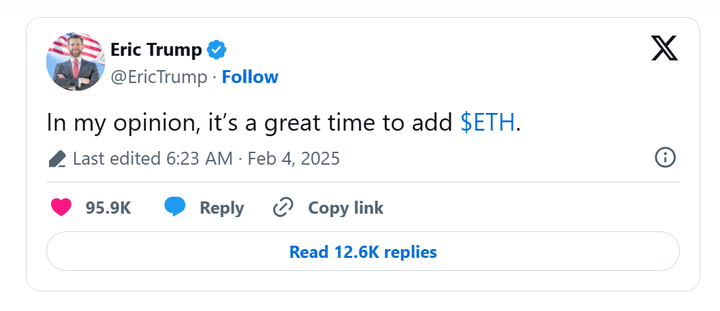
Large transfers linked to Trump family’s DeFi project draw market attention
Eric Trump’s comment coincided with major fund movements by World Liberty Financial (WLFI), a DeFi project closely associated with Donald Trump, Donald Trump Jr., and Eric Trump.
Data shows WLFI transferred eight assets worth $3.07 million to Coinbase Prime for financial management. This move attracted market attention and could further influence market sentiment toward digital assets like Ethereum.
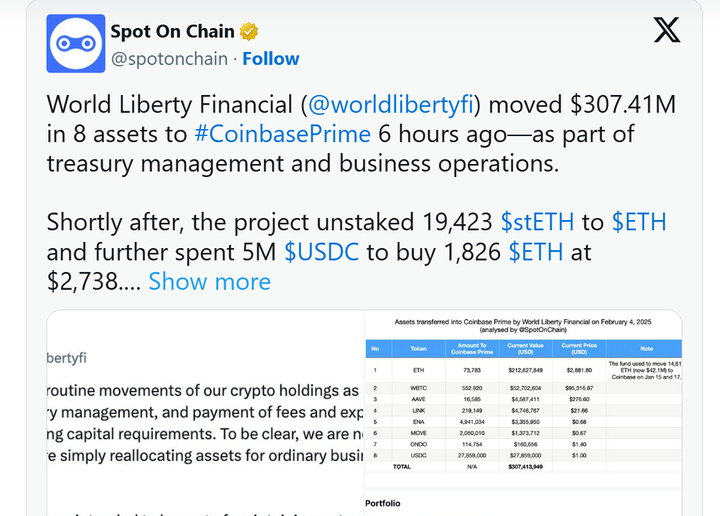
https://x.com/spotonchain/status/1886572108324725075?ref_src=twsrc%5Etfw%7Ctwcamp%5Etweetembed%7Ctwterm%5E1886572108324725075%7Ctwgr%5Ef39d77470064a7d15d206e3daa158fa4b431af84%7Ctwcon%5Es1_&ref_url=https%3A%2F%2Fcrypto.news%2Fethereum-price-prediction-2025-2030-outlook%2F
2. WLFI Unstakes Lido and Makes Major ETH Purchases
Shortly afterward, World Liberty Financial (WLFI) unstaked 19,423 Lido-staked Ethereum (stETH) tokens and converted them into ETH. Immediately following, the project used $5 million in USDC to purchase 1,826 ETH at $2,738 per coin.
Currently, WLFI still holds $96.62 million in various assets across nine known wallets, indicating the project remains actively engaged in managing its crypto portfolio.
At the same time as WLFI’s moves, traditional finance giant Fidelity Investments made a notable acquisition—on February 4, the firm purchased $49.75 million worth of ETH.
This series of capital flows indicates that Ethereum has not only bounced back strongly after market turbulence but is also attracting firm institutional buying, further boosting market confidence.
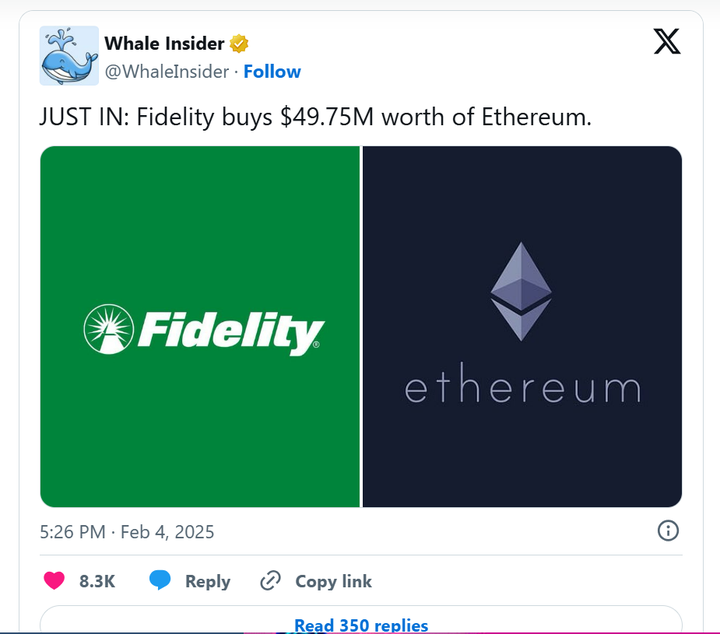
Despite institutional accumulation and price recovery, Ethereum is still down 15% over the past week and remains nearly 45% below its all-time high of $4,890 (November 2021).
So what exactly is happening within the Ethereum ecosystem? And how will these changes affect ETH’s future price trajectory? Let’s take a deeper look.
3. Ethereum Ecosystem Updates
Ethereum is undergoing key adjustments aimed at improving scalability and transaction efficiency.
Gas Limit Increase and Scalability Improvements
On February 3, Ethereum validators first approved a proposal to increase the gas limit—the first such adjustment since the Merge—marking another step forward in network scaling.
Adjustment details:
The gas limit has been raised from 30 million to 31 million, with potential future increases up to 36 million.
Unlike previous changes requiring hard forks, this adjustment takes effect automatically once supported by over 50% of validators.
Importance of the gas mechanism: Gas represents the computational power required to execute transactions and smart contracts. Each operation consumes gas fees, and the gas limit determines the total computational capacity a single block can handle.
When transaction volume exceeds capacity, users must either wait for later blocks or pay higher fees to prioritize their transactions.
Raising the gas limit means each block can process more transactions, increasing network throughput and alleviating congestion.
Impacts and challenges:
This helps complex DeFi applications, NFT platforms, and on-chain services operate more smoothly.
However, the gas limit adjustment does not solve core issues—transaction cost and speed remain concerns.
Ethereum processes 1–1.5 million transactions daily, while Solana handles 60–65 million, vastly outperforming Ethereum with lower costs.
This highlights that Ethereum’s long-term scalability challenges persist, making Layer-2 solutions and protocol upgrades critical.
With increased gas limits and upcoming upgrades, can Ethereum narrow the gap with competitors and lay the groundwork for a 2025 market rally? Future network developments warrant close attention.
4. Ethereum’s Market Position and Competitive Challenges
To address scalability and competitive pressures, Ethereum plans to launch the Pectra upgrade in early 2025, expected to significantly enhance the capabilities of Layer-2 solutions.
1) Pectra Key Improvement: Increased Blob Target
The Pectra upgrade will raise the blob target from 3 to 6.
Blobs (large data packets) are used by Layer-2 solutions to temporarily store transaction data off the main Ethereum chain.
Increasing blob capacity boosts L2 throughput, enabling faster transactions and lower costs.
2) Layer-2 Ecosystem Continues Expansion
Currently, Arbitrum, Optimism, and zkSync have become key pillars of Ethereum’s scaling strategy:
Arbitrum is the L2 solution with the highest TVL, significantly reducing costs by batching Ethereum transactions and generating compressed proofs.
Optimism uses a similar approach but adds incentive mechanisms, using OP Tokens to reward developers building on its network, enhancing ecosystem vitality.
With the rollout of the Pectra upgrade, Ethereum’s L2 ecosystem will gain even greater transaction processing efficiency, strengthening its position in the scalability race. However, facing competition from high-performance, low-cost chains like Solana, Ethereum must continue optimizing its L2 ecosystem and lowering user costs to solidify its market standing.
Whether Ethereum can dominate the 2025 bull market remains to be seen.
3) zkSync: Zero-Knowledge Rollups Offer Advanced Scaling Solutions
zkSync employs zero-knowledge rollups (zk-Rollups), providing advanced scaling solutions capable of near-instant transactions at reduced fees.
While L2 solutions play a crucial role in easing Ethereum congestion, they also highlight fundamental differences between Ethereum and its competitors.
4) Ethereum vs. Competing Blockchains: Fundamental Differences in Scaling Approach
Ethereum relies on Layer-2 solutions to improve scalability, whereas chains like Solana, Avalanche, and Sei natively support high throughput without requiring additional scaling layers.
Solana: No L2 needed—can process tens of thousands of transactions per second at extremely low cost.
Avalanche: Uses subnet architecture to enhance scalability and supports custom blockchain deployment.
Sei: An emerging high-performance chain focused on decentralized finance (DeFi) scenarios, offering ultra-fast transaction speeds.
In contrast, Ethereum continues to face scalability challenges, relying on L2 solutions, while competing chains’ base-layer architectures already support efficient handling of large transaction volumes—putting Ethereum under greater competitive pressure in scalability.
5) ETH/BTC Under Pressure, Ethereum’s Market Position Challenged
Beyond technical competition, Ethereum’s market performance has also taken a hit.
As of February 4, the ETH/BTC pair dropped to 0.027—the lowest level since March 2021.
This ratio is nearly 50% lower than a year ago, indicating ETH is relatively weaker compared to BTC, with market capital possibly shifting toward Bitcoin or competing blockchains.
Facing both technological upgrades and market position challenges, Ethereum’s future competitiveness depends not only on L2 ecosystem growth but also on continuous optimization in lowering transaction costs and improving mainnet performance. Otherwise, it risks losing further ground in the 2025 market competition.
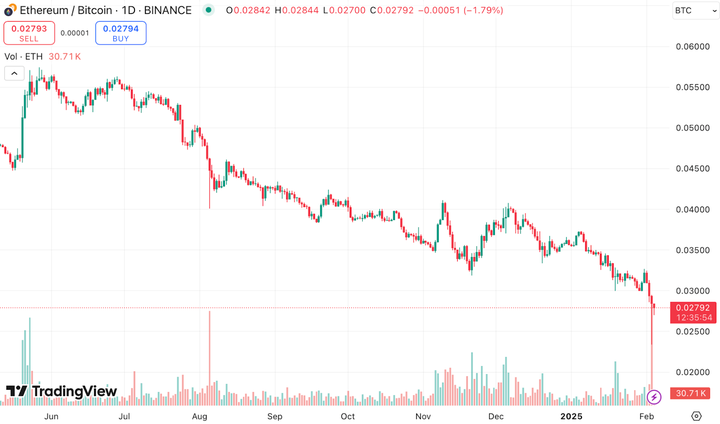
6) Bitcoin Dominates Market Liquidity, Pressuring Ethereum Valuation
As Bitcoin continues to strengthen its lead in market liquidity and investor attention, Ethereum’s relative valuation remains under close market scrutiny.
7) Can Ethereum Hold Its Ground?
ETH drops to $2,150: Market deleveraging clears excessive speculation Ethereum fell to $2,150 on February 3—not only due to macroeconomic uncertainty but also as part of market deleveraging, clearing excessively leveraged long positions accumulated in the market.
Analyst @EmperorBTC noted, “There were many low-quality leveraged longs in the ETH market, which got liquidated when prices hit the $2,100 zone.”
Data shows Ethereum’s open interest dropped by $4 billion in a short period, helping the market stabilize.
🔗 Related tweet: https://x.com/EmperorBTC/status/1886484757627744742
Post-deleveraging, spot demand drives ETH rebound
After the leverage cleanup, Ethereum rebounded from $2,150 to $2,700, primarily driven by spot buying rather than leveraged speculation—indicating a healthier market foundation.
Support from spot buying suggests recovering market sentiment, laying a more solid foundation for ETH’s future price trajectory.
5. Technical Analysis: Ethereum Tests Key Support Levels
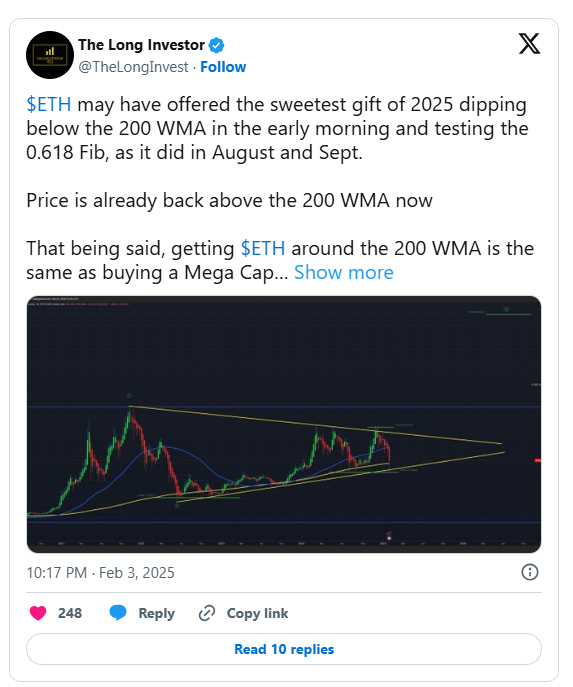
ETH briefly broke below the 200-week moving average (200 WMA), a long-standing key support level.
Another trader pointed out that ETH touched the 0.618 Fibonacci retracement level—a typical critical support at market cycle bottoms.
“ETH may have delivered the best ‘gift’ of 2025, briefly breaking below the 200 WMA and testing the 0.618 Fibonacci retracement overnight.”
This technical pattern suggests ETH may have entered a potential bottoming phase. If demand continues to rise, prices could see further rebounds.
However, ETH still needs to prove its competitiveness against BTC, relying on the Pectra upgrade and L2 ecosystem progress to strengthen its market position.
1) ETH Price Returns Above 200 WMA, But Macro Risks Remain
Although ETH’s price has reclaimed the 200-week moving average (200 WMA), historical data shows that after testing this support in August and September 2024, Ethereum previously saw strong rebounds.
However, the macroeconomic environment remains uncertain:
The trigger for the market crash—the escalation of U.S. tariffs—has caused volatility across global financial markets.
While diplomatic talks have temporarily eased market pressure, potential retaliatory measures or further economic restrictions could still pose risks to market sentiment.
If global liquidity tightens or risk appetite declines, Ethereum’s recovery momentum could face headwinds.
2) ETH/BTC Trend: Is Market Capital Flowing Toward Bitcoin?
The持续 decline in ETH/BTC suggests market capital favors Bitcoin, particularly evident in institutional inflows leaning heavily toward BTC.
Ethereum’s Pectra upgrade and gas limit increases may drive ecosystem growth, but whether these improvements deliver tangible benefits to users and developers will ultimately determine ETH’s long-term demand.
6. Ethereum Price Prediction: Will the Downturn Reverse?
This market correction cleared billions of dollars in leveraged positions, placing ETH in a healthier market environment. However, future price trends depend on multiple factors: scalability upgrades (Pectra, L2 development), market adoption (DeFi, NFT ecosystem growth), competitive landscape (challenges from Solana, Avalanche, etc.), and macroeconomic conditions (interest rates, liquidity changes).
1) Ethereum Price Prediction for 2025
🔹 DigitalCoinPrice forecast: ETH average price $5,510, peak at $6,037
🔹 Changelly more optimistic: ETH average $6,124, peak $7,194
Joe, co-founder of DeAgentAI, believes Ethereum’s current price action aligns with historical patterns. Short-term bearish signals—such as the February 3 break below the 200 WMA—often require deeper interpretation.
He notes that historical trends in 2023 and 2024 show ETH often experiences sharp reversals near key support levels. Traders should therefore monitor ETH’s reaction at these levels as an important signal for future trends.
Can Ethereum enter a bull market in 2025?
ETH is currently in a recovery rebound phase. If the Pectra upgrade rolls out smoothly and the L2 ecosystem continues expanding, Ethereum could regain market attention and reverse its market share gap with Bitcoin. However, if macroeconomic turmoil persists or competing chains further erode Ethereum’s dominance, ETH’s upside may be limited.
2) Ethereum Price Prediction for 2027
If Ethereum continues to lead in smart contract platforms and scaling solutions mature, ETH could see strong gains by 2027.
DigitalCoinPrice forecast: ETH average price $9,580, peak $10,098.
Changelly forecast: ETH average $12,316, peak $14,527.
Additionally, growth in the DeFi ecosystem, innovation in the NFT space, and Ethereum’s role in tokenizing real-world assets (RWA) could generate new demand for ETH.
However, if risk assets face tighter conditions, ETH prices may encounter resistance despite improving fundamentals.
3) Ethereum Price Prediction for 2030
Long-term forecasts suggest Ethereum could reach price levels once thought unimaginable.
DigitalCoinPrice forecast: ETH average price $14,829, peak $15,108.
Changelly forecast: ETH average $40,055, peak $47,066.
Nonetheless, long-term predictions carry inherent risks. Ethereum faces competition from Solana, Avalanche, and emerging blockchain networks aiming to offer lower fees and higher transaction speeds.
While ETH prediction models remain optimistic, combining technical forecasts with real-world adoption trends is essential before making long-term investment decisions. Therefore, investors should proceed cautiously and never invest more than they can afford to lose.
Join TechFlow official community to stay tuned
Telegram:https://t.me/TechFlowDaily
X (Twitter):https://x.com/TechFlowPost
X (Twitter) EN:https://x.com/BlockFlow_News
 @itscrypto_news