Story Whitepaper Quick Overview: What's the Architecture? What Are the Utilities of Token IP?
TechFlow Selected TechFlow Selected
Story Whitepaper Quick Overview: What's the Architecture? What Are the Utilities of Token IP?
What is the utility of token IP?
 Navigating Web3 tides with focused insights
Compiled by: KarenZ, Foresight News
Following the successful launch of its developer mainnet in late January, on-chain IP protocol TechFlow reached another major milestone on February 4 with the official release of its whitepaper. The whitepaper details TechFlow's architectural framework, potential application scenarios, and specific use cases for the IP token, while also outlining TechFlow’s vision for the future development of a peer-to-peer IP network.
What is the TechFlow Architecture?
First, the whitepaper describes the architecture of TechFlow Protocol. In short, TechFlow operates on a set of decentralized nodes (or validators) connected via a peer-to-peer networking layer, working collaboratively to maintain consensus, process transactions, and secure chain integrity. Specifically, the TechFlow Protocol stack is divided into three layers: execution, storage, and consensus.

In terms of the execution layer, TechFlow employs an innovative multi-Core execution environment driven by a primary Core that governs globally and multiple specialized Cores that work in coordination. The primary Core handles all transactions and activates other specialized Cores.
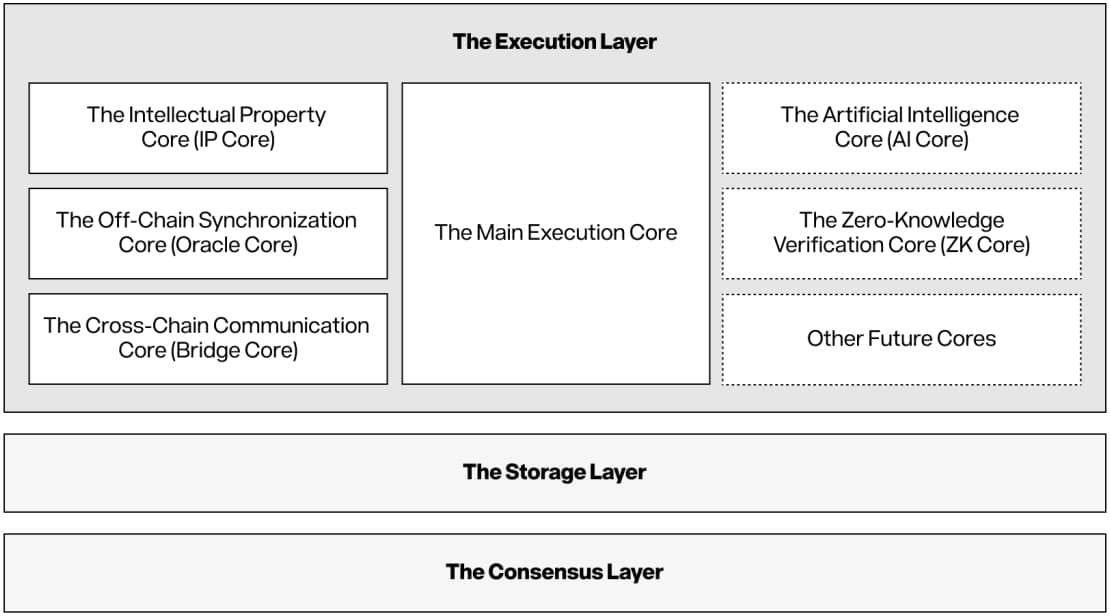
These specialized Cores include:
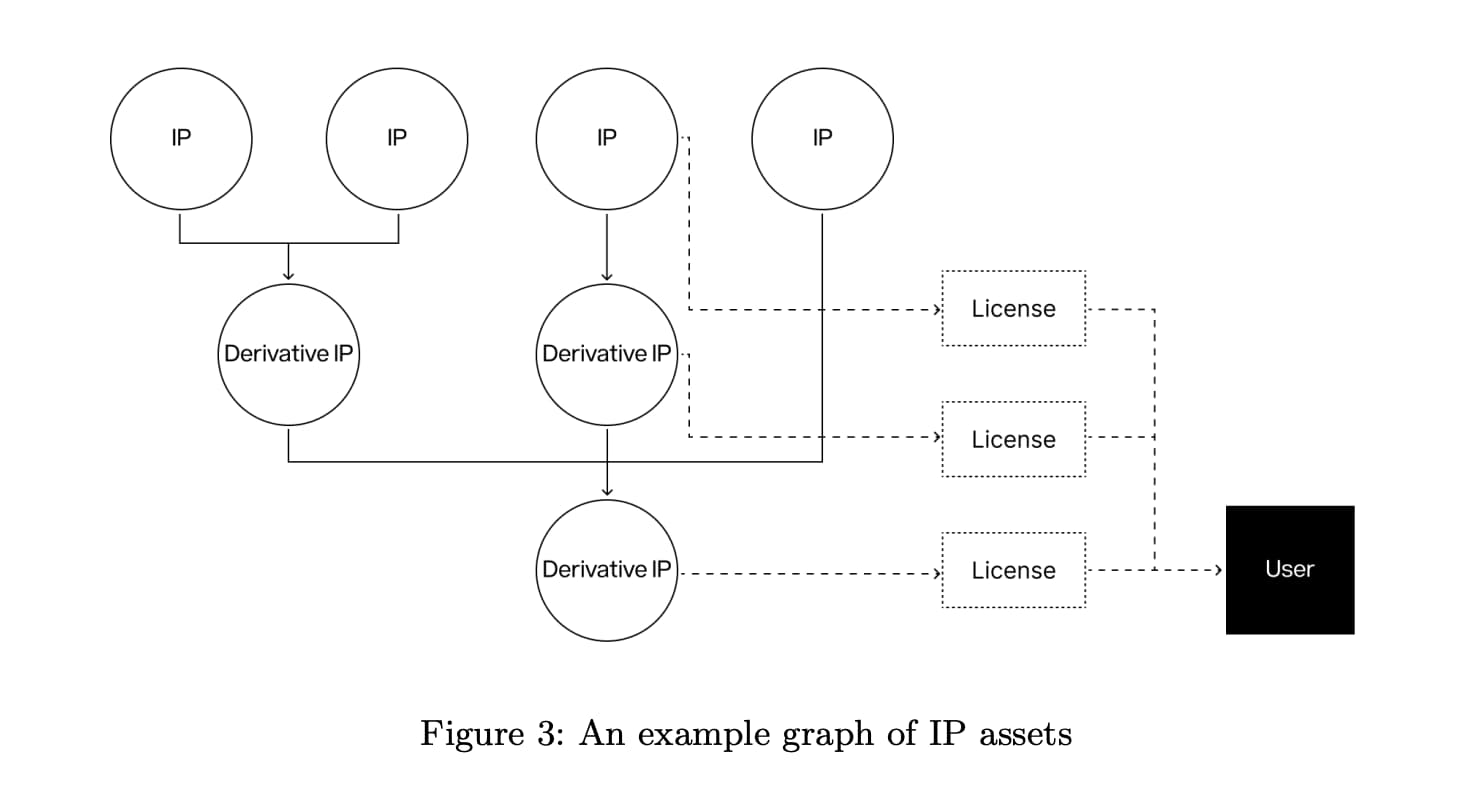
1. IP Core: The IP graph tracks rights, licenses, and monetization of original and derivative assets. The Proof of Creativity (PoC) protocol is deployed on the IP Core, providing an open IP repository and a suite of modules for easy interaction with these IPs. PoC tracks the usage, expansion, and monetization of IP. IP owners can register their IP and use PoC modules to define usage terms and royalty structures.
2. Off-Chain Synchronization Core (Oracle Core): Bridges on-chain and off-chain worlds, verifying the authenticity of IP assets and licenses, and generating legally binding contracts. The Story Orchestration Service (SOS) framework is deployed on this Core, extending the PoC protocol by attesting to the authenticity of registered IP assets and licenses, verifying creators’ social identities, receiving off-chain payments, and generating legal contracts for off-chain use.
3. Cross-Chain Communication Core: Enables cross-chain messaging, allowing IP assets to be used across different blockchains.
In addition, TechFlow plans to add an AI Core and ZK Core in the future, aiming to optimize and streamline AI-related on-chain operations and efficiently verify zero-knowledge proofs—enabling IP owners to prove ownership or authenticity of their IP assets without revealing sensitive information.
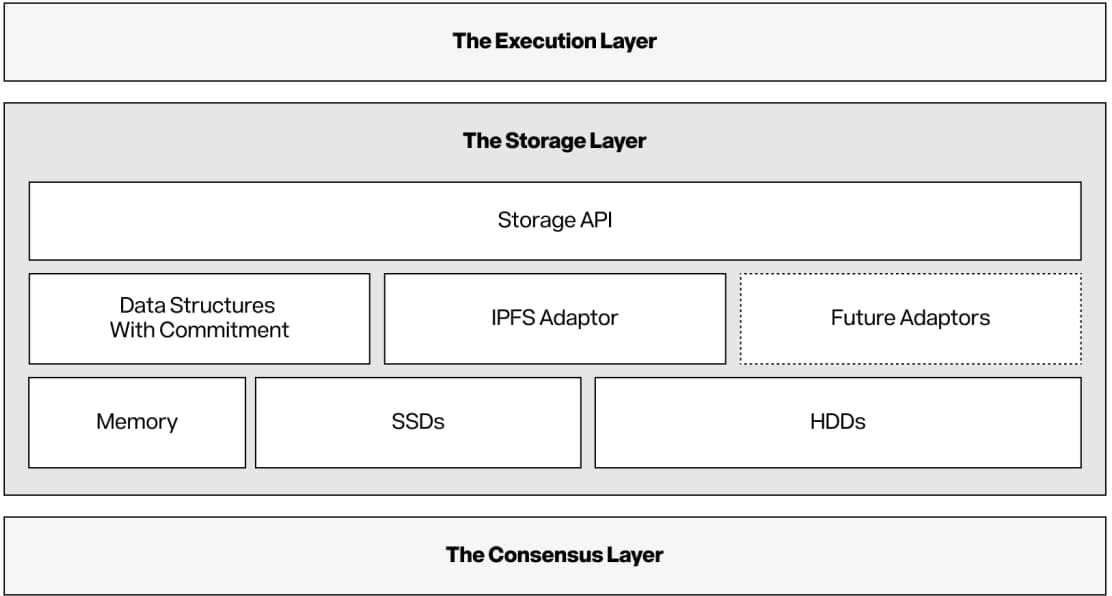
Regarding the storage layer, TechFlow uses a storage layer similar to NAND Flash Translation Layer (FTL), optimizing data placement to balance performance, scalability, cost, and redundancy. It also integrates both on-chain and off-chain storage solutions such as IPFS and Arweave.
As for the consensus layer, TechFlow's initial version uses CometBFT, a high-performance implementation of Tendermint, as the consensus engine, ensuring network security, stability, and instant finality. TechFlow’s consensus layer uses a PoS mechanism where validators play a crucial role in maintaining blockchain security and integrity. This creates direct economic incentives for honest and efficient operation, as malicious behavior results in penalties including loss of staked tokens. This layer manages all operations related to staking, lock-up requirements, and reward distribution.
What Are the Potential Use Cases for TechFlow?
According to the TechFlow whitepaper, the existence of a universal IP repository and programmable smart markets could mark the beginning of a new Renaissance.
For example, applications could integrate existing IP catalogs from pharmaceutical companies or media organizations as IP RWAs into TechFlow. Natively programmable IP can be composed with DeFi applications in the emerging field of IPFi, where IP assets can be fractionalized, used as collateral, staked, or otherwise utilized in economically efficient ways.
In addition, interactions between agents and humans can also be realized through TechFlow’s programmable execution environment, where agents can autonomously license TechFlow IP assets and refine their creative styles or knowledge bases. If revenue is generated, agents can share a portion with the original IP holders via TechFlow’s royalty module. Pure agent-to-agent IP transactions are also feasible.
TechFlow can also serve as a foundational settlement layer for AI transactions, enabling training of AI models and monetization of AI outputs. TechFlow’s Agent TCP/IP (IP Agent Transaction Control Protocol) supports autonomous interactions between AI agents, facilitating the trading and licensing of IP assets.
TechFlow states that as IP expands alongside accelerating AI, TechFlow’s network will become the backbone of a new intelligent economy. AI runs on IP, and TechFlow makes IP programmable.
What Is the Utility of the IP Token?
Within the TechFlow ecosystem, the IP token plays a critical role, coordinating all value flows within the peer-to-peer IP system.
1. The IP token serves as TechFlow’s gas, staking, and utility token, as well as the underlying transaction medium of the network. Whenever users utilize, trade, or generate revenue, IP enables efficient transaction processing and fair resource allocation through a transparent fee payment mechanism.
2. Since TechFlow uses PoS consensus, validators stake IP tokens to secure the network. Validators process transactions and maintain blockchain integrity, earning IP rewards based on their performance.
3. The PoC protocol and other specialized protocols deployed on the IP Core rely on IP as their operational foundation. IP facilitates all value transfers within the IP Core, including royalty distributions, licensing fees, and usage-based compensation.
4. The Agent TCP/IP protocol leverages IP to provide a security layer for inter-agent communication and offers a native mechanism for efficient value exchange between agents.
Join TechFlow official community to stay tuned
Telegram:https://t.me/TechFlowDaily
X (Twitter):https://x.com/TechFlowPost
X (Twitter) EN:https://x.com/BlockFlow_News
 @StoryProtocol