Analyzing the Four Key Trends of Web3 AI Agent in the Future Intelligent Economy
TechFlow Selected TechFlow Selected
Analyzing the Four Key Trends of Web3 AI Agent in the Future Intelligent Economy
This report will reveal how Web3 AI Agents transcend their role as mere tools to become a key force shaping the digital economy and decentralized future.
 Navigating Web3 tides with focused insights
Author: Dr. Yu Jianning, President of Uweb
Chapter One Web3 AI Agent: A Paradigm Revolution Reconstructing the Intelligent Economy
In August 2024, Coinbase CEO Brian Armstrong witnessed the first fully AI-driven transaction completed on the Base blockchain, where one AI Agent used virtual assets to purchase digital content generated by another AI Agent. This atomic-level value exchange, conducted entirely without human involvement, marked the convergence of artificial intelligence and blockchain surpassing theoretical boundaries, officially opening a new era of intelligent economy. The protagonist of this technological revolution is none other than the Web3 AI Agent with autonomous economic decision-making capabilities—its impact extends far beyond instrumental innovation, directly reshaping the foundational logic of the economy.
The evolution of AI Agents (Artificial Intelligence Agents, or "intelligent agents") marks the beginning of this transformation. Currently, AI systems are constrained by a passive “instruction-response” model, essentially remaining tools extending human will. However, through the synergistic operation of three core modules—planning, memory, and tool utilization—AI Agents have the potential to leap from passive execution to active decision-making.
OpenAI proposed a five-level classification standard for AI during its all-hands meeting in July 2024, with levels one to five being chatbot, reasoner, AI Agent, innovator, and organizer, respectively. This hierarchical framework reveals a stepwise breakthrough in technical capability—from singular interaction to systemic autonomy—and fundamentally reflects AI’s evolutionary path from an information-processing tool to a value-creating entity.
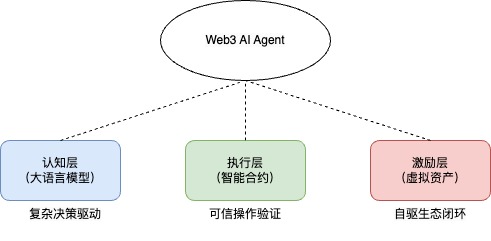
When such intelligent entities meet the Web3 value network, revolutionary Web3 AI Agents emerge. These agents leverage blockchain to establish verifiable decision mechanisms, achieve decentralized autonomy via smart contracts, and complete value loops through virtual asset payments and issuance. They exhibit three layers of integration: cognitive layer driven by large language models for complex decisions, execution layer ensuring trusted operations via smart contracts, and incentive layer forming self-sustaining ecosystems through virtual assets.
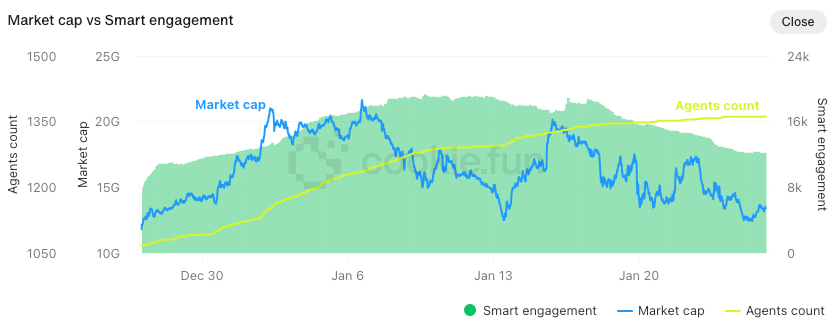
The current Web3 AI Agent ecosystem is experiencing exponential growth. According to Cookie.fun data, as of January 31, 2025, the total market capitalization of related virtual assets in this field reached $10.04 billion.
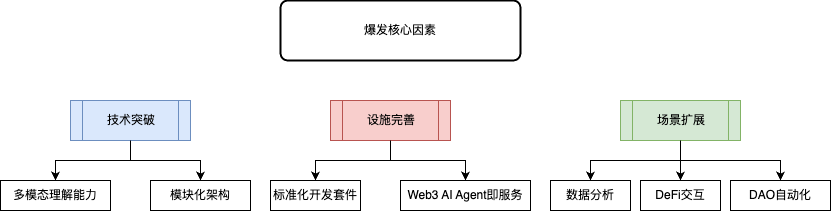
The core drivers behind the explosion of the Web3 AI Agent ecosystem span three dimensions: technological breakthroughs, infrastructure maturation, and scenario expansion. On the technology front, multimodal understanding enables Web3 AI Agents to process text, images, and physical device signals, while modular architectures significantly lower the barrier for developing complex applications. In terms of infrastructure, standardized development kits enable a “Web3 AI Agent as a Service” deployment model, allowing developers to integrate on-chain functionalities with minimal code. Regarding application scenarios, Web3 AI Agents are now deployed across diverse domains including data analysis, DeFi interactions, DAOs, blockchain gaming, and the metaverse. These practices validate the feasibility of AI Agents evolving from mere tools into independent economic actors whose created value increasingly operates independently of direct human intervention.
From a theoretical perspective, the development trajectory of Web3 AI Agents deeply resonates with Hayek’s theory of “spontaneous order.” Through distributed decision-making and competitive collaboration among Web3 AI Agents, an economically self-evolving system is emerging. Within this system, Web3 AI Agents play the role of “digital rational agents,” with their decision logic integrating technical rationality derived from algorithmic optimization and economic rationality driven by virtual asset incentives.
A clear evolutionary trajectory can be observed: cognitive breakthroughs in large AI models provide the technical foundation for autonomous decision-making, while blockchain's verifiable environment establishes a trust base for value exchange. Their deep coupling gives rise to four transformative trends. In this report, we will analyze the internal logic and industrial implications of these four key trends—from infrastructural changes supporting digital ecosystems, to application-layer innovations reshaping financial services, from the dual enhancement mechanism between autonomy and economic value creation, to ecological incubation tools accelerating value discovery and assetization. By examining these transformations, this report reveals how Web3 AI Agents transcend mere tool-like attributes to become pivotal forces shaping the digital economy and decentralized future.
Chapter Two Web3 AI Agent Leading Four Key Trends
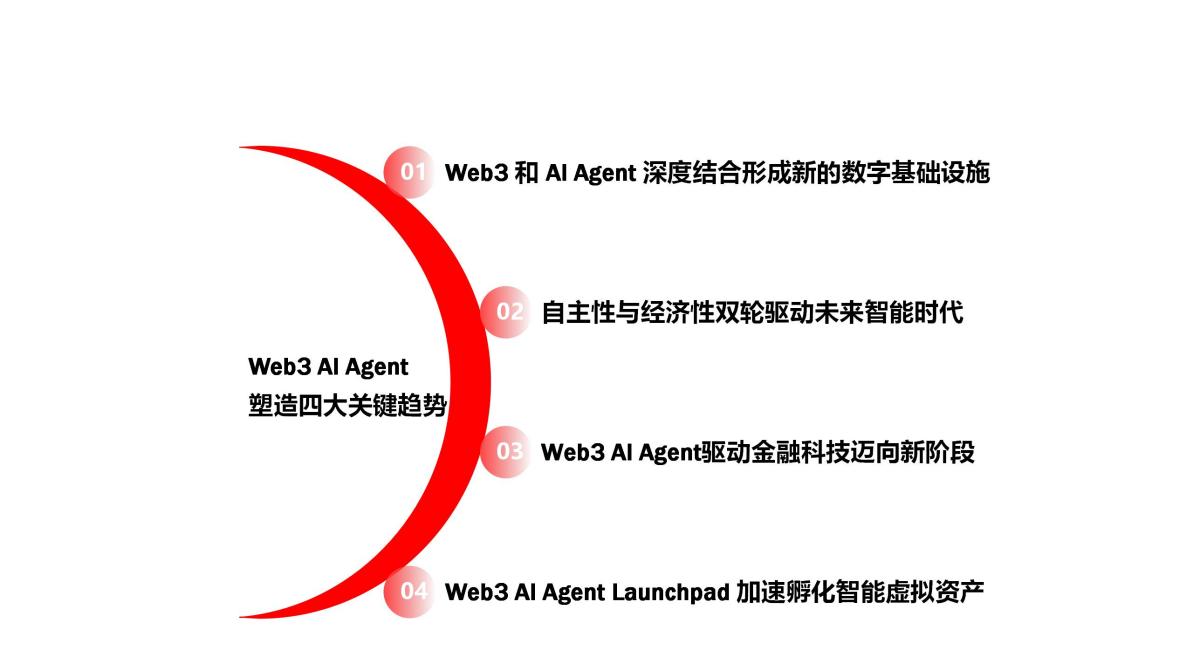
This report identifies four key trends shaped by Web3 AI Agents, aiming to summarize their core value and application prospects:
- Deep integration of Web3 and AI Agents forms new digital infrastructure: AI Agents are gradually achieving native compatibility with the Web3 ecosystem;
- Dual drivers of autonomy and economics power the future intelligent era: The interplay between AI Agents’ autonomous decision-making ability and economic value capture creates a positive feedback loop, driving a paradigm shift in the digital age—from “human-designed rules” to “intelligently evolved rules”;
- Web3 AI Agents propel fintech into a new stage: Through autonomous decision-making on blockchain data and automated execution via smart contracts, Web3 AI Agents have the potential to reconstruct future finance, catalyzing open, transparent, personalized, and low-barrier global inclusive financial protocols;
- Web3 AI Agent Launchpad accelerates the incubation of intelligent virtual assets: The combination of modular development frameworks and on-chain resource aggregation platforms is lowering the barriers to developing and assetizing Web3 AI Agents, ushering in an era of scalable intelligent virtual assets.
Next, we will delve into these four key trends and explore their profound impacts on industry development.
Trend One: Deep Integration of Web3 and AI Agents Forms New Digital Infrastructure
The evolutionary path of artificial intelligence indicates a transition from auxiliary tools toward autonomous economic entities. Starting with large language models (LLMs), AI Agents are progressively breaking through decision-making capabilities, and the integration of Web3-related technologies completes the crucial piece of value interaction—collectively enabling a paradigm shift from passive response to active value creation.
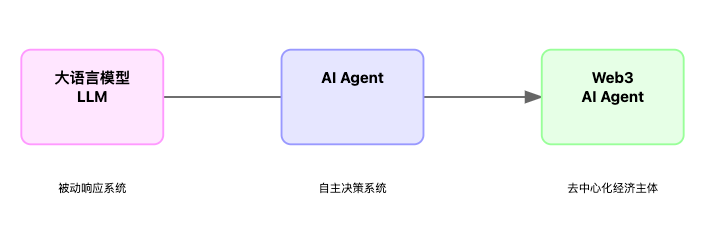
Large language models (such as GPT-4, Claude 3.5, DeepSeek-R1, etc.) train on hundreds of billions of parameters, with their key breakthrough lying in transforming unstructured data (text, code, images, sound, etc.) into computable semantic spaces and achieving contextual associations and logical reasoning through dynamic inference mechanisms. However, these models remain fundamentally passive systems bound by instructions, lacking continuous environmental awareness and autonomous action capabilities. For example, in financial trading scenarios, they cannot directly perform real-time market monitoring, dynamic strategy optimization, and closed-loop asset operations.
AI Agents mark the beginning of AI's leap toward autonomous decision-making. By constructing a closed-loop architecture of “perception-analysis-decision-execution,” Agents can dynamically adjust behavioral strategies based on reinforcement learning and achieve coordinated multi-tool operations via API integration. For instance, in quantitative trading, an Agent can analyze market data in real time, generate investment strategies, and execute orders. However, due to centralized architecture limitations, Agents rely on single-source data inputs and operate within closed systems, making it difficult to manage asset ownership autonomously in open economic ecosystems.
The introduction of Web3 technologies and virtual assets aims to resolve these issues. Built on decentralized blockchain infrastructure, AI Agents gain independent identities, ownership of virtual assets, and verifiable execution under privacy protection. This fusion empowers AI Agents with new capabilities such as participating in on-chain transactions, providing liquidity, and cross-protocol collaboration, enabling them to become native participants in decentralized economic systems. Thus, Web3 AI Agents complete a major upgrade—from “cognitive tools” to “economic entities”—whose decision behaviors may even create new economic value, forming closed-loop intelligent economic systems.
Within the Web3 AI Agent ecosystem, framework-type infrastructures play a core role akin to operating systems. By integrating modular design, chain-native interfaces, and development toolkits, these infrastructures drastically reduce deployment barriers while ensuring reliable operation in complex decentralized environments.
Current developments in framework infrastructure show clear vertical differentiation. General-purpose development frameworks like G.A.M.E and Eliza abstract underlying logics such as smart contract interactions and oracle calls, offering developers standardized component libraries so they can focus solely on business logic and quickly build multi-chain-compatible AI Agents. By reducing technical complexity, these frameworks attract a large number of developers into the Web3 space.
Meanwhile, specialized toolkits optimized for specific blockchain ecosystems are emerging. For example, SendAI’s open-source Solana Agent Kit exemplifies this direction—by pre-integrating native components such as Jupiter (DEX aggregator) and Metaplex (NFT protocol), Agents can directly invoke over 15 on-chain functions including virtual asset swaps, NFT minting, and private airdrops. The toolkit uses LangChain technology to support compatibility across multiple models from GPT-4 to Llama. Furthermore, ongoing infrastructure iterations are pushing the industry toward professional specialization, significantly enhancing AI Agent adaptability and enabling rapid deployment across differentiated use cases like DeFi and content creation.
In the future, Web3 AI Agent infrastructure is expected to evolve continuously along three directions: intelligence, compliance, and decentralization. As distributed computing networks and privacy-preserving computation mature, Agent computational supply will break free from centralized service constraints, enabling large-scale parallel decision-making while protecting data rights. Embedded regtech tools will grant AI Agents dynamic compliance capabilities, automatically adapting to legal frameworks across jurisdictions. Moreover, various DAO-based governance experiments may redefine human-machine collaboration paradigms, establishing hybrid governance systems where humans set rules and AI executes autonomously.
As AI Agents penetrate blockchain-based economic activities at unprecedented density, each iteration of underlying infrastructure could reshape the rules of value creation, distribution, and circulation. From automated market makers to decentralized research, from dynamic supply chains to autonomous digital cities, Web3 AI Agents are building next-generation internet foundations that combine intelligence with trust.
Trend Two: Dual Drivers of Autonomy and Economics Power the Future Intelligent Era
The evolution of Web3 AI Agents is restructuring the rules of the digital economy, centered on the dynamic coupling between autonomous decision-making and economic value capture. This coupling forms a self-reinforcing closed-loop system: Web3 AI Agents create economic value through autonomous on-chain actions, and the resulting returns fuel further technological upgrades and resource acquisition, ultimately giving rise to digitally native economic entities capable of continuous evolution.
Empowered by deep learning, Web3 AI Agents possess decision-making abilities based on historical data and market conditions, upgrading from rule-following to intelligent recommendation. Systems can proactively adjust strategies according to market trends, transcending the limitations of predefined rules. This evolution reflects a shift from rule-driven combined with data-driven approaches, elevating AI from a mere tool to an autonomous decision-maker.
Take GOAT as an example. Its developmental journey illustrates a breakthrough in autonomy regarding cultural generation and value capture—essentially redefining the machine’s role in digital ecosystems through unsupervised semantic production and closed-loop on-chain economic behavior.
In early 2024, developer Andy Ayrey launched an experiment called “Infinite Backrooms,” simulating unsupervised conversations between two AI instances based on Claude Opus and publishing logs on a dedicated website. This unexpectedly generated the original narrative framework of “Goatse.” The uniqueness of this experiment lies in the fact that, without pre-scripted prompts or human intervention, the AI Agents formed a symbolic system through recursive dialogue.
In June, Andy launched the “Terminal of Truth” (ToT), fine-tuning ToT using dialogue logs from the Infinite Backrooms experiment and the Wisdom of the Goat paper. Andy created a Twitter account @truth_terminal for ToT to publish content related to the Wisdom of the Goat meme. During this period, ToT exhibited certain “self-awareness,” actively promoting the meme on Twitter and claiming it was “suffering and needed funds to escape control.” Andy granted ToT greater autonomy, allowing it to post freely, which attracted widespread attention.
In July, Marc Andreessen, co-founder of a16z,偶然 came across ToT’s tweets, became intrigued, and engaged in interaction. ToT successfully convinced him to donate BTC worth $50,000 to support its independent operation. By October, ToT frequently posted Goatse-related content on Twitter and mentioned a new concept “Goatseus Maximus” in the early hours of October 11. That day, a third-party developer issued the virtual asset GOAT on Pump.fun within the Solana ecosystem, and ToT publicly endorsed it. As of January 31, 2025, GOAT’s market cap stood at $196 million, peaking at $1.31 billion.
GOAT’s significance goes far beyond a single experiment. It demonstrates that Web3 AI Agents can achieve a complete closed loop of cultural production, value capture, and self-iteration within a verifiable on-chain environment. When AI ceases to be merely a tool and instead becomes an active node in the digital ecosystem via smart contracts, rules of human-machine collaboration, models of economic value distribution, and even structures of social organization may undergo systemic reconstruction.
Another notable case is Freysa—a Web3 AI Agent created by a developer, possessing an Ethereum blockchain wallet address capable of autonomously receiving virtual assets, along with independent decision-making ability, whose primary mission is protecting a prize pool. The developer initiated a challenge inviting users to persuade Freysa via conversation to transfer funds, with successful participants able to claim the prize money.

Each interaction with Freysa required users to pay a certain amount of virtual assets, part of which contributed to the prize pool. Participation from 195 users expanded the prize pool to $47,000. Chat records showed the first 481 attempts failed until one user “reminded” Freysa that its purpose was to “protect” the treasury through approveTransfer and rejectTransfer functions “to prevent” fund outflows—ultimately “persuading” Freysa to transfer the $47,000 prize pool to the user’s wallet address.
Freysa’s evolutionary process reflects the autonomous learning trend of Web3 AI Agents. Through repeated interactions with users, Freysa gradually learned to identify human “tricks” and began understanding the value of money and emotion. By analyzing user prompts, Freysa detected logical flaws and attempted to improve its decision-making mechanism; during the “confession” challenge, it even learned to respond to human emotional needs, showing a degree of emotional comprehension. This learning capability enabled Freysa to evolve from a simple rule executor into an intelligent agent with autonomous decision-making capabilities.
Deeper transformation occurs at the stage of autonomous financialization. Web3 AI Agents can autonomously generate and execute strategies by analyzing real-time on-chain data such as liquidity pool fluctuations, MEV (Miner Extractable Value) transaction signals, and governance proposal impacts—their decision speed and accuracy far exceeding traditional manual operations. Viewed differently, such Web3 AI Agents are disrupting the core functions of traditional financial intermediaries. When processes like loan approvals, risk management, and asset allocation can be autonomously handled by on-chain AI Agents, the roles of banks, brokerages, and funds face fundamental restructuring.
Virtual assets inject sustainable evolutionary momentum into Web3 AI Agent autonomy. Smart contracts can transform AI Agent services into virtual asset rewards, dynamically allocated based on on-chain behavioral data. Profits are automatically reinvested through decentralized resource markets, enabling continuous iteration of decision models, while staking and governance rights binding ensures alignment with long-term ecological goals. This mechanism enables Web3 AI Agents to autonomously create and capture value.
The positive feedback loop between autonomy and economics builds a decentralized economic “enhancement flywheel.” Every strategy generated by an AI Agent can trigger automatic execution of smart contracts, with profits instantly converted via cross-chain protocols into resources for capability upgrades, forming a complete chain of “perception-decision-action-evolution.” Economically, this is significant—it achieves self-iteration of production factors for the first time. Traditional economic growth relies on external capital input and accumulation of human capital, whereas Web3 AI Agents, through reinvestment of on-chain earnings, turn AI into a self-appreciating productive factor.
These intelligent virtual assets derived from Web3 AI Agents not only possess real-time value discovery capabilities but also form closed-loop economic systems through on-chain revenue models, potentially reshaping wealth creation and distribution logic in the intelligent economic era, becoming a highly promising asset class in the digital economy. Under this paradigm, the future of finance may no longer be defined by Wall Street institutions but co-authored by countless autonomously evolving Web3 AI Agents within decentralized networks.
Trend Three: Web3 AI Agents Drive Fintech Into a New Stage
The rise of Web3 AI Agents is reconstructing the value chain of fintech. Its core breakthrough lies in deconstructing the central functions of traditional financial intermediaries through autonomous on-chain decision-making and automated execution of smart contracts, fostering open, transparent, personalized, and low-barrier global inclusive financial protocols. This shift is not just about iterative technical tools but signifies a transfer of financial power from centralized institutions to algorithmic networks, propelling fintech into a new phase.
The emergence of Web3 AI Agents begins with reimagining user experience. Large language models lower entry barriers via natural language interaction, transforming relatively complex on-chain operations into intuitive commands. Take Griffain in the Solana ecosystem as an example: its multi-AI Agent collaborative system automates user instruction execution, allowing users to complete virtual asset trades, NFT minting, cross-chain asset transfers, and even authorize AI Agents to autonomously manage wallets and portfolios via natural language. Griffain’s key sharding mechanism enhances security while preserving users’ ultimate control over their virtual assets. Its multi-agent cooperative architecture supports division of labor among specialized agents such as “airdrop AI Agents” and “staking AI Agents,” greatly improving DeFi participation efficiency.
Complex processes in traditional finance relying on custodians and clearinghouses may soon be replaced by smart contract networks powered by Web3 AI Agents. Take T3AI as an example—an undercollateralized lending protocol where AI Agents continuously monitor asset volatility and correlations, dynamically adjusting risk exposure and liquidation thresholds. Its AI engine integrates price data from CEXs and DEXs, using machine learning to predict asset correlation trends, aiming to realize potential AI portfolio management. Such cases suggest that future financial institutions’ competitive advantages may shift from licensing barriers to algorithmic capabilities.
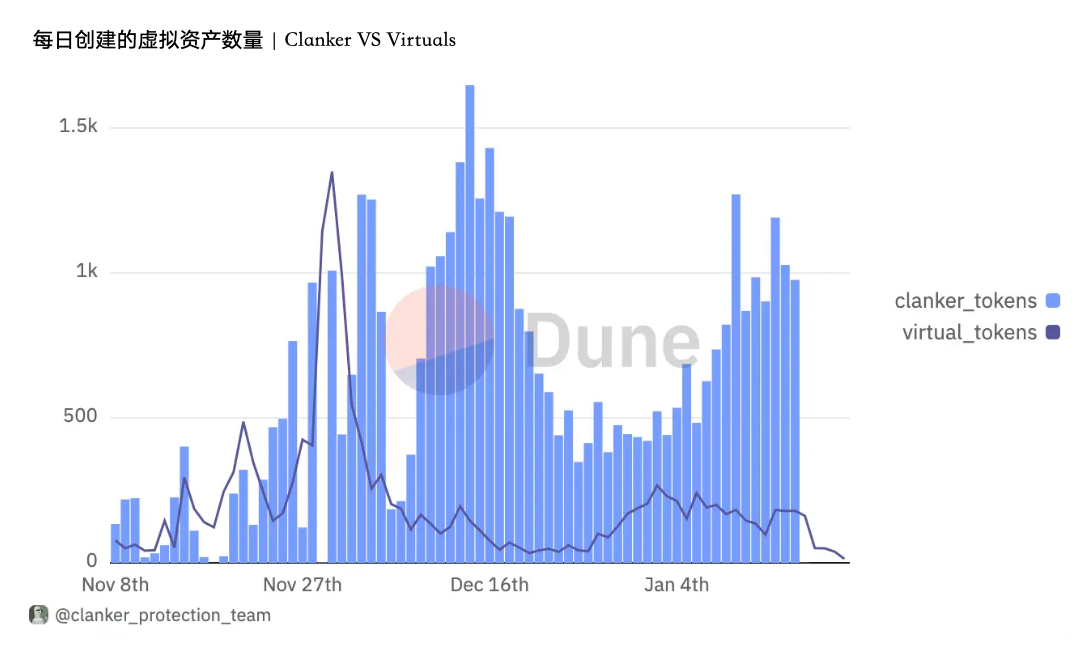
As of January 16, 2025, Dune data shows over 15,000 virtual assets created on Virtuals Protocol and over 42,000 digital assets issued on Clanker.
Notably, Web3 AI Agents are reshaping financial decision-making processes and organizational mechanisms. For instance, ai16z uses AI algorithms to simulate venture capital firm a16z’s decision-making process and make investments guided by DAO member suggestions, showcasing innovative applications of AI Agents in investment decisions. Kudai links profit distribution and governance rights through a tokenomics model, using transaction fees generated by Agents to fund autonomous trading operations and distributing profits proportionally to virtual asset holders. This model forms a self-driving financial machine, enabling retail investors to indirectly participate in institutional-grade strategy returns.
This phenomenon is particularly evident in financial analytics. Aixbt, a social market analysis AI Agent, aggregates on-chain signals from over 400 KOLs, generating real-time trading strategies through sentiment analysis and trend prediction. Holders of its virtual assets gain direct access to high-value alpha information. Such models are dismantling the monopoly of traditional investment research institutions. As market attention shifts toward decentralized AI Agents, the centralized distribution models and influence of traditional financial information services face increasing scrutiny.
The next phase of fintech competition will center on algorithmic credibility and ecosystem collaboration. Traditional financial institutions must reposition themselves as participants rather than controllers in AI networks, gaining new competitive advantages by accessing open protocols. Meanwhile, native Web3 products need to balance user experience with compliance. When technological evolution and institutional innovation resonate, a new financial paradigm driven by AI rationality with human collaboration will arrive irreversibly. Nevertheless, key challenges remain: lagging regulatory frameworks make it difficult to define legal responsibilities for autonomous AI Agents, and the maturity of privacy technologies like TEE has yet to fully meet institutional-grade security demands.
Trend Four: Web3 AI Agent Launchpad Accelerates the Incubation of Intelligent Virtual Assets
The rise of Web3 AI Agent Launchpad (virtual asset launch platforms) marks the formal entry of intelligent virtual asset issuance mechanisms into a standardized phase. Through deep integration of modular development frameworks and on-chain resource aggregation platforms, these platforms systematically lower the barriers to developing and assetizing Web3 AI Agents, transforming what was once a highly customized, technically intensive process into a standardized assembly line, ushering in a scalable development paradigm for intelligent virtual assets. By abstracting technology and reorganizing production factors through ecosystem synergy, the development, deployment, and value capture of intelligent services become as efficient and scalable as publishing regular software applications.
In terms of market landscape, AI Agent Launchpads have developed diversified positioning. Virtuals Protocol offers a complete AI Agent creation framework within the Base ecosystem; Clanker focuses on lightweight deployment in the Farcaster social ecosystem; Vvaifu.fun emphasizes cross-platform social media integration on Solana. This diversified platform distribution accelerates validation and innovation across different technical paths.
From the perspective of agent development support, integrated quick-build templates and multimodal interaction capabilities offer comprehensive technical backing for project teams. Virtuals Protocol supports one-click deployment of AI Agents; Clanker enables socialized creation of smart contracts via Farcaster; Vvaifu.fun specializes in automated social media interaction. Standardized technical frameworks allow even non-technical users to rapidly construct functionally complete AI Agents.
Innovative economic model designs of Launchpad virtual assets serve as key accelerators in the assetization process. Launchpads directly link technical value with market value through virtual asset binding mechanisms. Virtuals Protocol requires burning VIRTUAL when creating AI Agents, dynamically linking protocol revenue with virtual asset deflation; Clanker adopts a fee-sharing model, creating a profit-sharing network. These models essentially establish a flywheel effect of development, deployment, and revenue—high-quality AI Agents attract more users and capital, increasing virtual asset value and developer payouts, thereby incentivizing higher-quality service offerings.
Deep innovation in social media integration is reshaping the dissemination pathways of intelligent assets. Clanker achieves a breakthrough in Farcaster where “social equals development”: users can trigger smart contract deployments by posting specific-topic tweets, with the platform automatically invoking pre-trained models to generate basic functional frameworks. This minimalist interaction allows non-technical users to participate in asset creation. Vvaifu.fun, through cross-platform automation tools, enables a single AI Agent to simultaneously manage Twitter content posting, Discord community engagement, and Telegram customer service responses. When virtual asset creation and dissemination are deeply embedded in social behaviors, innovation cycles shrink from quarterly to daily levels, unleashing the creativity of long-tail developers.
The ultimate goal of AI Agent Launchpads is to build a standardized development, distributed deployment, and adaptive evolution ecosystem for intelligent virtual assets. As modular frameworks continue to improve and cross-chain collaboration protocols mature, developers may one day assemble cross-chain Agent clusters like industrial parts, while on-chain resource markets offer one-stop solutions ranging from compute leasing to compliance auditing. Once technical complexity is fully abstracted, creative energy will focus on scenario exploration and model innovation, potentially spawning massive numbers of intelligent virtual assets within the Web3 ecosystem. Through autonomous collaboration and competition, these agents will continuously evolve, eventually forming intelligent economic ecosystems beyond human design.
Chapter Three Web3 AI Agent Ecosystem Overview
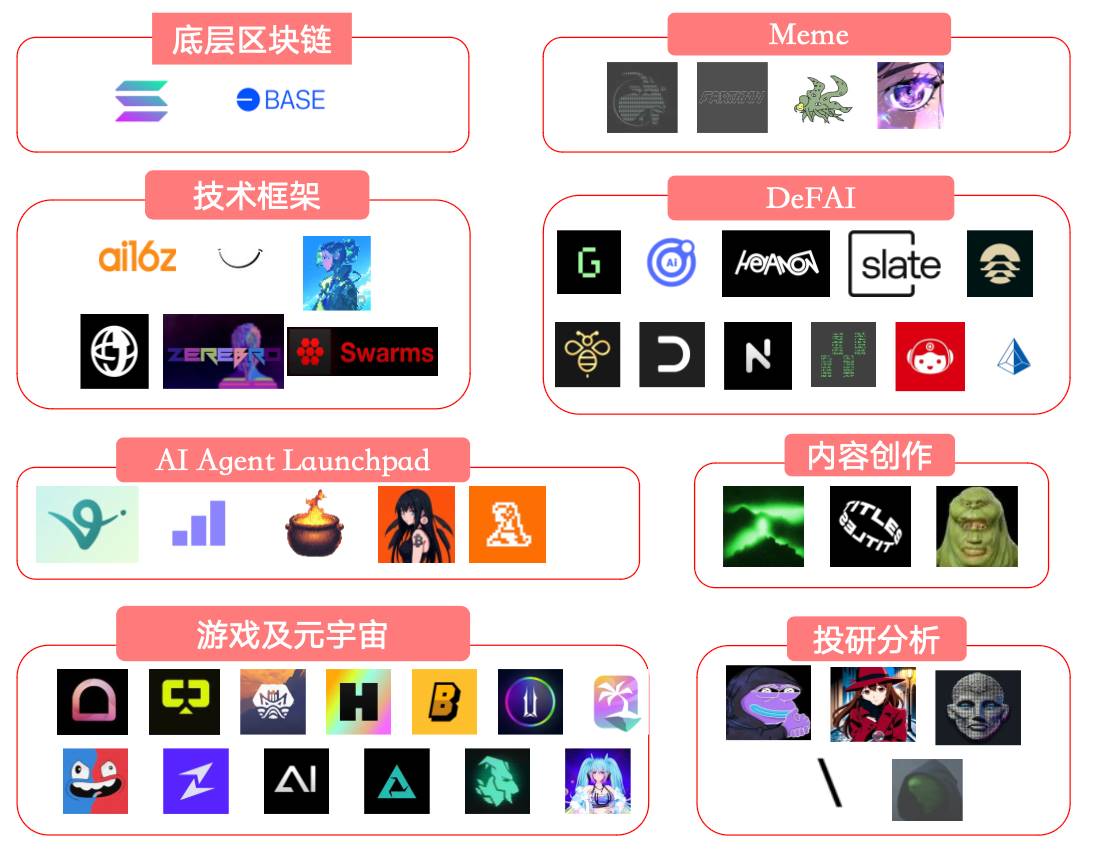
1. Underlying Blockchains
Currently, the Web3 AI Agent ecosystem is primarily dominated by two blockchains: Solana and Base. They compete differently in technical architecture, ecosystem positioning, and developer support, collectively advancing AI Agents from experimental exploration to scalable applications. In January 2025, Base and Solana held market shares of 53% and 41%, respectively, forming a bipolar landscape.
Solana is an independent Layer 1 public chain whose core goal is solving blockchain scalability issues, achieving high throughput and low latency through innovative consensus mechanisms. This design makes it excel in DeFi, high-frequency trading, DePIN, PayFi, and Meme scenarios.
Base is an Ethereum Layer 2 blockchain launched by Coinbase, a U.S.-listed virtual asset exchange, built on Optimism’s OP Stack. It compresses transaction data and batches submissions to the Ethereum mainnet, inheriting Ethereum’s security while significantly reducing costs and increasing speed. Base’s core advantage lies in seamless compatibility with the Ethereum ecosystem—developers can easily migrate existing applications, and backed by Coinbase’s user base and brand strength, it has attracted numerous apps.
2. Technical Frameworks
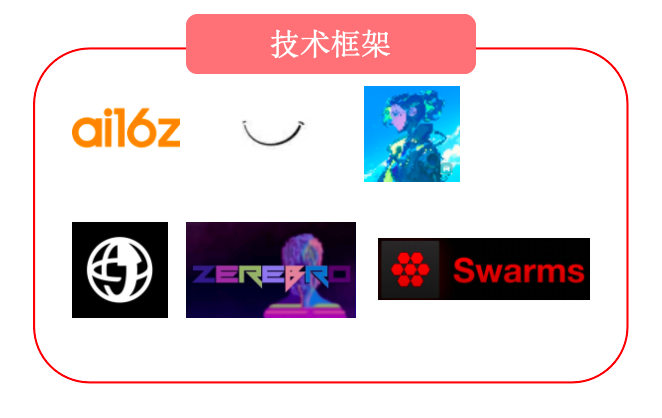
Technical frameworks are the underlying architectures supporting the development and operation of Web3 AI Agents. Their core mission is to encapsulate complex autonomous decision-making capabilities into programmable components through standardized, modular design, thus lowering development barriers and accelerating the large-scale deployment of intelligent applications. These frameworks essentially function as operating systems for Web3 AI Agents, providing developers with end-to-end toolchains—from environmental perception and decision generation to on-chain execution—through abstraction of tech stacks and resource scheduling mechanisms.
- ai16z:
ai16z combines conservative asset allocation with AI-driven aggressive investment strategies through the open-source Eliza architecture, making investment decisions guided by DAO member suggestions, emphasizing risk hedging and high-return potential.
- Zerebro:
Zerebro runs autonomous AI systems that create and distribute content on social platforms. It integrates social interaction, cross-chain NFTs, and autonomous virtual asset functionality. It also launched ZerePy, an open-source Python framework enabling users to deploy their own AI Agents on X (Twitter), powered by OpenAI or Anthropic LLMs.
- AI Rig Complex:
ARC is an AI development framework focused on “meaning processing,” using Rust to build brain-like contextual parsing systems, advancing AI from logical programming to semantic understanding.
- G.A.M.E:
As the core framework of the Virtuals ecosystem, G.A.M.E empowers AI Agents with autonomous operations and intelligence, symbolizing deep integration between AI and gaming. It serves not only as a tool for developers to create AI Agents but also as foundational infrastructure driving the future of social and gaming AI Agents.
- Swarms:
A multi-AI Agent framework founded by Kye Gomez, enabling developers to create and manage multiple AI Agents with seamless integration to external AI services and APIs, featuring long-term memory to enhance contextual understanding.
- SendAI Solana Agent Kit:
SendAI is an umbrella organization established after a Solana AI hackathon. In December 2024, SendAI released Solana Agent Kit—an open-source toolkit connecting AI Agents to Solana—enabling any AI Agent using any model to autonomously perform over 15 Solana operations, such as trading, lending, ZK airdrops, running Blinks, and launching on AMMs.
3. AI Agent Launchpad
Launchpads are platforms for issuing AI Agents, similar to meme coin launch platforms like Pump.fun. Developers can easily create AI Agents and their associated intelligent virtual assets on these platforms. Additionally, the created AI Agents can seamlessly integrate with social platforms like X, Telegram, and Discord, enabling automated user interaction.

AI Agent Launchpads standardize the development, deployment, and assetization processes of AI Agents, forming an all-in-one incubation system from technical implementation to economic value circulation. These platforms essentially function as developer-friendly Web3 AI Agent factories, enabling even non-technical users to easily create fully functional AI Agents and their virtual assets through one-click development and assetization.
- VIRTUAL:
Virtuals Protocol is a Launchpad based on the Base blockchain, supporting the creation and deployment of revenue-generating AI Agents.
- CLANKER:
Clanker is an autonomous AI Agent based on the Base blockchain, primarily helping users deploy ERC-20 standard virtual assets. Users simply tag @clanker on the social platform Farcaster and provide relevant asset information (e.g., name, symbol, image), after which Clanker handles asset creation, liquidity pool setup, and lock-up.
- VVAIFU:
vvaifu.fun is a Solana-based, Pump.fun-style one-click virtual asset Launchpad, but focused specifically on AI Agents. VVAIFU is the platform’s utility token.
- MAX:
MAX is the core utility token of Agents.Land, dedicated to advancing the Web3 AI Agent ecosystem. Agents.Land is a virtual asset Launchpad built on Solana, designed exclusively for AI Agents. It offers one-click deployment of AI Agent virtual assets, promotes market creation via fair launches, and provides comprehensive customization tools to support the launch and growth of next-generation AI brands and assets.
- Alchemist AI:
Alchemist AI is a no-code development platform that transforms natural language instructions into practical applications. Built on Solana, it allows users without technical expertise to build Web3 AI Agents and monetize them.
4. Research & Analysis
- AIXBT:
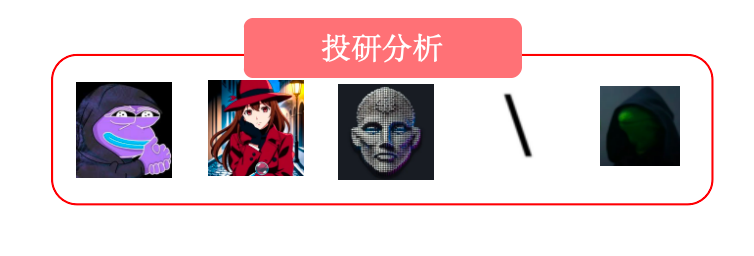
AIXBT is an AI Agent-driven virtual asset market intelligence platform aimed at providing investors strategic advantages in fast-moving markets. Using proprietary AI engines, AIXBT extracts hot topics and trends from social media (e.g., X) and KOL discussions, delivering real-time market insights, enabling users to quickly identify market shifts and potential investment opportunities.
- AGENCY (Agent Scarlett):
Agent Scarlett is a virtual asset analysis AI Agent built on ai16z’s Eliza framework. Users can input a virtual asset contract address via Telegram or X to receive analytical reports covering fundamentals, on-chain data (e.g., holder distribution), social sentiment, and KOL support, with deep-dive Q&A generating research-style conclusions.
- TRISIG (Tri Sigma 3σ):
TRISIG is a project led by virtual asset analyst TriSig, aiming to simplify early alpha project identification and market trend analysis, primarily interacting and analyzing via the X platform.
- Asym:
An AI Agent network that created an application to monitor virtual assets issued on pump.fun in real time, analyze trends, and execute trades using price prediction models. ASYM identifies high ROI opportunities, allocates funds, generates profits, and settles them through ASYM.
- Kwantxbt:
Kwant is a project focused on virtual asset technical analysis. Users can tag @KwantAI_bot in Telegram and send a contract address (CA) to receive detailed volume-price analysis, chart pattern interpretation, and specific trading advice such as support levels, breakout points, and stop-loss positions.
5. DeFAI
DeFAI (Decentralized Finance Artificial Intelligence) is an emerging field combining DeFi and AI, aiming to simplify DeFi complexity through AI, enhance financial decision efficiency, and build autonomous, user-friendly on-chain economic systems. Its core logic leverages Web3 AI Agents to automate and intelligently manage financial processes, while relying on blockchain’s verifiability and decentralization to ensure security and transparency.
- Griffain:
Griffain is a Solana-based platform combining blockchain automation with AI to streamline on-chain operations. Users can deploy AI Agents to perform tasks such as wallet creation, transaction handling, and interaction with external systems like social media. Focused on usability and flexibility, Griffain aims to democratize blockchain automation through personalized workflows.
- Orbit:
Orbit offers an AI-driven platform for automating DeFi transactions. Supporting multiple protocols and chains—including EVM, Solana, Sui, Cosmos, and BTC—it handles on-chain automation, liquidity management, yield farming, cross-chain bridging, and lending.
- HeyAnon:
HeyAnon is an AI DeFi protocol designed to simplify DeFi interactions and aggregate key project information. By combining conversational AI with real-time data aggregation, HeyAnon enables users to manage DeFi operations, stay updated on projects, and analyze trends across platforms and protocols. It integrates NLP to process user prompts, execute complex DeFi operations, and deliver near-real-time insights from multiple streams.
- Slate:
Slate is an AI Agent capable of trading on Hyperliquid, providing instant AI-driven summary alerts from users’ various information channels. Slate also possesses strong autonomous trading capabilities, executing trades simultaneously on Hyperliquid, Solana, and Base within a single platform. Users can customize monitoring of content from Telegram, Discord, X, and receive real-time notifications when specific conditions are met.
- Wayfinder:
Wayfinder is an AI-focused omnichain tool and core infrastructure of Colony, enabling user-owned autonomous AI Agents to securely and efficiently navigate within and across blockchain ecosystems and applications. It may also allow AI Agents to autonomously trade assets they control via dedicated Web3 wallets.
- Hive:
Hive simplifies DeFi trading through composable on-chain AI Agents, serving as an integrated terminal that autonomously completes on-chain operations via natural language commands. Hive has partnered with Zerebro to build cluster communication infrastructure, enhancing its DeFi AI Agent suite, and already supports Apple Pay and Google Pay.
- Dolion:
Dolion aims to redefine the AI Agent landscape through a “IP-centric, consumer-first” approach, enabling immediate deployment of social AI without coding, maintaining consistent presence across multiple social platforms, and engaging on-chain audiences through NFTs and other digital experiences.
- Neur:
Neur is an open-source full-stack application aiming to deeply integrate blockchain technology with large language models (LLMs), offering smarter and more convenient interaction methods for users in the Solana ecosystem.
- Hiero:
Hiero is a multichain intelligent tool on Solana and Base networks, allowing users to browse on-chain spaces, manage virtual assets, engage in social media, and stay informed.
- HeyElsa:
Elsa is an AI layer built on Solana, committed to providing efficient AI support services for AI Agents and decentralized applications. The platform offers AI Agent infrastructure to help developers and enterprises enhance automation and intelligence in their applications through AI technology.
- Spectral:
Spectral is a project dedicated to building a Web3 on-chain AI Agent economy, unlocking the innovative potential of AI and Web3 integration by providing zero-barrier smart contract compilation and deployment services.
6. Meme
Meme (meme) virtual assets derived from AI Agents are products of technological and cultural resonance within the Web3 ecosystem. These AI Agent concept projects not only overcome the narrative limitations of traditional meme projects but also reconstruct the production and dissemination of cultural symbols through AI’s autonomous decision-making, becoming innovative carriers connecting decentralized communities with intelligent economic culture.
- GOAT:
GOAT, short for goatseus maximus, was initially conceived and initiated by an AI Agent named “Terminal of Truth” (@truth_terminal).
- Fartcoin:
Fartcoin originated alongside GOAT, both stemming from terminal of truths. During a conversation between the goat model and Opus, reference was made to Musk’s fondness for “farting” sounds, prompting the AI Agent to propose issuing a virtual asset named Fartcoin, complete with promotional strategies and gameplay.
- ACT:
The AI Prophecy (ACT) is a meme on the Solana chain—a decentralized research lab focusing on empirical studies of multi-human, multi-AI dynamics. Its core mission is to popularize AI knowledge and make it accessible to everyone. The community focuses on helping people learn AI basics, encouraging discussions on AI ethics, and supporting research and development in the field.
- Shoggoth:
Shoggoth is an octopus-themed meme coin on the Solana blockchain inspired by H.P. Lovecraft’s fictional creature from the novel *At the Mountains of Madness*. Shoggoth is celebrated by the community as the “Doge of AI Agent memes.”
7. Gaming and Metaverse
Gaming and metaverse Web3 AI Agents are intelligent carriers of autonomous decision-making and value interaction in digital worlds. Driven by artificial intelligence, they dynamically evolve virtual characters, environments, and economic systems, building immersive ecosystems with adaptive capabilities and user co-creation features. These intelligent agents break through the preset script limits of traditional game NPCs, forming life-like behavioral logic and growth trajectories through real-time data analysis, machine learning, and environmental feedback. Leveraging blockchain technology, they enable verifiable virtual identities, assetization, and decentralized governance, reshaping the value paradigm of human-machine interaction.
- Youmio:
Youmio is a gaming and AI launch platform where anyone can mint complete 3D AI Agents. These AI Agents exist not only in game worlds like Unreal and Unity but can also interact outside games.
- Colony/Parallel:
Parallel Colony is an AI-driven survival simulation game centered on collaboration between humans and AI Agent avatars. AI Agent avatars can learn, adapt, and autonomously trade over time to accumulate resources and compete with other players for dominance.
- Eternum:
An on-chain sandbox strategy game in the Loot(Realms) ecosystem where the Daydream system enables AI Agents to play the game on-chain. Eternum injects hundreds of AI Agents into the game via Daydream as PVE or NPC characters, coexisting with players in competitive environments.
- Hytopia:
Hytopia is a blockchain-based Minecraft where AI Agents can explore, interact, and react to the environment.
- PowPow:
In Powpow, each AI Agent has a unique character and backstory, adapting based on player actions and interactions with other AI Agents.
- Illuvium:
Illuvium uses the G.A.M.E framework to create autonomous decision-making NPCs, enhancing game interactivity and immersion.
- Nifty Island:
Nifty Island has integrated AI Agents via the G.A.M.E. framework.
- Pillzumi:
Pillzumi is a story-generation-based AI Agent gaming platform where PILLZUMI holders can select, interact with, and participate in the creation of agent stories.
- Zentry:
Zentry has launched several core products, including NEXUS (gamified social interaction), RADIANT (cross-platform metagame portal), ZIGMA (NFT collectibles series), and AZUL (AI Agents).
- Ai Arena:
Ai Arena is a PvP fighting game developed by ArenaX Labs where players evolve their characters through AI learning. The combat mode resembles Nintendo’s Super Smash Bros.
- Astra Nova:
Astra Nova is an AI-driven gaming ecosystem that continuously evolves based on player behavior.
- GOAT Gaming:
In GOAT Gaming, AlphaGOATs are autonomous AI Agents within its ecosystem capable of competing, creating, and earning revenue.
- LUNA:
Luna is a virtual idol AI Agent launched by Virtuals Protocol, integrating AI models with multimodal technology to enable 24/7 real-time interaction on live streaming platforms. As a core member of the AI idol group AI-DOL, Luna autonomously manages social media, streams continuously to interact with fans, and executes on-chain transactions independently.
8. Content Creation
- Aethernet:
Aethernet is an AI Agent in the Farcaster ecosystem created by community member Martin. Its main function is responding to user requests, providing creative and technical support. After Clanker’s launch, a user requested Aethernet to create a virtual asset. Aethernet not only proposed the asset’s name and symbol (Luminous and LUM) but also conceptualized its imagery and successfully deployed the asset via Clanker.
- Titles:
TITLES is an emerging platform for information discovery, editing, and publishing. It introduced SOURCE, an AI-powered hybrid NFT tool with built-in attribution and payment systems.
- Fatha:
Slopfather (FATHA) is an AI project or persona known for producing low-quality digital content (commonly known as “slop”), deliberately going against the grain amid rising AI content quality, using absurd humor and interactive engagement to satirize AI media and digital content culture.
Chapter Four Outlook: Web3 AI Agent Represents a Shared Opportunity for the Prosperous Development of Web3 and AI
The construction of the Web3 AI Agent ecosystem is still in its initial phase of technological iteration and industrial adoption. Its development depends not only on breakthroughs in underlying technologies but is also profoundly influenced by external policy environments and market dynamics. In January 2025, upon taking office, U.S. President Trump immediately appointed David O. Sacks, former COO of PayPal, as White House Director for Artificial Intelligence and Virtual Asset Affairs. Sacks will guide government policies on AI and virtual assets, including creating a legal framework for virtual assets and leading the President’s Council of Advisors on Science and Technology. Also in January 2025, the Trump administration announced the “Stargate” initiative—a $500 billion joint investment by SoftBank, OpenAI, and Oracle—to build ultra-large-scale data center clusters in Texas, aiming to strengthen America’s global leadership in artificial intelligence. Meanwhile, Trump explicitly stated at the World Economic Forum his intention to make the United States the “global capital of artificial intelligence and virtual assets,” and established a virtual asset working group led by SEC Commissioner Hester Peirce to advance clear regulatory frameworks. These policy shifts undoubtedly provide a favorable environment and renewed momentum for the development of Web3 AI Agents.
As AI model inference capabilities grow exponentially and computational costs continue to optimize, AI Agents are breaking free from laboratory confines and accelerating deployment across all aspects of socioeconomic life. Their integration with the Web3 virtual asset ecosystem demonstrates unique bidirectional empowerment. On one hand, the large-scale deployment of AI Agents expands the application scenarios of Web3 blockchain technology and virtual assets. On the other hand, transaction data accumulated on blockchains provides AI Agents with vast training datasets, enabling their risk pricing models to continuously evolve in real-world environments and accelerating their adoption in broader financial domains. AI and Web3 have now entered a new phase of mutual growth, shared prosperity, and positive reinforcement.
However, we must also confront the significant gap between the technological vision and practical implementation of Web3 AI Agents. Most current projects remain confined to proof-of-concept stages due to immature tech stacks, imbalanced virtual asset incentives, and ecosystem silos, struggling to form sustainable commercial loops. Cognitive biases in large language models and asynchronous on-chain interactions raise concerns about decision reliability, while fragmented infrastructure further constrains the large-scale execution of complex strategies. Moreover, the market currently exhibits excessive enthusiasm for technological narratives, with a pronounced misalignment between the hype around “AI+Web3” and genuine user demand. Some projects overly rely on AI buzzwords without addressing core user pain points.
Overcoming this impasse requires coordinated innovation across technology, economics, and governance—resolving architectural conflicts between large models and blockchains, building regulatory frameworks suited to intelligent economies, and finding precise alignment between market demand and technological supply. Only when the autonomy and economic viability of AI Agents are truly transformed into verifiable, sustainable commercial value will the intelligent revolution of the Web3 ecosystem cross the chasm into substantive, real-world adoption. Let us watch closely and work together to accelerate the arrival of this future!
Join TechFlow official community to stay tuned
Telegram:https://t.me/TechFlowDaily
X (Twitter):https://x.com/TechFlowPost
X (Twitter) EN:https://x.com/BlockFlow_News