









China's Cross-Border Financial Opening Policy Released, Is the Crypto Asset Industry Getting a New Break?
TechFlow Selected TechFlow Selected
China's Cross-Border Financial Opening Policy Released, Is the Crypto Asset Industry Getting a New Break?
Under this policy framework, can the crypto asset industry find alignment and leverage policy tailwinds to expand its development path?
 Navigating Web3 tides with focused insights
By Liu Honglin, Attorney
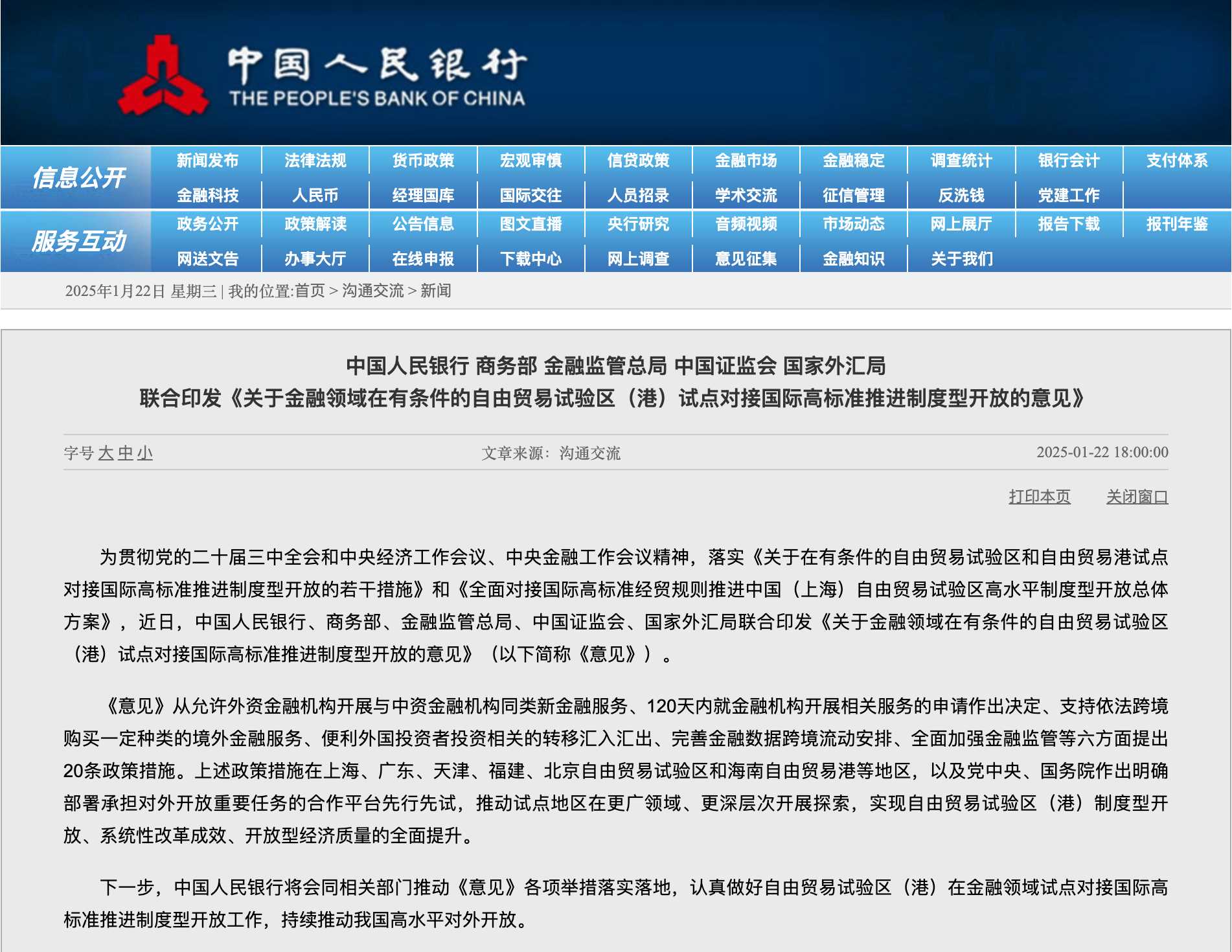
On January 22, five Chinese authorities, including the People's Bank of China, jointly issued the "Opinions on Piloting Alignment with International High Standards to Advance Institutional Opening in the Financial Sector within Eligible Pilot Free Trade Zones (Ports)" (hereinafter referred to as the "Opinions").
The document outlines 20 policy measures, including supporting the optimization of the Guangdong-Hong Kong-Macao Greater Bay Area’s “Cross-border Wealth Management Connect,” improving arrangements for cross-border financial data flows, and allowing foreign-invested financial institutions to provide new financial services. This marks the official beginning of a new round of financial opening-up.
Under this policy framework, can the crypto asset industry find alignment points and leverage policy benefits to expand its development pathways? This article explores the potential and future of blockchain and crypto asset industries in the Greater Bay Area from two perspectives: building a new blueprint and analyzing existing challenges.
Crypto Asset Industry: Potential Pathways Under Policy Guidance
The Opinions offer numerous potential opportunities for the blockchain and crypto asset sectors—particularly in qualified investment products, data flow support, and financial service innovation—where policy and industry objectives may align.
The document states: "Support residents within the mainland part of the Guangdong-Hong Kong-Macao Greater Bay Area in purchasing eligible investment products sold by Hong Kong and Macao financial institutions through such institutions, while expanding the range of participating institutions and eligible investment products." Currently, eligible products are primarily traditional financial instruments such as Hong Kong stock funds and offshore bonds. However, given the Hong Kong Special Administrative Region government’s proactive exploration of virtual asset regulation—including the launch of virtual asset ETFs—it is worth watching whether these products could eventually be included in the Cross-border Wealth Management Connect.
If Hong Kong-based crypto asset products could be made accessible to mainland investors via the Wealth Management Connect under current policy provisions, it would not only diversify asset allocation options for mainland residents but also serve as an important tool for advancing RMB internationalization. Should the scope of the Cross-border Wealth Management Connect further expand, virtual asset ETFs or on-chain bonds might become early pilot candidates, opening doors for financial applications of blockchain technology.
How Can Foreign-Invested Financial Institutions Support Domestic Enterprise Financing?
The Opinions explicitly state: "Facilitate and regulate cross-border data flows for financial institutions in pilot areas, exploring a unified compliance approach for cross-border financial data transmission under the national framework for cross-border data transfer security management." This creates room for blockchain applications in cross-border finance.
The inherent transparency and security of blockchain technology can meet regulatory requirements for tracking fund flows, while smart contracts enhance transaction efficiency. These advantages apply not only to small-scale cross-border payments between individuals and businesses but also to large-scale trade financing and settlement.
The Opinions also note: "Allow foreign-invested financial institutions to provide new financial services comparable to those offered by domestic institutions, with relevant approvals required to be completed within 120 days," and "Under genuine and compliant circumstances, allow all transfers related to foreign investor investments in pilot zones to be freely remitted in and out without delay. Such transfers include: capital contributions; profits, dividends, interest, capital gains, royalties, management fees, technical service fees, and other expenses."
These policies ease access not only for traditional financial services but also create new possibilities for integrating blockchain technology with conventional finance. Particularly in the area of RWA (Real World Assets), collaboration between foreign-invested financial institutions and blockchain firms could become a key driver for expanding domestic enterprises’ access to financing.
RWA refers to digitizing and tokenizing real-world assets—such as real estate, equity, and bonds—using blockchain technology, enabling more efficient circulation and financing. At a time when many domestic enterprises face difficulties in accessing affordable funding, RWA offers a novel pathway beyond traditional financial constraints.
RWA opens up opportunities for domestic enterprises to access international markets. Traditional corporate financing often involves multiple intermediaries, complex procedures, and high costs. By leveraging RWA and blockchain technology, companies can directly reach international investors, bypassing cumbersome approval processes and intermediary layers, significantly shortening the time to secure funding. This direct access improves financing efficiency and reduces overall transaction costs. The high transparency of tokenized assets allows investors to conduct real-time risk assessments based on on-chain data, greatly reducing information asymmetry and thereby lowering investors’ required risk premiums—ultimately enabling borrowers to obtain lower financing rates.
Through partnerships with foreign-invested financial institutions, domestic enterprises can attract international investors interested in emerging markets and use on-chain asset circulation to enter global markets. This model of internationalized financing not only diversifies funding sources but also enhances their influence in global markets, further expanding business growth potential.
The adoption of RWA could enable meaningful collaboration between foreign financial institutions and blockchain enterprises, creating new financing channels for domestic companies. This model not only addresses shortcomings in traditional financing methods but also injects fresh momentum into financial opening in the Greater Bay Area, serving as a vital bridge connecting domestic and international capital markets.
Significant Challenges: The Art of Balancing Regulation and Innovation
Although the policy creates opportunities for the crypto asset industry’s development, the tension between regulation and innovation remains a critical reality. This balancing act involves both constraints imposed by existing legal frameworks and the industry’s ability to achieve technological breakthroughs and commercial implementation within compliance boundaries.
01 Dynamic Tension Between Policy Flexibility and Compliance Pressure
Mainland China maintains strict oversight over crypto assets. Since the comprehensive ban on ICOs (Initial Coin Offerings) in 2017, domestic operations of cryptocurrency trading platforms have been heavily restricted. While the Opinions propose expanding the Cross-border Wealth Management Connect and support purchasing certain types of overseas financial services, currently permitted investment instruments remain limited to traditional financial products. Whether crypto assets will be included in future pilot programs remains a matter of ongoing regulatory deliberation.
In Hong Kong, the introduction of the Virtual Asset Service Provider (VASP) regime in 2023 has provided a legal pathway for compliant crypto trading platforms, positioning Hong Kong as one of the key international hubs for crypto asset development. However, whether the mainland will leverage Hong Kong and Macao’s pilot outcomes to indirectly pave the way for crypto products entering the mainland market remains uncertain.
02 Integration Challenges Between Technology and Business Models
Blockchain technology is renowned for its transparency and efficiency, yet its integration into traditional financial systems faces multiple hurdles. Cross-border payments represent a popular application area for blockchain, but established networks like SWIFT and CHIPS have already built sophisticated and efficient global clearing infrastructures. How blockchain-based payment systems can seamlessly integrate into these existing networks remains an unresolved commercial challenge.
Asset tokenization—the process of representing real-world assets such as real estate, stocks, and bonds as digital tokens on a blockchain—is another major application with significant theoretical advantages, enabling fractional ownership and enhanced liquidity. However, practical obstacles persist. For instance, whether tokenized assets receive equivalent legal recognition compared to traditional assets requires further policy clarification. Additionally, ensuring that cross-border capital flows comply with complex international regulatory standards presents a major challenge. Moreover, the process of moving assets onto a blockchain must guarantee data authenticity and integrity. Especially across multiple jurisdictions, achieving effective cross-border regulatory coordination remains an area requiring continuous exploration.
03 Market Education and Investor Trust
The crypto asset industry has long faced criticism due to high price volatility and lack of transparency. Even if policies open the door for certain crypto products to enter pilot programs like the Wealth Management Connect, public understanding and acceptance will ultimately determine market maturity.
For example, virtual asset ETFs, as relatively conventional crypto investment vehicles, have already launched in several global markets. Yet even in mature regulatory environments, concerns about ETF liquidity and volatility persist among investors. Furthermore, the complexity and high technical barriers of crypto assets make it difficult for average investors to properly assess risks. In this context, how financial institutions enhance investor confidence through transparent disclosures and user education will be a crucial issue for future development.
Conclusion and Outlook: The Crypto Asset Industry Amid the Wave of Opening-Up
The financial opening-up in the Greater Bay Area presents broad opportunities for the crypto asset industry, along with new challenges. Finding paths for innovative breakthroughs under stringent regulatory conditions is now the core issue facing the sector. From a policy standpoint, if the crypto asset industry advances along the lines of compliance and transparency, it stands a chance of becoming an integrated component of the Greater Bay Area’s financial system.
Going forward, the industry needs to accelerate real-world deployment of technology and explore cooperation models with traditional financial institutions. At the same time, stakeholders should place greater emphasis on investor education and information disclosure to break down knowledge barriers surrounding crypto assets. Through these efforts, the crypto asset industry could chart a stable path to growth in the Greater Bay Area, contributing to broader possibilities for China’s financial opening-up.
Join TechFlow official community to stay tuned
Telegram:https://t.me/TechFlowDaily
X (Twitter):https://x.com/TechFlowPost
X (Twitter) EN:https://x.com/BlockFlow_News










