








The Next Era of P2E: The Convergence of Gaming, AI Agents, and Cryptocurrency
TechFlow Selected TechFlow Selected
The Next Era of P2E: The Convergence of Gaming, AI Agents, and Cryptocurrency
The convergence of AI agents, game design, and crypto is not just another tech trend—it has the potential to address various issues that have long plagued indie games.
 Navigating Web3 tides with focused insights
Author: Sid @IOSG

The Current State of Web3 Gaming
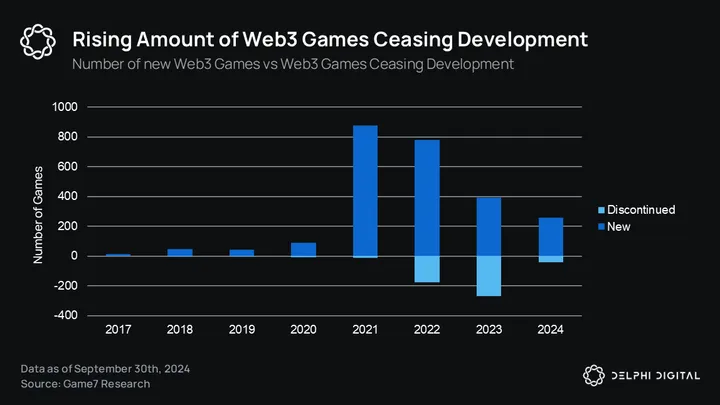
As newer and more attention-grabbing narratives emerge, Web3 gaming has taken a backseat in both private and public market storytelling. According to Delphi's 2024 report on the gaming industry, cumulative fundraising for Web3 games in the private market totaled less than $1 billion. This isn't necessarily a bad thing—it suggests that the hype bubble has deflated, and capital may now be flowing toward higher-quality, more game-compatible projects. The chart below illustrates this clearly:
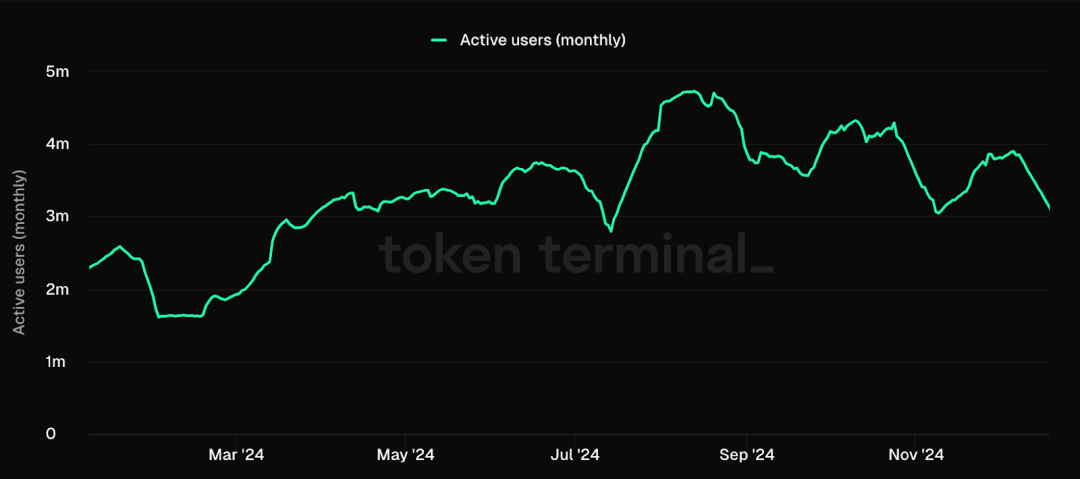
Throughout 2024, user numbers on gaming ecosystems like Ronin surged dramatically, nearly matching the peak of Axie’s glory days in 2021, thanks in part to high-quality new titles such as Fableborn.
Gaming ecosystems (L1s, L2s, RaaS) are increasingly resembling Web3 versions of Steam, controlling distribution within their ecosystems—this becomes a key incentive for game developers to build on them, as it helps attract players. According to their prior reports, user acquisition costs for Web3 games are approximately 70% higher than those for Web2 games.
Player Retention
Retaining players is just as important, if not more so, than acquiring them. While data on Web3 player retention remains scarce, retention closely correlates with the concept of "Flow"—a term coined by Hungarian psychologist Mihaly Csikszentmihalyi.
"Flow state" is a psychological condition where players achieve perfect balance between challenge and skill level. It’s that feeling of being “in the zone”—time flies, and you’re completely immersed in the game.
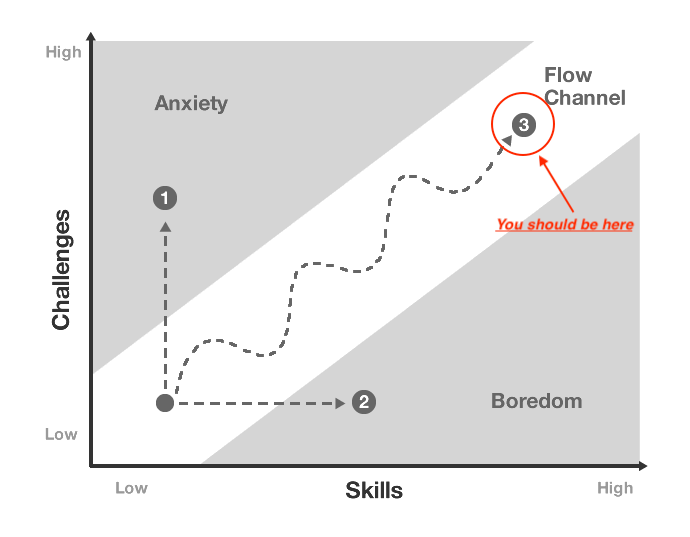
Games that consistently create flow states tend to have higher retention rates, thanks to the following mechanisms:
#Progressive Design
Early game: Simple challenges to build confidence
Mid-game: Gradually increasing difficulty
Late game: Complex challenges requiring mastery
This careful difficulty scaling keeps players within their optimal performance zone as their skills improve.
#Engagement Loops
Short-term: Immediate feedback (kills, points, rewards)
Medium-term: Level completion, daily quests
Long-term: Character progression, rankings
These nested loops sustain player interest across different timeframes.
#Factors that disrupt flow include:
1. Poor difficulty/complexity design: Could stem from flawed game design or imbalanced matchmaking due to low player counts
2. Unclear objectives: A game design flaw
3. Delayed feedback: Caused by design or technical issues
4. Intrusive monetization: Game design + product issue
5. Technical issues / lag

The Symbiosis of Games and AI
AI agents can help players achieve this flow state. Before exploring how, let’s first understand which types of agents are suitable for gaming applications:
LLMs vs. Reinforcement Learning
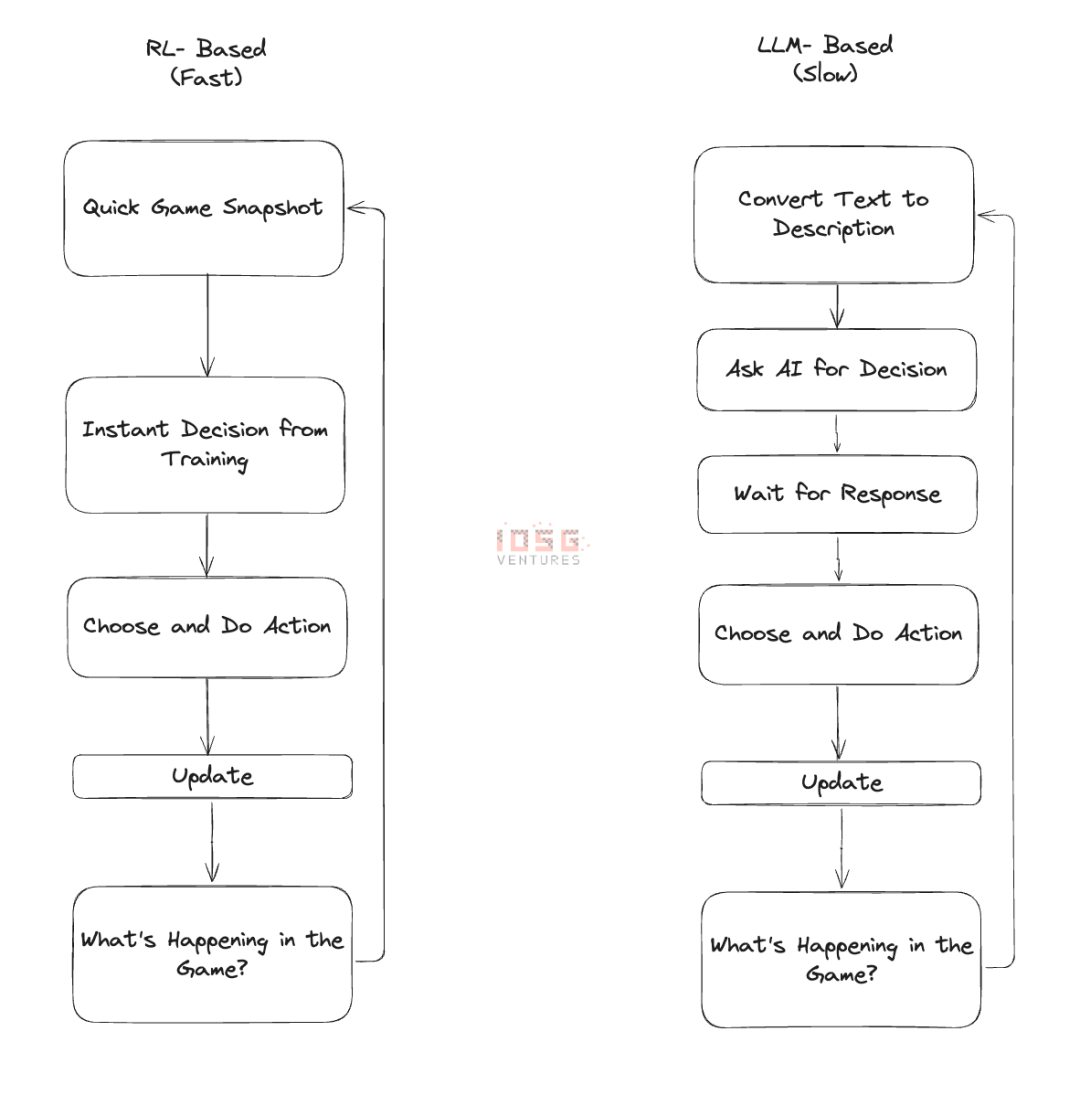
The key to gaming AI lies in speed and scale. When using LLM-powered agents in games, each decision requires calling a large language model—analogous to having an intermediary who must be consulted before every move. The intermediary is intelligent, but waiting for responses slows everything down painfully. Now imagine doing this for hundreds of characters simultaneously—it becomes not only slow but also prohibitively expensive. This is why we haven’t seen widespread adoption of large-scale LLM agents in games yet. The largest experiment to date involves 1,000 agents running in Minecraft. Scaling to 100,000 concurrent agents across different maps would be extremely costly. Each additional agent introduces latency, potentially disrupting player experience and breaking the flow state.
Reinforcement Learning (RL) offers a different approach. Think of it as training a dancer rather than guiding them step-by-step through an earpiece. With RL, you invest time upfront teaching the AI how to “dance” and respond to various in-game situations. Once trained, the AI acts fluidly, making decisions in milliseconds without external queries. You can run hundreds of these trained agents in your game, each independently reacting to its environment. They may not be as expressive or flexible as LLM agents, but they operate quickly and efficiently.
The real magic of RL emerges when agents need to collaborate. LLM agents require lengthy “conversations” to coordinate, while RL agents develop implicit teamwork during training—like a football team that’s practiced together for months. They learn to anticipate each other’s moves and coordinate naturally. It’s not perfect; sometimes they make mistakes LLMs wouldn’t, but they operate at a scale unmatched by LLMs. For gaming applications, this trade-off makes consistent sense.
Agents as NPCs
Using agents as NPCs addresses a core problem faced by many current games: player liquidity. Play-to-earn (P2E) was the first experiment using cryptoeconomics to solve this issue—we all know how that turned out.
Pre-trained agents serve two primary functions:
-
Filling the world in multiplayer games
-
Maintaining an appropriate difficulty level for the player group, keeping them in a flow state
While this seems straightforward, implementation is challenging. Indie and early Web3 games often lack the financial resources to hire AI teams—a gap that presents opportunities for service providers offering RL-based agent frameworks.
Games can partner with these providers during playtesting and development phases to lay the groundwork for player liquidity at launch.
This allows game developers to focus primarily on gameplay mechanics, enhancing overall fun. While we enjoy integrating tokens into games, at the end of the day, games should be enjoyable first and foremost.
Agent Players
One of the world’s most played games, League of Legends, has a black market where players pay to have their characters trained with optimal stats—something the game officially prohibits.
This highlights the potential for character and stat NFTs, enabling a legitimate marketplace for such services.
What if a new subset of “players” emerged—coaches for these AI agents? Players could train and guide AI agents, monetizing their expertise through tournament wins or by serving as practice partners for esports athletes and enthusiasts.
The Return of the Metaverse?
Early versions of the metaverse may have merely recreated another reality rather than an ideal one, thus falling short of expectations. AI agents can help metaverse residents craft an ideal world—a true escape.
In my view, this is precisely where LLM-based agents can shine. Imagine someone creating a pre-trained agent based on 1000 hours of Elon Musk interviews, and users paying to deploy instances of this agent in their personal worlds. This creates entirely new economic models.
Platforms like Nifty Island could make this vision a reality.
In Today: The Game, the team has already built an LLM-based AI agent called "Limbo" (with a speculative token launched), envisioning a world where multiple agents interact autonomously, with 24x7 live streaming available for observation.

How Crypto Fits In
Crypto can help address these challenges in several ways:
-
Players contribute their gameplay data to improve models, receive better experiences, and earn rewards in return
-
Coordinate incentives among diverse stakeholders—character designers, trainers, etc.—to co-create the best in-game agents
-
Create markets for owning and monetizing in-game agents
One team actively tackling all of the above—and more—is ARC Agents. They are addressing every challenge mentioned here.
They offer the ARC SDK, enabling game developers to create human-like AI agents tailored to game parameters. With minimal integration, it solves player liquidity issues, cleans and transforms gameplay data into actionable insights, and helps maintain player flow by dynamically adjusting difficulty levels. They achieve this using Reinforcement Learning (RL) technology.
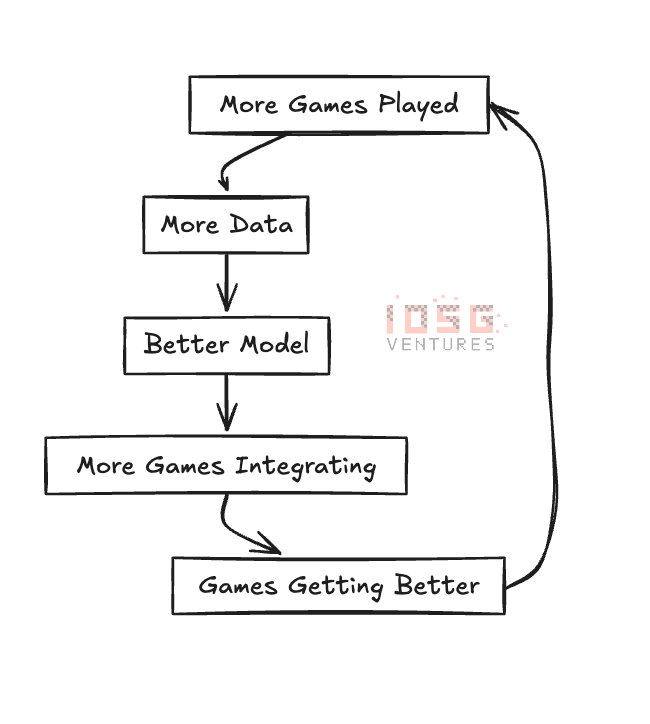
They initially developed a game called "AI Arena," where players essentially train their AI characters to battle. This helped them build a benchmark learning model that forms the foundation of the ARC SDK. This creates a flywheel effect similar to DePIN:
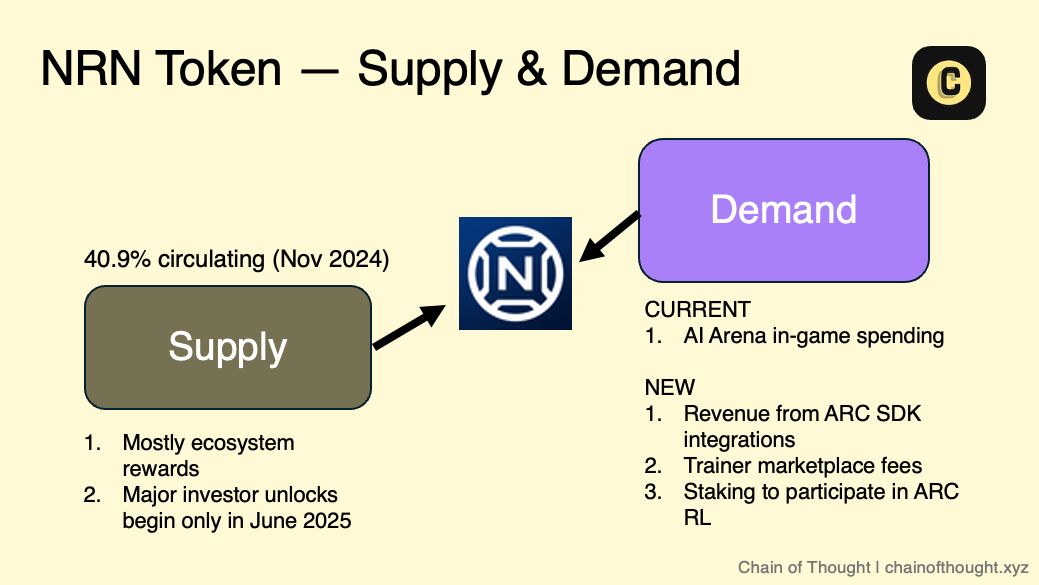
All of this is coordinated via their ecosystem token, $NRN. The Chain of Thought team explained this mechanism well in their article on ARC Agents:
Games like Bounty are taking an agent-first approach, building agents from scratch in a wild west-themed world.

Conclusion
The convergence of AI agents, game design, and crypto is more than just another tech trend—it holds real potential to solve longstanding issues plaguing indie games. The beauty of AI agents in gaming is that they enhance what makes games great: fair competition, rich interaction, and deeply engaging challenges. As frameworks like ARC Agents mature and more games integrate AI agents, we’re likely to see entirely new kinds of gaming experiences. Imagine worlds that feel alive not because of other human players, but because agents within them learn and evolve alongside the community.
We are transitioning from a "play-to-earn" era into something far more exciting: an age of games that are genuinely fun and infinitely scalable. For developers, players, and investors watching this space, the coming years will be extraordinary. Games beyond 2025 won’t just be more technologically advanced—they’ll be fundamentally more engaging, participatory, and alive than anything we’ve seen before.
Join TechFlow official community to stay tuned
Telegram:https://t.me/TechFlowDaily
X (Twitter):https://x.com/TechFlowPost
X (Twitter) EN:https://x.com/BlockFlow_News
 IOSG Ventures









