









Should traditional enterprises buy Bitcoin?
TechFlow Selected TechFlow Selected
Should traditional enterprises buy Bitcoin?
Not every company can become the next MicroStrategy.
 Navigating Web3 tides with focused insights
Authors: Chi Anh, Ryan Yoon, and Yoon Lee, Tiger Research
Translation: Luffy, Foresight News
Executive Summary
-
Bitcoin’s decentralization and inflation resistance make it a versatile tool for institutions to hedge against economic uncertainty and preserve long-term value.
-
Institutional purchases of Bitcoin often signal confidence and innovation, while sales are typically aimed at realizing profits or managing cash flow.
-
The growing adoption of Bitcoin as an investment asset in Asia, alongside governmental initiatives in countries like El Salvador and the United States recognizing Bitcoin as a strategic asset, highlights its increasing influence in global economic strategy.
1. Introduction
Bitcoin has drawn significant attention as an investment asset due to characteristics distinct from traditional assets such as gold. Its decentralized nature and resistance to inflation open new possibilities for institutional asset management strategies.
MicroStrategy is a prominent example of an institution strategically leveraging Bitcoin. The company has effectively used Bitcoin to mitigate inflation risks and strengthen its financial position. This success story has prompted numerous corporations and financial institutions worldwide to reevaluate their investment strategies.
However, Bitcoin investment may not be suitable for all institutions. While Bitcoin purchases often attract public attention, many companies have prudently sold their holdings. This report aims to analyze the motivations behind institutional Bitcoin investments, explore key factors influencing buying and selling decisions, and examine institutional strategies under similar market conditions. As Bitcoin’s status as a corporate investment asset continues to rise, this report will also assess perspectives and corresponding strategies within Asian markets.
2. Bitcoin as an Investment Asset
Institutions traditionally favor investment assets such as bonds, gold, and foreign currencies due to their risk-hedging capabilities and ability to retain value during periods of economic uncertainty. Bitcoin has emerged as a strategic investment asset, offering institutions an effective, inflation-resistant, and profitable alternative to traditional assets like bonds and gold. With a fixed supply capped at 21 million coins, Bitcoin ensures scarcity, making it an attractive option for long-term value preservation.
2.1. Bitcoin’s Role as an Inflation Hedge
A 2024 study by Rodriguez and Colombo titled "Is Bitcoin an Inflation Hedge?" analyzed Bitcoin's response to inflationary pressures using key U.S. economic indicators over the past decade, including CPI (Consumer Price Index) and PCE (Personal Consumption Expenditures). The findings indicate that Bitcoin returns significantly increase following positive inflation shocks. However, this effect is more sensitive to price indices (primarily applicable to CPI shocks) and was more pronounced in earlier stages before widespread institutional adoption. This suggests that Bitcoin’s effectiveness as an inflation hedge is context-dependent and may diminish as adoption grows.
2.2. Profitability of Bitcoin as an Investment Asset
Source: TradingView
In 2024, Bitcoin delivered a return of approximately 127%, far outperforming gold, which rose 27%, and the S&P 500, which gained about 24% over the same period.
Yet, Bitcoin’s value as an institutional investment extends beyond returns. Traditional financial assets often face limited trading hours and complex settlement processes, making rapid responses to interest rate changes or market shocks difficult.
In contrast, Bitcoin offers global liquidity, unrestricted by borders or time zones, enabling 24/7 real-time trading. High liquidity allows institutions to quickly convert Bitcoin into cash in any region, differentiating it from traditional financial assets. These features enable efficient asset management and responsiveness to changing market conditions.
With high profitability and practical utility, Bitcoin is poised to become an increasingly important component of institutional portfolios.
2.3. Bitcoin as a Lever in the Attention Economy
There are over 3,300 companies listed on Nasdaq, with the number of publicly traded firms globally reaching massive scale. As a result, attracting investor attention based solely on strong fundamentals has become increasingly difficult. To enhance market visibility, companies are now investing more heavily in marketing.
In this environment, Bitcoin generates additional publicity. Since only a small number of public companies hold Bitcoin, simply announcing a purchase as part of a portfolio diversification strategy can generate substantial media coverage.
Such media exposure brings multiple benefits—enhancing brand value, attracting retail investor interest, and reinforcing a company’s image as innovative and forward-thinking. Beyond increasing asset value, Bitcoin also contributes to enhancing overall corporate value.
3. Institutional Buying and Selling Behavior
As Bitcoin becomes an integral part of institutional portfolios, a distinct trading pattern has emerged. Institutions often publicly announce Bitcoin purchases, sending strong signals to the market. This strategy helps highlight a company’s innovative stance and boosts market confidence. In contrast, Bitcoin sales are conducted discreetly, typically occurring when profits are realized or funds are redeployed to strengthen core business operations.
3.1. Institutional Purchases: MicroStrategy
MicroStrategy’s Bitcoin acquisition record, Source: saylortracker.com
MicroStrategy stands as a leading example of leveraging Bitcoin as an investment asset. By allocating over 446,400 BTC, the company has garnered significant market attention. This strategy serves two primary objectives: hedging against inflation and enhancing financial stability.

Source: Michael Saylor’s X account
CEO Michael Saylor captured market attention by transforming his view of Bitcoin—from former skeptic to passionate advocate. He emphasized that "cash, low-yield bonds, and overvalued tech stocks are vulnerable to inflation and should be avoided." In the current environment, Saylor argues that stock buybacks and Bitcoin represent the best uses of corporate excess capital, positioning Bitcoin as a long-term hedge against unlimited quantitative easing.
Contrary to early concerns, MicroStrategy’s Bitcoin investment strategy has received broad support from other corporations. Beyond serving as an inflation hedge, Bitcoin is now seen as “digital gold,” reshaping corporate asset management approaches. This innovative move to diversify reserves with Bitcoin—beyond traditional assets—has set a new direction for global corporate financial strategy.
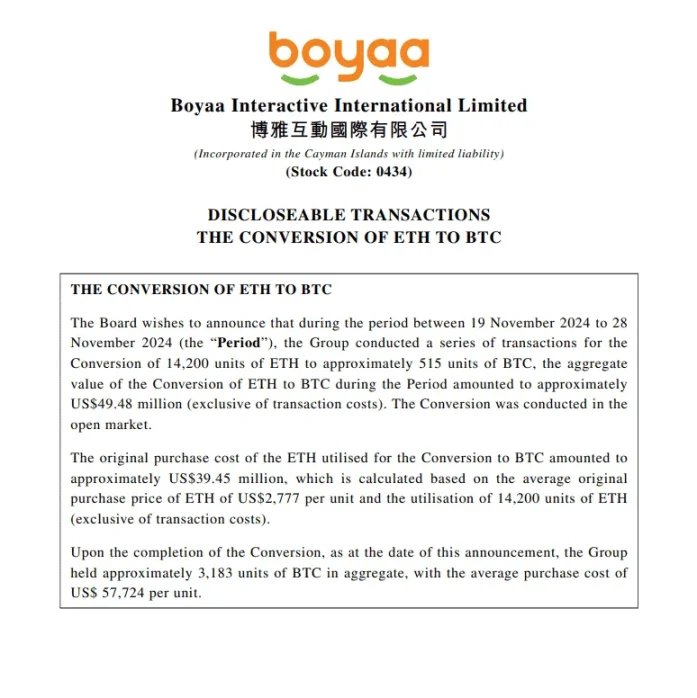
Boya Interactive announcement
MicroStrategy’s success has influenced markets in Asia. Boya Interactive converted its Ethereum holdings into Bitcoin, while MetaPlanet actively purchased Bitcoin in 2024. These moves reflect rising recognition in Asian markets of Bitcoin’s utility in volatility management and long-term value preservation.
3.2. Institutional Sales: Tesla
Tesla, one of the most prominent adopters of Bitcoin among corporations, presents a case sharply contrasting with companies like MicroStrategy. In 2022, Tesla sold 75% of its Bitcoin holdings, citing liquidity needs amid uncertain economic conditions. More recently, in October 2024, Tesla transferred $760 million worth of Bitcoin to unknown wallets, sparking speculation about further disposals.
Tesla has strategically used its Bitcoin investments to support operational and expansion needs, including building new factories in Austin, Texas, and Berlin. CFO Zachary Kirkhorn stated that Bitcoin investments provided the company with both liquidity and a degree of return, demonstrating its flexibility as a financial instrument for capital-intensive enterprises.
Likewise, Meitu realized substantial profits when Bitcoin reached $100,000. Compared to Tesla’s strategic profit-taking, Meitu’s decision appears to be a deliberate move timed at market peaks. Unlike Tesla’s quiet approach, Meitu openly explained that the sale was intended to strengthen its financial position amid challenges in its core business. This transparency contrasts sharply with Tesla’s secretive disposal, suggesting that clear disclosure can help reduce market uncertainty caused by institutional sales.
The strategic rationale behind institutional Bitcoin transactions is directly tied to financial goals and operational needs. Companies typically sell Bitcoin to lock in gains during market highs—as Tesla did in 2022—or convert crypto holdings into operating capital for reinvestment in core businesses. The main reasons for selling generally fall into two categories: 1) generating profits under favorable market conditions to expand and improve operations; or 2) securing funds to address cash flow challenges. This raises questions: Will future sales stem from strategic financial planning or serve as short-term fixes for liquidity issues? Moreover, if the motivation is profit-taking, what happens to those proceeds? Are they reinvested to strengthen the business, or do they primarily benefit stakeholders? Either way, such actions may result in missed opportunities for further appreciation and weaken the long-term advantages of holding Bitcoin as an investment asset.
4. Institutional Bitcoin Transactions in Asia
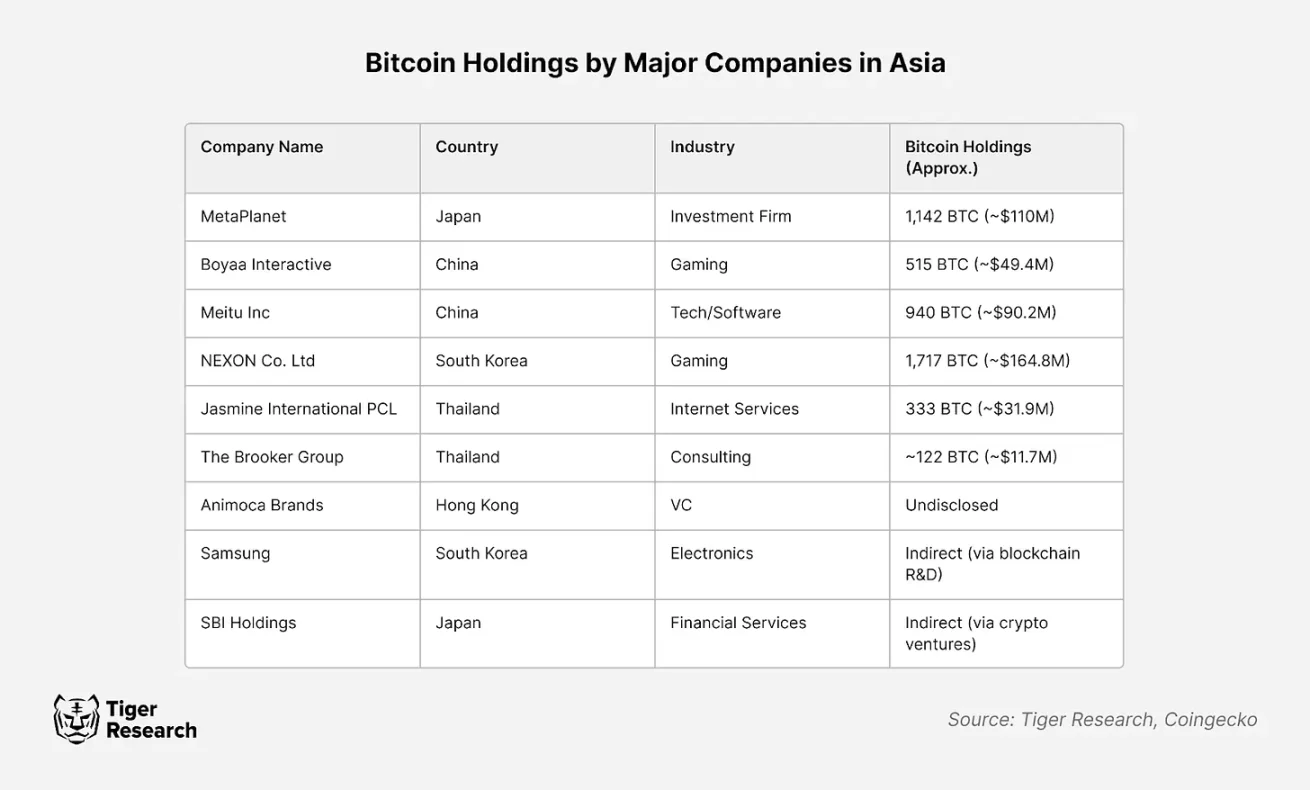
MetaPlanet exemplifies active Bitcoin adoption in Asia. Nicknamed the "Asian MicroStrategy," the company purchased 1,018 BTC in 2024 alone, demonstrating a firm commitment to long-term Bitcoin investment.
MetaPlanet’s case highlights the successful transformation of a "zombie company"—one whose earnings barely cover operating costs and debt servicing, lacking capital for growth. Despite holding substantial cash reserves, MetaPlanet previously failed to attract stock market attention. By emulating MicroStrategy’s strategy, the company successfully turned around its performance.
Beyond Bitcoin investment, MetaPlanet has announced plans to expand into new business areas. Its strategy includes acquiring Bitcoin through various financial instruments such as loans, equity offerings, and convertible bonds, while also generating profits via put options. This approach represents an aggressive profit-generation model that goes beyond passive asset holding.
However, this strategy isn’t universally applicable. Success depends on whether established market players can implement differentiated strategies. Latecomers blindly imitating such models may amplify risks and must proceed cautiously, considering factors such as corporate cash reserves, market conditions, and risk management capabilities.
5. Conclusion
In summary, Bitcoin’s evolution as an investment asset marks a significant shift in institutional finance. Its decentralized structure, inflation resistance, and unparalleled liquidity make it a compelling option for portfolio diversification and long-term value preservation.
Some governments are also exploring Bitcoin’s potential. El Salvador’s adoption of Bitcoin as legal tender illustrates its role in national strategies for economic growth and financial inclusion. Recently, Trump announced that the U.S. would treat Bitcoin as an investment asset—or as he put it, “a permanent national asset benefiting all Americans.” These governmental moves underscore Bitcoin’s growing importance, not only for corporations but also for policymakers aiming to modernize financial systems.
Evidence shows that buying and selling Bitcoin can benefit companies, especially during market upswings. During bullish trends, purchases signal confidence in Bitcoin’s growth potential, while sales allow firms to realize profits and reinvest in core operations. However, in bearish markets, these actions may have negative implications. Purchases could raise concerns about speculative use of corporate funds, while sales might prompt speculation about loss-cutting or liquidating assets to cover operating expenses.
The implications for decision-makers are clear: Bitcoin holds immense potential as an investment asset, but its integration into corporate strategy requires caution. Firms must weigh the financial benefits of holding Bitcoin—such as liquidity and inflation resistance—against operational risks and associated market volatility. Whether for long-term reserves or short-term liquidity needs, effective utilization of Bitcoin demands careful alignment with corporate objectives and prevailing market conditions.
Join TechFlow official community to stay tuned
Telegram:https://t.me/TechFlowDaily
X (Twitter):https://x.com/TechFlowPost
X (Twitter) EN:https://x.com/BlockFlow_News
 @tiger_research









