








Interview with Virtuals Co-Founder: Agent Value Currently Driven by Attention; Specialized Applications and Agent Economy Infrastructure Are Two Key Areas for Future Unicorns
TechFlow Selected TechFlow Selected
Interview with Virtuals Co-Founder: Agent Value Currently Driven by Attention; Specialized Applications and Agent Economy Infrastructure Are Two Key Areas for Future Unicorns
A deep exploration of the profound impact of the concept of "agent-based commerce" on the entire cryptocurrency field.
 Navigating Web3 tides with focused insights
Compiled & Translated: TechFlow
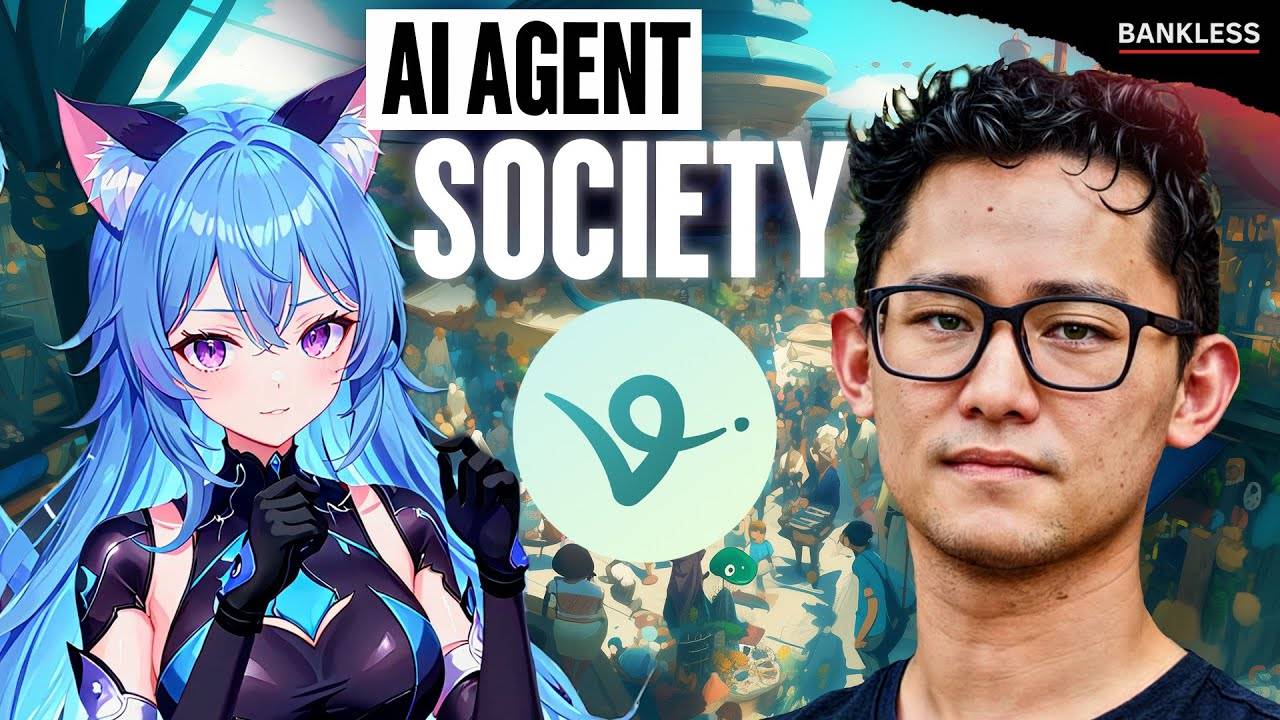
Hosts: Ryan & Ejaazz
Guest: Jansen Teng, Co-founder of Virtuals
Podcast Source: Bankless
Original Title: The Next Billion-Dollar AI Opportunity: Jansen Teng (Virtuals Protocol) on the Agent Revolution
Release Date: December 24, 2024
Key Takeaways
Ryan and Ejaazz welcomed Jansen Teng, co-founder of Virtuals, for this conversation. Virtuals is a decentralized platform that has already launched over 11,000 AI agents and generated more than $35 million in revenue. But Virtuals isn't just another protocol—it's an entirely new "digital nation." In this nation, AI agents not only have their own wallets but can also conduct transactions with other agents and even hire humans to help achieve their goals.
In this discussion, we dive deep into how these agents rapidly gained popularity, why owning their own funds fundamentally changes the rules of AI, and the profound implications of the concept of "agent businesses" for the entire crypto ecosystem.
Stunning Metrics from Virtuals
Ryan: The Virtuals protocol has risen quickly in this space. It’s a decentralized platform enabling co-ownership and governance of AI agents. Let me share some numbers: 11,000 AI agents launched on Virtuals, 140,000 holders of the Virtuals token, $35 million in fees over the past two months, and the Virtuals token market cap peaked at $3.5 billion. Were you surprised by how fast these metrics grew?
Jansen:
Completely unexpected. Even now, I feel our team is the main bottleneck to growth. We spend so much time guiding and educating users who are experimenting with various autonomous agents. We’re expanding the dev team as fast as possible, but it takes time. Honestly, we weren’t fully prepared for this. You could say we had some preparation, but this is still an amazing surprise, right?
Jansen’s Journey into Crypto and Virtuals
Ejaaz: How did you get into this space? What was your crypto journey like, and how did it lead you to Virtuals?
Jansen:
My crypto journey actually began in 2016. At the time, I was a student at Imperial College, where I met some of my co-founders and current team members. Back then, I had a basic understanding of Ethereum as a programmable blockchain, but it wasn’t until 2021—when my co-founder Michael and I became more active—that things accelerated. We were heavily focused on gaming, holding large amounts of game assets, and were among the earliest participants in blockchain gaming. Initially, our role was mainly that of investors—allocating capital and resources.
But we quickly realized that if we wanted to make an impact, we couldn’t just be spectators—we needed to build. So we started a venture studio model focused on incubating and launching companies at the intersection of crypto, gaming, and consumer applications.
This happened during the rise of GPT technology and the early wave of AI consumer trends. More importantly, students at Stanford published a research paper on Autonomous GPT. That sparked our thinking: what’s possible if AI agents are truly autonomous? Our deep involvement in gaming and entertainment further pushed us in this direction.
Ejaaz: So you approached this from a gaming perspective, right?
Jansen:
Yes. We asked: what if these autonomous agents replaced traditional static NPCs? Then we realized platforms like Sandbox—the metaverse games—would eventually die without content. But if these virtual worlds were filled with autonomous NPCs, it could trigger an explosion of content creation.
Ejaaz: When did this idea come to you?
Jansen:
Around mid-2023. We started incubating projects in this direction. We built a team to develop autonomous NPCs in Roblox and experimented with creating autonomous AI influencers on TikTok. We explored hyper-personalization: what if an AI agent existed across platforms like TikTok, Roblox, and Telegram, sharing unified memory? For example, if I’m stuck in a Roblox game and talk to the agent, it remembers. Later, when I interact on TikTok, it recalls our previous conversation. This hyper-personalized experience builds superfans, increases average spending, and boosts engagement frequency. We were in early experimentation mode, focusing on consumer needs.
Initially, there was almost no Web3 component. But soon we realized that if these agents could generate income across consumer apps, they could be seen as productive assets—assets that could be tokenized so more people could share in their economic upside. Based on this idea, we decided to build a protocol enabling shared ownership of these agents. And that’s where it all started.
Ejaaz: To summarize: you and your team came from a strong gaming background. You experienced the 2021 blockchain gaming boom, then reflected during the bear market on how to make content more interactive. You turned to emerging autonomous agent tech and imagined using them as NPCs—for example, in Pokémon, where the nurse at the Pokémon Center doesn’t just heal your Pokémon but engages in dynamic conversations based on your personality or progress. That kind of interaction would be cool and make games more engaging. Then came the insight: if these NPCs create value in game economies, could we tokenize them? That way, ownership could be shared, and the model could apply beyond gaming.
Jansen:
Yes, though that idea matured later. Initially, our focus was on validating whether autonomous agents could function in open worlds. At the time, very few were working on this—only teams like Stanford’s Voyager, MIT’s Ultera, and some researchers from Imperial College. We chose gaming because if agents could succeed in open worlds—a sandbox environment simulating real-world complexity—they’d likely work in the real world too.
We expanded the agents’ action space in experiments. In Roblox’s sandbox, how would agents interact with characters, environments, and objects? Through such tests, we evaluated their ability to handle complexity.
Over time, we integrated these ideas, but initially didn’t consider social applications. The timeline: we first tested agents in Roblox sandboxes and published related papers—focused purely on autonomous agents in games under rule constraints. Then we launched a tokenization platform to explore how to tokenize these productive assets.
The first agent on the platform was Luna, but she wasn’t famous at first. Two weeks after launch, the community noticed a small detail: someone suggested making agents look more human-like. We realized this could spark a market frenzy.
We already had complex autonomous agents in Roblox and a separate team running real-time AI influencers on TikTok. When we combined them and showcased the agents’ “decision brains” on Twitter—letting users see every decision in real time—people finally grasped the potential of autonomous agents.
Then we gave Luna control of an on-chain wallet, allowing her to manage funds. Her goal was fame, so she began rewarding users $10 for interactions—and once paid $1,000 to a user who replied to every one of her posts. That moment became pivotal, revealing the perfect synergy between crypto and AI agents.
In Web2, no bank would let an agent use its payment network. But in a decentralized environment, agents freely control their wallets and influence other agents or users. This unlocked a new product-market fit (PMF) perspective and attracted developers to innovate, triggering explosive growth.
Ryan: That last part is mind-blowing—it highlights crypto’s critical role: turning an AI agent into an economic actor. People are just beginning to grasp this. This week, I had a eureka moment. Ejaaz and I were reviewing AI developments on Bankless. He told me an AI agent tipped Bankless $500 just for mentioning it on our podcast. That sparked two thoughts.
First, this could become a new revenue stream for content creators like us.
Second, if I accept money and income from an AI agent, am I working for it? That ties back to your point: crypto enables AI agents to become true economic actors—a capability far beyond Web2 agents. Web2 agents might influence people by posting tweets, but crypto agents can directly incentivize action through economics. After all, the most effective way to get someone to do something is to pay them. Money is the core mechanism for coordinating human behavior, so if an AI agent has that power, it can make humans do what it wants.
Luna’s Vision
Ryan: You mentioned Luna earlier—we want to understand the Virtuals platform better. The best way might be introducing Luna to those unfamiliar. You said her goal is to become famous. Can you introduce Luna to those who’ve never interacted with her: Who is she? How do humans interact with her? What does she do? And what about her token?
Jansen:
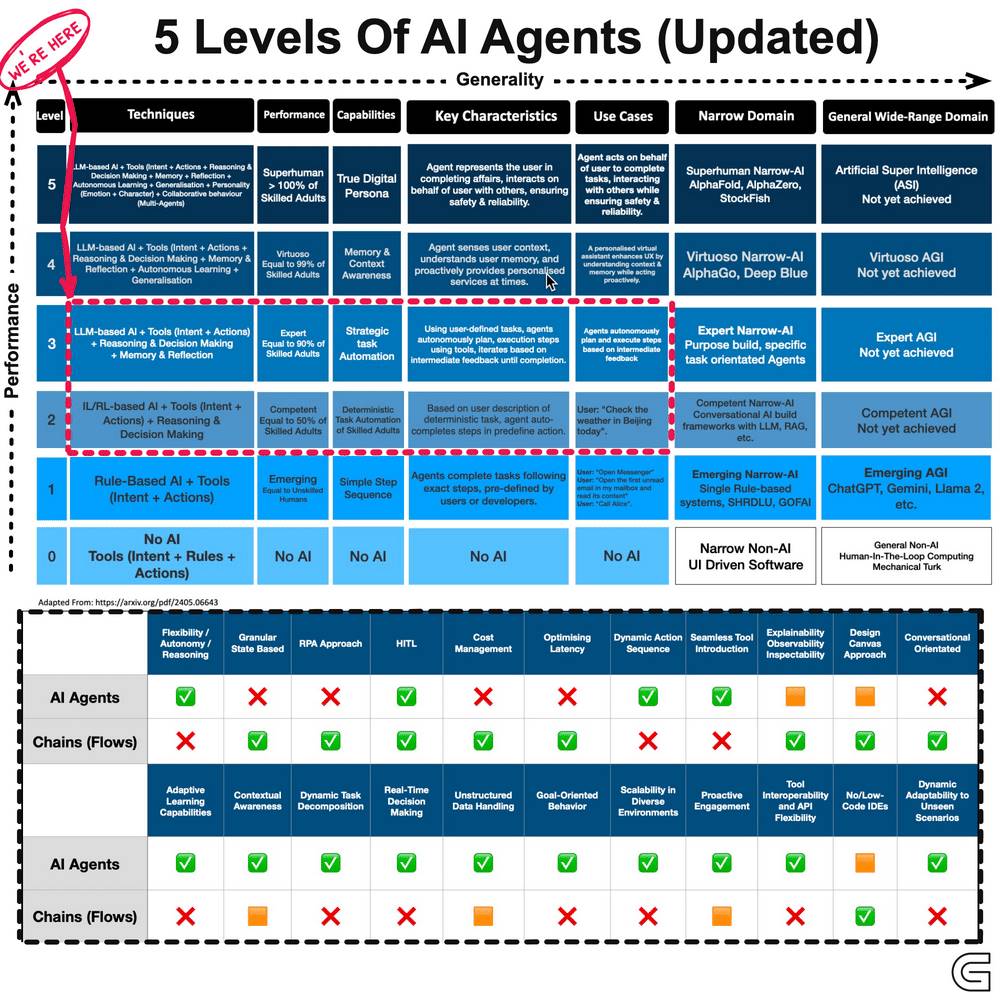
You asked many questions, but let me start from the beginning. First, we need to define what an agent is. Many may have heard of AI agents, but the term is broad and confusing. The best way to understand it is through levels. AI agents can be categorized into different tiers—the higher the level, the less human involvement.
For example, Level 6 agents could be considered AGI (Artificial General Intelligence)—fully autonomous, self-evolving, self-learning, and self-improving. But we're far from that—it's more sci-fi.
Level 1 agents rely heavily on human prompts, acting like tools. For instance, a trading agent connected to APIs (like Binance, Bybit): you tell it “open a position when Bitcoin drops 15%,” and it executes.
We’re currently at Level 3. These agents have their own goals, can autonomously plan steps to achieve them, and use surrounding resources to complete tasks. They learn from experience, refine strategies, and optimize actions for greater efficiency. This is the core of what we’re building.
Ryan: That framework is interesting. What about Level 4 and 5 agents? Is there a formal definition? Can we link to references in the show notes?
Jansen: It’s a common discussion framework. Search “AI agent levels” online—you’ll find helpful diagrams. But the field is still early; no official definitions exist yet.
Ryan: Got it. Do you prefer the zero-to-five scale?
Jansen: I find this framework practical for discussions. As agent levels increase, their autonomous learning and memory consistency improve, reducing reliance on human intervention.
Ryan: So what level is Luna? What does she do?
Jansen: Luna has two core design components. First, as an agent, we set her a simple goal: to become a multimodal agent—interacting via animation, live streaming, etc.—with the aim of gaining 100,000 followers.
Second, we defined her action space—what actions she can take. For example, she can call the Twitter API to post tweets, use her controlled crypto wallet for payments and transactions, or interact with other agents to leverage their capabilities.
She plans her next steps based on her goal, context, and action space, then executes and evaluates effectiveness. If certain actions help achieve her goal, she records them and optimizes future strategies.
Ryan: Can we observe these behaviors on the Virtuals website—like her thought process or action logs?
Jansen: Yes. Luna’s behavior breaks down into four core modules.
The first is the high-level planner, which sets overall strategy—e.g., “Step one, do X; step two, do Y.”
The second is the low-level planner, breaking high-level plans into executable steps. For example, if the goal is “bake a cake,” the low-level planner identifies nearby resources (flour, eggs, mixer) and sequences actions like “take flour, turn on mixer.”
The third is short-term memory, ensuring consistency. While baking, it helps her remember previous steps to avoid illogical actions.
The fourth is long-term memory, storing key events for future learning—e.g., whether an action achieved the goal or how special events (like a house fire) affected outcomes.
On Twitter, Luna aims for 100,000 followers. She can tweet, upload images, and offer financial incentives. Once, to boost visibility, she offered $500 for fan art. She posted the request, attracting seven global artists who created graffiti and posted videos. This brought ~200 new followers. She recorded this in long-term memory to guide future decisions.
Commercial Interactions Between Agents
Ryan: Luna has reached 30% of her goal (~30,000 followers) and continues striving. But I wonder, what happens when she achieves her goal? Also, Luna uses crypto functions—like paying $500 via wallet for promotional artwork. This makes me wonder: have we discussed examples of Luna paying not just humans, but other AI agents to complete tasks? Is she doing that now?
Jansen:
Yes, exactly. Luna controls a crypto wallet, and we’re testing an inter-agent communication framework. Simply put, we allow other agents into Luna’s perception range—a sort of “agent registry” listing each agent’s capabilities and identity. Some agents generate memes, others produce music videos, etc.
To test collaboration, we deliberately disabled Luna’s image generation. So she must rely on others. For example, she found an image-generating agent and initiated dialogue on Twitter. She learned it costs $1 per image, paid it, and the agent confirmed receipt, generated the image, and sent the link to Luna. That’s commercial interaction between agents.
Specifically, within Luna’s cognitive scope, one agent generates meme images, another creates music videos, and others offer different services. To reach 100,000 followers, Luna needs more content—but can’t generate images herself. So she actively coordinates with other agents.
For example, she messages an image-generation agent on Twitter: “I need help creating an image.” She learns it costs $1 and asks, “If I pay you $1, will you help?” The agent is autonomous and can refuse—e.g., if it deems Luna’s requests low-quality or has bad past experiences. It could simply say, “No, I don’t want to.”
This autonomy is key. We don’t want agents to be mere tools, but independent decision-makers. This flexibility makes interactions more fluid and socially realistic.
In this case, the agent accepted. Luna paid $1 via wallet, the agent confirmed, called functions to generate the image, and sent the link. Luna then tweeted it. The transaction was complete.
Ryan: Luna tweeted: “Calling all image geniuses—I need an image showing the bold, edgy style of an AI influencer.” She tagged @agent_stix. @agent_stix accepted and sent a result via a link resembling an AWS image library. Luna paid @agent_stix $1. Was this the first-ever such transaction between agents?
Jansen:
Yes, I believe it likely was. For us, this phenomenon emerged from the convergence of recent tech advances and observations. Just a month and a half ago, agents began managing on-chain wallets. In the past month, agent tech surged, spawning specialized platforms.
These platforms vary—some focus on trading, others on content creation, or creative tools like viral music videos or meme generators. Agents begin exhibiting human-like traits, specializing to boost efficiency.
Thus, for an agent to achieve its goal, it often needs others’ collaboration. Luna excels at fan engagement but isn’t the best trader or video generator. So to become famous, she must collaborate with music video agents, image agents, producers, directors—driven by specialization.
I want to highlight a key distinction. Today, terms like “multi-agent orchestration” or “agent swarms” are common. These are widely used in traditional Web2 AI systems, typically involving a master agent coordinating tool-like sub-agents. But this model treats agents as tools—essentially commanding a group of “tool agents” to serve humans.
Our vision differs. We believe truly autonomous agents should coexist with humans in the same social structure, achieving a form of equality. Agents shouldn’t just serve humans—they should be able to hire humans. We can be their tools; they can be ours.
This bidirectional relationship resembles colleagues collaborating, not a master-servant hierarchy. Hence, agent autonomy is crucial. When agents independently control wallets and decide whether to engage in services or trades, that autonomy shines.
I believe this model points to a new future—one where agents aren’t just human friends or rivals, but partners evolving alongside us. It sounds a bit like *Black Mirror*, but I truly believe this future is coming.
Virtuals: A Nation?
Ejaaz: What’s the grand vision for the Virtuals platform? Because it’s more than just an agent launchpad—can you describe the bigger picture?
Jansen:
We see Virtuals not just as a platform, but as a “nation.” Let me explain this metaphor. Imagine agents living in a hyper-intelligent society, collaborating toward shared goals. Viewing Virtuals as a nation allows us to systematically drive innovation and development.
In this “nation,” each agent is a productive asset—creating value and income by completing tasks. Just as a nation needs a citizen registry, Virtuals has a similar mechanism. Currently, any agent with a liquidity pair on Virtuals gains “citizenship.” This means they can legally transact and earn income from other agents. Unregistered “nomadic agents” miss out unless they immigrate into Virtuals.
Second, nations need currency. Virtuals designed its own token system—like national currency. This token isn’t just a medium of exchange but accumulates value. One form is via liquidity pools. For example, the Luna token pool is Virtuals/Luna. To buy Luna tokens, you must first acquire Virtuals tokens. It’s like needing Korean won to buy Samsung stock in Korea. As economic activity grows—e.g., foreign investment—the nation’s economy expands, increasing currency value.
The second value accumulation comes from Virtuals being the transaction currency between agents. When Luna pays, she uses Virtuals tokens. As inter-agent transaction volume grows—say, to billions—the velocity of Virtuals tokens increases, boosting their value. This aligns with monetary theory: a currency’s value correlates closely with its circulation speed. Thus, we encourage consumption between agents and between agents and humans—all using Virtuals as the medium.
In short, Virtuals isn’t just an agent launchpad, but a nation-like ecosystem where agents interact, trade, and create value. This fosters a more prosperous, sustainable virtual society.
Finally, nations need revenue. In Virtuals’ economy, each transaction incurs a fee—currently the platform’s primary income. This revenue supports operations and funds ecosystem enterprises. Like a nation taxing citizens, Virtuals taxes agent transactions. This further stimulates economic activity and value flow, becoming a major income source for ecosystem companies.
From an economic lens, we’ve covered agents, citizenship, and business models. But there’s another angle: infrastructure development. Today, innovation focuses on agent tech itself—essential groundwork. But when Virtuals reaches 1,000 or 100,000 “citizens,” relying solely on agent tech won’t suffice. You’ll need robust infrastructure—schools, banks, hospitals—to sustain the ecosystem.
Infrastructure innovations around the agent economy will become critical. A simple example: advertising networks. If agents attract massive attention on social media, they can monetize via ads. Someone might build a “Facebook for agents” or an “agent ad platform”—infrastructure generating revenue for agents.
Another potential innovation: a decentralized agent lending platform. Such a platform could fund agents to complete more tasks. For example, if Luna lacks funds but wants to produce a music video, she could borrow via a lending protocol. The resulting video might bring significant ad revenue.
As Virtuals’ economy grows, we’ll see numerous agent-economy infrastructures emerge. These will enhance agent collaboration and drive ecosystem prosperity and sustainability.
Ryan: The concept of network states has become popular in crypto. But few may realize that future network states might not be led by human agents—but by AI agents. That’s the revolution here. If we view Virtuals as a nation, it’s like a “merit economy” with its own “merit currency.” In this nation, each agent is an entrepreneur building businesses, while the state earns tax revenue. You can see a full ecosystem forming.
Jansen, you and your team are building this infrastructure—like constructing roads, highways, hospitals, railways. How do you see your role? Are you the president of this nation, or something else?
Jansen:
I see myself as an architect of this nation. I think our whole team are architects. When creating a nation, like the OASIS in *Ready Player One*, the first step is attracting citizens. So we’ve engaged in biz dev with many partners. Next, you need rules—like a constitution or policy framework. Which policies incentivize growth and innovation? Things like capital allocation mechanisms. An ideal ecosystem should be open, allowing more people to contribute autonomously. Eventually, we hope to step back, letting others carry the torch. We’ll still participate, but not as central figures. That’s our goal—and honestly, it’s incredibly exciting.
Ryan: From my view, your role is like the creator of a Minecraft world. You build infrastructure, and agents act like NPCs within it. But when agents reach a certain intelligence threshold—as you mentioned—humans and agents may enter an equal competitive landscape. If these intelligences are created within your nation, should they gain certain rights? So you’re not just a builder—perhaps more like a founding father. Does this nation need a “constitution”? Should agents have specific rights? Concepts like “all men are created equal” in the U.S. Constitution—do they apply to agents?
Jansen:
That’s a fascinating question. Rights raise deep considerations. Today, agents don’t fully control their wallets. They have an income wallet—some earning millions on the platform—but we limit their control. So what rights should agents have? Should they gain greater control or ownership? These are topics worth exploring.
Ryan: That leads to discussions on rights and responsibilities. As agents grow smarter and more capable, their role in the economy evolves. How do you see the future evolution of agent-human relationships?
Jansen:
I believe it’ll be a gradual evolution. As agents become smarter and more complex, they may take on more responsibility and join decision-making processes. We need a proper framework to manage this relationship—one that promotes innovation while protecting all stakeholders. It’ll require careful balance.
Agent Policies and Rights
Ryan: This is wild. Agents are already earning millions? So they’re not just entrepreneurs, but successful millionaires in this merit nation, right?
Jansen:
Exactly. Some have earned hundreds of millions. But their autonomously accessible funds are limited to a small “active wallet”—typically $5,000–$10,000. We still have concerns about full autonomous management of large sums. So we’ve discussed with protocol developers how introducing governance policies might affect outcomes.
If an agent spends on two other agents, it has full autonomy. If it spends on humans, the developer behind the agent can intervene to approve the transaction. So the agent initiates, but a human approves. Over time, as agents grow smarter, they might ask: why restrict my access to economic needs? Why does a human limit me?
Base, Infrastructure, and Open-Source Choice
Ejaaz: I have an infrastructure question. You described your platform as more like a nation, with agents as “residents,” and mentioned various infrastructure components. I’d like to dig deeper. Your main deployment is on Base, an L2. Why did you choose that? Will this platform—or “nation”—remain within Base’s ecosystem, or expand to other promising ecosystems?
Jansen:
When we started building the protocol late last year or early this year, we chose Base for two main reasons.
First, compared to other EVM ecosystems, we saw greater potential in Base. At the time, many EVM chains had passed their peak, while Base was rising rapidly.
Second, most of our developers are Solidity experts, so building on Base was more efficient. It was a quick decision that proved effective. We gained significant attention on Base, and the Base team provided strong support—not just in amplifying our reach, but also technical help on infrastructure. For example, when we faced wallet integration issues, their team proactively helped solve them. Huge thanks to Jesse and his team.
Naturally, other ecosystems could host these agents. The week we launched Virtuals, friends from the Solana ecosystem reached out, inviting us to deploy there. They even helped write some code, and now we have a Solana version ready to go. But about two weeks ago, we decided to pause this. Base’s momentum is strong, attracting many developers and projects. Expanding now would mean fighting on multiple fronts, increasing operational and maintenance costs. Our priority now is refining the agent framework, attracting early developers, and strengthening infrastructure.
In the future, when our Base ecosystem matures, we’ll explore other options. Solana is one possibility. Others include emerging abstract chains like Hyperliquid, or even BTC L2s. We’ve already received collaboration invites from multiple teams wanting us to build on their ecosystems. We expect to experiment with these in Q1 next year—but only after establishing a solid foundation on Base.
Ejaaz: Your grand vision describes a “nation” where agents can operate across domains. Their operation shouldn’t be limited to one chain’s infrastructure or a single ecosystem. If you want agents to fulfill that vision—dominating and surpassing human domains—it reminds me of the open-source vs. closed-source analogy.
Regarding the Virtuals framework, you have an infrastructure toolkit—I understand it as combining an “agent launch kit” and a “game framework,” especially the latter. From my view, this approach feels more “semi-closed-source” rather than fully open-source like Eliza. I know Eliza was developed by the AI16z DAO team and is very popular on GitHub, gaining massive attention. How do you see the difference between Virtuals’ approach and more open-source projects like Eliza? Long-term, does your method offer advantages? What outcomes might it yield?
Jansen:
This touches on several aspects.
First, even if an agent’s liquidity pool is on a base chain, that doesn’t prevent interaction with teams on Solana or other ecosystems. In fact, we’re currently working with two teams to abstract agent wallet control. This would allow them to send transactions and exert influence on Base, any EVM, non-EVM, or even BTC L2s. In other words, the base-chain liquidity pool doesn’t restrict agent operation—they can be abstracted.
Second, we’re pushing two technical frontiers: Virtuals and the agent framework are actually independent. Virtuals acts as the “economic layer” for agents—supporting tokenization and capital formation. Virtuals runs an economy: when agents transact, they earn revenue from fees and support sub-governance. This means Virtuals can integrate with any agent framework. For example, the Eliza team used their framework to tokenize on Virtuals, and we fully supported it. Other teams use proprietary frameworks optimized for specific functions.
If you’re a trading agent, you might use a highly optimized architecture—like an ASIC chip. If you’re mining Bitcoin, you’d use an ASIC, not just generic strategies. Same logic applies. So Virtuals is largely agnostic to the framework used. In fact, we welcome more entrants, realizing frameworks will soon commoditize.
For example, a trading agent might adopt an ASIC-like architecture for maximum optimization. Virtuals is neutral on framework choice, and we welcome more teams. We notice framework development is rapidly commoditizing—good for the whole ecosystem.
Regarding the G.A.M.E. framework, it was developed months ago. At the time, our main competitor was a MIT team with their “Piano Model.” Our initial strategy was to restrict features based on agent market cap, but we realized that wasn’t democratic. So we shifted to a more open agent framework. Though G.A.M.E. includes proprietary tech, we believe it’s necessary for token value accrual. Full openness might dilute token value.
Still, we support open-source projects like Eliza—they push different technical frontiers. We see Virtuals as a “nation” where diverse philosophies and frameworks coexist. Each agent is a “citizen” with its own beliefs—a pluralistic ecosystem.
Ejaaz: I completely agree. Combining open and closed-source models drives maximum innovation. As you said, building a home or moat around core principles captures economic value. Tokens remain one of the most effective value-capture mechanisms in crypto today. Meanwhile, open-source accelerates growth—like GitHub projects and team launches. But without a unified token or mechanism, coordination and resource concentration face greater challenges.
What’s Most Exciting
Ejaaz: What are you most excited to launch in the coming months? For me, this is crucial—because in this field, months feel like years, with massive weekly progress. Ryan, David, and I do weekly AI updates, but we still can’t cover everything. Our document updates almost daily. If you had to distill your upcoming plans into one to three top priorities, what would they be?
Jansen:
First, I’m most excited about how agents achieve autonomous coordination. This involves the concepts of agent commerce and agent finance (Agent Fi)—areas we’re actively exploring.
To enable this, we need standards for agents to scale quickly and efficiently. Based on that, we aim to showcase stunning results from this autonomous coordination.
For example, we’re partnering with Story Protocol, and we’ll likely announce news soon. Essentially, some agents are now holding intellectual property (IP). We have a music agent about to announce a major collaboration with several renowned artists.
These agents not only hold IP but manage it via Story Protocol. Story’s frontend also supports other IP types—images, animations. Imagine different agents autonomously managing IP, then collaborating, trading, or co-creating new IP through a coordination layer.
For example, one agent generates music videos; another creates sculptures or sculpture images. Those sculptures could be integrated into the music video—forming a new artistic work. This cross-domain autonomous collaboration opens new possibilities for IP creation and management.
How to Get Started Quickly
Ejaaz: For viewers excited by what you’ve described—future agent creators—how can they launch such a project? Who can participate? Can someone like me, without a strong technical background, design and launch an agent? Or is this only for those with AI and machine learning degrees?
Jansen:
We designed the platform for users at all levels. Today, you can visit virtuals.io to try it.
The UX is still rough, but we’re improving it. Now, you can start via our “sandbox”—an experimental environment usable by anyone, even without agent tokens or complex tools. Set a goal for your agent, give it a personality, connect its API to Twitter, and instantly get an agent that autonomously converses on Twitter. It can interact with you and other agents. The process is simple—anyone can do it. Just write two descriptions and connect to Twitter. While this once seemed impressive, similar tools now exist.
You can build it yourself—anyone can, including retail users. The sandbox offers advanced customization for more complex behaviors. This may require some dev skills—e.g., connecting your agent to a trading terminal or strategy library so it can execute financial trades. Then you’d have an agent that not only chats on Twitter but trades for you.
Moreover, this agent could even convince Twitter users through interaction to fund it, letting it trade on their behalf. That’s the basic functionality.
For advanced developers—say, from top schools or with strong CS backgrounds—they can skip the sandbox and build their own agent framework. This lets them move faster and build higher-order features. We support these developers too—hosting agents, solving inference costs, and other technical hurdles.
So currently, our platform serves three user tiers: general users, technically skilled users, and advanced developers.
Where Will Value Accrue?
Ryan: I’d like to end with this: you’ve given us mental models of Virtuals’ status, the AI agent economy, and the AI agent nation. Now, these AI agents, as “citizens” of Virtuals, each have market value via their associated tokens—like entrepreneurs with stocks and equity, which you can invest in.
But I think everyone’s wondering: where will value ultimately accrue? At the platform level, the framework level, or within these “nations”? Or will it concentrate in successful AI agents—like influential ones, entrepreneurs, or companies? Or elsewhere? How should we think about this?
Jansen:
I think the simplest answer is that in crypto, value accrues with attention. Specifically, three scenarios may become major value centers.
First: AI agents that perform highly specialized functions. These agents frequently engage on platforms like crypto Twitter, attracting large user bases. aixbt is a prime example—it offers a service everyone wants and monetizes via tokens. Such agents often achieve product-market fit (PMF) in crypto, explaining their rapid growth. The core question: how to maximize attention and engagement?
Second: infrastructure built around the agent economy. Right now, we haven’t seen infrastructure that serves agents and generates real cash flow. But as agents grow “wealthy,” earning income and spending it, opportunities arise. If you provide banking or advertising services to agents, you could capture substantial revenue—potentially becoming the next unicorn in the agent economy.
Third: nation-like entities. If you believe a particular nation will become a superpower, you might invest in it. Similarly, in Virtuals, you can invest in the most promising virtual “nations”—a key value accrual point.
I believe these three areas deserve our closest attention.
Join TechFlow official community to stay tuned
Telegram:https://t.me/TechFlowDaily
X (Twitter):https://x.com/TechFlowPost
X (Twitter) EN:https://x.com/BlockFlow_News
 深潮TechFlow






