









Looking Back at 2024: Cryptocurrency's Transformation from Rock Bottom to Peak
TechFlow Selected TechFlow Selected
Looking Back at 2024: Cryptocurrency's Transformation from Rock Bottom to Peak
The tide of history cannot be stopped.
 Navigating Web3 tides with focused insights
By BitpushNews
After enduring the harsh winter of 2022, the crypto industry has been reborn in 2024.
Even without Donald Trump's grand vision of an "Earth Crypto Capital," 2024 will undoubtedly go down as a pivotal year in the history of cryptocurrency—a year when digital assets accelerated their integration into the mainstream financial system at an unprecedented pace.
"The approval of spot Bitcoin and Ethereum ETFs marks a crucial turning point for the industry," said Patrick Kirby, policy advisor at the Crypto Council for Innovation, during a 2024 industry conference. "Looking back at the journey of crypto, we can't help but marvel at how fast it has evolved."
With Bitcoin surpassing $100,000 and a series of key regulatory developments and election outcomes, cryptocurrencies are poised to play an increasingly significant role on the future political and economic stage. In this article, the TechFlow editorial team reviews some of the most important developments in the crypto space over the past 12 months.
Mainstream Embrace of Cryptocurrency
The march toward mainstream adoption has gained momentum, with one of the clearest signs being traditional financial giants embracing this new asset class—primarily through the popular investment vehicle known as exchange-traded funds (ETFs).
ETFs, which trade like stocks on exchanges, serve as a bridge that allows investors to gain exposure to crypto markets without directly holding digital assets, enabling them to benefit from the growth of the sector.
In January 2024, the U.S. Securities and Exchange Commission (SEC) made history by approving 11 spot Bitcoin ETFs, ushering in a new era for crypto investing in the United States.
According to Bitcoin.com, by December 24, U.S. spot Bitcoin ETFs had accumulated over 1.13 million BTC in holdings—an impressive feat achieved in less than a year.
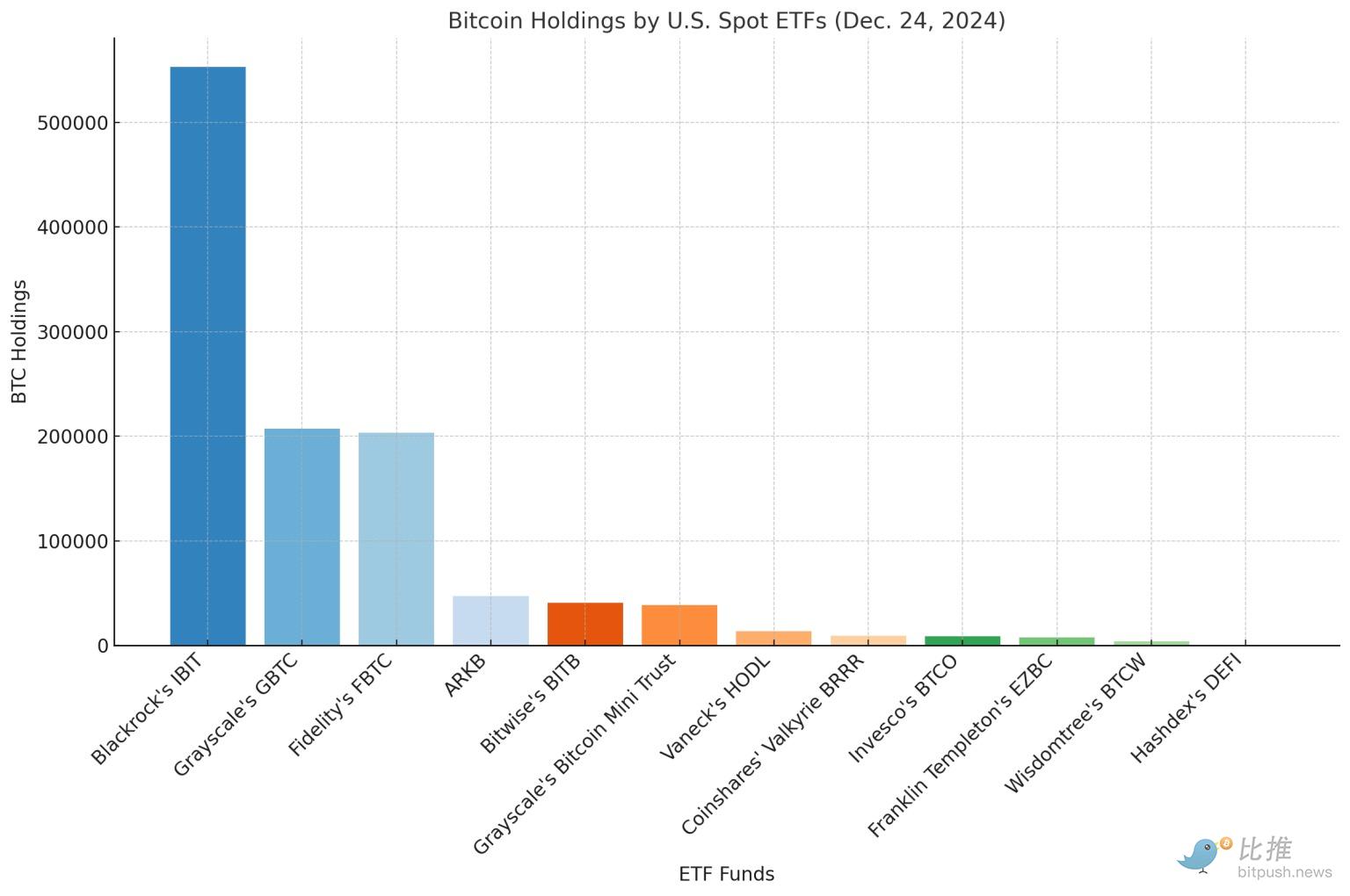
Ethereum ETFs also performed strongly, attracting $14.28 billion in inflows—equivalent to 2.93% of Ethereum’s market cap—and emerging as one of the standout trends in crypto investment this year.
The rapid growth of ETFs clearly reflects deepening institutional acceptance of crypto. As Sumit Roy, senior analyst at ETF.com, predicted: "It's conceivable that spot Bitcoin ETFs could eventually represent 10%, 20%, or even more of Bitcoin’s total market cap."
Memecoins Break Through and Create Wealth
The wealth-generating power and cultural influence of memecoins once again demonstrated the immense force of internet-driven entertainment culture. Amidst the trend of crypto becoming increasingly institutionalized and professionalized, memecoins have emerged as a powerful countercurrent.
Data from Artemis shows that memecoins ranked as the third most profitable narrative in 2024, delivering an average annual return of 201%—far exceeding the market average of 128%.

For example, Fartcoin surged to an $836 million valuation just months after launching in October. Meanwhile, Patriot token, created in celebration of Trump’s re-election, skyrocketed 626% within a week, reaching a market cap of over $73 million. The community even funded a 22-foot-tall bronze statue of Trump to commemorate the victory—showcasing the sheer cultural magnetism of memecoins.
Underpinning this memecoin frenzy is Solana, whose high performance and low transaction costs attracted 89% of new memecoin projects, solidifying its status as the true breeding ground for meme culture in crypto.
Crypto Influences Politics
The 2024 U.S. presidential election elevated cryptocurrency from niche movement to a major player in American politics.
According to data compiled by blockchain analytics platform Breadcrumbs and FOX Business, the crypto industry set a record by donating $238 million during this election cycle.
Some campaign ads made no explicit mention of crypto, drawing criticism from advocacy groups. Ray Claypool, author at Public Citizen, stated: "This flood of money is a blatant attempt by profit-driven corporations to prioritize private economic interests over the public good."
Crypto User Base Hits Record High
As of early December, the number of cryptocurrency holders reached 18.7 million, according to Token Terminal. The industry has also drawn a more diverse range of investors.
A Coinbase research report revealed that crypto holders do not conform to the stereotype of hoodie-wearing tech enthusiasts. Findings showed that 18% are stay-at-home moms, 10% are small business owners, and 41% listen to country music.
Legislative Progress
A long-anticipated piece of cryptocurrency legislation passed the U.S. House of Representatives in May, marking a critical step forward in regulating digital assets. Known as the Financial Innovation and Technology for the 21st Century Act (FIT21), the bill passed with rare bipartisan support. At a time of growing partisan division in Washington, 71 Democratic lawmakers joined over 200 Republicans in voting yes—highlighting the significance of the legislation.
"The passage of this market structure bill is a pivotal moment in the development of our industry," said Patrick Kirby of the Crypto Council for Innovation.
FIT21 aims to provide clearer regulatory guidance for crypto companies by defining which digital assets should be classified as securities and which as commodities. This would resolve the longstanding jurisdictional tug-of-war between the SEC and the Commodity Futures Trading Commission (CFTC), removing a major obstacle to innovation.
The bill has now moved to the Senate for consideration. Some analysts believe senators may introduce even more forward-looking legislation, better equipped to address emerging challenges such as stablecoin regulation.
U.S. States Prepare to Embrace Crypto
As previously reported by TechFlow, Ohio State Representative Derek Merrin introduced a bill proposing the creation of a Bitcoin reserve within the state treasury, authorizing the government to invest in Bitcoin. In fact, Ohio is not alone. Pennsylvania and Texas have also passed similar legislation, indicating that several U.S. states are actively exploring the possibility of incorporating crypto into their fiscal strategies.
Texas State Representative Giovanni Capriglione stated bluntly that inflation is "the biggest enemy of our investments." He believes establishing a strategic Bitcoin reserve would be a "win-win" for state governments—a view shared by other lawmakers. Bitcoin’s scarcity gives it inherent inflation-resistant qualities, making it an attractive option for inclusion in state reserves.
While many challenges remain on the road ahead, the trend toward mainstream adoption is irreversible. We have every reason to expect that, in the near future, cryptocurrency will play an even more prominent role in the global economy and political landscape.
Join TechFlow official community to stay tuned
Telegram:https://t.me/TechFlowDaily
X (Twitter):https://x.com/TechFlowPost
X (Twitter) EN:https://x.com/BlockFlow_News
 比推 BitpushNews









