From Payment Tools to Financial Infrastructure: The Evolution and Future of Stablecoins in a Trillion-Dollar Opportunity
TechFlow Selected TechFlow Selected
From Payment Tools to Financial Infrastructure: The Evolution and Future of Stablecoins in a Trillion-Dollar Opportunity
The RWA and stablecoin sectors are poised to achieve broader global adoption and deeper impact.
 Navigating Web3 tides with focused insights
"Stablecoins represent a trillion-dollar opportunity."
According to a research report by Pantera Capital partners Ryan Barney and Mason Nystrom, the claim that stablecoins are a multibillion-dollar opportunity is no exaggeration. As crypto assets pegged 1:1 to fiat currencies and stabilized via algorithms or reserves, stablecoins have seen their share of blockchain transactions surge from 3% in 2020 to over 50% today, thanks to their non-speculative nature.
Development of the Stablecoin Market in the Last Two Years
2024: A Breakthrough Year
This year marked a significant breakthrough for stablecoins, with annual transaction volume reaching $5 trillion—over 200 million accounts generating more than 1 billion transactions. Unlike the previous bull market cycle, stablecoin applications have now expanded beyond the DeFi ecosystem, showing strong potential in cross-border payments, particularly experiencing notable growth in emerging markets with high demand for U.S. dollars. Currently, both the supply and transaction volume of on-chain stablecoins have reached record highs.
Traditional fintech giants are actively entering the space:
• Stripe acquired the Bridge platform for $1.1 billion, calling stablecoins "the superconductor of financial services"
• PayPal launched its own stablecoin, PYUSD, in 2023
• Robinhood announced plans to build a global stablecoin network through collaboration with crypto firms
• The U.S. Treasury RWA market has grown to nearly $3 billion, a 30x increase since early 2023, including:
• USYC by Hashnote and Copper at $880 million
• BUIDL by BlackRock at $560 million
2025: Further Expansion Expected
In Bitwise's previously released "Top 10 Crypto Predictions for 2025," it was stated that with anticipated U.S. stablecoin legislation passing and institutional capital flowing in, the market cap of stablecoins could double to $400 billion by 2025. The tokenized real-world asset (RWA) market is projected to reach $50 billion. ParaFi forecasts the tokenized RWA market could hit $2 trillion by 2030, while the Global Financial Markets Association predicts it may exceed $16 trillion.
Global financial institutions are making strategic moves:
• Goldman Sachs: Launched a digital asset platform, assisted the European Investment Bank in issuing a €100 million digital bond, and plans to build a private blockchain
• Siemens: Issued a €60 million on-chain digital bond, becoming an early adopter
• HSBC, JPMorgan Chase, Citigroup: Exploring U.S. Treasury tokenization initiatives
Next, let’s take a closer look at key projects across major RWA sub-sectors:
RWA Sector
Ondo Finance (ONDO)
Ondo Finance is an RWA project focused on bringing traditional financial instruments into DeFi. By partnering with traditional financial institutions, Ondo acquires U.S. Treasury assets and issues tokenized securities via smart contracts, fractionalizing ownership of these Treasuries into smaller shares. Investors can purchase these tokens to gain indirect exposure to U.S. Treasuries, with token value closely tied to the underlying Treasury holdings. Given the importance and stability of U.S. Treasuries in global finance, ONDO attracts many investors seeking stable returns and risk mitigation. Its token price remains relatively stable during volatile markets, and trading volume shows steady growth. As demand for digitized traditional financial assets grows, Ondo is well-positioned to expand its market share, especially among institutional and high-net-worth individual investors.
Circulating Market Cap: $2,407,391,199
Rank: #51
Synthetix (SNX)
Synthetix is a protocol for creating synthetic assets. Users can mint various synthetic assets linked to real-world assets by collateralizing SNX tokens. These synthetics track the value of stocks, commodities, currencies, and other traditional assets. For example, users can create a synthetic asset tied to Apple’s stock price, with price movements reflecting Apple’s performance in traditional markets via oracle-provided data. SNX offers investors a convenient way to access traditional market exposures without direct ownership, broadening investment options. However, long-term success depends heavily on transparency, liquidity, and regulatory clarity, along with risks related to oracle mechanisms and market manipulation.
Circulating Market Cap: $760,095,061
Rank: #117
Plume Network
Plume Network is an emerging platform dedicated to real-world asset finance (RWAfi), aiming to streamline the issuance, trading, and management of real-world assets using blockchain technology. It provides infrastructure enabling enterprises and asset managers to easily tokenize traditional assets. The platform supports multiple functions such as asset tokenization, trade matching, and liquidity provision. Its strength lies in strong interoperability, supporting diverse traditional assets like real estate, bonds, and equity. This opens up more efficient financing channels for businesses, though challenges remain in integrating with traditional financial institutions and ensuring regulatory compliance.
Stablecoin Sector
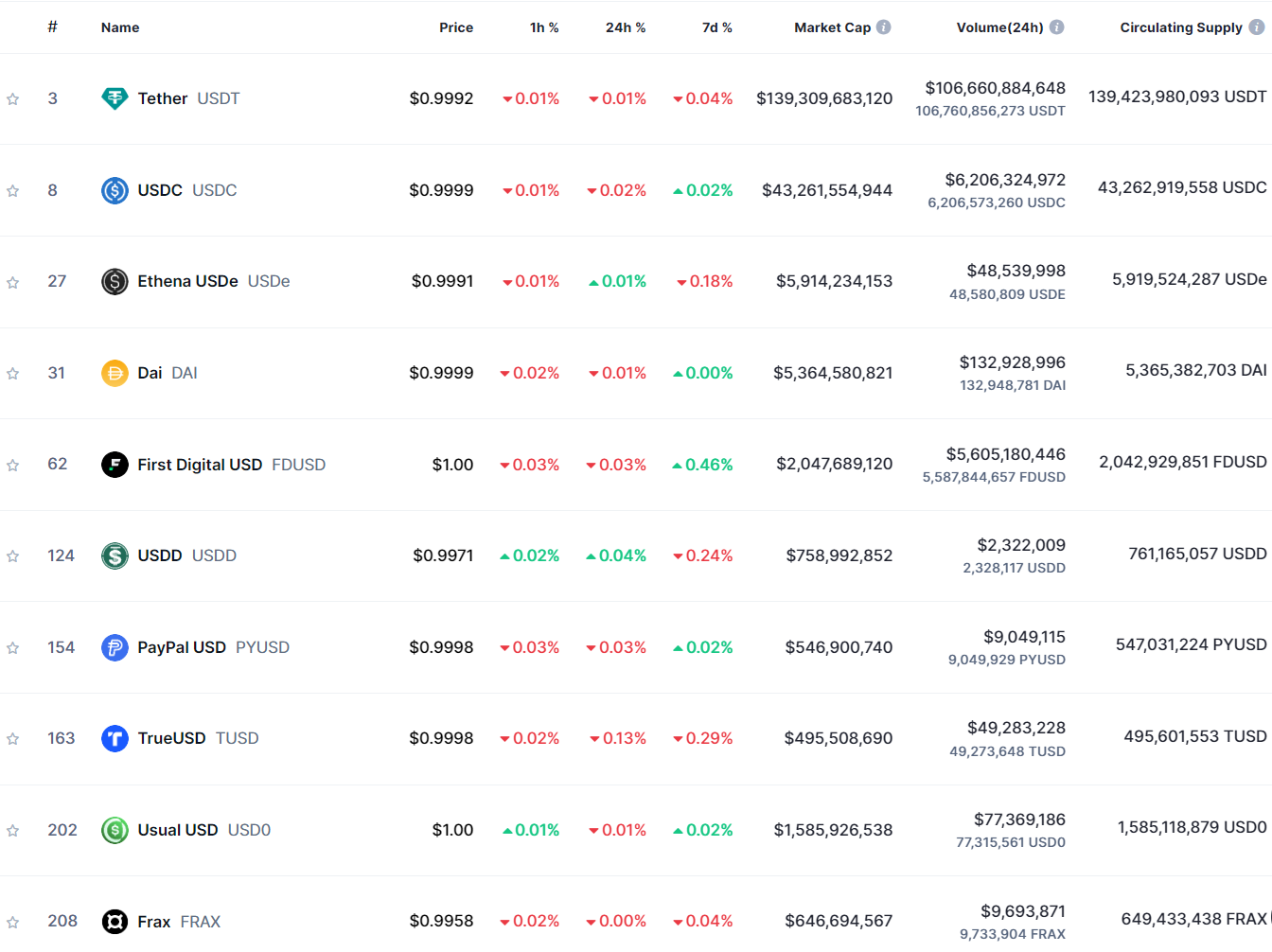
Among the top 10 stablecoins by market cap, USDT leads significantly with a total market cap of $142.7 billion, far surpassing others in supply. USDC ranks second at $41.9 billion. However, on-chain transaction data shows USDC usage exceeds that of USDT—its total transaction volume over the past month is nearly twice that of USDT. In December, USDe reached a market cap of $6 billion, surpassing DAI ($4.5 billion) to become the third-largest stablecoin by market cap.

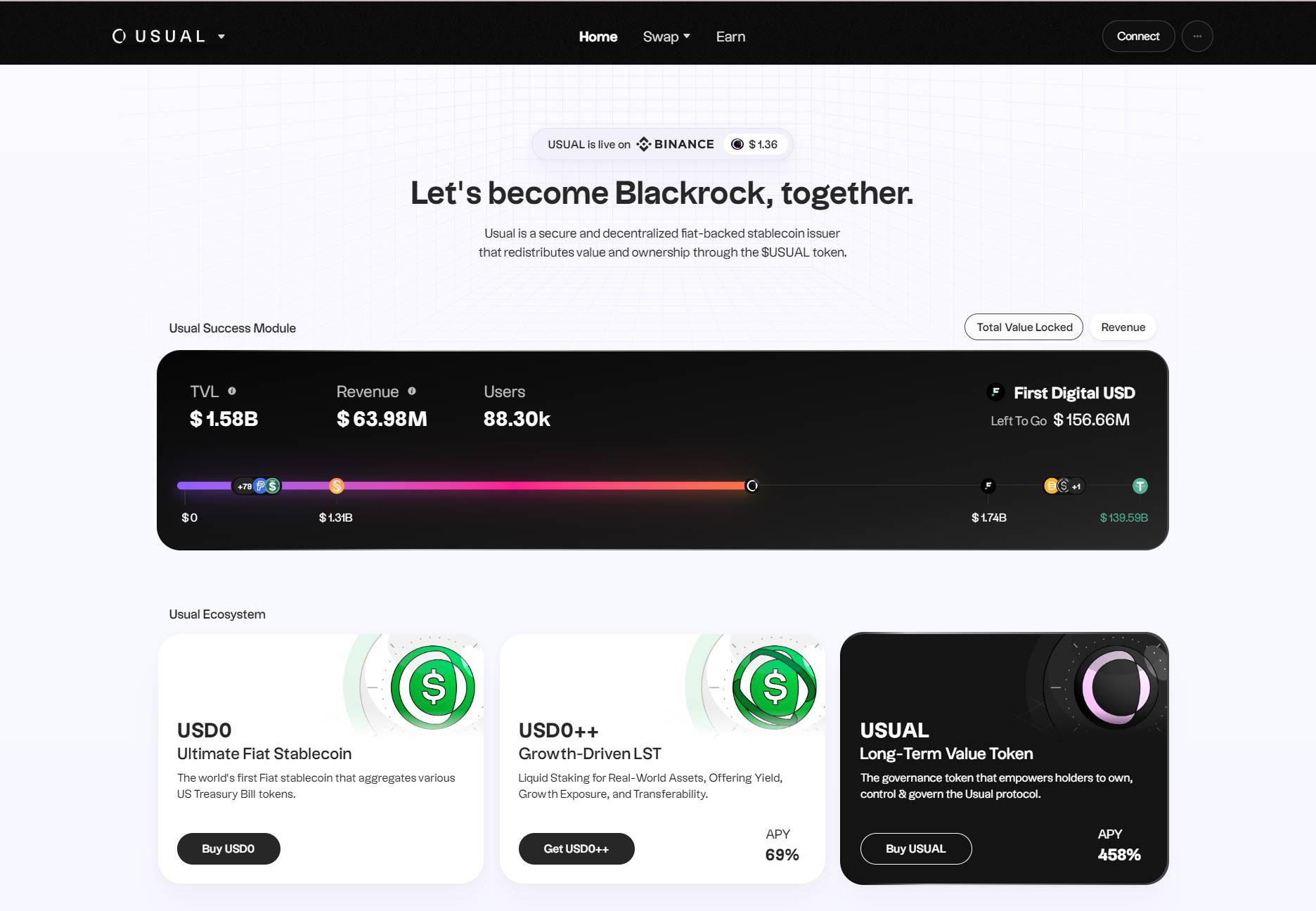
According to CMC rankings, USD0 has also entered the scene with a market cap of $1.5 billion, surging 77.17% over the past seven days and jumping to 9th place. Issued by Usual—a project launched via Binance Launchpool—USD0 is an innovative stablecoin protocol integrating BlackRock, Ondo, Mountain Protocol, M0, and Hashnote into a permissionless, on-chain verifiable, and composable stablecoin. The project recently distributed generous airdrops to users, and its platform token USUAL has shown strong price performance. The following section highlights several promising stablecoin projects worth watching.
Usual (USUAL)
Usual is a secure and decentralized fiat-backed stablecoin issuer that maintains dollar reserves to ensure its stablecoin USD0 can be redeemed 1:1 for U.S. dollars. Additionally, Usual distributes platform ownership and governance rights through its native token, USUAL. As a multi-chain infrastructure provider, Usual integrates growing tokenized real-world assets (RWA) from institutions such as BlackRock, Ondo, Mountain Protocol, M0, and Hashnote, transforming them into permissionless, on-chain verifiable, and composable stablecoins. USD0 is its first Liquid Deposit Token (LDT), backed 1:1 by short-term real-world assets, offering high stability and security. Users can mint USD0 either directly by depositing RWA or indirectly via USDC/USDT, enabling flexible and accessible operations.
Circulating Market Cap: $634,268,673
Rank: #133
Ethena (ENA)
Ethena is widely recognized as a decentralized stablecoin project (USDe) and an Ethereum-based synthetic dollar protocol, providing a crypto-native monetary solution and an “internet bond” aimed at solving autonomous currency issuance and base pricing within web3, returning monetary sovereignty to the web3 world. In 2023, over $12 trillion in stablecoin settlements occurred on-chain. AllianceBernstein forecasts the stablecoin market could reach $2.8 trillion by 2028, suggesting massive potential for ENA if widely adopted. However, ENA faces several risks. On funding risk: although it earns from funding rates, it may pay fees under certain conditions, though negative yields are typically temporary and user funds are protected by reserve buffers. On liquidation risk: derivative positions use low leverage, and multiple safeguards keep risk manageable. On custody risk: reliance on “off-exchange settlement” providers is mitigated through bankruptcy-remote trusts and diversified partnerships. Exchange failure risk is reduced via multi-exchange integration and retained asset control. While collateral differs from the target asset, low leverage and small haircut margins minimize impact. Overall, Ethena presents both significant opportunities and challenges, warranting close attention moving forward.
Circulating Market Cap: $3,030,206,926
Rank: #42
Frax (FXS)
FRAX is the first partially collateralized, partially algorithmic stablecoin protocol, combining the strengths of fiat-backed reserves and algorithmic supply adjustments. Through smart contracts, FRAX dynamically balances stablecoin supply with market demand. Its innovation lies in an elastic collateral mechanism—users can mint FRAX by depositing USD or other cryptocurrencies. The protocol introduces FRAX Share (FXS) as a governance token, granting holders voting rights and profit-sharing privileges. Frax also powers three core applications: Fraxswap, an AMM with built-in TWAMM functionality for large, long-duration trades; Fraxlend, a lending platform enabling ERC-20 token lending markets with customizable OTC debt terms; and Fraxferry, a cross-chain bridge that securely transfers natively issued Frax tokens without relying on third-party bridges, with funds arriving within 24–48 hours. Together, Frax Finance builds a robust DeFi ecosystem offering diverse services across multiple use cases.
Circulating Market Cap: $355,706,115
Rank: #194
Lista DAO (LISTA)
Lista DAO is a liquid staking and LSDFi project built on the BNB Chain, formed from the merger of Helio Protocol (backed by Binance Labs) and Synclub. It aims to generate yield on staked crypto assets while supporting decentralized lending of its native stablecoin, LISUSD. Core mechanisms include stablecoin lending, liquid staking, and innovative collateral options. The lending system operates on an over-collateralization model, with LISUSD serving as a decentralized stablecoin not fully pegged to fiat and supporting multiple collateral types. The Innovation Zone allows onboarding of new staking assets. In liquid staking, users stake crypto to receive liquid tokens—for instance, staking BNB yields sLISBNB, which can be used across platforms while earning staking rewards. Users can further pledge sLISBNB to borrow LISUSD at 0% interest currently. Overall, Lista DAO holds strong potential in DeFi, leveraging its service offerings and innovations to carve out a unique position.
Circulating Market Cap: $85,255,603
Rank: #475
Summary
In conclusion, the RWA and stablecoin sectors demonstrate immense potential in bridging blockchain technology with traditional finance. With ongoing technological advancements and clearer regulations, these sectors are poised for further maturation, serving as critical links between legacy financial systems and the blockchain world. Through innovative mechanisms, these projects lower barriers to financial participation and enhance asset liquidity and transparency, attracting increasing interest from institutional and individual investors alike. For investors, gaining a deep understanding of each project’s operational model and associated risks will be key to capturing opportunities in this space. However, rapid development also brings risks—including market volatility, regulatory uncertainty, and cybersecurity concerns.
One crucial point deserves special attention: while RWA and stablecoin projects offer unprecedented opportunities, they may also carry hidden risks related to compliance and transparency. Therefore, investors should thoroughly understand the associated risks and carefully assess potential returns against their own risk tolerance before participating. This report is for informational purposes only and does not constitute any investment advice. Looking ahead, as regulations become clearer and technology continues to improve, the RWA and stablecoin sectors are expected to achieve broader global adoption and deeper impact.
Join TechFlow official community to stay tuned
Telegram:https://t.me/TechFlowDaily
X (Twitter):https://x.com/TechFlowPost
X (Twitter) EN:https://x.com/BlockFlow_News
 @XTexchange