WOO X Research: Yielding Stablecoins That Thrive in Any Market
TechFlow Selected TechFlow Selected
WOO X Research: Yielding Stablecoins That Thrive in Any Market
Stablecoins have become a battleground for competing interests.
 Navigating Web3 tides with focused insights
Cryptocurrencies have long been perceived as highly volatile, with tokens prone to sharp price swings, seemingly having little to do with "stability." Stablecoins, however, are mostly pegged to the U.S. dollar and serve not only as exchangeable assets for other tokens but also as tools for payment systems and similar functions. The total market capitalization of this sector exceeds $20 billion, making it a relatively mature segment within the crypto market.
Yet, the most common stablecoins in today’s market—USDT and USDC—are centralized entities, together accounting for nearly 90% of market share. Other projects are now eager to capture a piece of this growing pie. For example, Web2 payments giant PayPal launched its own stablecoin, pyUSD, in 2023 to secure an early foothold; more recently, Ripple, the company behind XRP, introduced RLUSD to challenge the stablecoin market.
These two cases primarily focus on using stablecoins for payment services, backed largely by U.S. dollars or short-term Treasury bonds. In contrast, decentralized stablecoins emphasize yield generation, collateral mechanisms, and composability within DeFi ecosystems.
Demand for decentralized stablecoins has remained strong over time. From DAI to UST, the evolution of decentralized stablecoins has gone through multiple iterations. Ethena pioneered the use of futures-spot arbitrage combined with staking to generate yield via its USDe token, expanding users’ imagination around interest-bearing stablecoins. USDe has become the third-largest stablecoin by market cap, reaching $5.9 billion. Recently, Ethena partnered with BlackRock to launch USDtb, a new stablecoin backed by real-world assets (RWA) that generates yield. This product avoids the risk of negative funding rates and delivers stable returns regardless of bull or bear markets, completing Ethena’s product suite and making it a focal point in the market.
In light of Ethena’s success, more interest-bearing stablecoin protocols have emerged, such as Usual, which recently announced a collaboration with Ethena; Anzen, built on the Base ecosystem; and Resolv, which uses ETH as collateral. What are their pegging mechanisms? Where does their yield come from? Let WOO X Research break it down.
Source: Ethena Labs
USUAL: Strong team background, token design exhibits Ponzi-like characteristics
USUAL is an RWA-based yield-generating stablecoin, with income generated from short-term U.S. Treasuries. Its stablecoin is USD0, and users receive USD0++ after staking USD0, with $USUAL distributed as staking rewards. The team argues that current stablecoin issuers are too centralized—similar to traditional banks—and rarely distribute value back to users. USUAL aims to make users co-owners of the project, returning 90% of generated value to them.
On the team side, CEO Pierre Person served as a French parliament member and political advisor to President Emmanuel Macron. Yoko, the Asia region executive, previously led fundraising efforts for Macron’s presidential campaign. With strong ties to French politics and business, USUAL enjoys favorable regulatory conditions—an essential factor for RWA projects, where transferring physical assets onto the blockchain requires significant government support. This political advantage forms a key moat for the project.
Looking at the protocol mechanism itself, USUAL’s tokenomics exhibit Ponzi-like traits. $USUAL is not just a mining token—it has no fixed supply and follows an inflationary model tied to the TVL of USD0 (and USD0++). However, issuance adjusts based on the protocol’s “revenue growth,” strictly ensuring that inflation remains below the rate of protocol expansion.
Each time a new USD0++ bond token is minted, a corresponding amount of $USUAL is emitted to various stakeholders. The Minting Rate—the conversion ratio—is highest immediately after TGE (Token Generation Event) and then declines exponentially over time, rewarding early adopters while creating scarcity later to drive up the intrinsic value of each token.
In simple terms: the higher the TVL, the lower the USUAL emissions, and the higher the individual value of each USUAL token.
Higher USUAL price → incentivizes USD0 staking → increases TVL → reduces USUAL emissions → further increases USUAL price
USD0’s market cap grew by 66% in the past week, surpassing pyUSD to reach $1.4 billion, with USD0++ offering an APY as high as 50%.
Recently, Usual partnered with Ethena to accept USDtb as collateral and will gradually shift part of USD0’s supporting assets to USDtb. Over the coming months, Usual is expected to become one of the largest minter and holders of USDtb.
As part of this collaboration, Usual will establish an sUSDe vault for USD0++ bond holders, allowing users to earn sUSDe rewards while maintaining exposure to Usual’s base assets. This enables Usual users to benefit from Ethena’s incentives while boosting Ethena’s TVL. Additionally, Usual will promote and enable swaps between USDtb-USD0 and USDtb-sUSDe, enhancing liquidity among core assets.
Recently, Usual also opened $USUAL staking, with rewards drawn from 10% of the total USUAL supply. Current APY stands at a staggering 730%.
Key metrics:
-
Current price: 1.04
-
Market cap rank: 197
-
Circulating market cap: $488,979,186
-
TVL: $1,404,764,184
-
TVL/MC: 2,865
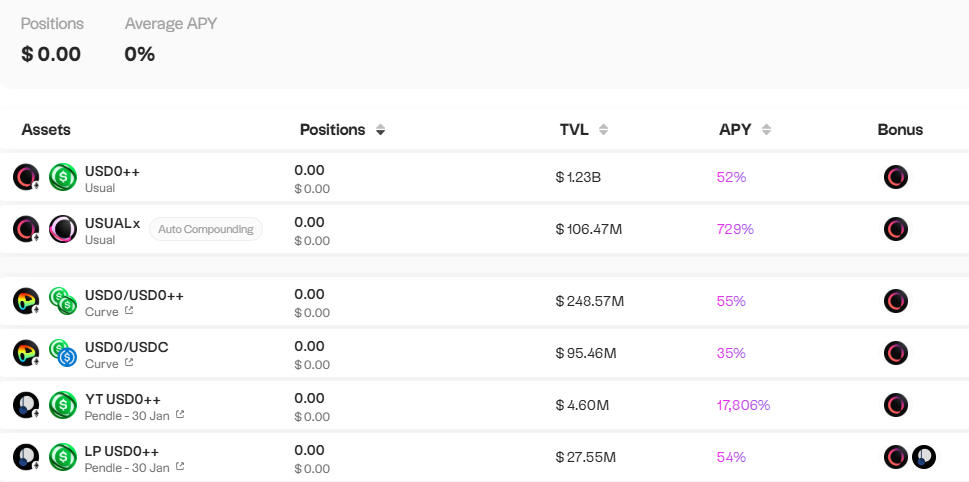
Source: usual.money
Anzen: Tokenizing Credit Assets
Anzen issues USDz, currently supported across five chains: ETH, ARB, MANTA, BASE, and BLAST. Backed by a portfolio of private credit assets, USDz can be staked to obtain sUSDz and earn RWA yields.
The underlying assets are managed in partnership with Percent, a U.S.-licensed broker-dealer. The portfolio focuses on the U.S. market, with no single asset exceeding 15% allocation and diversified across 6–7 asset types. Current APY is approximately 10%.
The project has notable traditional finance partners, including BlackRock, JP Morgan, Goldman Sachs, Moody’s Ratings, and UBS.
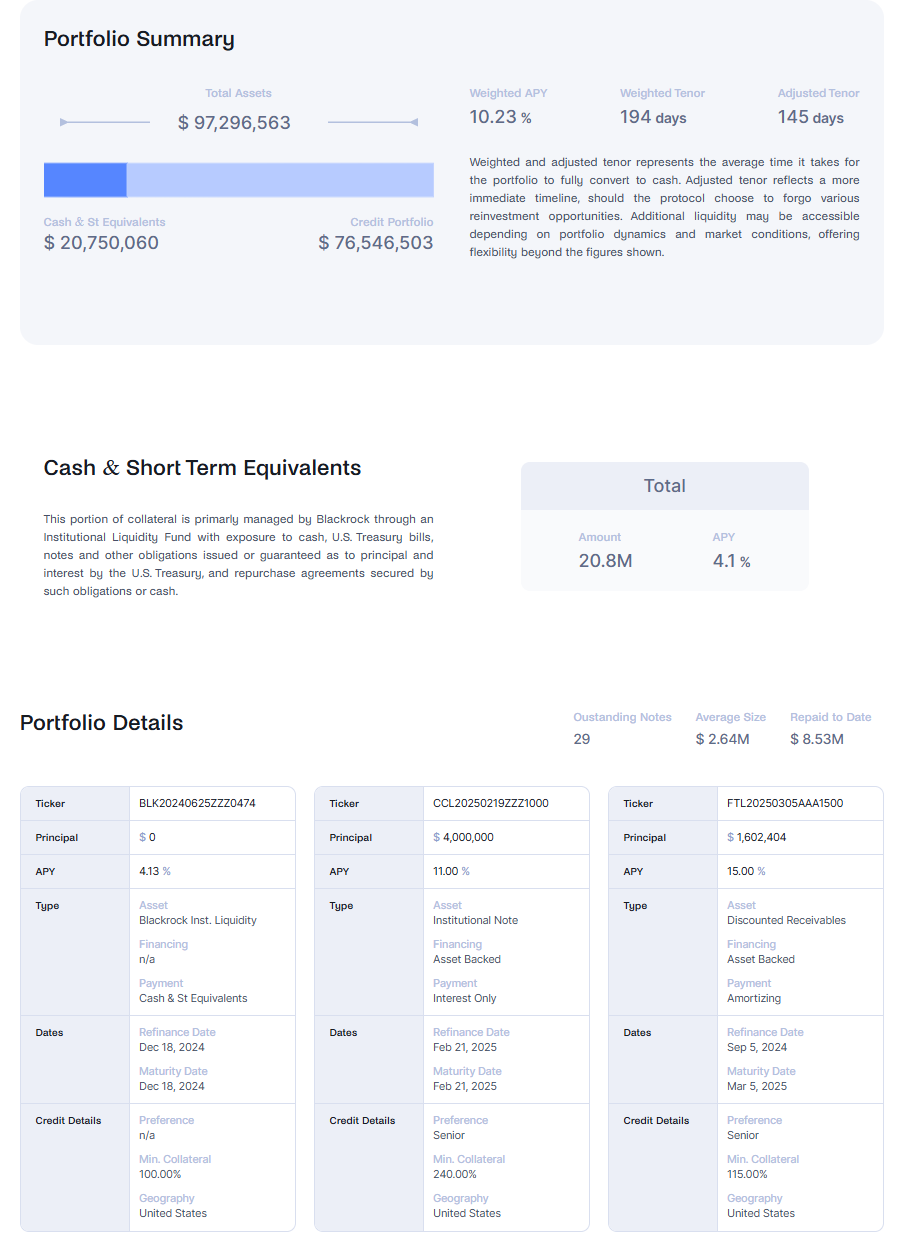
Source: Anzen
In terms of funding, Anzen raised $4 million in seed financing from Mechanism Capital, Circle Ventures, Frax, Arca, Infinity Ventures, Cherubic Ventures, Palm Drive Ventures, M31 Capital, and Kraynos Capital. It successfully raised $3 million through a public sale on Fjord.
For ANZ token design, Anzen adopts a ve-model: ANZ can be locked to obtain veANZ, which entitles holders to a share of protocol revenues.
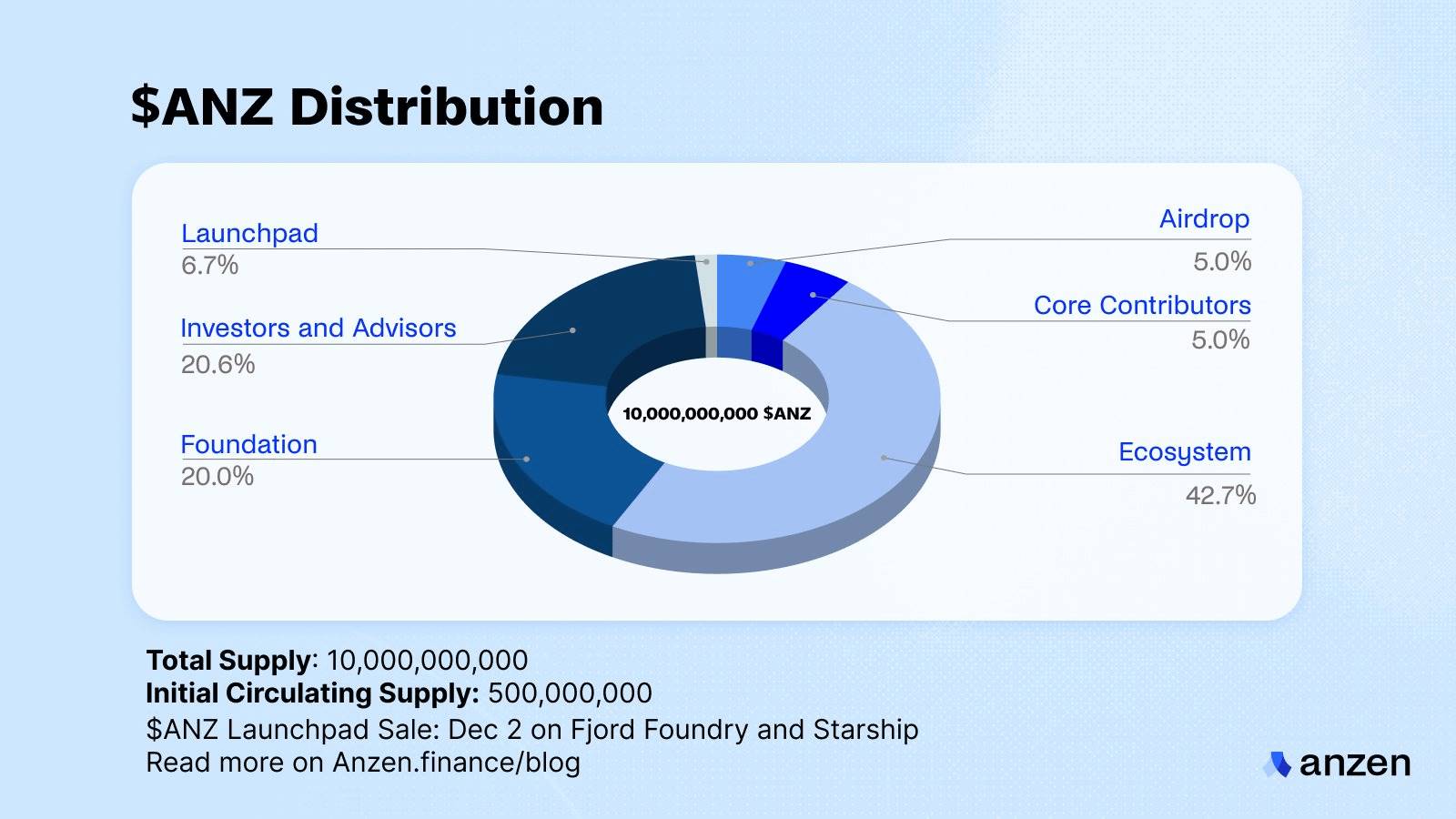
Source: Anzen
ANZ key metrics:
-
Current price: 0.02548
-
Market cap rank: 1,277
-
Circulating market cap: $21,679,860
-
TVL: $94,720,000
-
TVL/MC: 4,369
Resolv: Delta-Neutral Stablecoin Protocol
Resolv offers two products: USR and RLP.
-
USR: A stablecoin over-collateralized by ETH and pegged to the dollar via RPL. Users can stake USR to receive stUSR and earn yield.
-
RLP: Since USR is over-collateralized (above 100%), the excess collateral supports RLP. RLP is not a stablecoin—its required collateral amount for minting or redemption varies based on the latest RLP price.
For ETH used to mint USR, Resolv employs a delta-neutral strategy. Most collateral is held directly on-chain and staked, while a portion is held off-exchange by institutions as futures margin.
On-chain collateral is fully deposited into Lido. Short-side margin ranges between 20%–30%, equivalent to 3.3x to 5x leverage. Of this, 47% is on Binance, 21% on Deribit, and 31.3% on Hyperliquid (using Ceffu and Fireblocks as CEX custodians).
Revenue sources: On-chain staking yields and funding fees.
Rewards distribution:
-
Base reward (70%): Distributed to stUSR and RLP holders proportionally based on their TVL.
-
Risk premium (30%): Allocated entirely to RLP holders.
For example, if the collateral pool generates $20,000 in profit:
-
Base reward = $20,000 × 70% = $14,000, distributed proportionally to stUSR and RLP based on TVL.
-
Risk premium = $20,000 × 30% = $6,000, allocated to RLP.
Thus, RLP receives a larger share of profits—but when funding rates turn negative, losses are absorbed by the RLP pool, making RLP riskier.
Recently, Resolv launched on the Base network and initiated a points program: holding either USR or RLP earns points, laying the groundwork for a future token launch.
Key data:
-
stUSR APY: 12.53%
-
RLP APY: 21.7%
-
TVL: $183M
-
Collateral ratio: 126%

Join TechFlow official community to stay tuned
Telegram:https://t.me/TechFlowDaily
X (Twitter):https://x.com/TechFlowPost
X (Twitter) EN:https://x.com/BlockFlow_News
 @WOOXResearch