









Top 10 Crypto Moments of 2024: Trump's Election, Spot ETF Approvals, Bitcoin's First Break Above $100,000
TechFlow Selected TechFlow Selected
Top 10 Crypto Moments of 2024: Trump's Election, Spot ETF Approvals, Bitcoin's First Break Above $100,000
By observing what emerges, one can understand what enters; by reviewing the past, one can foresee the future.
 Navigating Web3 tides with focused insights
Author: 1912212.eth, Foresight News
2024 is about to pass in the blink of an eye, a year that has undoubtedly left behind many significant moments. In the ever-uncertain world of crypto, there have been surprises, hopeful aspirations, and astonishing transformations.
At the beginning of this year, the long-awaited spot Bitcoin ETFs were officially approved. Just as the public began to think progress on spot Ethereum ETFs would be slow, the SEC suddenly changed its stance. As the U.S. election drew nearer, Polymarket gained widespread attention due to shifting prediction data, becoming one of the few crypto applications to break into mainstream discourse. Meanwhile, Binance founder and CEO Changpeng Zhao served a three-month prison sentence after being found guilty, and was officially released at the end of September.
By the fourth quarter, Trump—widely seen as crypto-friendly—won the U.S. presidential election as expected. With Elon Musk’s proposal, the Department of Government Efficiency (DOGE) was established, reviving the long-dormant Dogecoin. Riding the Dogecoin wave, numerous meme coins experienced explosive growth. Solana emerged as the king of meme chains, with the total market cap of its meme coins briefly surpassing $15 billion. At the same time, the current SEC chair, long criticized by the industry, was set to step down when Trump officially took office, bringing relief to the crypto sector. Amid continuous volatility and upward momentum, Bitcoin finally broke through the $100,000 mark for the first time on December 5.
1. Spot Bitcoin & Ethereum ETF Approvals—Wall Street's New Favorites
The much-anticipated spot Bitcoin ETF had been eagerly awaited since late 2023. On January 10, the U.S. Securities and Exchange Commission (SEC) announced the official approval of the first-ever exchange-traded funds (ETFs) backed directly by Bitcoin, allowing these ETFs to begin trading publicly on U.S. exchanges starting January 11, 2024 (early morning Beijing time).
The 11 institutions approved to launch spot Bitcoin ETFs included Grayscale, Bitwise, Hashdex, iShares, Valkyrie, Ark 21Shares, Invesco Galaxy, VanEck, WisdomTree, Fidelity, and Franklin. This decision marked a historic milestone for the U.S. digital asset ecosystem, signaling that the crypto market may be standing at a new historical starting point.
As of December 9, net inflows into Bitcoin ETFs reached $33.43 billion, with no signs of slowing down.
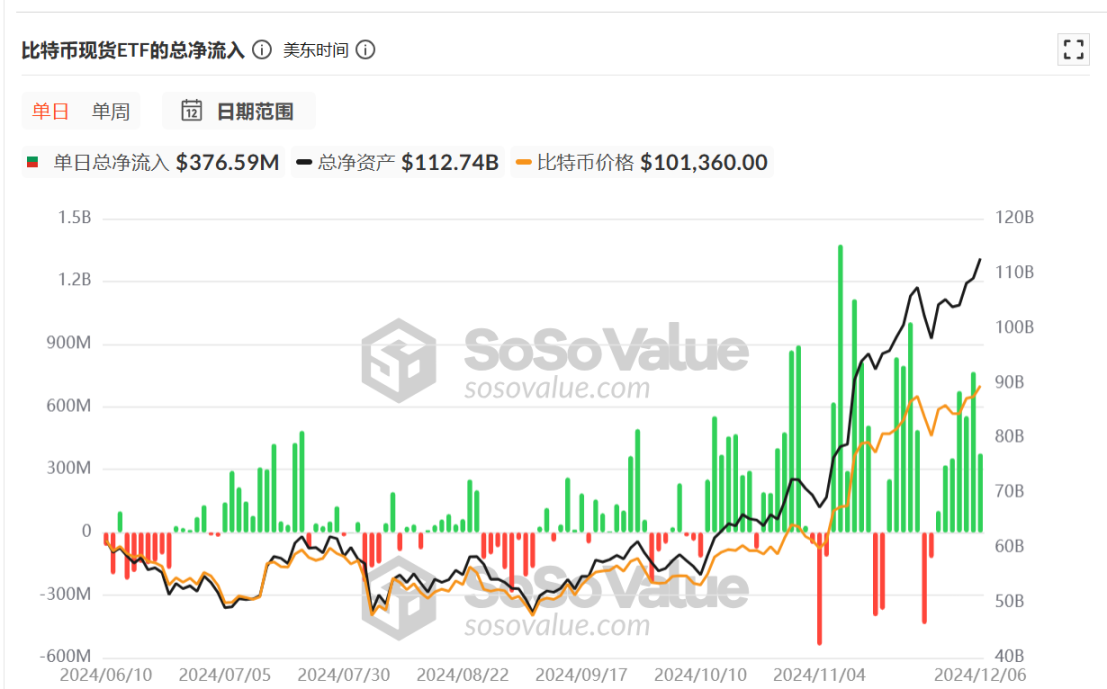
Beneath these record-breaking figures lies the growing institutionalization of Bitcoin. The purchasing power of both institutional and retail investors has been unleashed through spot ETFs, laying the foundation for sustained price appreciation.
After the approval of spot Bitcoin ETFs, investor attention naturally shifted to Ethereum. However, due to prolonged silence from regulators, some began to lose hope. On May 14, Bloomberg senior ETF analyst Eric Balchunas stated he did not expect the ETF to be approved before the end of 2025. At the same time, betting markets on Polymarket gave only a 14% chance of SEC approval by May 31.
Yet the approval of spot Ethereum ETFs came faster than expected. Just ten days later, on May 24, the SEC officially greenlit spot Ethereum ETFs. It approved listing proposals from the New York Stock Exchange, Cboe, and Nasdaq, clearing eight applications including those from BlackRock and Fidelity.
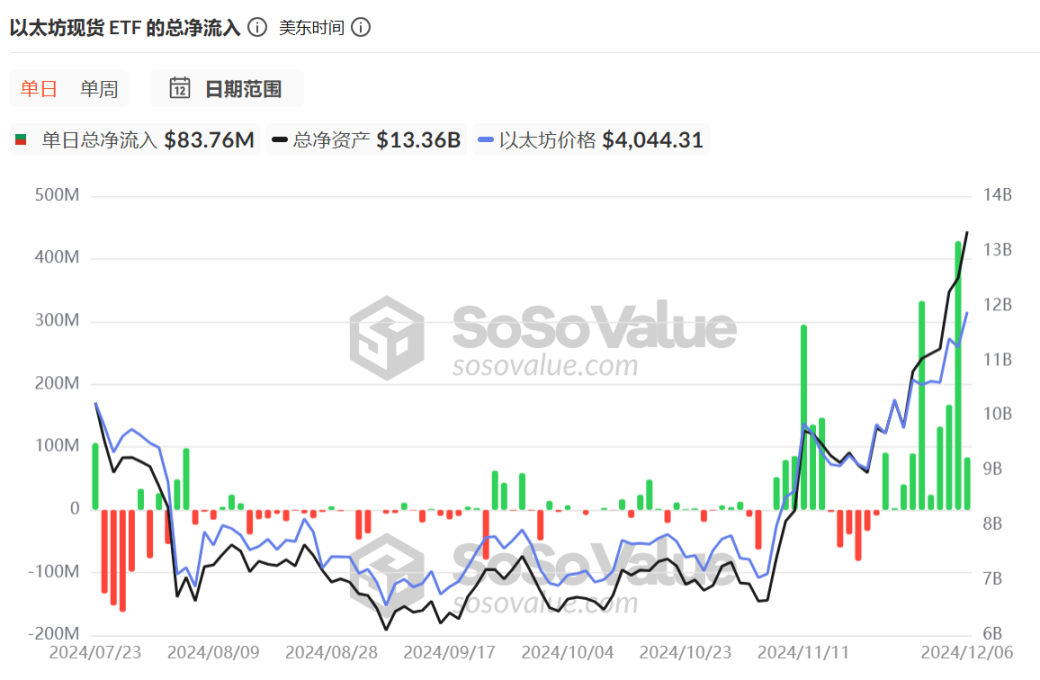
Unlike spot Bitcoin ETFs, which launched during a bullish market, spot Ethereum ETFs debuted amid weak market sentiment, resulting in underwhelming performance—net outflows often exceeded inflows for extended periods. Not until early November did net inflows significantly surpass outflows, marking the start of a strong capital influx.
As of December 9, cumulative net inflows into spot Ethereum ETFs reached $1.41 billion.
2. Polymarket Breaks Out—The Most Accurate Polling Platform
Leveraging rising market interest and the U.S. election cycle, Polymarket rose to prominence as the most talked-about crypto application outside the industry. In June, its trading volume hit $109 million, a record high, while monthly active users reached 29,200, also setting a new peak.
In the months leading up to the U.S. presidential election—July, August, September, and October—Polymarket set new all-time highs in trading volume each month. Bets on whether Biden would drop out and the odds between Trump and Harris pushed platform metrics to new heights. Figures like Elon Musk and media outlets such as CNN frequently cited Polymarket data when discussing the election.
In October, Trump’s odds of winning surpassed 60%, and by November 6, they surged above 88%. After the official results were announced, the accuracy of Polymarket’s predictions earned widespread praise: "Betting with real money often better reflects true market sentiment."
Prediction markets proved more accurate than traditional polls, media commentary, or expert forecasts. Beyond correctly predicting Trump’s victory, one French whale reportedly made unrealized gains of $47.8 million by betting on Trump. This "whale" is a wealthy French trader and former bank trader who used his mathematical expertise to analyze U.S. polling data over the summer, ultimately gaining fame through this single successful bet.
In November, Polymarket’s trading volume soared to $2.577 billion, a new record, with 293,705 active users and 339,531 new accounts created—both also record highs.
3. Changpeng Zhao Sentenced to Four Months—161 Letters That Changed the Outcome
Binance founder Changpeng Zhao was officially released from prison on September 29. Since late 2023, Zhao had been barred from holding any position at Binance. On November 22, he appeared in a Seattle court, where Reuters reported, citing sources, that Binance would pay a record $4.368 billion fine—the largest penalty ever levied in the crypto industry. Court records show Binance faced three criminal charges: operating an unlicensed money transmitting business, conspiracy, and violating the International Emergency Economic Powers Act.
Zhao himself pleaded guilty to charges related to anti-money laundering violations and paid a $50 million fine. He was initially granted $175 million bail and allowed to return to the UAE during pretrial release. However, as the case progressed, U.S. courts repeatedly overturned prior decisions, eventually banning him from traveling abroad.

In April 2024, U.S. prosecutors formally requested a 36-month prison sentence for Zhao, alleging serious compliance failures at Binance, including failure to report suspicious transactions linked to terrorist organizations, facilitating the sale of child sexual abuse material, and receiving ransomware payments. Prosecutors argued these actions severely violated U.S. AML laws and warranted strict punishment.
On May 1, Zhao’s sentencing was finalized. Clearly influenced by 161 letters of support, he was sentenced to just four months in prison.
Since his release, Zhao said in interviews that he now spends at least half his time on Giggle Academy, a digital education platform he finds highly interesting and impactful.
4. Trump Wins Election—The First “Crypto President”
A photo of Trump raising his fist after surviving an assassination attempt went viral globally. Perhaps fortune favored him after the ordeal, but on November 6 (Beijing time), Trump defeated Harris and officially won the U.S. presidential election. Prior to the campaign, Trump positioned himself as pro-crypto, voicing views such as firing the current SEC chair and establishing a national Bitcoin reserve.
After his victory, Trump moved swiftly, nominating five prominent figures from the crypto space to serve as department heads in his new administration. He also plans to expand the regulatory authority of the CFTC and clarify jurisdictional boundaries with the SEC. The selection process for the next SEC chair remains ongoing.
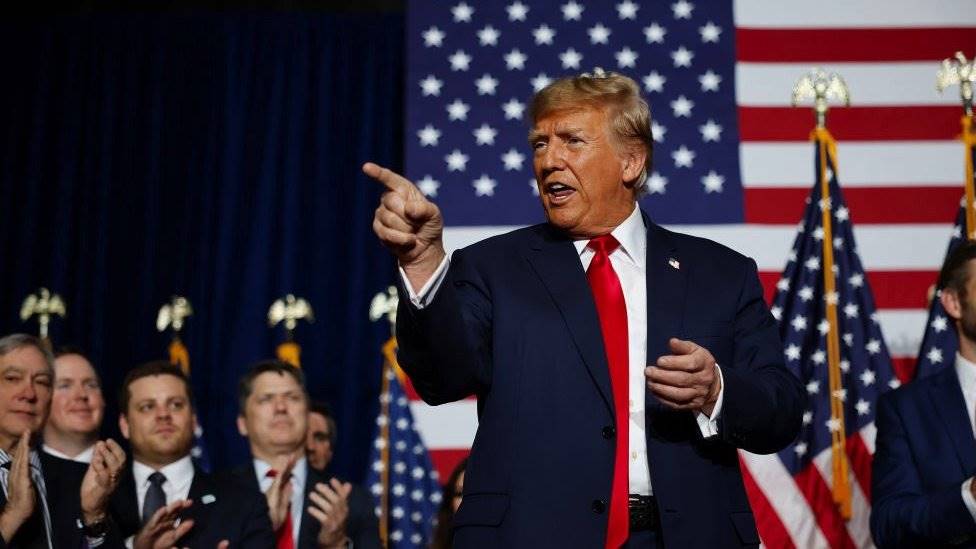
For years, U.S. regulatory policies have drawn criticism for their harshness. Repeated enforcement actions by the CFTC and SEC have dampened market confidence. Trump’s incoming presidency and cabinet nominations have sparked renewed optimism.
Bitcoin rallied following Trump’s win, breaking the $100,000 threshold in early December. Anticipated regulatory easing and new cabinet appointments also fueled a revival in DeFi, driving gains across U.S.-based blockchains, DeFi protocols, and RWA projects.
Hunter Horsley, CEO of Bitwise, noted in early December: "Over the past 30 days, Coinbase’s market cap increased by approximately $30 billion, and XRP’s by about $100 billion. The shift in the U.S. from regulatory resistance to regulatory support is one of the biggest and most important structural catalysts we’ve seen in crypto. Its impact has only just begun."
5. Creation of the Department of Government Efficiency (DOGE)—A Win for Dogecoin
Musk’s idea for a Department of Government Efficiency was already in development before Trump’s election. It originated as a joint initiative between Musk and former President Donald Trump, aimed at conducting a comprehensive financial audit of the federal government and proposing ways to reduce waste, fraud, and unnecessary spending.
In September, Trump formally announced during a speech at the New York Economic Club that, if elected, he would establish the Department of Government Efficiency together with Musk. Therefore, the subsequent official announcement was merely a formality.
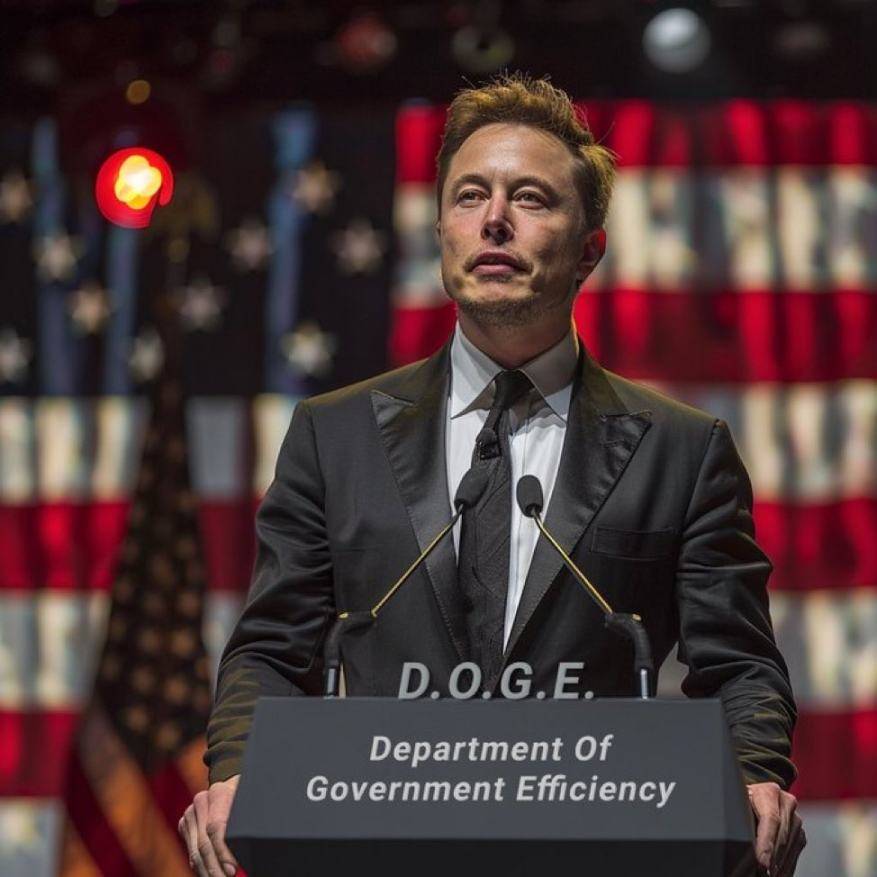
Trump expressed high hopes for the initiative, calling it potentially “the Manhattan Project of our time.” Reducing government bloat has long been a dream among Republican politicians. To drive this transformation, DOGE will operate externally, offering advice and guidance in collaboration with the White House and Office of Management and Budget to implement large-scale structural reforms and create an entrepreneurial-style government.
The final statement added: “Their work will be completed no later than July 4, 2026, delivering a smaller, more efficient, and less bureaucratic government—a perfect gift to America on the 250th anniversary of the Declaration of Independence.”
The acronym D.O.G.E. for Department of Government Efficiency is no coincidence. Inspired by the Dogecoin community, Musk called the name “perfect” during a Twitter exchange in August.
Riding the DOGE hype, Dogecoin surged from September, peaking near $0.48—an increase of nearly sixfold.
6. HBO Documentary 'Money Electric: The Bitcoin Mystery' Released—Who Is Satoshi?
HBO’s documentary *Money Electric: The Bitcoin Mystery* premiered on October 8, aiming to uncover the true identity of Satoshi Nakamoto. Before this, potential candidates included Len Sassaman, Nick Szabo, and Adam Back.

The film identifies Bitcoin developer Peter Todd as Satoshi Nakamoto. In response, Todd stated: “Wrongly declaring an ordinary person to be extremely wealthy exposes them to threats like robbery and kidnapping. This question isn’t just foolish—it’s dangerous. Satoshi clearly doesn’t want to be found, and for good reason. No one should help those trying to uncover his identity.”
Despite Todd denying the claim, the documentary sparked intense debate.
On December 16, after Bitcoin surpassed $106,000, Satoshi became the 16th richest person in the world, with a personal fortune exceeding $100 billion.
7. SEC Chair Gary Gensler Resigns—Dawn is Near
On November 22, the SEC announced that Chair Gary Gensler, whose term was originally set to end in June 2026, would step down on January 20, 2025.
Following the FTX collapse, the SEC tightened its grip on the crypto industry, launching a series of high-profile lawsuits. Gensler maintained that most cryptocurrencies are securities and sought to enforce compliance through aggressive legal action.
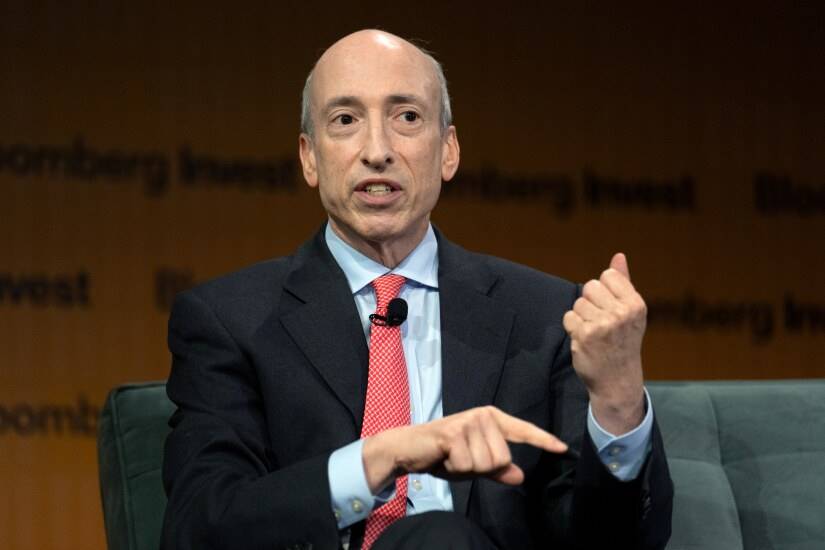
He repeatedly labeled the crypto space as rife with fraud, scams, bankruptcies, and money laundering in public statements. Yet paradoxically, during his tenure, both spot Bitcoin and Ethereum ETFs were approved.
Most industry participants held critical views of Gensler. With Trump’s victory, speculation intensified over who would succeed him at the SEC. In early December, Trump nominated Paul Atkins for the role, but Atkins declined. While Coinbase’s CEO praised Atkins as an excellent choice, the position remains unfilled.
8. Bitcoin Breaks $100,000 for the First Time—Making History Again
On December 5, after consolidating above $90,000, Bitcoin finally broke the $100,000 barrier. This marked the first time in its history since its inception in 2009, pushing its market cap beyond $2 trillion and ranking it among the top seven assets globally. Throughout multiple bull and bear cycles, Bitcoin has remained dominant, consistently topping the crypto market cap rankings.
As blockchain technology continues to spread globally and more financial institutions, sovereign nations, and regions recognize its value, Bitcoin’s price and market size continue to expand. Mike Novogratz, CEO of Galaxy Digital, commented on the milestone: “There’s a global Bitcoin buying frenzy underway. It’s one of the first truly global assets.”
With spot Bitcoin ETFs seeing record inflows and a crypto-friendly president-elect taking office, Bitcoin is poised to lead the next major surge in the crypto market.
9. MicroStrategy Joins Nasdaq 100 Index—The Crypto Version of Nvidia
On December 14, Nasdaq (Nasdaq: NDAQ) announced the results of the annual rebalancing of the Nasdaq-100 Index® (Nasdaq: NDX®), effective at the market open on Monday, December 23, 2024. MicroStrategy Incorporated (Nasdaq: MSTR) was added to the index.
The Nasdaq-100 Index tracks the performance of the 100 largest non-financial companies listed on the Nasdaq exchange. It is a closely watched benchmark for global investors. Eligibility includes stringent requirements around market capitalization, liquidity, public float, and financial health.
Since 2020, MicroStrategy has adopted Bitcoin as its primary treasury reserve. As the company aggressively accumulated BTC, its stock price surged alongside Bitcoin’s rally in the latest cycle. In January 2023, MSTR traded at $150 per share; by March 2024, it peaked at $1,999.99, achieving a market cap in the tens of billions and over 1,000% returns in just over a year.

As of December 8, MicroStrategy held a total of 423,650 bitcoins (2.017% of the total supply), acquired at an average cost of approximately $60,324 per BTC, totaling around $25.6 billion.
For the crypto industry, MicroStrategy’s inclusion in the Nasdaq 100 could inspire more corporations to follow suit and invest in Bitcoin. As institutional participation grows, demand for Bitcoin may rise further, fueling additional price gains.
10. Stablecoin Market Cap Hits Record High—Mass Adoption
On December 9, the total market cap of stablecoins surpassed $200 billion for the first time, setting a new all-time high. After peaking near $186 billion in May 2022, stablecoin market caps declined steadily until early 2024, when they began a steady recovery as capital flowed back into the crypto market.
Within the crypto sector alone, stablecoins like USDT, USDC, and USDE provided crucial fuel for price increases. Currently, USDT dominates with nearly 70% share and a market cap exceeding $140.57 billion, while USDC stands at over $42.11 billion. The emerging stablecoin USDE achieved a market cap of over $5.87 billion within just a few months.
Stablecoins offer lower fees, greater competition among payment providers, and broader accessibility. By reducing transaction costs to nearly zero, they enable businesses to overcome friction inherent in traditional payment systems. Adoption will likely begin with enterprises most affected by current payment inefficiencies, ultimately disrupting the entire payments industry. Major players including Visa, Mastercard, and PayPal have already entered the stablecoin payments space.
Join TechFlow official community to stay tuned
Telegram:https://t.me/TechFlowDaily
X (Twitter):https://x.com/TechFlowPost
X (Twitter) EN:https://x.com/BlockFlow_News
 Foresight News









