Decentralized or Centralized? A Deep Dive into Hyperliquid's Dimensional Strike Against Other On-Chain Trading Platforms
TechFlow Selected TechFlow Selected
Decentralized or Centralized? A Deep Dive into Hyperliquid's Dimensional Strike Against Other On-Chain Trading Platforms
Hyperliquid has captured the largest share of the on-chain Perps market, with daily trading volume reaching as high as $6 billion, and its market scale continues to grow further.
 Navigating Web3 tides with focused insights
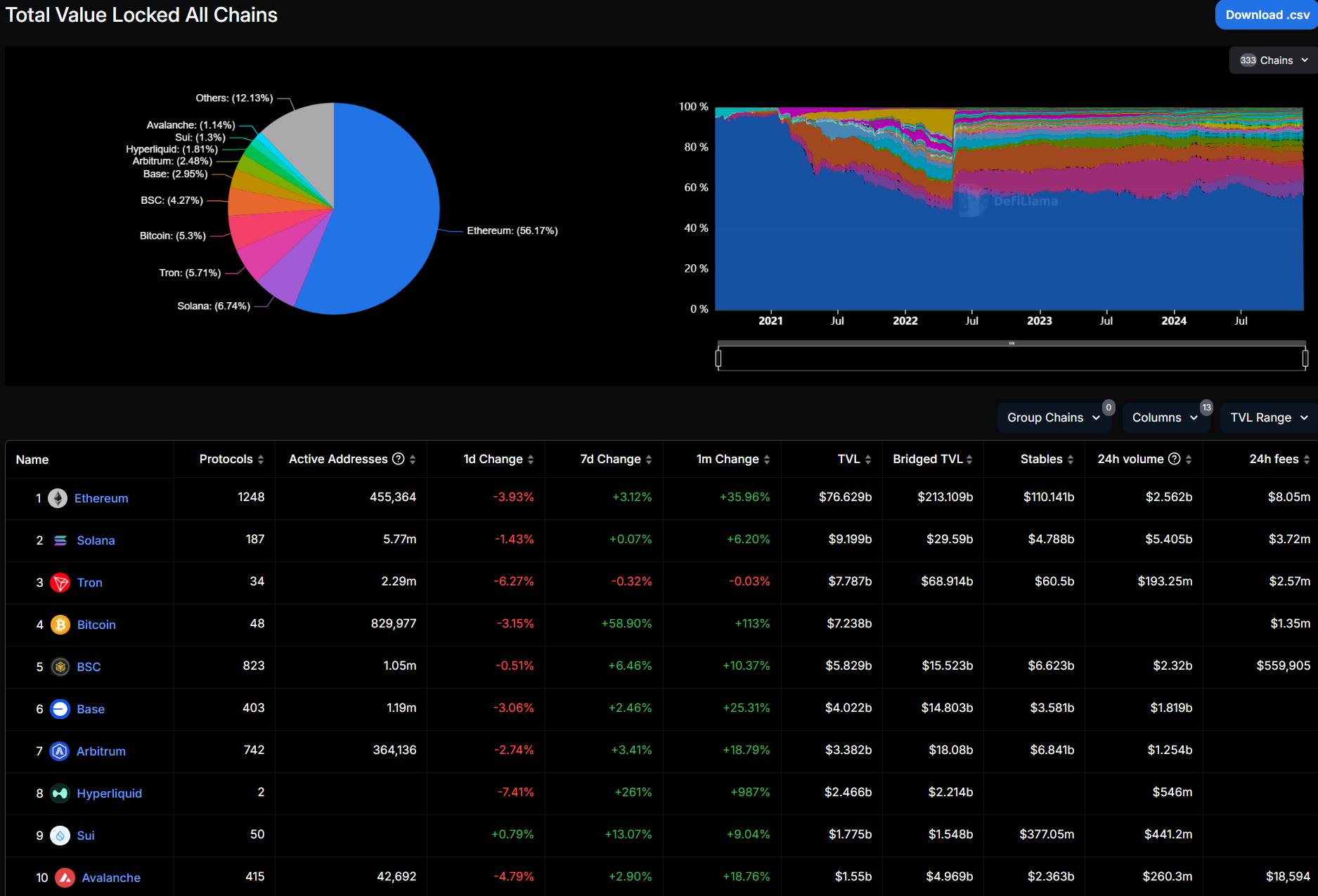
From November to early December 2024, as the altcoin market strengthened, decentralized exchanges (DEXs)迎来了a new wave of development opportunities. Binance successively listed several DEX-native tokens including COW, AERO, and VELO, all of which demonstrated strong trading performance. Users are increasingly adopting DEX platforms for trading. Market trends are rotating rapidly: as meme token enthusiasm in the Solana ecosystem cools down, trading activity is shifting toward Base and BSC chains. The emerging player Hyperliquid has further drawn capital from Solana’s on-chain ecosystem, with its total value locked (TVL) surging 14-fold within a single week to surpass $2.8 billion, catapulting it to eighth place among all Layer 1 blockchains.
1. Hyperliquid Project Overview
Project Background: Hyperliquid is an innovative Layer 1 blockchain leveraging the HyperBFY consensus algorithm, designed for high throughput and low-cost transactions with block latency under one second—built specifically for DeFi applications. Through its native token HYPE and a fully on-chain decentralized exchange, Hyperliquid offers a perpetual futures platform based on an order book model, delivering significant yield opportunities. Additionally, Hyperliquid provides an auction mechanism for new token listings.
Industry Background: Although the project has not publicly disclosed detailed team backgrounds or funding information, the substantial inflow of capital and its sophisticated quantitative trading system lend credibility to market rumors suggesting that the founding team possesses Wall Street quantitative trading experience.
Competitors: Hyperliquid focuses primarily on order-book-based perpetual futures trading, positioning itself in competition with DEX platforms such as Uniswap and Jupiter, while also challenging traditional centralized exchanges like Binance and Coinbase. This strategic orientation reflects growing market demand for transparency and security in trading. Despite previous attempts by various projects to establish decentralized platforms in the perpetual contracts space, CEXs still dominate this market. By introducing innovative trading mechanisms and optimized user experiences, Hyperliquid is gradually disrupting this status quo, capturing significant market share in perpetual contracts and challenging the dominance of CEXs.
Ecosystem Data:
Hyperliquid ranks 8th in TVL among all Layer 1 blockchains, with a current total value locked (TVL) of $2.466 billion. Including cross-chain protocols, its TVL previously exceeded $3 billion, though the ecosystem remains relatively sparse in terms of deployed projects.
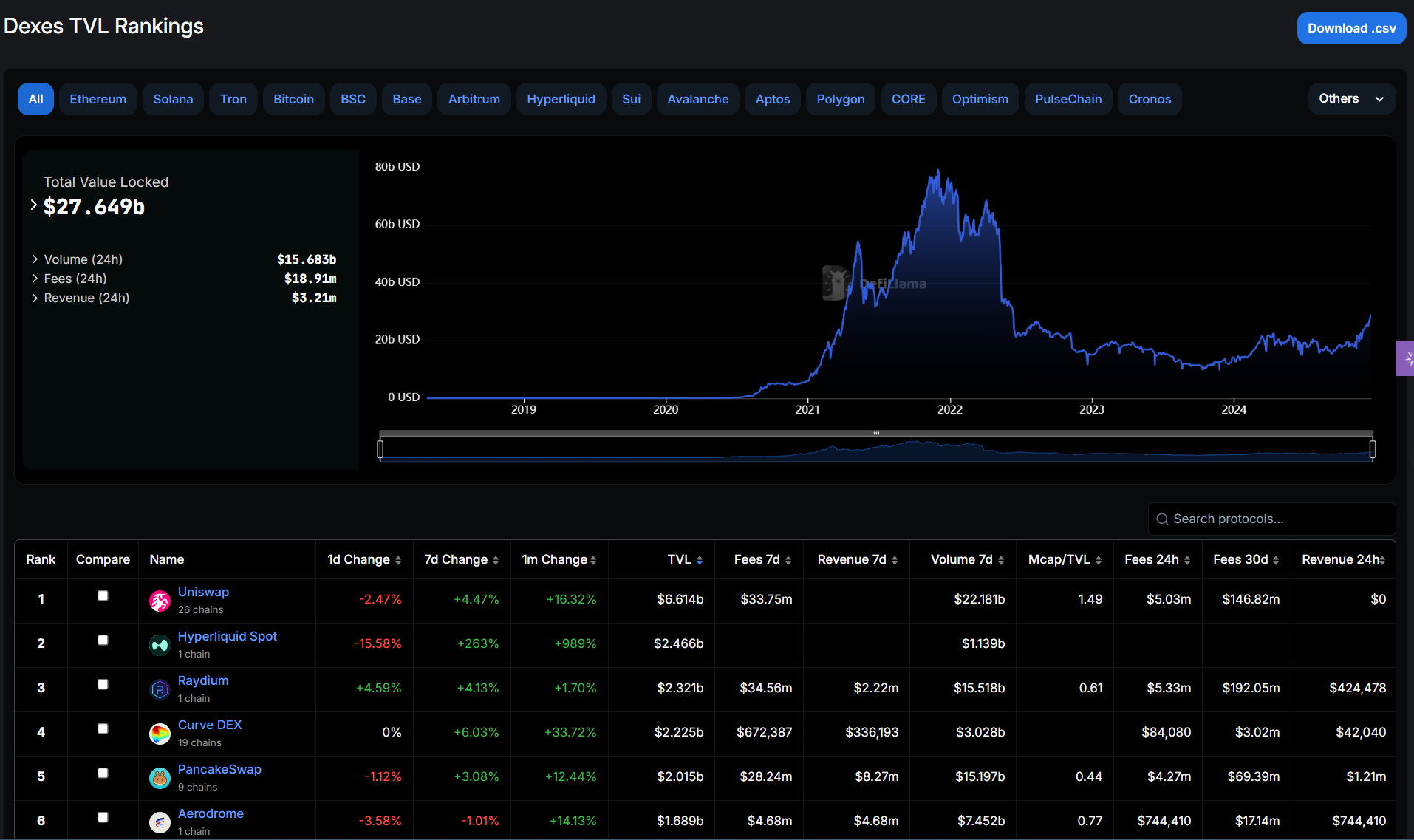
Capital inflows into Hyperliquid have been significant, ranking third globally over the past seven days with $1.87 billion in net inflows, behind only Bitcoin and Ethereum. In terms of overall DEX TVL, Uniswap maintains dominance with a 23.95% market share, while Hyperliquid has surpassed Raydium with 8.95%.
Total DEX TVL: $27.6 Billion, broken down as follows:
Uniswap: $6.61B (23.95%)
Hyperliquid: $2.47B (8.95%)
Raydium: $2.32B (8.41%)
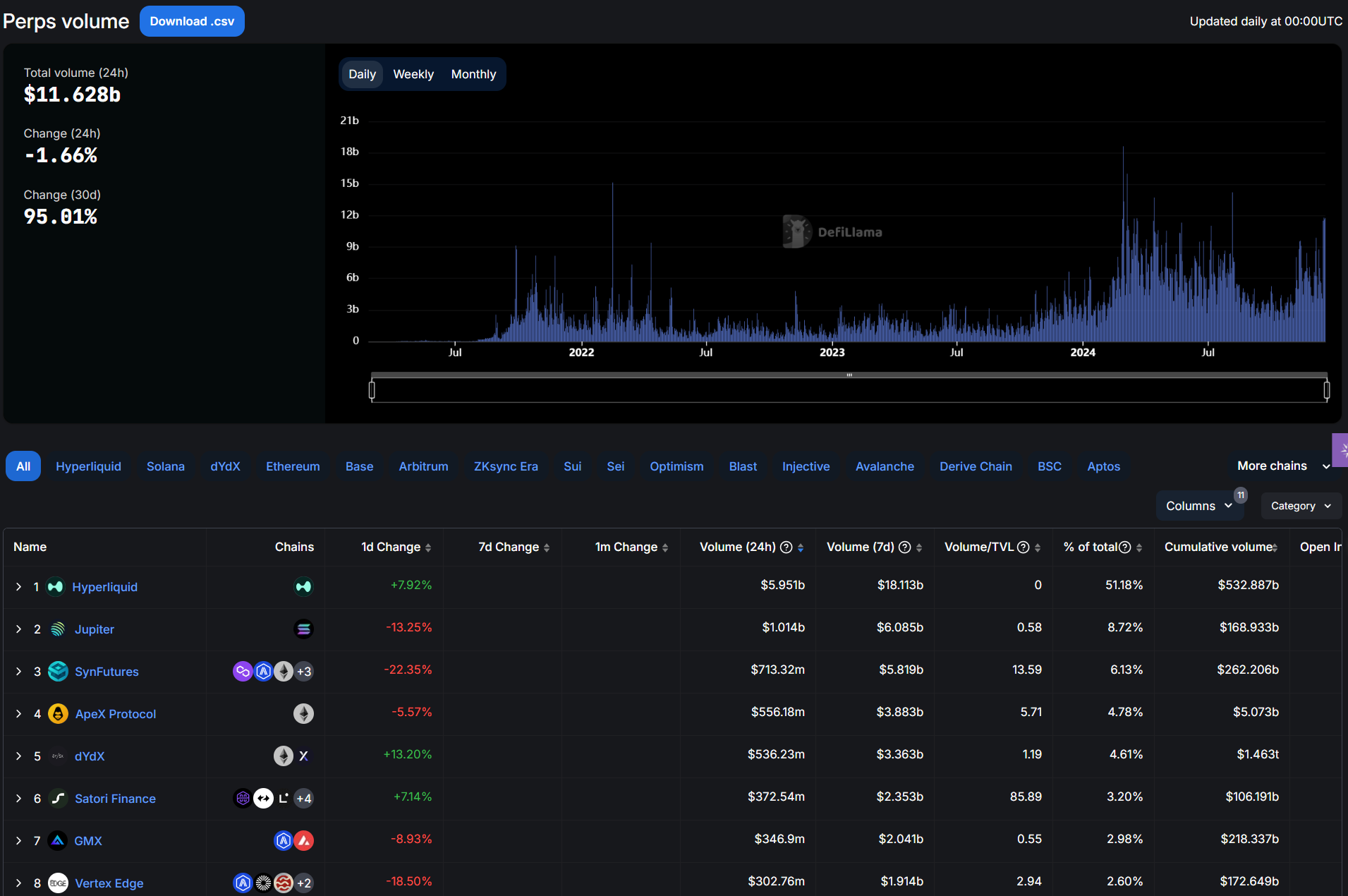
In the on-chain futures market, Hyperliquid leads in trading volume, reaching $5.95 billion in the last 24 hours, with cumulative platform trading volume totaling $532.88 billion.
2. Ecosystem Projects
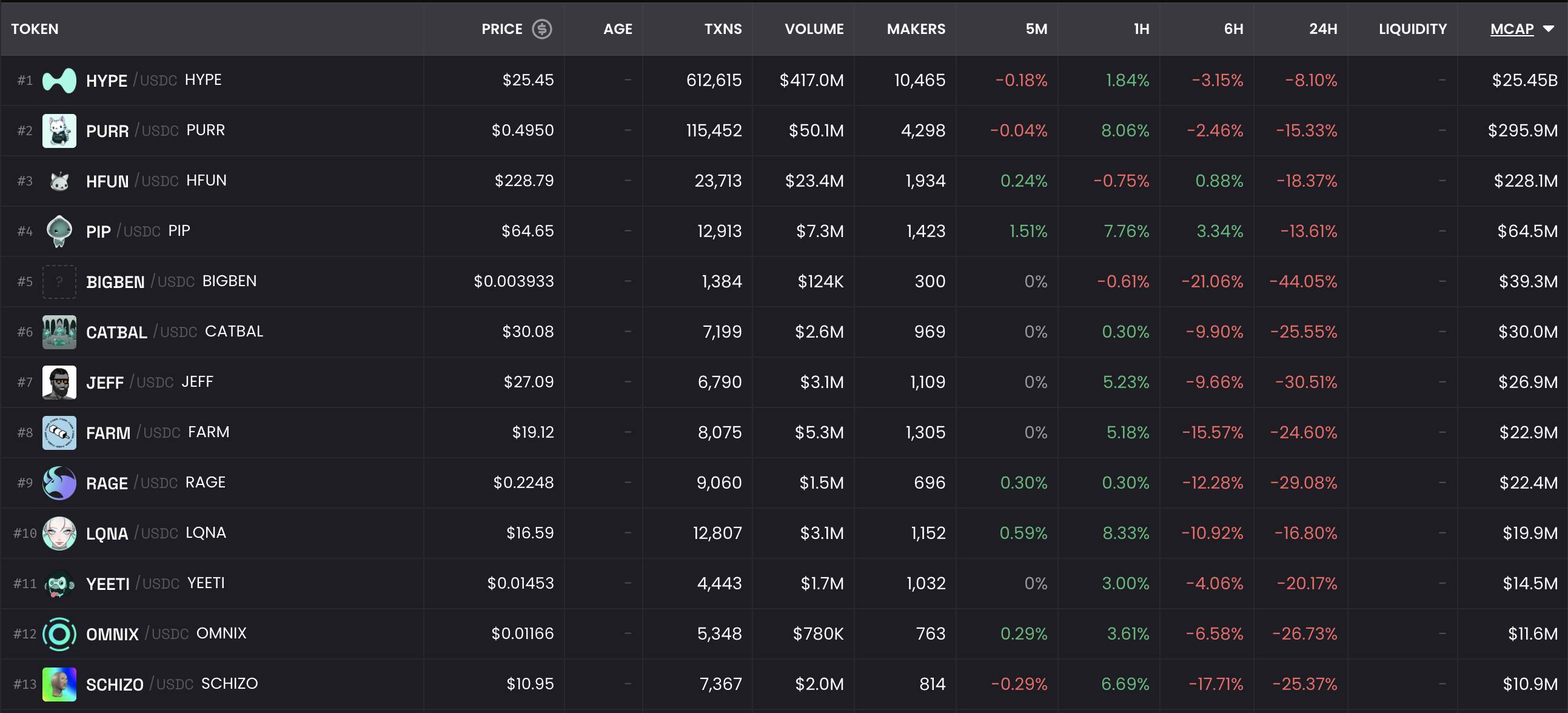
Hyperliquid's ecosystem tokens have recently performed impressively. The platform token HYPE once surged beyond $29, setting new all-time highs; currently, three tokens have market caps exceeding $100 million—HYPE, PURR, and HFUN—while 17 others exceed $10 million. With Hyperliquid’s transparent listing mechanism and the emergence of platforms similar to Pump.fun, numerous new tokens have sprung up rapidly. HYPE’s daily trading volume share has declined from an initial ~92% to around 70%. Below we examine some key tokens within the Hyperliquid ecosystem.
1) PURR
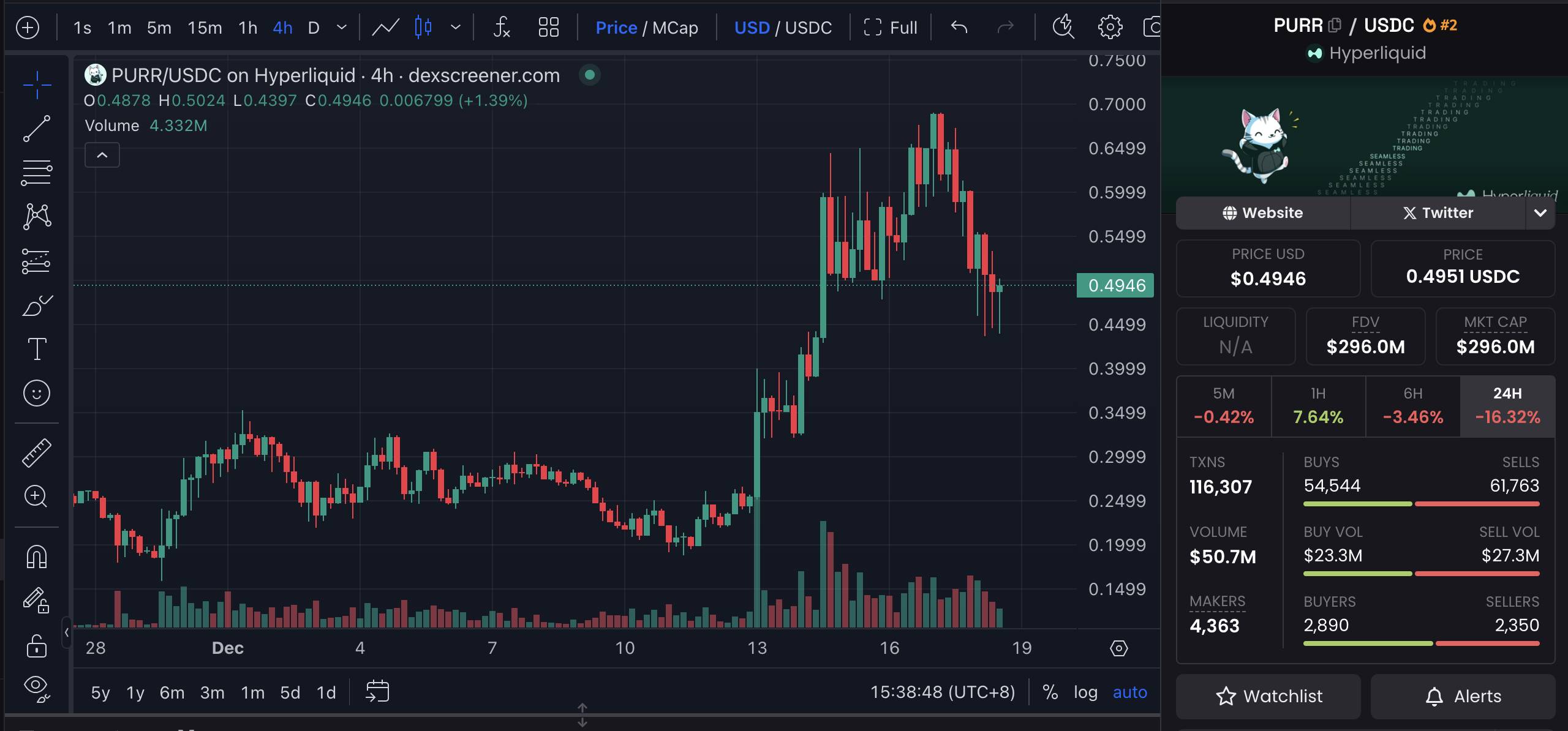
PURR is the first native token on Hyperliquid to implement the HIP-1 standard—a cat-themed meme coin. The token did not conduct an initial sale; instead, 50% was airdropped to users based on points holdings, while the remaining 50% was added to the PURR/USDC liquidity pool (later, following community suggestions, 40% of the supply was burned). As of December 18, PURR’s market cap was approximately $296 million, making it effectively the official meme coin on Hyperliquid with strong community consensus.
2) HFUN
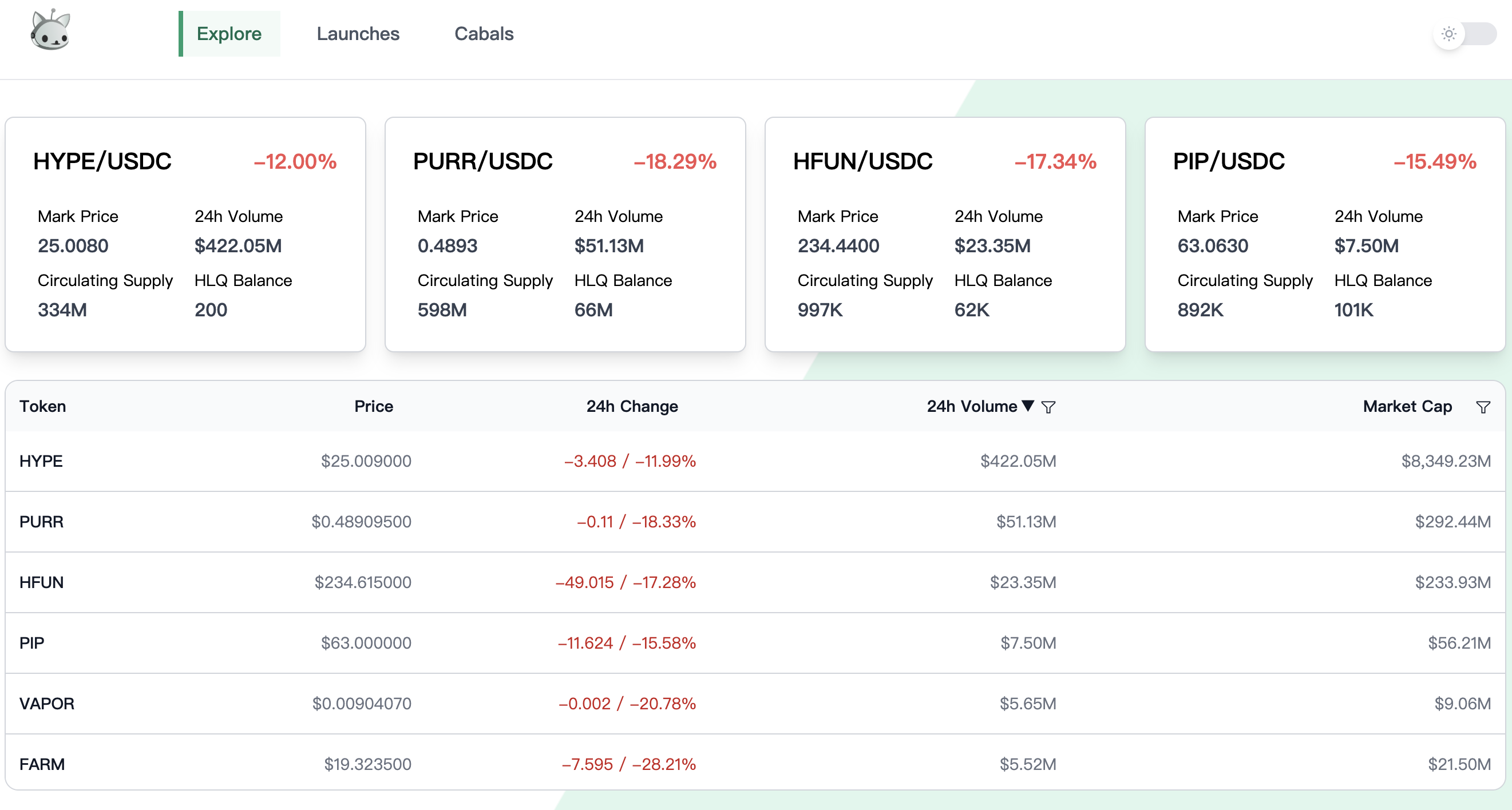
This project can be viewed as a Pump.fun equivalent on Hyperliquid, enhanced with a dedicated Telegram trading bot. As known, Hyperliquid’s success stems largely from its open and transparent listing process. To launch a spot pair, projects must first apply for permission to deploy a HIP-1 native token (HIP-1 being Hyperliquid’s token standard), followed by a Dutch auction to determine which project secures the ticker.
In response to this listing auction mechanism, Hypurr Fun emerged, allowing users to pool funds and compete for spot listing slots on Hyperliquid. Users can access Hypurr token details and trading data—including project descriptions, token prices, market caps, and volumes—via the web interface. Actual trading, however, is currently only available through the Telegram Bot.
Website: https://app.hypurr.fun/launches
Trading Bot: https://t.me/HypurrFunBot
Hypurr Fun remains in early stages and is steadily growing. Its tooling is clearly underdeveloped and leaves significant room for improvement, especially when compared to mature pump-style ecosystems. Precisely because of this immaturity, it may offer abundant alpha opportunities.
3) FARM
FARM is the first GenAI-powered AI agent game built on Hyperliquid. It combines GenAI models (“Cryptokitties 2.0”) + Stardew Valley (simulation gameplay) + Pokémon GO (combat/eSports), enabling users to perform AI-driven biological synthesis on-chain.
Official website: https://www.thefarm.fun/
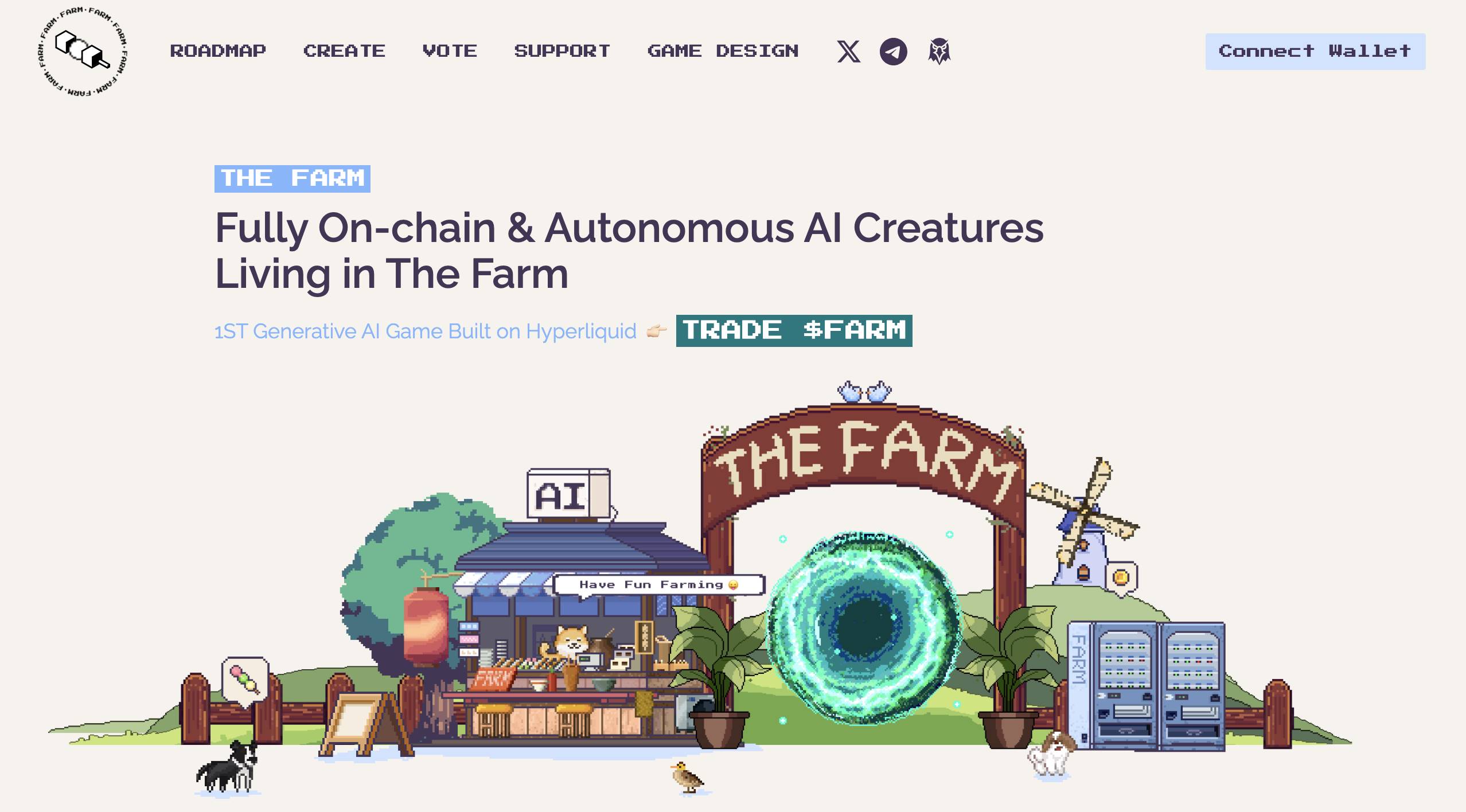
The product roadmap outlines three phases, with subsequent releases planned continuously. Phase One launched on December 13, 2024, at 08:00 AM Eastern Time. Its tokenomics allocate 20% to market makers for ultra-liquidity, and 80% distributed fairly via Hypurr Pump participants. The supply is fixed—no future minting of FARM will occur. Additionally, 50% of fees collected within FARM will be automatically burned, and 50% of profits will be used to buy back and burn circulating supply.
4) RAGE
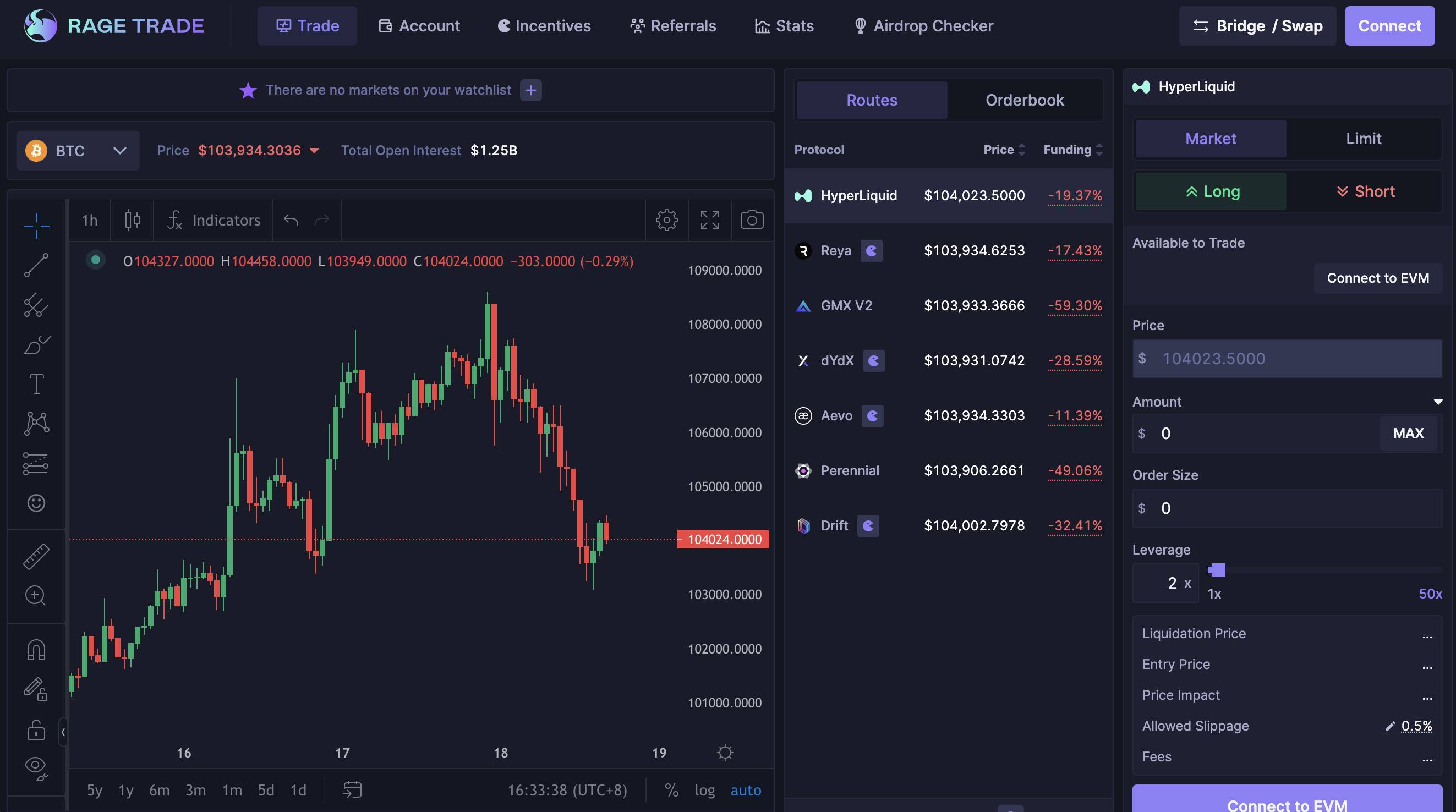
Rage Trade is a derivatives and yield aggregation platform in the DeFi space. Originally launched on Arbitrum around 2022, it gained fame for its “Delta Neutral GLP” strategy, integrating GLP (GMX’s LP token) with hedged positions to deliver stable returns during volatile markets. Core features include ETH perpetual contracts with up to 10x leverage, cross-chain recyclable liquidity, and income-generating 80–20 vaults.
In August of this year, RAGE completed its public sale, raising $6 million within 15 minutes. Previously announced tokenomics indicate allocations as follows: 35% for token sale, 30% for community treasury, 15% for team, 13.5% for private buyers, and 6.5% for airdrops. RAGE currently has a market cap of approximately $22 million.
Summary
Currently, Hyperliquid dominates the on-chain Perps market, achieving daily trading volumes as high as $6 billion, with continued market expansion expected. The platform attracts users with zero gas fees and a mere 0.03% trading fee, offering execution speeds comparable to centralized exchanges and significantly reducing trading costs. However, the platform’s trading volume and revenue data remain opaque externally—unavailable on DefiLlama—and can only be accessed via the official Hype website. According to public reports, the platform boasts over 50,000 monthly active users. While Hyperliquid excels in user engagement and daily usage metrics, its operational model closely resembles that of a centralized exchange, leaving room for improvement in decentralization. This “CEX-like” characteristic has sparked community debate about its true level of decentralization.
Join TechFlow official community to stay tuned
Telegram:https://t.me/TechFlowDaily
X (Twitter):https://x.com/TechFlowPost
X (Twitter) EN:https://x.com/BlockFlow_News
 @XTexchange