New Developments in the Stablecoin Arena: 23 Projects Announce Fundraising in Second Half, Binance and Circle Reach "Historic Reconciliation"
TechFlow Selected TechFlow Selected
New Developments in the Stablecoin Arena: 23 Projects Announce Fundraising in Second Half, Binance and Circle Reach "Historic Reconciliation"
Currently, from Binance and Circle's renewed collaboration to major crypto players intensively expanding their presence, frequent fundraising activities, and a gradually improving policy environment, the stablecoin sector is rapidly expanding in terms of liquidity and use cases, accelerating its emergence as one of the core narratives of this cycle.
 Navigating Web3 tides with focused insights
By Nancy, PANews
As the stablecoin market continues to expand, its fundamentals are undergoing multidimensional upgrades. From Binance and Circle ending their rift, to crypto giants intensively expanding their presence, frequent fundraising rounds, and gradually improving regulatory environments, liquidity and use cases for stablecoins are rapidly broadening—accelerating their role as one of the core narratives of this cycle.
Binance and Circle Reconcile as Industry Giants Accelerate Stablecoin Expansion
On December 11, Binance officially announced a strategic partnership with Circle, the issuer of USDC, aiming to broaden USDC adoption and support the development of global digital assets and the wider financial services ecosystem. Under the agreement, Binance will deeply integrate USDC across its product suite, offering trading, savings, and payment services to its 240 million global users, while adding USDC to its corporate reserves. Circle will provide Binance with technical support, liquidity, and complementary tools.
Binance CEO Richard Teng stated that both parties will jointly drive innovation in stablecoins and expand their applications. Circle CEO Jeremy Allaire emphasized that USDC could achieve broader adoption by leveraging Binance’s rapidly growing financial super-app ecosystem.
The "historic reconciliation" shocked the crypto community, especially given the prior adversarial relationship between the two companies. Last year, BUSD, the stablecoin jointly issued by Binance and Paxos, came under investigation by U.S. regulators—an inquiry that ultimately forced Binance to step back from the center stage of the stablecoin arena. Circle was widely believed to be the behind-the-scenes whistleblower; according to Bloomberg, citing sources, Circle reported to the New York State Department of Financial Services (NYDFS) in autumn 2022 that Binance lacked sufficient reserves to back its Paxos-issued BUSD tokens.
Yet today’s collaboration not only marks a truce between two major rivals but also lays a new foundation for large-scale expansion of stablecoins.
In fact, leading crypto firms have been increasingly active in the stablecoin space recently. For example, Binance has expanded applications for multiple stablecoins, including integrating FDUSD on the Sui network and USDT on the Aptos network.
Tether has also released several key updates. It significantly increased USDT minting volume—the total minted in December reached $4 billion—and currently over 100 million on-chain wallets hold USDT. Additionally, USDT received recognition as a virtual asset from the Abu Dhabi Global Market. Tether is also accelerating multi-chain expansion, having launched USDT on the TON blockchain and planning integration with the Aptos network.
Circle is similarly ramping up its efforts. Recently, Circle unveiled CCTP V2, an upgraded cross-chain transfer protocol that reduces settlement time from minutes to seconds. Scheduled for launch in early 2025, it will initially support Ethereum, Base, and Avalanche, with plans to expand to more blockchains later. Circle also announced the launch of USDC on Aptos and plans to support platforms like Unichain.
Additionally, Ripple's stablecoin RLUSD received approval from the New York Department of Financial Services, though initially it will only be available to institutional clients.
These developments indicate rapid growth in the stablecoin market, with accelerated moves by industry leaders undoubtedly driving deeper penetration and adoption within the global financial system.
Stablecoin Market Cap Surpasses $200 Billion, Ecosystem Flourishes Amid Investment Surge
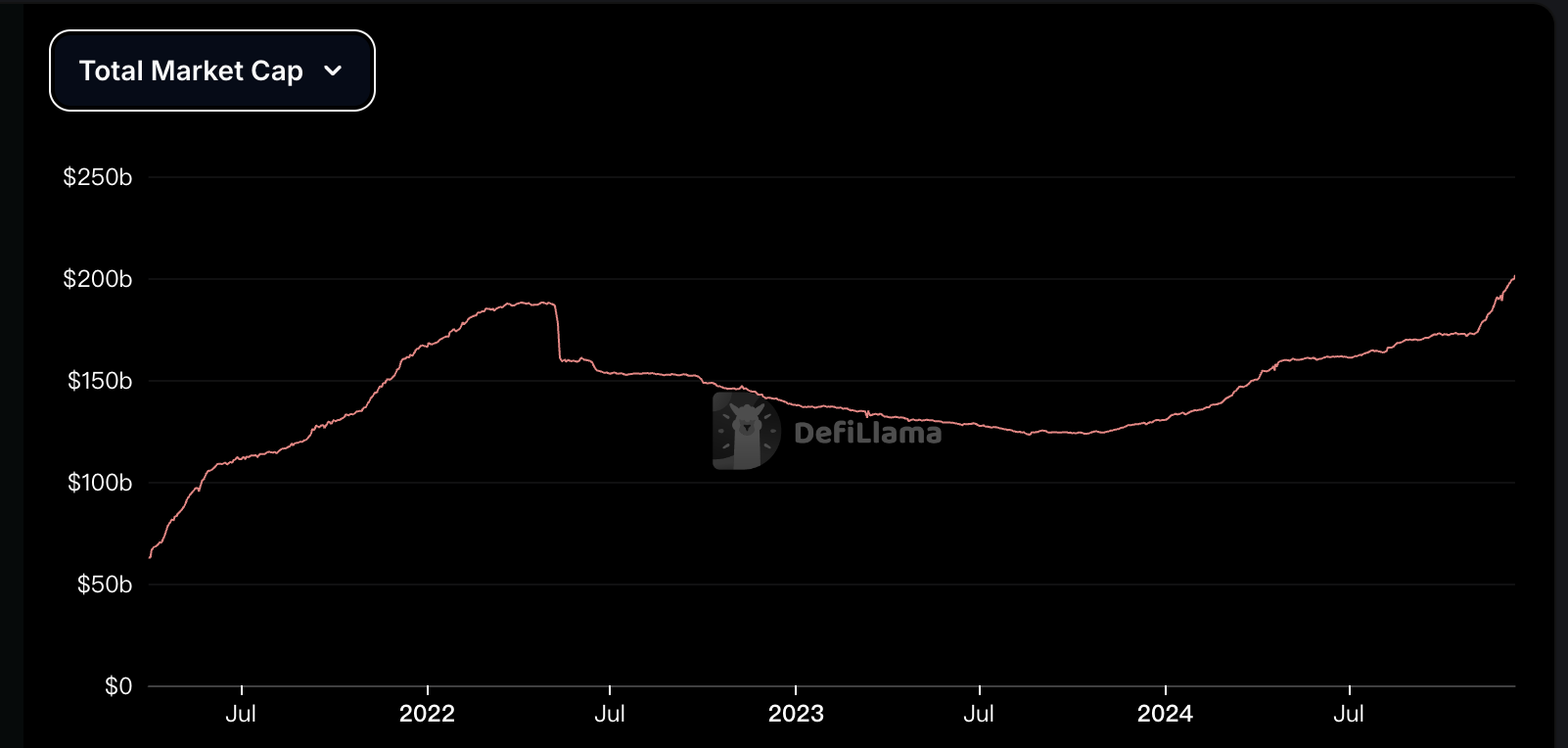
The stablecoin market has reached a milestone moment. According to DeFiLlama, as of December 12, the total market capitalization of stablecoins hit a record high, surpassing $200 billion. Asset management firm Bitwise forecasts the stablecoin market could double next year, reaching $400 billion.
In reality, stablecoins are playing an increasingly prominent role in the global financial system, with applications becoming more diverse. According to a recent report by Standard Chartered Bank, stablecoins have evolved from being used solely on cryptocurrency exchanges to becoming vital tools in global finance. Particularly in emerging markets where traditional cross-border banking is limited, stablecoins offer a fast and reliable method for transferring digital dollar assets. A survey found that in countries such as Brazil, Turkey, Nigeria, India, and Indonesia, 69% of respondents use stablecoins as a currency alternative, 39% for goods and services payments, and another 39% for cross-border transactions.
With the rise of innovative stablecoin projects, the ecosystem is becoming richer and demand for these tools continues to grow. Capital inflows are opening up new possibilities and opportunities for further development. According to PANews, at least 23 stablecoin projects announced funding rounds in the second half of this year, collectively raising over $1.86 billion. Notably, Bridge raised $1.68 billion, largely due to its acquisition by payments giant Stripe for $1.1 billion in October.
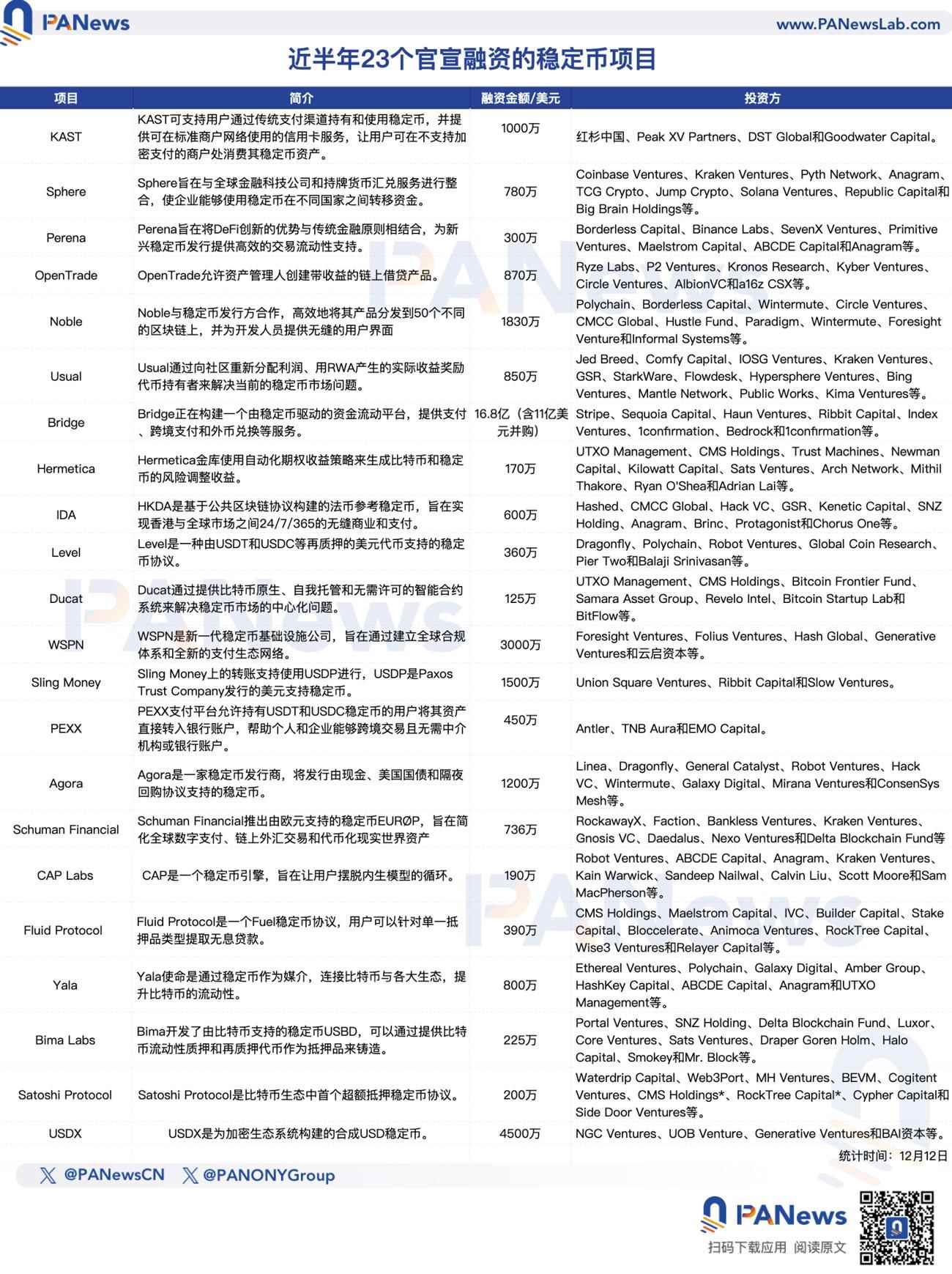
For example, Perena, a Solana-based stablecoin trading infrastructure project backed by Binance Labs, aims to solve fragmentation in the stablecoin ecosystem and lower capital requirements for launching new stablecoins through its product Numéraire. Users can mint stablecoins, earn returns from tokenized real-world assets, and utilize a tiered collateralized debt position system to customize risk-return profiles.
KAST, a stablecoin-driven financial platform, announced a $10 million seed round led by Peak XV (formerly Sequoia India and Southeast Asia) and HongShan (formerly Sequoia China). The platform enables users to hold and use stablecoins via traditional payment channels and offers credit card services compatible with standard merchant networks, allowing users to spend stablecoin assets even at merchants that don’t support crypto payments.
Sphere, a cross-border stablecoin payment company, secured a $5 million funding round led by Coinbase Ventures and Kraken Ventures. By partnering with global fintech firms and licensed remittance providers, the protocol enables enterprise-level cross-border stablecoin payments and allows conversion into local fiat currencies in supported regions.
These advancing innovations are injecting fresh momentum into stablecoin development and gradually expanding their role within the global financial ecosystem.
At the same time, the global regulatory environment for stablecoins is gradually maturing, with policy developments providing institutional support. Hong Kong’s draft “Stablecoin Bill” will be submitted for first reading at the Legislative Council on December 18, proposing a regulatory framework for fiat-backed stablecoin issuers—marking a substantive step forward in stablecoin oversight. The Central Bank of Brazil may lift its ban on self-custody of stablecoins, signaling a more open regulatory stance. The upcoming EU Markets in Crypto-Assets Regulation (MiCA) is expected to become a landmark in global stablecoin regulation, enhancing compliance safeguards. Meanwhile, the pending U.S. “Clarity for Payment Stablecoins Act,” which would license stablecoin issuers, may gain momentum under the incoming Trump administration.
In summary, with proactive expansions by major crypto players and sustained capital inflows, stablecoins are unlocking more use cases to meet the global financial market’s urgent demand for convenient, secure, and efficient payment tools—accelerating their transition from the crypto periphery into mainstream finance. Concurrently, progressive regulatory developments worldwide are paving the way for a compliant and standardized stablecoin market.
Join TechFlow official community to stay tuned
Telegram:https://t.me/TechFlowDaily
X (Twitter):https://x.com/TechFlowPost
X (Twitter) EN:https://x.com/BlockFlow_News
 PANews