The Man Behind Tether Emerges: Trump's Nominee for Commerce Secretary Faces Turmoil — Entwined Powers or Professional Collaboration?
TechFlow Selected TechFlow Selected
The Man Behind Tether Emerges: Trump's Nominee for Commerce Secretary Faces Turmoil — Entwined Powers or Professional Collaboration?
There are external concerns that Lutnick will be unable to avoid violating the transition team's own ethical guidelines.
 Navigating Web3 tides with focused insights
By Weilin, PANews
Howard Lutnick, chairman and CEO of Wall Street financial services firm Cantor Fitzgerald, was appointed by Trump on November 20 as the next U.S. Secretary of Commerce, pending Senate confirmation. However, this crypto-backing executive—previously known for his close ties to stablecoin issuer Tether's custody business—has been revealed to have led Cantor Fitzgerald into an agreement last year to invest in Tether and acquire approximately 5% equity.
Observers now suspect Lutnick may inevitably violate the transition team’s own ethical guidelines, which align with federal conflict-of-interest standards requiring members to recuse themselves from matters involving personal financial interests or organizations closely tied to their businesses.
According to recent reports, Howard Lutnick stated that upon Senate confirmation of his appointment, he will resign from Cantor and plans to divest his interests in the company to comply with government ethics rules.
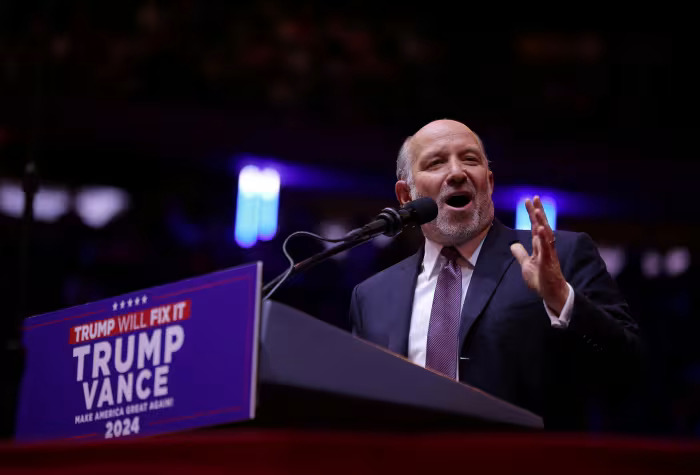
Wall Street Billionaire Howard Lutnick Assumes Dual Roles
Howard Lutnick’s recent nomination as U.S. Secretary of Commerce has drawn widespread attention and controversy. He is not only the chairman and CEO of Wall Street powerhouse Cantor Fitzgerald but also co-chair of Trump’s transition team. Lutnick is tasked with selecting around 4,000 new appointees for Trump’s administration, including antitrust officials, securities lawyers, and national security advisors with global experience. Yet, while serving on the transition team, he has not fully stepped back from managing his financial enterprises.
This dual role has raised concerns over potential conflicts of interest. Max Stier, president of nonpartisan government watchdog Partnership for Public Service, said the Trump team’s approach “crosses serious boundaries.” He added: “They’ve strayed far beyond the established processes and frameworks designed to ensure future leaders serve the public interest, not their private gain.”
Critics argue that Lutnick’s companies—including financial services firm Cantor and brokerage BGC Group—have stakes across nearly every sector of the American economy, from healthcare to technology. The publicly traded Newmark Group, where Lutnick serves as chairman, provides commercial real estate advisory services globally. Policies and regulations under a Trump administration—such as maintaining low corporate tax rates or FDA decisions on drug approvals—could significantly impact clients of Cantor and BGC. In response to concerns about financial stability, Lutnick has publicly defended Tether, the stablecoin issuer.
Additionally, Lutnick relies on lobbyist and fundraiser Jeff Miller, who maintains close ties with Trump allies and Republican lawmakers in Congress, to assist Tether’s operations in Washington. Since late last year, a subsidiary of Lutnick’s holding company, Cantor Fitzgerald, has paid Miller’s lobbying firm $300,000. Miller has also helped Lutnick establish connections with members of Congress.
Cantor’s “Deep Ties” With Tether Spark Controversy
Last year, Cantor entered into an agreement with Tether, the world’s largest stablecoin issuer, investing in the company and acquiring roughly 5% of its shares. According to the Wall Street Journal, Cantor values these shares at approximately $600 million. Tether currently holds tens of billions of dollars in U.S. Treasuries through Cantor’s custodial services, generating tens of millions of dollars in annual revenue for Cantor, according to sources familiar with the matter.
Moreover, Bloomberg reported that Cantor is negotiating with Tether for funding support for its newly announced Bitcoin financing business. Under the plan, Cantor would initially offer $2 billion in Bitcoin-backed loans to investors, with intentions to scale up the program further.
Following Lutnick’s nomination, Cantor’s role has come under increased scrutiny. Lutnick has proudly claimed that Tether allows Cantor full access to audit its financials. Yet critics argue that this “trust-based model” contradicts the crypto industry’s core principle of “don’t trust, verify.”
A recent Politico report highlighted concerns among some “Trump insiders” that Lutnick is conflating personal business interests with governmental duties. The report noted that during meetings with lawmakers on Capitol Hill—where discussions should center on transition planning—Lutnick has brought up regulatory issues affecting his commercial interests, including his relationship with Tether.
Ethics experts have also voiced concern over Lutnick’s potential new role, warning that his background with Tether could influence the selection of financial regulators under a Trump administration. Richard Painter, an ethics lawyer under former President George W. Bush, stated: “Putting someone from the crypto industry in charge of picking financial regulators is asking for trouble.”
Stablecoin Competition: USDC May Gain Regulatory Edge
On November 24, a Tether spokesperson said: “Tether’s relationship with Cantor Fitzgerald is purely professional, based on reserve management. Claims that Howard Lutnick joining the transition team implies influence over regulatory actions are baseless.”
On November 25, Howard Lutnick said he would resign from Cantor, BGC, and Newmark following Senate approval. Currently serving as Cantor’s CEO, he plans to hand over the company’s Tether-related operations to a colleague—reportedly likely his son, Brandon Lutnick.
It remains to be seen whether Tether can leverage Lutnick’s long-standing relationship with Trump to block legislation or criminal investigations that might favor USDC, or even protect assets held under Cantor’s custody.
While Tether’s market cap ($120.1 billion) far exceeds that of USDC ($34.3 billion), USDC may gain advantages in regulation—for instance, becoming the first stablecoin approved under the European Union’s Markets in Crypto-Assets Regulation (MiCA) this past summer. Tether has criticized MiCA requirements—such as mandating 60% of reserves be held in EU banks—arguing they increase risk.
In the U.S., Tether is reportedly under regulatory scrutiny over anti-money laundering concerns. Compared to Circle, Tether faces greater transparency criticism. To date, Tether has not undergone independent third-party audits of its multi-billion-dollar fiat reserves—primarily U.S. Treasuries—while Circle has at least disclosed detailed CUSIP numbers for its reserve assets, seen as a step toward greater transparency.
Several stablecoin-related bills are currently under consideration in the U.S. Congress and may surface during the post-election “lame-duck session”—the period between the election and the convening of the new Congress. These proposals could favor so-called “payment stablecoins,” a term widely interpreted as benefiting Circle’s USDC more than Tether’s USDT.
During a February congressional hearing, a Circle executive warned that “opaque stablecoin issuers” could be exploited by terrorists and illicit organizations. While she did not name Tether or Cantor directly, another lawmaker bluntly criticized Cantor for providing Tether access to the U.S. financial system.
Circle’s political influence in the U.S. is also growing. Its major donor, the political action committee Fairshake, has funded numerous pro-crypto candidates. If these lawmakers enter Congress, legislation favorable to USDC may pass more easily, while Tether could face heightened scrutiny.
Looking ahead, Lutnick has placed Cantor’s relationship with Tether under intense public and legislative scrutiny—potentially complicating his future government role. Tether’s dominant position in the stablecoin market—and the controversies surrounding it—will continue to shape the evolving landscape of regulation, legislation, and competition in this space.
Join TechFlow official community to stay tuned
Telegram:https://t.me/TechFlowDaily
X (Twitter):https://x.com/TechFlowPost
X (Twitter) EN:https://x.com/BlockFlow_News
 PANews