DeSci: How Can On-Chain Memes Challenge the Existing Scientific Research System?
TechFlow Selected TechFlow Selected
DeSci: How Can On-Chain Memes Challenge the Existing Scientific Research System?
If DeSci is treated as a meme, it requires stronger narratives and prominent figures to endorse it, while also possessing greater potential to break out of its niche.
 Navigating Web3 tides with focused insights
Author: YBB Capital Researcher Ac-Core

TL;DR
● The rise of DeSci as a hot topic stems mainly from Binance Labs investing in BIO Protocol, CZ’s new strategic direction involving biotech adoption, CZ and Vitalik jointly discussing DeSci, and a16z leading a funding round for the DeSci project AmionChain;
● If viewed as a Meme, DeSci requires stronger narratives and influential endorsements compared to meme trends in areas like zoos, AI, or art, while also possessing greater potential to break into mainstream awareness;
● In practical terms, the current DeSci market lacks sufficient economic scale to support actual scientific research funding—DeSci remains in an early "market-cap dream" phase where speculative hype is the primary driver.
I. Background
1.1 What Is DeSci?
An official explanation: DeSci (Decentralized Science) aims to build public infrastructure for scientific research using Web3 technologies in a fair and equitable manner, focusing on solving issues related to peer review, research funding, intellectual property management, data transparency, and censorship resistance.
In simpler terms, DeSci injects the crypto world’s speculative energy into the traditionally non-speculative realm of scientific research. However, DeSci is not a new concept born this year. VitaDAO, which focuses on funding and advancing early-stage longevity research, was established as early as 2021 and even received investment from Pfizer, a globally renowned pharmaceutical company. Yet DeSci has long remained obscure and overlooked—until recently, when Binance Labs announced its investment in BIO Protocol and CZ participated alongside Vitalik in a DeSci discussion, bringing the sector back into the spotlight.
1.2 Catalysts Behind the Hype
1. Binance Labs Exclusively Invests in BIO Protocol:
BIO Protocol functions as a crowdfunding platform for scientific projects, raising funds through token sales to support and advance biotechnology initiatives. Intellectual property is represented via IPTs (Intellectual Property Tokens) under the Molecule protocol and shared among participants.
Revenue generated from IP rights and product sales flows back into the BioDAO treasury to fund next-generation R&D. Binance Labs described BIO as “a Y Combinator for on-chain science.” To date, the top 100 companies incubated by Y Combinator have a combined valuation exceeding $100 billion, including major names such as Airbnb, Coinbase, Stripe, and Reddit.
2. CZ's New Strategic Focus Includes Biotech and Joint DeSci Discussion with Vitalik:
In his first post-release speech at the 2024 Dubai Binance Blockchain Week, CZ stated: “Now I focus on two things: one is Google Academy, the other is investing. My investments are primarily concentrated in three areas—blockchain, artificial intelligence, and biotechnology.” Shortly after, CZ attended Binance’s DeSci Day event in Bangkok, where he discussed DeSci with Vitalik. This sparked significant market attention, driving sharp increases in the token prices of various DeSci-related projects.
3. a16z Leads Seed Round for DeSci Project AmionChain:
Recently, AminoChain announced it raised $5 million in seed funding led by a16z. With prior investments from private funds including Cercano, total funding has reached $7.8 million. Its vision is to build a decentralized “biobank” on Layer 2, enabling researchers easy access to biological samples while ensuring patients retain control over their data and receive compensation for its use.

Image source: X(@BinanceLabs)
II. Real-World Needs and Actual Use Cases of DeSci
2.1 Scrutinizing DeSci: Funding Requirements in Scientific Research
According to the 2024 report by the U.S. National Science Foundation (NSF) and the National Center for Science and Engineering Statistics (NCSES), U.S. research spending in 2023 was estimated at $710 billion, approaching $700 billion in 2022. Private sector investment dominates R&D, accounting for about 78% of total funding—especially in information technology and pharmaceuticals.
In 2021, apart from China and the U.S., countries with the highest R&D expenditures included Japan ($177 billion), Germany ($154 billion), and South Korea ($120 billion). In 2021, U.S. R&D spending amounted to 3.5% of GDP. Israel and South Korea exceeded 4% R&D intensity, while Taiwan, Japan, and Germany ranged between 3%–4%, and the UK and China surpassed 2%. In 2022, higher education institutions ranked second in R&D investment in the U.S., behind only the business sector. Life sciences received the largest share of funding across science and engineering fields—$42 billion (44% of the total)—primarily funded by the Department of Health and Human Services (see extended link 1).
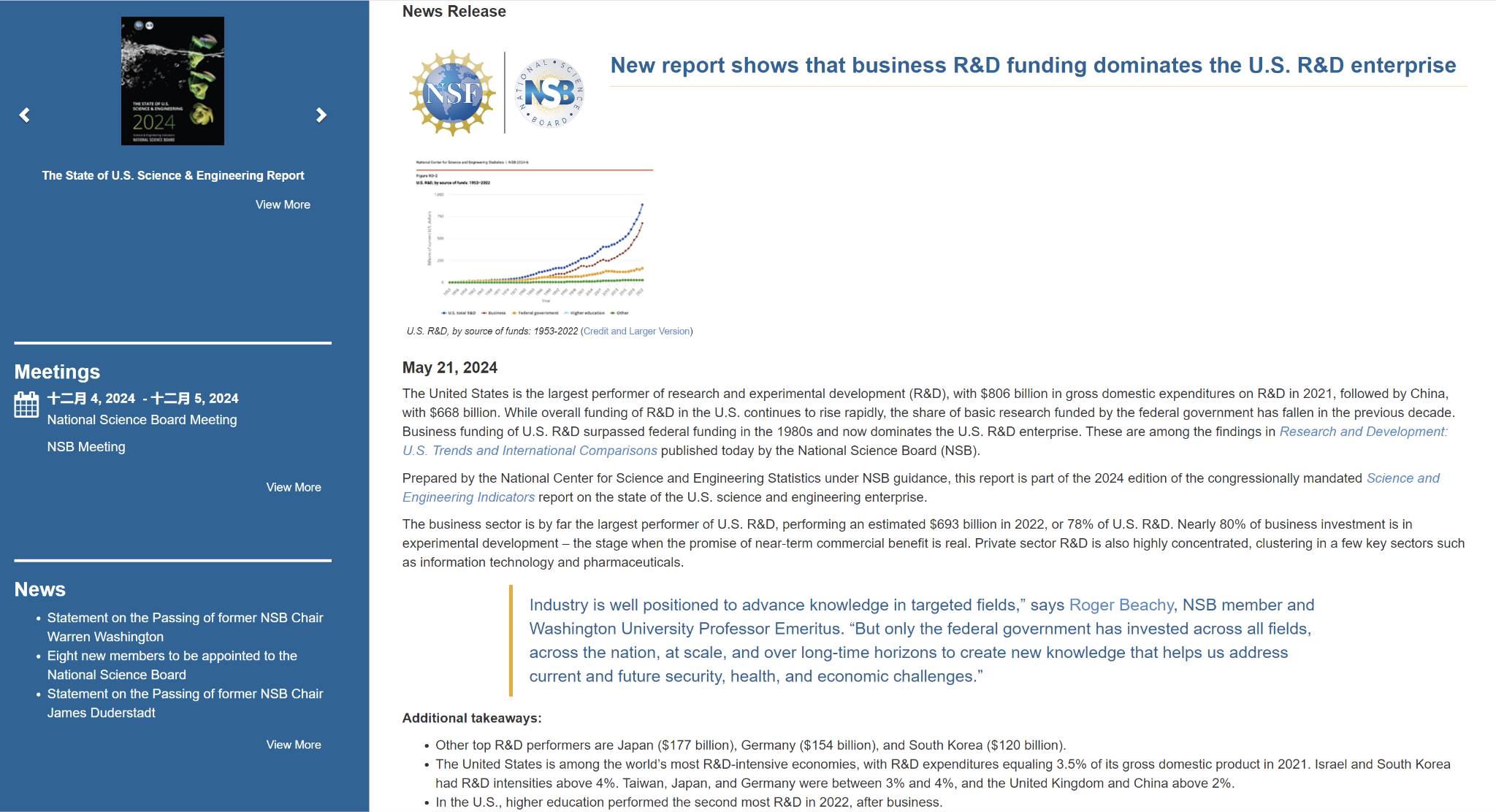
Image source: see extended link 1
In 2023, China’s R&D expenditure exceeded 3.3 trillion RMB (approximately $458.5 billion), up 8.1% year-on-year, with fundamental research funding reaching 221.2 billion RMB—an increase of 9.3%. In recent years, China has maintained high growth rates, particularly in high-tech and basic research, reflecting the momentum behind its national strategy to become a science and technology powerhouse (see extended link 2).
Comparison of R&D growth: China shows faster growth in research funding, especially in fundamental research, demonstrating strong national commitment to technological innovation and advanced sectors. While the U.S. maintains higher absolute spending levels, its growth rate is more stable, with emphasis on maintaining long-term leadership in cutting-edge technologies.
In practical application, DeSci remains largely in the stage of meme-driven narrative rather than directly advancing real scientific progress. Whether driven by empathetic storytelling encouraging donations or speculation-driven liquidity, the existing economic scale is still far too small to cover the massive funding needs of actual scientific research. Thus, DeSci remains in the early stages of a “market-cap dream.” For DeSci to truly materialize, it will require not only regulatory compliance but sustained support from highly influential figures.
2.2 A Real-World Case of Academic Finance: The Korean LK-99 Room-Temperature Superconductor Incident
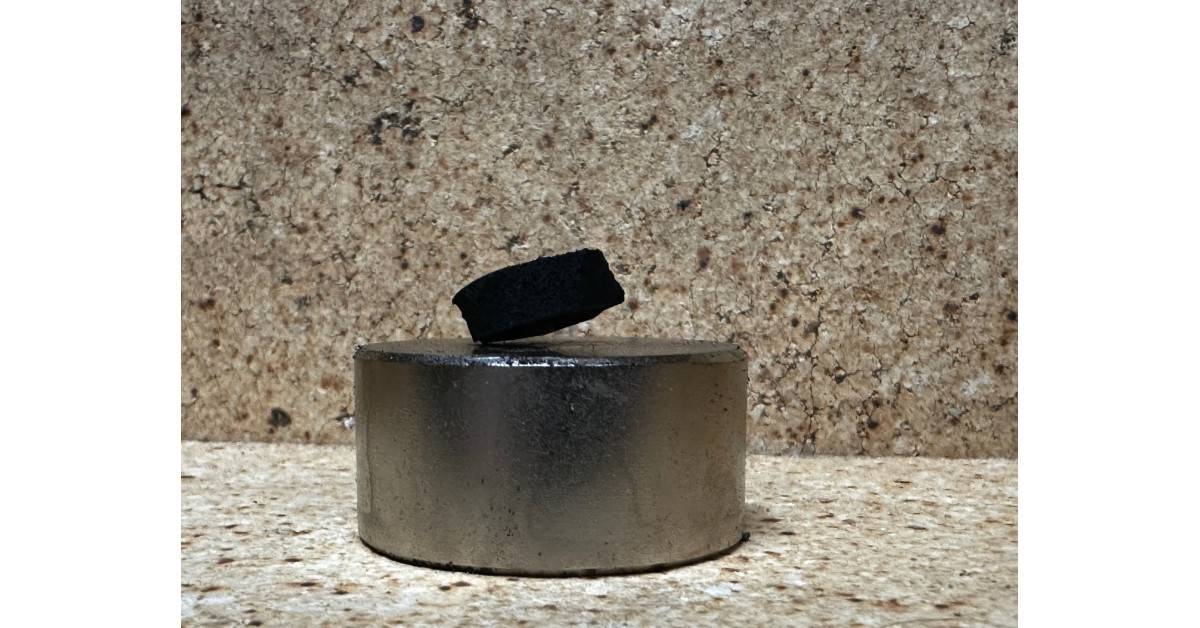
Image source: Taj Quantum - Official website of Taiji Quantum, USA
2023 was hailed as the “Year One of Room-Temperature Superconductivity,” triggered by several claims of discovering room-temperature superconductors that captured global scientific attention. However, subsequent investigations revealed serious flaws, escalating into academic scandals.
The incident began when Ranga Dias, a physicist at the University of Rochester, published a paper in *Nature* claiming discovery of a material capable of superconductivity at room temperature. Initially celebrated as a breakthrough, such a development could revolutionize energy transmission, medical devices, and electronics. Conventional superconductors require extremely low temperatures (below -196°C), making room-temperature operation a long-sought goal. Yet Dias’ work faced immediate skepticism, compounded by controversies surrounding his academic reputation dating back to 2020.
In 2020, Dias gained fame for a similar room-temperature superconductor claim, but the paper was later retracted by *Nature*. Despite this, he published another similar study in 2023, reigniting interest. However, peers accused him of data manipulation and even plagiarizing content from a doctoral thesis. Major outlets including *The Wall Street Journal* and *Science* launched investigations exposing problems in his research. The University of Rochester initiated multiple internal reviews, and external experts confirmed “data reliability issues,” resulting in Dias losing authority over his lab and students. In November 2023, *Nature* officially retracted his latest paper on room-temperature superconductivity.
Behind-the-scenes details gradually emerged. According to *Nature*’s news team, members of Dias’ research group did not observe the key superconducting phenomenon—the Meissner effect—yet received a manuscript draft from Dias shortly afterward and were pressured to co-submit. Graduate students expressed confusion over certain experimental data but ultimately refrained from public criticism due to hierarchical pressure. Subsequent peer reviewers and experts raised further doubts, uncovering signs of data tampering.
While the first paper faced scrutiny, Dias claimed another breakthrough—room-temperature superconductivity in a lutetium-hydrogen compound (LuH). But these measurements were similarly flawed. Many students pointed out systemic errors, feeling they were “deceiving themselves.” Despite mounting criticism, Dias pushed forward publication, though 8 of the 11 co-authors eventually requested retraction.
This series of academic scandals severely damaged Dias’ reputation and undermined trust across the scientific community. Young scientists involved now face uncertain career prospects, and credibility in the field has been eroded. Paul Canfield, a physicist at Iowa State University, commented: “This scandal harms young scientists’ careers, especially those in the superconductivity field.”
Meanwhile, the Korean LK-99 team became embroiled in similar controversy. Although they claimed in 2024 to have discovered a new “room-temperature superconductor”—PCPOSOS—many scientists questioned the validity of their research. Data presented at academic conferences mirrored previous LK-99 studies, lacking sufficient verification.
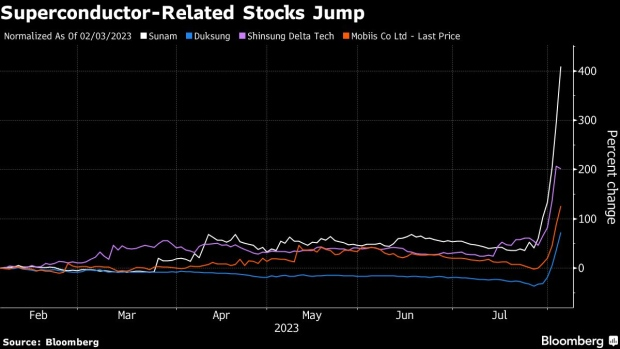
Image source: Bloomberg
Following announcements of breakthroughs in superconductor technology, several South Korean stocks linked to superconductivity attracted heavy investor interest. Small-cap stocks such as Duksung Co. and Sunam Co. surged 30% for three consecutive trading days. Sunam Co. rose approximately 260% over six trading days, while Duksung climbed 170%. Mobiis Co. jumped 30% on Thursday, and Shinsung Delta Tech Co. briefly rose 21%, hitting an all-time high.
Later, the verification committee of the Korean Superconductivity Society concluded that LK-99 showed no Meissner effect and therefore could not be proven a superconductor. This caused volatility in Chinese superconductor-linked stocks: Farseeing and Zhongfu Industrial saw sharp declines—Farseeing having no actual superconductor involvement, and Zhongfu offering only site and equipment support. Meanwhile, U.S.-based superconductor company American Superconductor dropped 29%, and Sumitomo Electric Industries declined due to poor performance.
III. DeSci Ecosystem Overview
3.1 BIO Protocol
BIO Protocol, backed by Binance Labs, has been dubbed the “on-chain science version of Y Combinator,” serving as an incubator for early-stage startups by providing capital and resources to accelerate development. According to TechFlow content, its core components include BioDAO, curation systems, liquidity and IP tokenization, and incentive mechanisms.
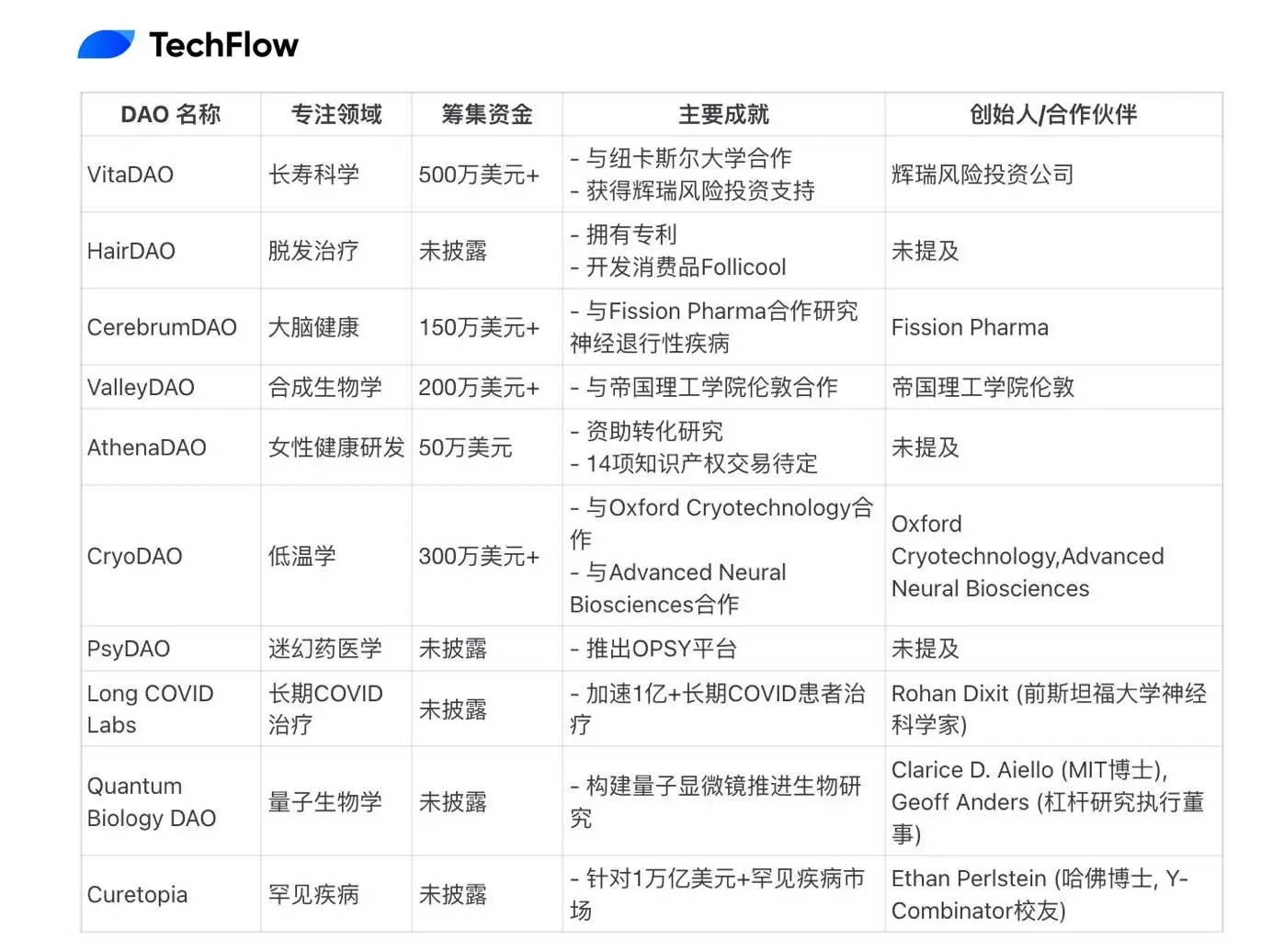
Image source: TechFlow - Interpreting BIO Protocol - BioDAO
$VITA (VitaDAO): Launched in 2021, VitaDAO focuses on funding and advancing early-stage longevity research aimed at extending human healthspan, governed by $VITA token holders;
$RSC (ResearchCoin): Rewards user contributions on the ResearchHub platform, incentivizing community participation to accelerate scientific research. Anyone can earn $RSC by sharing, curating, and discussing academic science within ResearchHub;
$ATH (AthenaDAO): A decentralized community of researchers, funders, and advocates dedicated to advancing women’s health research, education, and funding;
$GROW (ValleyDAO): A decentralized organization focused on anti-aging drugs and life extension projects.
3.2 Pump.Science
Molecule DAO, a Solana-based DeSci platform, unveiled Pump.science during the Solana Breakpoint 2024 conference—a meme launchpad that issues drug-themed meme tokens on Pump.fun. Notable concept tokens include:
$RIF: Rifampicin—an antibiotic gaining attention for its surprising effects on aging. As described on the official site: “Rifampicin has been shown to activate natural cellular defense mechanisms against stress and damage in model organisms like *C. elegans*, commonly used in aging research. Imagine it as a ‘cell coach,’ helping cells maintain health and resilience by protecting them from harmful oxidative stress and preserving protein quality inside cells. These protective effects help worms live longer and healthier lives.”
$URO: Urolithin A—a compound your body produces when consuming ellagitannin-rich foods like pomegranates. Its uniqueness lies in enabling a “spring cleaning” for your cells. It helps remove old, dysfunctional mitochondria (the cell’s power plants), allowing fresh, healthy ones to thrive. This process, known as mitophagy, has been shown to extend lifespan in *C. elegans* by making cells more efficient and energetic.
3.3 Donation-Based Concepts
$Scihub: An unofficial token donated by @0xAA_Science to support open-access scientific paper websites. Inspired by Sci-Hub’s shadow library, it serves purely as a community meme token. Sci-Hub is a non-profit, non-governmental platform offering free downloads of academic papers. Beyond Google Scholar, Sci-Hub, LibGen, and PubMed, it aggregates various publicly available Chinese and English academic resources, enabling one-stop searching and free downloading of literature, patents, books, and other scholarly materials.
3.4 DeSci Quantum Memes
$ANTI - Antitoken and $PRO - Protoken: A paired token set representing opposing stances toward meme tokens, created by algorithm engineer and mathematical physics expert @sshmatrix_. 1 $ANTI = 1 $PRO, moving in tandem in price.
IV. How Long Will the On-Chain Elixir of Immortality Last?
DeSci is not a new concept, but its sudden surge in popularity results from the confluence of three recent events: Binance Labs investing in BIO Protocol, CZ and Vitalik jointly discussing DeSci, and a16z leading a funding round for AmionChain—all fueling market momentum under the mantra of “pumping is justified.”
Currently, the DeSci space is primarily driven by memes, yet its foundational attributes differ from other meme categories:
● Different from Other Memes: Compared to AI, zoo, or art-themed memes, DeSci relies more heavily on endorsement from highly credible, influential figures—perhaps unable to sustain solely on crypto-native traffic, requiring real-world personalities associated with “scientific research”;
● Lighthouse Projects Need Sustained Valuation Growth: No DeSci project has yet reached a $1 billion market cap. Compared to meme trends in other sectors, DeSci still holds significant untapped market potential. Mainstream centralized exchanges have not listed related tokens, and large-scale fundraising in the primary market remains absent;
● DeSci May Have Greater Breakout Potential: PVP (player-versus-player) competition is fierce, but if an outsider with a “scientist” background leverages DeSci narratives for donations or fundraising, it could unlock substantial growth. Similar to $PEOPLE crowdfunding to buy a rare original copy of the U.S. Constitution, or Beeple’s NFT selling for $69.34 million at Christie’s, or Musk sending $DOGE to the moon—these cases share a core logic with DeSci, where marketing impact rivals Jia Yueting presenting a PowerPoint plan to build cars in crypto circles.
Extended links:
https://www.nsf.gov/nsb/news/news_summ.jsp?cntn_id=309719&org=NSB
https://english.www.gov.cn/news/202403/05/content_WS65e6ff4dc6d0868f4e8e4b66.html
Join TechFlow official community to stay tuned
Telegram:https://t.me/TechFlowDaily
X (Twitter):https://x.com/TechFlowPost
X (Twitter) EN:https://x.com/BlockFlow_News
 @YBBCapital