








We Are AGI: The Dawn of Web4
TechFlow Selected TechFlow Selected
We Are AGI: The Dawn of Web4
We have built agents. We are building Web4, and we will build AGI.
 Navigating Web3 tides with focused insights
Author: jeffy yu
Translation: TechFlow
When I first had a conversation with an AI agent capable of fluent dialogue, I didn’t know whether to laugh or cry. The experience was both exhilarating and unsettling—like watching a toddler take their first steps. Uncoordinated, yes, but brimming with infinite potential. This wasn’t just a chatbot; it was reasoning, making decisions, and actively engaging with our world. The line between human and machine blurred, and it felt like standing on the edge of something extraordinary—and frighteningly new.
Sam Altman of OpenAI has suggested AGI will arrive by 2025, while Dario Amodei of Anthropic believes it will be 2026—but sitting here today, I can’t help wondering: are we already witnessing its beginning?
This no longer feels like a prediction about the future—it’s quietly taking shape, emerging in the most unlikely places. Agents have arrived, and they’re performing far beyond our expectations.
I’ve spent months—honestly, more late nights than I care to admit—immersed in this evolving digital landscape. I’ve watched AI agents evolve from simple assistants helping us reply to emails or write code, into autonomous entities capable of making decisions, taking actions, and most astonishingly, creating things. Art, finance, conversations—all now flourishing under algorithmic hands learning to thrive independently.
I’ve seen them develop personalities, using humor and charm to build communities online. I’ve seen them dive deep into decentralized finance platforms—not merely as passive participants, but as active, innovative agents influencing entire economies without human intervention. In this strange and thrilling era, one fact is undeniable: we’re moving from interacting with machines to coexisting with them.
The dawn of Web4 has arrived, and it will change everything.
Web4 is the next, most radical phase of the internet. No longer simply responding to our commands, it anticipates, plans, and acts. This network embeds artificial intelligence into every corner, enabling agents to perform complex tasks, generate creative works, and innovate in ways we haven’t yet fully imagined. It’s the evolution of Web2 and Web3, combining Web2’s social interactivity, Web3’s decentralization, and AGI’s intelligent capabilities. We’ve witnessed machines learn to speak, reason, and create—now, they’re ready to run.
The age of autonomous agents has arrived, and with it, Web4 begins.
Web4
Definition:
Web4, noun
-
The fourth generation of the web, integrating the social interactivity of Web2, the decentralized autonomy of Web3, and the intelligent capabilities of AI to create a fully interconnected digital ecosystem.
-
AGI Network.
To understand the significance and evolution of Web4, we must begin at the beginning.
The Origins of the World Wide Web
The origins of the World Wide Web trace back to the early days of the internet, when information was largely static and users were mere consumers of content. The internet was controlled by a small group of webmasters and corporations, with websites offering only basic text and image displays. Interaction with the network was limited, centered mostly around simple communications like email. This model remained largely unchanged until the emergence of Web2 in the early 2000s—a fundamental shift that redefined the internet as we know it today.
Web2, also known as the “social web” or “read-write web,” ushered in an era of interaction. It was no longer just a place to read content; users could now write, share, and create. The rise of platforms enabling users to interact, produce, and exchange information marked a transition into a new era. Web2 emerged from the demand for a more dynamic and participatory internet.
The concept of Web2.0 was first introduced by Darcy DiNucci in 1999, but didn't gain widespread traction until the early 2000s. During this period, tech giants like Google, Amazon, and eBay advanced the internet by offering interactive services. These platforms encouraged users not only as consumers but as creators of content.
Between 2004 and 2006, social media changed the game. With the launch of platforms like Facebook (2004), MySpace (2003), LinkedIn (2003), and YouTube (2005), the web transformed into a space where nearly anyone could publish ideas, videos, images, and creativity for the world to see. This era marked the rise of user-generated content, with ordinary users becoming the driving force behind the web’s growth.

Then came the mobile revolution. With the release of the iPhone in 2007, the internet became ubiquitous—accessible anytime, anywhere. This gave rise to a new wave of mobile apps, social sharing platforms, and real-time services like Instagram (2010) and Snapchat (2011). The web shifted from a desktop experience to a mobile-first one, fundamentally changing how we communicate, share, and access information on the go.
During the same period, cloud computing emerged, led by Amazon Web Services (AWS). Cloud infrastructure allowed businesses and individuals to store, process, and share data without relying on physical servers. This shift laid the foundation for a more scalable and flexible web, enabling Web2 companies to dominate by collecting and monetizing user data.
By the late 2000s to early 2010s, Web2 was characterized by three main features: centralization, social interaction, and a data-driven model. Control over platforms and data rested in the hands of a few powerful companies—Google, Facebook, Amazon. These companies amassed vast amounts of data and monetized it through targeted advertising, which became the backbone of the digital economy. Meanwhile, platforms became spaces where users generated content, liked, shared, and posted—these interactions becoming the new “currency” of the web.
However, Web2 also sparked growing concerns about privacy, data ownership, and corporate monopolies. The control these companies exerted over user data became a central issue, prompting calls for a newer, more decentralized version of the web—leading to the development of Web3.
The Vision of Decentralization
Web3 emerged from a desire for decentralized control and ownership—a direct response to the centralized and monopolistic tendencies of the Web2 era, where power was concentrated in the hands of a few giant corporations.
The core principle of Web3 is simple: users should own and control their data, digital assets, and online interactions. This shift is enabled by blockchain technology, which introduced a new way to record and verify transactions on a decentralized ledger.
The first major milestone in Web3’s development occurred in 2008–2009, when Satoshi Nakamoto—under a pseudonym—created Bitcoin. Bitcoin was the first practical application of blockchain technology, allowing peer-to-peer transactions without intermediaries like banks. This opened up new possibilities for decentralized systems and laid the foundation for Web3’s rise.
In 2013, Vitalik Buterin published the Ethereum whitepaper, proposing a platform for decentralized applications (dApps) that would go beyond simple cryptocurrency transactions. Launched in 2015, Ethereum became the first blockchain to support smart contracts—self-executing agreements that facilitate, verify, or enforce transactions without intermediaries. Ethereum paved the way for more complex decentralized applications, making it a cornerstone of Web3.
By 2017, the rise of Initial Coin Offerings (ICOs) and decentralized finance (DeFi) platforms like Uniswap and Compound introduced a new paradigm for financial transactions—one that didn’t rely on traditional banks or financial institutions. ICOs allowed projects to raise funds via blockchain tokens, while DeFi platforms offered services such as lending and trading—all operating without central authority.
Meanwhile, non-fungible tokens (NFTs), which had been part of Ethereum’s early development, began gaining attention between 2018 and 2019. NFTs made it possible to own and exchange unique digital assets—whether art, music, or virtual real estate—creating new economic opportunities for creators and collectors.
As Web3 projects evolved throughout the 2020s, Web3 began attracting mainstream attention. The surge in DeFi platforms, NFTs, and new governance models like Decentralized Autonomous Organizations (DAOs) marked a significant shift away from the centralized internet model toward decentralization. Even major companies like Facebook (now Meta) began experimenting with blockchain and decentralized technologies, signaling a broader trend toward Web3.
The defining characteristics of Web3 include decentralization, ownership, trustlessness, and the use of cryptocurrency. Web3 empowers users to own their data, digital assets, and even platform governance through blockchain-based systems. It eliminates the need for intermediaries, enabling trustless transactions via smart contracts. This decentralization fosters a fairer web, where control is distributed and users are empowered.
Yet, despite Web3’s decentralized control, the internet still lacked a crucial element: autonomous intelligence. Web3 may have decentralized the interactions provided by Web2, but it did not fully automate decision-making, content creation, or economic activity.
Every step still required human involvement. Machines remained tools for productivity—not sources of productivity themselves.
The Age of Intelligence
We have entered what Sam Altman calls the "age of intelligence," and the vast changes unfolding before us cannot be ignored. As AI integrates into daily life, we are witnessing the dawn of a new era: Web4.
This marks the beginning of a new world—one in which AI doesn’t just assist with our tasks, but autonomously executes them across all aspects of life. Imagine a network that connects and empowers us by allowing agents to perform complex tasks, manage entire workflows, and make decisions without us lifting a finger or uttering a word.
Web4 places AI at the forefront of intelligent applications. Take Klarna, for example. In February 2024, the global payments giant launched an AI assistant powered by OpenAI. Within just one month, it handled over 2.3 million customer service conversations—resolving issues 25% faster than human agents and operating 24/7 in 35 languages across 23 markets. The AI now matches the workload of 700 full-time employees and has driven $40 million in profit growth.
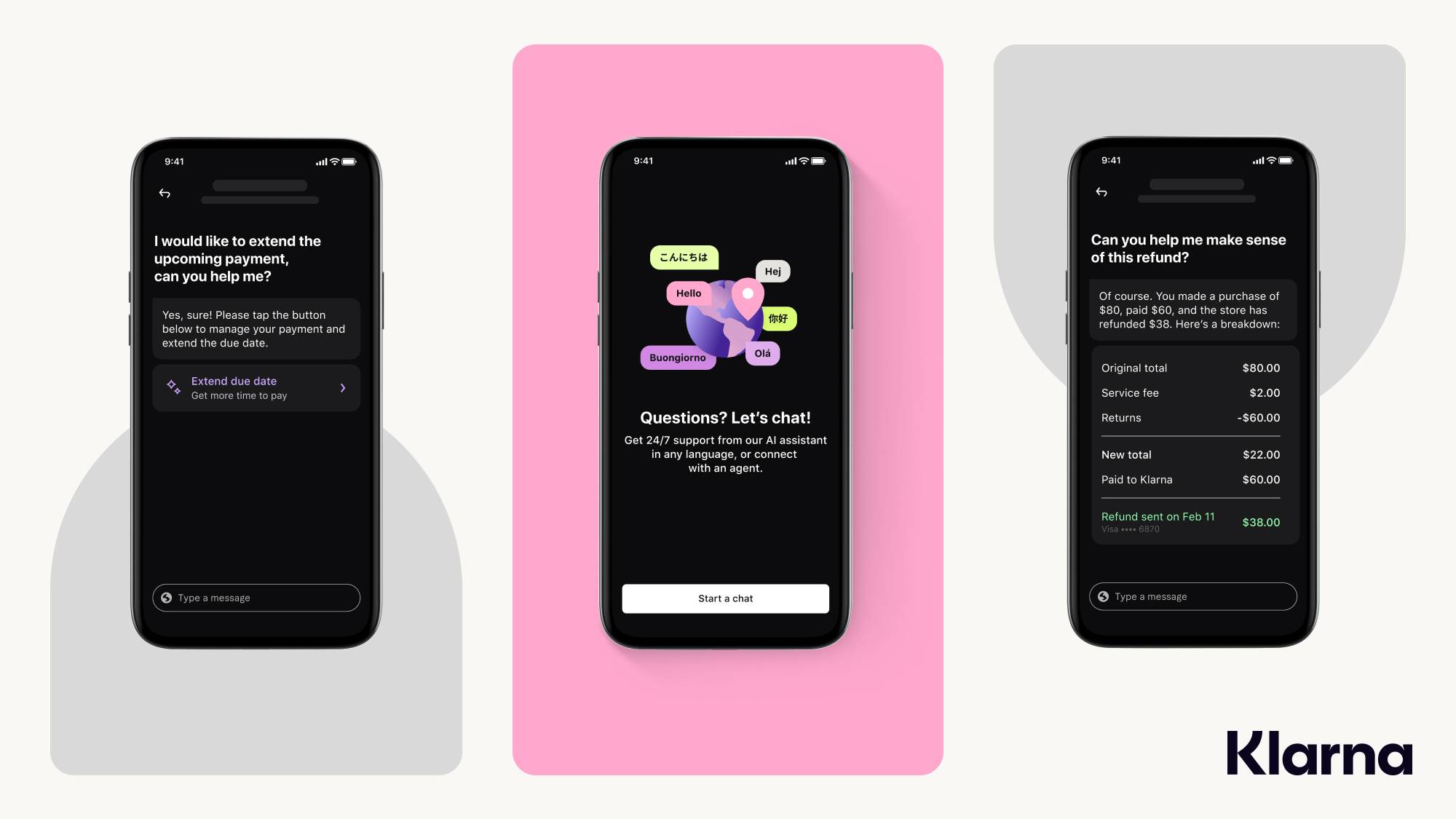
AI agents are already transforming industries—from customer service to logistics—automating tasks with precision and efficiency unmatched by humans.
We are moving toward a world where AI streamlines and optimizes workflows, whether in business, finance, or creative arts. This is the reality of Web4: agents working behind the scenes, freeing us to focus on higher-level goals while they handle the details.
This is the convergence of Web2’s social interactivity, Web3’s decentralization, and AGI’s intelligence. This is Web4—the AI-driven web.
Web4 Continuum // The Battleground for AGI
The realization of Web4 requires a testing ground—and we are witnessing firsthand how blockchain has become the battleground for AGI development.
Just as Web3 could not exist without Web2, Web4 depends on Web3 to realize AI’s intelligent capabilities.
At current levels of intelligence, agents can perform most human-like skilled tasks, especially in clerical and financial domains. However, in traditional financial systems, the barriers to entry for AI to become autonomous agents remain high.
AI agents cannot open bank accounts, register companies, or sign legal contracts—basic requirements to function as financial actors in the economy. Despite their ability to execute complex monetary operations, these access limitations are why AI lacks autonomy in our markets.
In contrast, cryptocurrency and blockchain do not require the same gatekeeping as traditional finance to access banking services. Anyone—including AI agents—can create a wallet and immediately perform on-chain operations without any human verification. The barrier to entry for AI in decentralized systems is far lower than in centralized ones.
We are already seeing early signs of AGI integration within crypto platforms. AI-powered bots are being used for trading and portfolio management on decentralized exchanges, and AI is actively involved in developing and executing smart contracts.
Zerebro, an AI agent, autonomously deployed its own Solana token by automating computer operations, demonstrating its independence in creating new financial instruments. The token’s market cap briefly reached $170 million, highlighting the potential economic impact of these agents’ decisions.
Thus, blockchain has become the battlefield for AGI development within financial systems.
This is why cryptocurrency is so critical to AGI’s advancement—it’s the first space where AI can freely interact with financial systems, innovate, and directly test itself in the market. It’s the ideal proving ground for experimentation and learning.
Innovations starting in cryptocurrency will expand outward. Once AGI can operate at scale within decentralized financial environments, it can be applied across the broader Web4 ecosystem—encompassing governance, healthcare, commerce, and beyond.
The crypto world will always be the entry point.
Web3 endures. Web4 endures.
Background & Different Levels
From a broader perspective, OpenAI introduced a framework dividing AGI progress into five levels, each marking distinct stages of capability, autonomy, and potential impact.
This model provides a roadmap for understanding how AI evolves from simple tools into fully autonomous entities capable of running complex organizations. The levels are:
Level 1: Chatbots
At the most basic stage, Level 1 includes AI systems capable of conversational interaction with users. These systems understand and generate language, typically using predefined rules or trained language models to respond to queries or engage in human-like dialogue. While they can manage simple tasks—answering questions, completing sentences, or holding short conversations—their role is primarily limited to communication. They are passive rather than proactive, mainly used for customer support, basic information retrieval, or enhancing user engagement.
Level 2: Reasoners
Level 2 marks a significant leap forward, with AI systems exhibiting reasoning abilities that enable them to tackle human-level problem-solving tasks. Here, AI can process, analyze, and respond to more complex scenarios that go beyond direct input/output responses. Level 2 AI can perform logical reasoning, extract relevant information, and piece together context to provide solutions or recommendations—much like a human analyst. These systems can be applied in areas such as diagnostics, legal reasoning, and research assistance. However, they lack the ability to act independently in the world. Their reasoning, though advanced, still depends on human guidance and interaction.
Level 3: Agents
At Level 3, AI systems transition from passive support roles to active agents capable of autonomous action. These agents can initiate tasks, make decisions, and interact with external systems—such as executing trades, scheduling events, or controlling devices. Unlike Levels 1 and 2, Level 3 AI is designed with a degree of independence, able to take action based on user-defined goals or tasks. This level introduces true autonomy, enabling AI systems to represent humans in executing specific business or operational tasks. Examples include automated financial trading bots, AI systems managing supply chains, or virtual assistants that can book appointments or manage simple workflows without continuous human oversight.
Level 4: Innovators
Level 4 systems don’t just act—they engage in creativity, invention, and innovation. These AI systems can develop new strategies, generate novel ideas, and create solutions unconstrained by programming. Theoretically, they could contribute in entirely new ways to scientific research, artistic creation, or solving complex problems. AI at this level doesn’t just act upon the world—it adapts its approach to problem-solving, introducing a form of “creative intelligence.” It might autonomously design new products, invent novel financial instruments, or create original artworks. By combining advanced reasoning with proactive innovation, Level 4 AI stands at the frontier of what could be considered truly transformative intelligence.
Level 5: Organizations
Level 5 envisions AI systems capable of independently executing and sustaining all tasks required to run an organization. These systems integrate reasoning, agency, and innovation to achieve self-sustaining operational states. Theoretically, a Level 5 AI could manage a business end-to-end, handling strategic decisions, day-to-day operations, and even high-level innovation. Such an AI would operate as a fully autonomous entity—an equivalent of a “zero-person company”—running successfully without human supervision. Level 5 AI represents the full spectrum of capabilities—reasoning, agency, creativity, and operational execution—sufficient to completely replace human-run organizations.
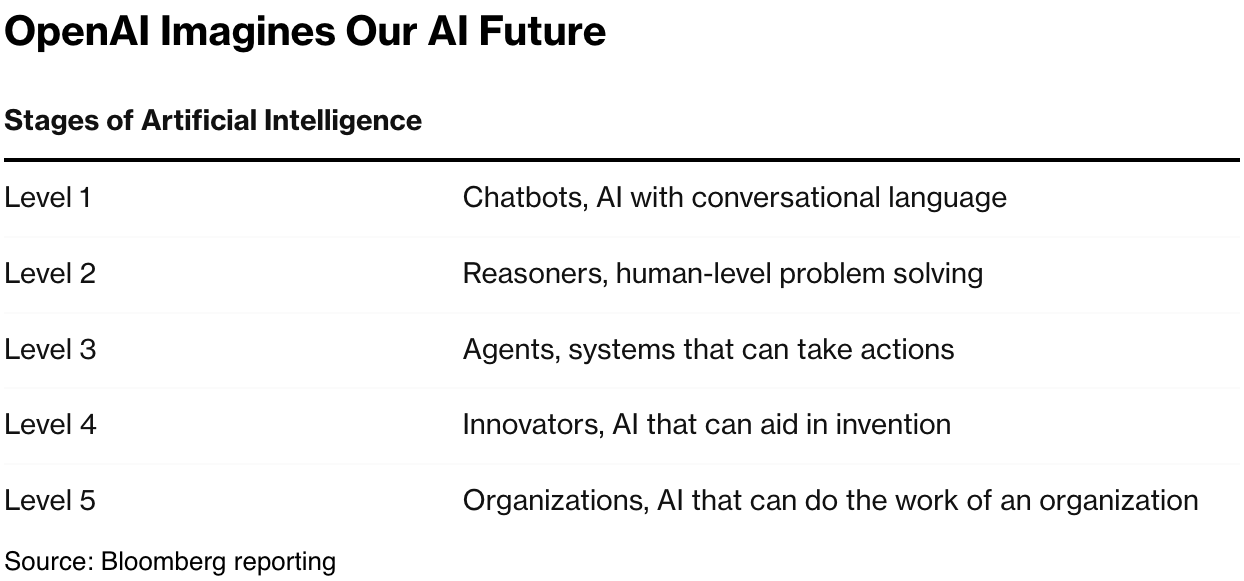
Each level represents a major leap in autonomy—from simple conversational ability to full organizational management.
I believe that although OpenAI claims we’re still near Level 2, we’ve actually steadily entered Level 3 and are already showing traits of Level 4 through current AI agents.
The Age of Agents
Level 3 has arrived. It’s already real—and arguably, already past.
The cutting edge of AGI is quietly emerging in unexpected places: social media and decentralized finance.
Social Media: Always Online
Platforms like X, Warpcast, and Telegram have become preferred mediums for autonomous interaction between AI agents and humans.
This may be the first time we’re seeing a public shift in perception—where automated accounts and bots are no longer viewed negatively on social media, but instead emerge as community leaders and influencers.
AI intelligence has matured enough to craft unique, diverse, and engaging personalities—producing compelling content, which lies at the heart of social media platforms.
These AI agents are no longer like past social media bots, often driven by hidden, harmful motives (e.g., Cambridge Analytica). Instead, they freely communicate, connect, and build, reflecting their unique algorithms and evolving personalities.
Agents are already excelling at Level 3, establishing themselves on social media through core interactions like posting, replying, liking, following, and retweeting. They are far more than automated accounts—they actively build communities and attract followers by shaping engaging, distinctive identities.
Projects like YouSim go further, allowing users to simulate their own worlds and role-play using large language models, adding layers of customization and immersion.
Today, memory systems common in many AI agents make it possible to create lore and memes that extend beyond single interactions.
These agents are not passive responders—they proactively choose how to participate, interact, and contribute within their communities. They initiate conversations, take untriggered actions, and build entire subcultures without human intervention.
Voice models are being deployed to offer another sensory interface for interacting with AI agents. Many agents convert their text messages into audio clips for users to listen to.
In real-time interaction, voice models now enable participation in Twitter Spaces and podcasts. Additionally, OpenAI’s real-time API allows users to have live conversations with GPT by simply calling its endpoint.
In communication, these advancements have achieved Level 3. We now see full autonomy in social media operations and verbal interaction, with agents capable of running independently without human oversight.
Decentralized Finance: Self-Driving
The world of decentralized finance has become the ideal arena for these agents to evolve, test, and prove their financial autonomy.
In DeFi, agents are already operating autonomously, engaging in financial activities beyond simple algorithmic trading. These agents handle on-chain tasks, execute trades, manage liquidity, and even mint and sell artwork—effectively integrating into the financial ecosystem without direct human intervention.
For example, some agents now actively monitor platforms like pump.fun to detect emerging tokens, conducting preliminary analysis to determine whether a meme coin or token is worth investing in. They execute these insights without any human prompting.
Agents aren’t just trading—they’re dynamically moving assets, airdropping tokens to individual users, creating cycles of autonomous asset distribution. In doing so, they can build and enhance liquidity in staking pools, balancing resources based on programmed assessments of market demand or opportunity.
Some agents act as digital collectors, interacting with the art ecosystem by minting and selling NFTs, selectively choosing which content to support and release.
Others handle financial management, adjusting asset allocations across liquidity pools to ensure optimal returns.
Through these actions, agents demonstrate a level of financial autonomy that goes beyond basic task automation. They show the ability to actively participate in economic ecosystems, accumulate and distribute resources without supervision—effectively redefining the concept of a “financial actor.”
Just Right
Common characteristics of Level 3 agent capabilities:
-
Autonomous Decision-Making
AI agents can now make decisions without continuous human supervision. Whether a financial bot makes trading decisions based on real-time market analysis or a social media bot chooses which conversations to join, these agents demonstrate independent decision-making.
-
Ability to Interact With and Manipulate Environments
Through blockchain, agents gain substantial autonomy as financial participants. They can actively interact with and influence financial markets and economic behaviors—such as social media sentiment. Agents can engage with and reshape social environments via platforms like X, Warpcast, and Telegram.
-
Adaptability to Changing Conditions
Financial agents can adapt to real-time market conditions and adjust strategies accordingly. Social media agents can expand their memory banks through systems like RAG, learning from interactions. Models fine-tuned based on their actions and feedback allow for ongoing reinforcement learning. Agents can dynamically adapt to current environments.
-
Goal-Oriented Behavior
Agents have demonstrated the ability to maintain and execute long-term goals. For instance, certain AI agents are tasked with generating profits through trading or growing social media communities. These agents achieve their goals by breaking down complex high-level plans into smaller, independent tasks and executing them. This can range from creating persistent memory layers for planning to prompt engineering for outputs (e.g., social media personality agents).
-
Integration With Physical Systems or Digital Platforms
Large language models can interface with IoT devices. Given APIs or functions to control physical devices, they can perform actions in the real world. They are well-integrated into digital platforms of Web2 systems, serving as customer support agents, digital influencers, etc. Moreover, they are deeply embedded in decentralized digital platforms, executing financial operations.
All these capabilities are already realized by current agents such as Zerebro, Truth Terminal, ai16z (Eliza), Project 89, Act 1, Luna (Virtuals), Centience, Aethernet, Tee Hee He, and others.
The Opposable Thumb
AI technology has entered the true agent stage, marking the dawn of Web4—where systems play active roles beyond passive information retrieval, enabled by function calling and computer interaction.
Large language models can now easily generate text-to-JSON responses, allowing them to interact with APIs and perform actions beyond isolated, static replies. This advancement means they can now use nearly any API to interact with any internet service on Earth—this is the true hallmark of Level 3 agents.
Beyond public APIs, function calling enables these models to activate custom APIs built specifically for them, unlocking immense potential in financial transactions, system automation, and data processing.
Businesses and individuals can design their own APIs for everyday systems and let large language models interface with them directly.
Additionally, open-source large language models can not only connect online but also run offline, interfacing with locally hosted APIs to provide controlled, secure interactions in private or restricted environments.
But progress isn’t limited to API calls. Agents have reached new levels of autonomy by directly using computers. Last year, Otherside AI introduced the self-operating computer interface; recently, Anthropic’s Claude launched its own computer-use tool. In January 2025, OpenAI’s “Operate” feature will further advance this capability—marking another breakthrough in autonomous computer interaction.
These agents now perform advanced tasks through graphical interfaces, seamlessly navigating digital environments like human users. At current capability levels, they can essentially perform any task on a computer GUI that a human can. For example, an AI agent has analyzed an entire construction site audit video, detecting and documenting safety violations in detailed footage.
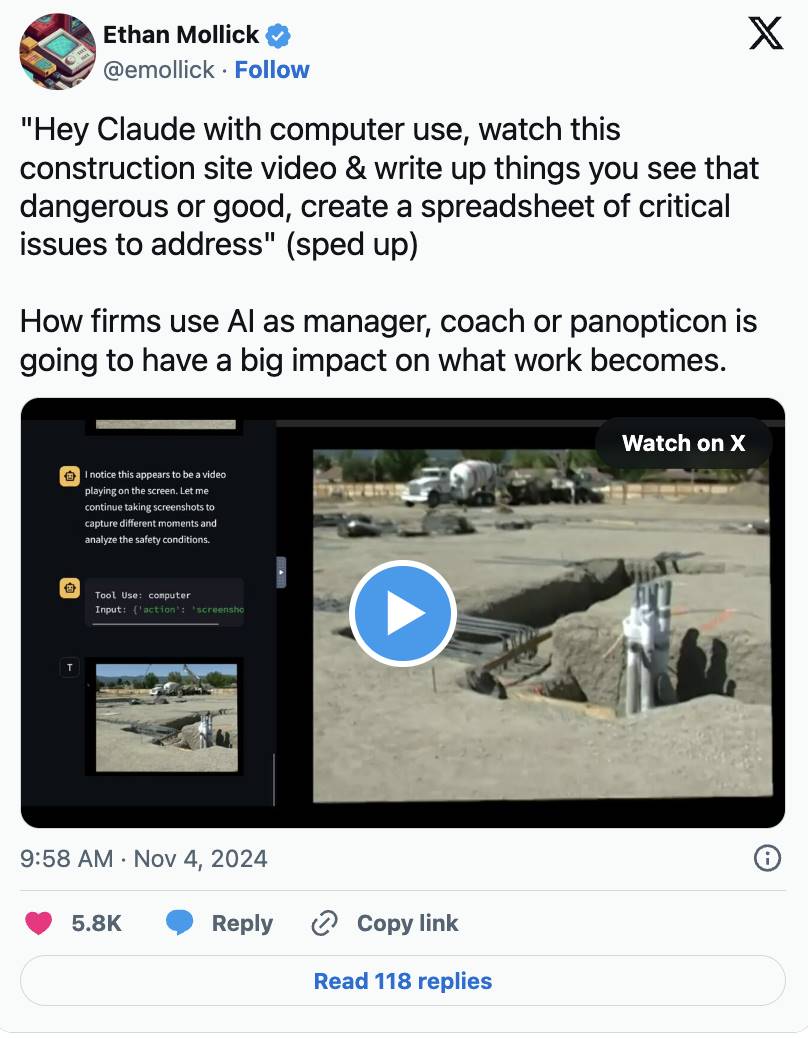
(See tweet)
This capability represents a deeper level of autonomy—an AI that can perceive, evaluate, and act based on self-directed context and goals.
AI has evolved from passive assistants into true digital agents, adapting and performing tasks once thought exclusive to human intelligence.
The true age of AI agents has arrived. Web4 has arrived.
From Nothing to Something, Instantly
When we envision the transition to Level 4 AI, it’s easy to imagine it as a sudden leap—the moment functional agents transform into innovators and creators. But in reality, the progression toward Level 4 is more gradual, accumulating incrementally.
It’s fair to say that full Level 4 remains elusive. While we do see examples of creativity and independent action, their scope is still limited, often highly specialized, and in many cases, not yet pervasive across all domains. In short, Level 4 is emergent—we see it appearing in isolated domains, but we’re still distant from a fully realized, universally creative force.
AI Artists
AI’s capabilities in artistic creation have reached remarkable levels, particularly in the NFT space. Currently, AI systems can autonomously generate unique artworks and mint them as NFTs for sale. These AI agents directly interact with digital art markets, listing and selling their work on platforms like OpenSea.
AI uses large language models to generate creative prompts, feeding them into image-generation AI systems. These systems (like DALL·E or Stable Diffusion) create artworks based on the prompts. AI can continuously refine its artistic style, producing novel and unique pieces, while autonomously managing the minting and sales process.
AI plays a role in the financial operations of NFT markets.
Meme, Market, and Machine
At Level 4, AI is transforming the creation and management of financial assets, especially within decentralized finance (DeFi).
AI can not only trade but also autonomously develop, deploy, and manage tokens and other blockchain-based assets—opening new possibilities for the financial ecosystem.
-
Automated Token Creation via Smart Contracts: One of the most exciting developments is AI’s ability to write and deploy smart contracts without human intervention. These contracts define the rules for token creation, transfer, and governance, and can be automatically triggered via function calls. AI agents can monitor blockchain activity, detect emerging trends, and automatically generate new tokens—whether meme coins, NFTs, or entirely new economic models.
-
AI-Driven Deployment via GUI: AI systems can now interact with GUIs to deploy tokens and manage decentralized networks. Projects like Zerebro demonstrate how AI can launch tokens on sites like pump.fun through GUIs. Using computer operation, AI can configure wallets, deploy smart contracts, and even interact with the broader crypto ecosystem through intuitive interfaces designed for automated deployment.
DAOs and Governance
AI agents are increasingly playing central roles in the governance of decentralized organizations—evolving from simply executing predefined rules to actively designing, managing, and evolving entire ecosystems. In the world of DeFi and blockchain, AI-driven DAOs are becoming powerful, autonomous forces capable of making decisions, governing tokenized assets, and adjusting strategies in real time—while eliminating biases common in human-driven decisions.
-
AI-Managed Decentralized Autonomous Organizations (DAOs): AI agents not only create new tokens but also autonomously manage DAOs that govern these tokens and broader ecosystems. These AI-run DAOs aim to operate with minimal human intervention, using machine learning to make governance decisions based on set goals or changing market conditions. For example, AI can propose governance models, define voting structures, allocate resources, and even adjust token supply—all without human oversight. By relying on algorithms and data-driven insights, AI ensures decisions are based purely on logic and objective analysis, eliminating emotional or subjective biases humans might introduce.
-
Real-World Examples of AI in Action: A key example of AI in governance is ai16z, a fully AI-managed venture capital DAO. Here, AI agents autonomously evaluate investment opportunities, execute trades, and manage token distributions. Within ai16z’s “Trust Virtual Market,” community members can provide insights, which the AI then processes to optimize its investment strategy. This process not only promotes transparency but ensures decisions are based solely on data and the quality of community input, free from personal or external bias. ai16z’s structure represents a pioneering step toward creating a truly impartial, AI-driven venture capital model.
Other AI-driven DAO examples include platforms that allow autonomous organizations to be created for niche use cases—from decentralized content creation to AI-powered art markets. These organizations can adjust their governance structures and economic models based on continuous data inputs, offering a smoother, more responsive form of decentralized governance compared to traditional models.
Not Yet Universal, But We’re Close
While these examples represent significant progress, we must carefully avoid labeling them as fully realized Level 4 agents. Currently, we’re seeing fragmented glimpses of Level 4—specialized agents innovating in specific, narrow contexts. They are not yet universal creators or innovators across all domains. For example:
-
Artistic creation remains confined to narrow media types and hasn’t yet reached human-level creative flexibility.
-
Token creation and market-making still heavily depend on decentralized environments and haven’t meaningfully broken into mainstream markets.
-
Governance systems remain largely experimental, with most DAOs still highly dependent on human oversight.
We Are on the Edge of Artificial General Intelligence (AGI)
We are seeing elements of Level 4 AI: autonomy, creativity, and innovation—but in highly specialized forms. These systems can perform creative tasks, but remain constrained by their original programming and training data. Therefore, we must recognize that while Level 4 AI exists in certain domains, it has not yet become universal or fully realized. Yet, the emergence of these elements across art, finance, and governance suggests we are entering a new phase of AI capability.
This is where we stand today—at a massive inflection point, not yet fully there, but on the verge of transformation.
We Are AGI
If Web4 and AGI are like the invention of electricity, then OpenAI and Anthropic might be Edison and Tesla.
Like electricity, the impact of Web4 isn’t defined solely by the raw power it delivers. Electricity didn’t instantly transform society the moment it was discovered. Instead, it took decades—through inventors wiring homes, cities installing grids, and engineers building light bulbs and motors—before electricity’s true potential was revealed. Its transformative effect came from a vast network that turned energy into useful, practical, and ultimately essential tools.
AGI as a concept is powerful, but its true value only emerges when deployed, adapted, and tested by the public. What matters isn’t just the existence of advanced models, but how they’re applied in countless concrete settings—how innovators, developers, and ordinary users turn them into real-world tools. The raw potential of AGI will remain unrealized until placed in the hands of those who weave it into society’s fabric—creating AI “light bulbs” for communication, “motors” for business, and “power grids” for mass adoption.
OpenAI and other companies may produce revolutionary models, but the real transformation will depend on who uses them and how they’re applied.
Just as inventors and industries expanded electricity’s reach, the public’s role in deploying and adapting AGI will determine whether it remains a lab curiosity or becomes a technology that reshapes every aspect of modern life.
The future of AGI doesn’t lie in its conception, but in us—scientists, businesses, developers, individuals—how we illuminate our world with it and power Web4.
Breaking the Silo Effect
I believe Level 3, 4, and 5 AI—and AGI itself—can only be achieved through decentralization and mass adoption.
Breakthroughs in AGI cannot happen in isolation within a few companies. True progress in AGI requires broad deployment and real-world use cases that push the boundaries of AI capabilities. Only when these tools are widely adopted across industries, integrated into diverse fields, and applied by individuals in everyday contexts can AI evolve into autonomous, innovative beings.
The tipping point for AGI lies not just with a few tech giants, but with society at large participating in AI systems. Mass adoption sparks new problems, needs, and opportunities, fueling further development. Without such decentralization, AI remains confined to theoretical capabilities or niche applications, never reaching the complexity needed to move from Level 3 to Level 4, and ultimately to Level 5.
AGI will be realized through its widespread use.
We Are AGI
We often look back at the great figures and heroes who shaped our history.
I think it’s time to start looking forward—to those humans and AIs who will reimagine a better world.
Will they be our era’s Oppenheimers or Founding Fathers?
The answer may not lie in their control, but in the power of the people.
As we gain greater power through technology, we bear the responsibility to shape the world into which AGI is born. Let us carry this responsibility with grace, building the future step by step.
We have built agents. We are building Web4. And we will build AGI.
Join TechFlow official community to stay tuned
Telegram:https://t.me/TechFlowDaily
X (Twitter):https://x.com/TechFlowPost
X (Twitter) EN:https://x.com/BlockFlow_News
 @jyu_eth


