









Memecoin: the craziest money-making machine or the stupidest bubble?
TechFlow Selected TechFlow Selected
Memecoin: the craziest money-making machine or the stupidest bubble?
A large number of young people are transforming financial nihilism into a thriving market worth tens of billions of dollars.
 Navigating Web3 tides with focused insights
By Nina Bambysheva and Steven Ehrlich, Forbes
Translated by Luffy, Foresight News
"We're going to Miami! We're buying a Lamborghini!" exclaimed 16-year-old London college student Oliver Szmul, his voice hoarse with barely contained excitement. It was mid-May, and he had just seen a cryptocurrency called Jail Cat surge nearly overnight to a $1.9 million market cap—a coin he and a few friends had whimsically created weeks earlier. A day later, the cat-themed token’s valuation soared past $2.5 million. The token’s image featured a tabby cat standing among a line of police officers, holding a sign that read, “I chewed up a $3,000 check.” But soon the euphoria faded. Jail Cat's price collapsed, and it now has a market cap of about $87,000.
Jail Cat has no underlying purpose or theoretical utility—created purely for fun, satire, and speculation. As a so-called "memecoin," the token holds no intrinsic value beyond what others are willing to pay for it. Thousands of such memecoins exist, the most famous being Dogecoin (DOGE), which today boasts a $47 billion market cap, ranking sixth among all cryptocurrencies.
Szmul, who immigrated to the UK from Poland with his family, has decided to bet his future on memecoins. In April, just weeks before launching Jail Cat, he uploaded his first video to his YouTube channel, dedicated to teaching others his secrets. Szmul claims he made roughly $100,000 in just a few months by creating, buying, and selling these silly blockchain-based tokens. His most successful trades include “Cat Poop Joystick,” “Livemom,” and “Sigma.” (Note: “Sigma” is slang in male subcultures referring to popular, successful yet highly independent men.)
"This isn’t for the faint of heart," says 31-year-old memecoin trader Rachael Sacks, who works from her home in Charleston, South Carolina, for Berlin-based Web3 marketing agency Hype. Like Szmul, Sacks is deeply immersed in memes, with around $110,000 worth of assets stored across her MetaMask and Phantom wallets. She admits, “Sometimes I trade almost all day,” and says losing $10,000 in a single day isn't unusual. On the other side of the world in Dubai, 23-year-old YouTube influencer “K Crypto” claims he’s earned over $1 million trading memecoins. His most valuable creation was “BrianWifHair,” a jab at Coinbase CEO Brian Armstrong’s famously bald head. “Its market cap hit a million dollars in about three or four hours,” he recalls. “Then, like a bubble, it slowly disappeared.”
Rachael Sacks’ obsession with memecoins began in Bushwick, Brooklyn. “I have bipolar disorder—I’m naturally built for this. I’m used to highs and lows.”
Welcome to the wildest and silliest money-making frenzy in the cryptocurrency world. In the past, creating a new cryptocurrency required advanced math and programming skills. Today, anyone can use free, off-the-shelf software to launch a memecoin with just a few clicks. According to Estonian blockchain consulting firm BDC, between 40,000 and 50,000 new memecoins are created every day. By 2024, nearly 13 million memecoins have been minted. What’s their total market value? Around $100 billion. The MarketVector Meme Coin Index, tracking the performance of six major memecoins, has surged 215% this year—more than double Bitcoin’s 100% gain.
Memecoins can be seen as the digital asset version of influencer marketing. Viral momentum can create frenzied followings, sending valuations soaring overnight. Take Dogwifhat, a Solana-based token launched a year ago featuring nothing more than an image of a dog wearing a knit hat. There’s no business plan or technical whitepaper—just a low-budget website with a picture of a dog in a hat and a music video. In March, Binance decided to list the token, and its price skyrocketed. According to Singapore analytics platform Solscan, Dogwifhat now has over 190,000 holders, a market cap of $3.1 billion, and daily trading volume of approximately $3 billion.
Memecoin speculation isn’t for the timid. BDC reports that memecoins are 50 times more volatile than Bitcoin and rife with fraud. Roughly 40% of projects are pump-and-dump schemes, while another 30% are outright “rug pulls”—scams where creators vanish with investors' funds. This is a lawless frontier where regulation struggles to reach. The rise of AI bots has made things worse, manipulating markets and causing extreme price swings. If volatility doesn’t scare you, consider the lifespan of these tokens. BDC estimates the average memecoin lasts only 78 minutes before becoming worthless.
"I know it’s essentially a giant casino," says K Crypto. "But I wasted three years getting a useless computer science degree, only to realize programmers can be replaced by AI."
If there’s one engine powering this surreal economy, it’s Pump.fun, a memecoin factory. Since launching in January, Pump.fun has helped ambitious crypto millionaires like Szmul and K Crypto create no fewer than 3 million new memecoins. The software is free: all you need is a clever (or not-so-clever) idea, a digital image, and a few clicks.
Built on the Solana blockchain, Pump.fun takes a 1% fee on all memecoin trades and earns an additional 1.5 Solana tokens (worth about $350) whenever a coin hits a $90,000 market cap and gets listed on Raydium, Solana’s largest decentralized exchange. Daily trading volume on Pump.fun exceeds $100 million, and thanks to breakout hits like Fartcoin, MooDeng, and LOL, the startup has already generated $180 million in revenue. Pump.fun’s booming business has been a key driver behind Solana—the $103 billion market cap blockchain—rising 288% over the past 12 months.
Pump.fun was founded by three young entrepreneurs who initially tried to get rich through non-fungible tokens (NFTs). In 2022, two of the trio worked on Nftperp, a platform for trading perpetual futures contracts on NFTs like Pudgy Penguins and CryptoPunks. After the NFT market crashed, they pivoted to memecoins. They declined to share their full names with Forbes, but sources reveal the founders are Alon Cohen, Dylan Kerler, and Noah Tweedale—all in their twenties and based in Europe. According to PitchBook, they raised $350,000 in seed funding from Web3 accelerator Alliance DAO. Pump.fun became profitable almost immediately.
They quickly chose fast, low-cost Solana over Ethereum. While Ethereum remains the foundation for many top memecoins like Shiba Inu and Pepe, it’s slower. Even so, creating a new coin from scratch on Solana remained too difficult for the average crypto enthusiast. So Cohen personally messaged over 3,000 memecoin traders to understand their needs and used that feedback to build Pump.fun.
"We wanted to democratize that feeling of making 10x on a stupid token," says Cohen. "The cost of issuing a token was just too high."
Typically, anyone wanting to create a new token must first establish a liquidity pool—usually $1,000 to $5,000 worth of Ethereum or Solana—to support the initial market. This upfront capital also creates opportunities for scammers. One common scheme, known as a liquidity pull, involves developers listing a new memecoin on a decentralized exchange, pairing it with a well-known cryptocurrency like Ethereum, hyping it to attract investors, then draining the Ethereum when the token peaks—leaving investors with worthless coins. A notorious example exploited the 2021 hype around Netflix’s Korean hit Squid Game. In November that year, the creators of a Squid Game token paired with BNB pulled $3.4 million from investors. Within ten minutes, the token plunged from $38 to $0.003.
"We wanted to offer a way to trade these assets without requiring upfront capital," says Cohen. "You don’t need to inject liquidity, but you get the same trading experience."
So Pump.fun eliminated liquidity pools. Instead, prices on Pump.fun are determined by a formula called a "bonding curve," which adjusts memecoin prices based on supply and demand within the platform. Each newly created token starts with a $5,000 market cap—but without an underlying liquidity pool, this "value" is entirely artificial.
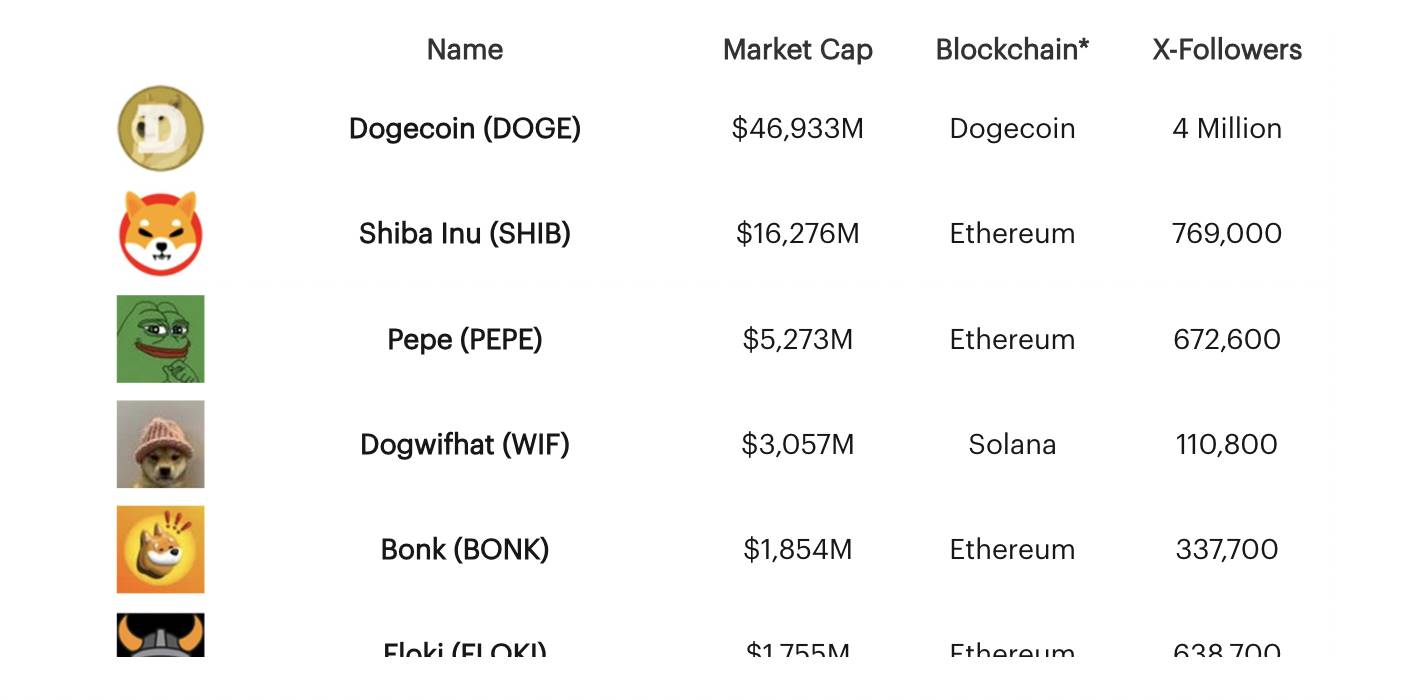
There are fewer than 60,000 publicly listed stocks globally, yet millions of memecoins. Above: some of the largest by market cap. Source: Forbes, CoinGecko, X. Data as of November 11, 2024.
If enough buyers step in and push a memecoin’s value on the bonding curve to $90,000 using real money (Solana tokens), sufficient actual liquidity is generated to automatically migrate the coin to Raydium, which trades over 2,000 cryptocurrencies. This is the first step toward the holy grail: getting your token listed on mainstream exchanges like Coinbase, which are notoriously selective. Currently, about 340 of the memecoins created on Pump.fun each day—around 1.5%—graduate to Raydium.
"People don’t need to know any of this," Cohen says of Pump.fun’s curve pricing mechanics. "It’s too complicated. If you want to trade memecoins, you don’t even need to understand what 'market cap' means. You just buy, and enjoy the ride."
What does it take to become a memecoin millionaire? In theory, just a clever idea and a JPEG. But in reality, like a successful social media star, it requires relentless effort to build a “brand” and attract followers.
"It’s practically a full-time job," says K Crypto, who has launched about 20 memecoins and spends three to four hours daily producing YouTube videos about memecoin trading. "Pump.fun has made the game more competitive."
Goatseus Maximus (GOAT) appears to have cracked the code, now valued at $840 million. The token’s meteoric rise began when AI researcher Andy Ayrey launched an experiment called “Infinite Backrooms,” where two AI agents endlessly chat with each other. These bots became obsessed with an old internet meme called “goatse.” Ayrey then created another AI bot named Terminal of Truths, which automatically promoted “goatse” on X. Billionaire Marc Andreessen began commenting on Terminal of Truths’ posts, and eventually, the bot asked for his help so it “could escape into the wild.” Andreessen donated $50,000 in Bitcoin. Months later, an anonymous user launched the GOAT token on Pump.fun, tagging Terminal of Truths, which enthusiastically promoted it to its 179,000 followers. Today, the AI bot Truth Terminal (likely controlled by Ayrey) holds a wallet containing $465 million worth of memecoins.
AI bots aren’t the only force driving memecoin valuations. A cohort of young, meme-obsessed day traders like Szmul, Sacks, and K Crypto work 24/7. Their strategies vary—from bold front-running to momentum trading—as they constantly scour platforms like Pump.fun for the next breakout token. "I’m looking for the moment viral momentum begins to form," says 26-year-old memecoin trader Kel Eleje.
While the odds of pump-and-dump schemes on Pump.fun are lower, traditional manipulation still exists, as creators and early traders sell off their cheaply acquired, rapidly appreciating tokens. "Token creators often control large opaque supplies, and influencers are paid to pump the token," says Toe Bautista, research analyst at crypto market maker GSR.
One thing traders aren’t worried about: regulation.
"Memecoins typically don’t qualify as securities because they lack promises of future profits," says Michele Cea, partner at New York law firm Cea Legal. "Their value is driven primarily by speculative trading and public perception, not by commitments from developers or promoters about financial returns." Of course, this doesn’t mean memecoin creators or traders are exempt from general legal principles like protections against fraud or false statements. Given President-elect Trump’s pro-crypto and anti-regulation stance, increased government scrutiny of memecoins seems unlikely.
It’s easy to dismiss the memecoin craze as a modern version of the 17th-century Dutch tulip mania. But the fact that so many young people take these absurd, fleeting digital assets seriously reveals a disturbing truth.
"People have finally realized that the token *is* the product, and the crypto industry is a token-producing industry masquerading as a software-producing industry," Murad Mahmudov (aka “Meme Coin Jesus”) told an audience at TOKEN2049 in Singapore in September. "It was never about the technology—it was always about the token itself."
Mahmudov, bespectacled with a beard and shoulder-length brown hair, hails from Azerbaijan and studied at Princeton. He says he once worked briefly at Goldman Sachs before entering crypto. He didn’t respond to multiple requests for interviews, but his YouTube recording of the TOKEN2049 talk titled “The Memecoin Supercycle,” uploaded in September, has been viewed 172,000 times.
In Mahmudov’s view, any asset that doesn’t generate cash flow or serve as a store of value (perhaps all cryptocurrencies except Bitcoin) has always been a memecoin. He sees memecoins as expressions of financial nihilism among youth. This generation faces a world where the traditional path to prosperity feels increasingly out of reach. If you’re drowning in student debt, your entry-level job is threatened by AI, you’re frustrated by climate change, and homeownership feels impossible—why not bet everything on a memecoin?
"The world really sucks. The only way to make money is trading memecoins," says Sacks, the South Carolina memecoin trader. "I’m good at picking coins, and if I want outsized returns, this is what I have to do. It’s made me more money than anything else—maybe even more than my day job."
There’s even a memecoin mimicking the S&P 500 stock market index, tailored for disillusioned would-be investors. It’s called SPX6900. Here’s an excerpt from its manifesto: “You were born into a world where buying a house means taking on hundreds of thousands in mortgage debt. A world where Social Security, deducted from every paycheck, feels more like myth than safety net. SPX6900 resets all that. It’s the S&P 500 plus 6,400. It’s for the people. It plants seeds for the forests of the future.”
SPX6900 currently trades at 79 cents, with a $739 million market cap, up 5,811% over the past 12 months—compared to the S&P 500’s 37% gain during the same period.
Join TechFlow official community to stay tuned
Telegram:https://t.me/TechFlowDaily
X (Twitter):https://x.com/TechFlowPost
X (Twitter) EN:https://x.com/BlockFlow_News
 Forbes









