









How far is mainstream cryptocurrency adoption from reaching ordinary people?
TechFlow Selected TechFlow Selected
How far is mainstream cryptocurrency adoption from reaching ordinary people?
Cryptocurrencies have potential, but their complexity and lack of simplified user experience make widespread adoption difficult.
 Navigating Web3 tides with focused insights
Written by: blackb-rd
Translation: Baishuo Blockchain
I haven’t earned enough from crypto to buy a new house or car, but overall, I think cryptocurrency is a good idea. Maybe I don’t fully grasp the deeper political nuances behind it, but in practice, it has already brought tangible and legitimate benefits to my life.
I feel positioned between two types of users: one side includes those who are still easily deceived or don’t know how to save on transaction fees; the other consists of those who’ve seen everything crypto has to offer. This allows me to connect and interact with a wide range of people—from complete beginners to those building careers around crypto. In this article, I’d like to share some thoughts and reflect on crypto’s broad adoption.
1. Where did I start?
My profession is content manager, focused on educational practices. Currently, I design onboarding materials for both beginners and those who consider themselves advanced users. In fact, I initially developed blockchain courses for a university’s master's program, where I had to begin with concepts like directed acyclic graphs (though I’ve never used them) and 51% attacks. Yet even with that knowledge, it didn’t save me—I only figured out how to reduce Ethereum network fees about a year later. At the time, terms like Optimism, Avalanche, and Arbitrum were just empty buzzwords to me. Admittedly embarrassing, but true.
Over time, things became clearer. Once I understood the relationship between consensus mechanisms, block formation, and transaction placement in blockchains, everything clicked. It actually took me two full learning cycles to truly grasp blockchain technology. Slow? Perhaps. Let the comments decide.
In any case, after two years of moderate study, I finally feel like I understand most aspects—down to some finer details. Still, many concepts only became intuitive once I dedicated serious focus to learning. For example, to understand Ethereum’s L2 solutions, you first need to comprehend Ethereum’s problems, then appreciate how L2s solve them—or you can simply trust others blindly and start using L2s right away. Either way, average users don’t necessarily see these solutions as important—they care about saving on transaction fees and avoiding spending more on gas than they earn from a day in the pool. When I opened Avalanche’s official website, the first thing I saw was the slogan “Build without limits.”
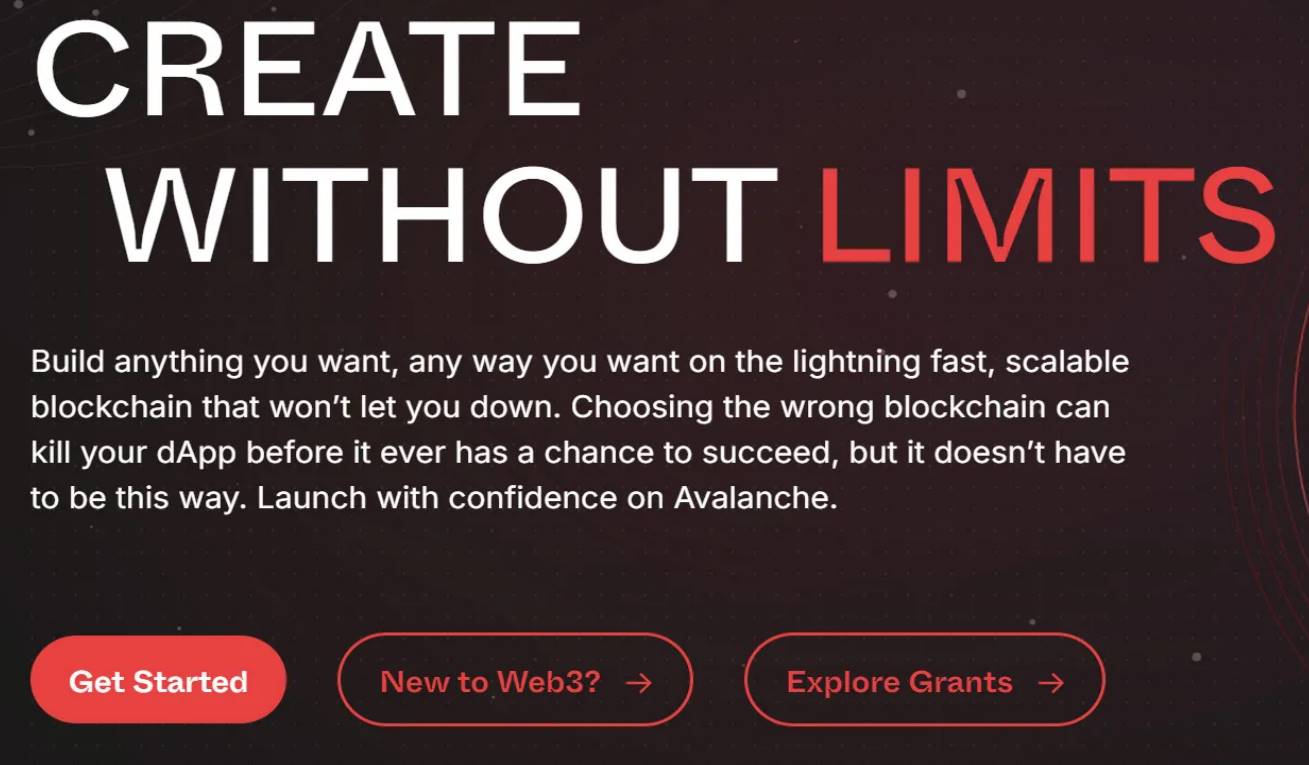
Avalanche’s homepage—nowhere does it mention how retail users can save on transaction fees.

Then, clicking on "New to Web3?" (why would a beginner even know what Web3 is?), I was bombarded with terms like “smart contracts” and “Web3.” Your parents likely don’t realize they’re currently on Web2, nor do they know they’re being invited into a world called Web3 filled with smart contracts. Some might barely remember Web1.
This might be a place to discuss whether ordinary people should move beyond centralized exchanges. But personally, I believe the decentralized space should be accessible to everyone—not just geeks, content managers like me, entrepreneurs, and developers. So how do regular people perceive the crypto industry? After talking to about 100 individuals and observing thousands of messages, I’ve formed some insights.
2. The mainstream perspective
“Crypto is a scam”—this sentiment persists into late 2024. Interestingly, it resembles the “bell curve” meme: crypto is seen as a scam by those who’ve never touched it at all, or by those deeply involved in project development. My IQ isn’t 145—I fall somewhere in the middle of this distribution.
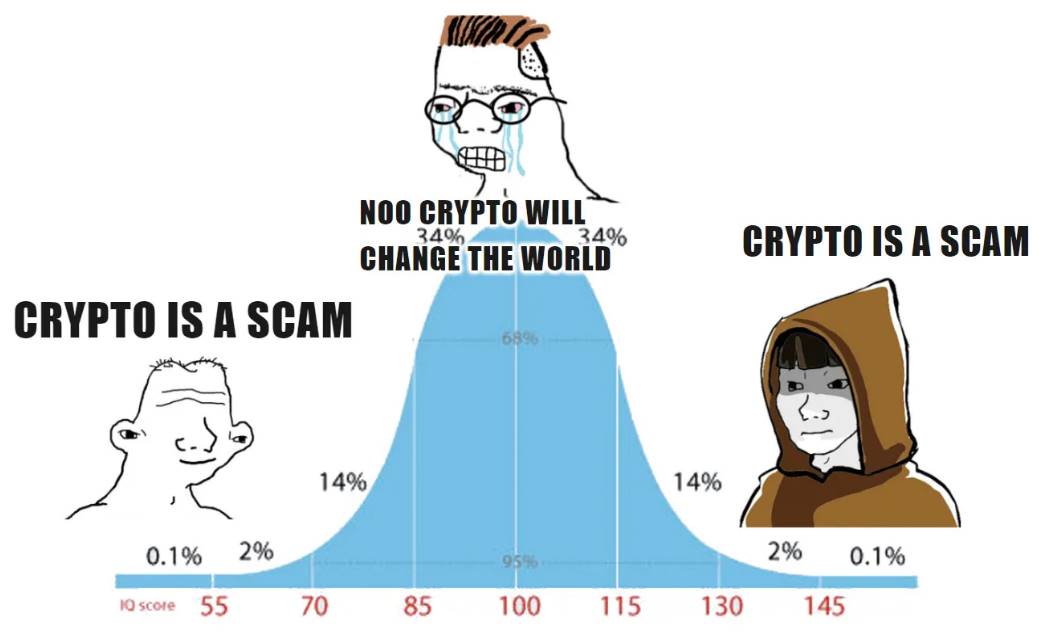
These people are victims of unfulfilled narratives—you can’t expect constructive thinking from a narrative; it’s just storytelling. For instance: “Buy my crypto token and get 10x returns, enough to buy a Lamborghini.” This narrative seems rooted in the ICO boom of 2016–2017. Later, when it failed, the counter-narrative emerged: crypto is a scam. Of course, this skepticism stems from humanity’s age-old resistance to new things, amplified by scams over recent years. Today, “buy my token” has evolved into meme coins—but thankfully, meme coins no longer represent the entire industry.
Top influencers who aren’t crypto-focused still confuse centralized and decentralized exchanges. And ordinary people—even senior IT professionals, even former NASA employees—don’t understand what crypto is for. Can we blame them? The crypto industry hasn’t simplified user experience, let alone explained its relationship with traditional finance.
At one point, I tried to go beyond understanding blockchain as just a “distributed database,” aiming to clarify the roles of blocks and transactions within it. Even language models kept feeding me the same analogies, making things more confusing: “Imagine a ledger recording transactions…” Imagine the frustration of an average person trying to use a blockchain explorer, not to mention figuring out when their transaction will be confirmed. Four years on, there’s been no real improvement.
Do I really need to watch a Stanford mini-course just to send money to a friend without losing $50 in Ethereum gas fees during peak times? That’s a rhetorical question.
The massive gap between crypto jargon and how non-crypto users communicate makes current UX feel built by developers for developers—or at best, by hardcore crypto enthusiasts for other hardcore enthusiasts. These are entirely different linguistic worlds, difficult for non-technical people to penetrate. This complexity broadly helps maintain exit liquidity, but becomes a barrier if we want broader participation. Such intricate language for basic operations like buying and selling seems excessive.
But on the other hand, should we really try to get people to explore beyond USDT? Or is it sufficient to simply enable them to use an Avalanche card for daily spending?
3. “I still consider myself a beginner”
This is how people familiar with centralized exchanges, aware of decentralization (but not utilizing its “benefits”), and attempting to invest in crypto assets describe themselves. Again, this has little to do with education level—these individuals are highly diverse. Almost none go further—AAVE marks their limit (TVL data supports this). Some don’t even know they can avoid Ethereum’s high fees, let alone how to check them, yet everyone struggles with protocol interfaces. Each protocol feels different, creating confusion about what to do next, fear of proceeding, and ultimately disengagement—this is a real quote from an employee at a crypto venture fund.
It’s hard to blame protocols for lacking user-friendliness—these issues should be solved through standardization. But imagining a standardized web and mobile interface across crypto protocols today feels far-fetched. And none of them know how to check their transaction status: why a transaction hangs for hours, whether funds are lost, or where to seek support (which often doesn’t exist). Almost no one understands blockchain explorers. If they’ve heard of them, they don’t know where to find them. Should we even mention how hard it is to find legitimate links to these tools without getting scammed?
From my experience, a simple and obvious conclusion emerges: the fewer extra steps required to achieve a goal, the more likely people are to succeed. Today’s customer journey map (CJM) resembles that infamous funnel—with Vitalik seemingly sitting at the bottom.

For example, “staking ETH to support network security” means nothing to these users. To understand this, you must first grasp PoS consensus, which requires understanding why consensus matters at all.
The sad reality is that even those who appear “advanced” compared to true newcomers are still essentially exit liquidity. In the worst cases, these “beginners” lose access to their funds. For instance, one of my clients panicked after creating a second wallet linked to her MetaMask account on Fuel Network, believing her money was gone. This makes me feel that today’s crypto industry functions like traditional financial tools: people are invited in, make money (or at best break even), then return to traditional finance.
Considering I still can’t buy sausages with Bitcoin in Europe, this seems accurate. Is that bad? Not necessarily. Is anyone to blame? Hard to say—buying sausages with crypto requires explicit government approval, which enthusiasts and developers alone can’t deliver. Yet despite our talk of borderless transactions and sausage tokenization, this aspect receives surprisingly little attention in the industry, even though it could genuinely improve lives.
4. Advanced users—myth or reality?
This question highlights the toxic dynamics in the industry, where people often view each other as fools or at best, novices. In crypto, so-called “advanced users” are essentially those with full professional expertise. By “advanced,” I mean individuals whose livelihood depends on the industry in some way: algorithmic traders, analysts, developers, and those exploiting various profit mechanisms (like farming, node operation, gamblers, etc.).
Interestingly, they fall into two categories: highly empathetic and highly toxic. The reason is simple—the huge gap between the beginners mentioned earlier and these “advanced” users. Toxic individuals refuse to help bridge this gap, while only the empathetic explain what’s happening. Crypto communities often help each other. On the other hand, I’ve seen chat groups where asking “What’s the difference between staking and liquid staking?” gets you banned.
Becoming an advanced user takes years of learning and unequal financial investment. Yet even “advanced” is a relative term—someone may be experienced in analyzing crypto project business models but still become exit liquidity in a meme coin or fall victim to MEV attacks. Even in haste, they might click a phishing address via transaction history.
By the way, crypto security deserves its own article. Beyond the complexities mentioned, users quickly face challenges around safety and asset protection. This challenge remains relevant regardless of skill level. I once heard a story about someone stealing private keys by monitoring screen radiation. But these are just thoughts—it reflects a conceptual issue in the industry: more freedom = more responsibility.
Practically speaking, based on our onboarding experience, I consider users “advanced” once they regularly use non-custodial wallets. Coincidentally, these individuals usually navigate protocols well and don’t get lost in niche technicalities like Uni V3 concentrated liquidity. At this point, advancement follows a right-skewed distribution: mastery far exceeds any level of ignorance. Generally, grasping all fundamental concepts takes 3 to 6 months of focused learning, while reaching skill ceilings and understanding nuances takes much longer. This appears to be the key factor behind whether people become highly toxic or highly empathetic.
By the way, 3 to 6 months isn’t a random number—it’s exactly how long it took a former banker immersed in crypto concepts.
5. My main point
Perhaps I seem critical or skeptical. Locally, maybe so—but globally, I understand things are as they are. You can’t just walk into Avalanche’s customer success department and demand they “simplify everything.” What I want to highlight is the contradiction in this situation. Many in the industry are waiting for retail liquidity to flood in—i.e., mass adoption. Supposedly, this would drive Bitcoin to millions or tens of millions of dollars, ease regulatory pressure, or protect assets from bank errors or abuses. Basically, different stakeholders—crypto investors, crypto anarchists, and ordinary globalists—have their own reasons. Yet the situation has become absurd—mass adoption is impossible when even a basic onboarding flow is missing, even on L2 homepages claiming to improve user lives.
More interestingly, this task often falls to ordinary users (or YouTubers). Most beginners remain stuck on centralized exchanges (CEXs), which are only loosely connected to blockchain and decentralization ideals. While beginners stay trapped on CEXs, the decentralized space remains merely a subcategory of traditional finance—a playground for technically skilled users with ample free time.
Telegram attempts to attract traffic through airdrops and Telegram mini-apps, offering interactive immersive experiences. That’s better than nothing, but creates two problems:
1) The entire immersive experience is limited to the TON ecosystem (hopefully only for now).
2) A large group (131 million) was disappointed by the Hamster Kombat airdrop, becoming victims of the “crypto is a scam” narrative.
One of the most interesting drivers of mass adoption I’ve seen is the call to “learn Bitcoin.” Undoubtedly a good practice, but first, a mid-19th-century political theory was also marketed as the gateway to a bright future (and of course, the masses never bothered to study it). Second, I’d bet most people buy Bitcoin because of jokes on crypto Twitter, not after reading the whitepaper. Here, I advocate for some realism.
I don’t know if we truly need mass adoption, or if the entire industry is just a quirky wealth redistribution mechanism. Or perhaps we do need mass adoption, but right now developers are scratching their heads trying to explain to a shop owner in Alabama why keeping funds in a Rabby wallet is cooler than in a bank. Currently, the crypto industry’s positioning around mass adoption feels completely disconnected. Money transactions—the most common act in our lives—shouldn’t impose such cognitive load or consume so much time.
Join TechFlow official community to stay tuned
Telegram:https://t.me/TechFlowDaily
X (Twitter):https://x.com/TechFlowPost
X (Twitter) EN:https://x.com/BlockFlow_News
 白话区块链
白话区块链









