









As Republicans achieve a "red wave," the time for crypto revival has come
TechFlow Selected TechFlow Selected
As Republicans achieve a "red wave," the time for crypto revival has come
The next Congress could fulfill its long-standing wish: setting rules different from those of Wall Street.
 Navigating Web3 tides with focused insights
Source: The Wall Street Journal
Translation: Mary Liu, BitpushNews
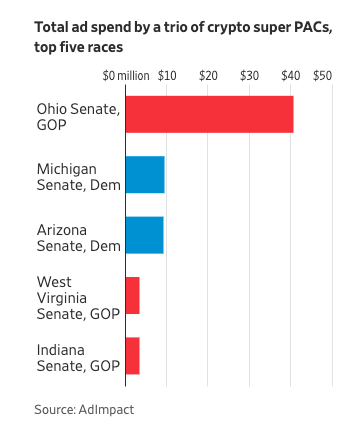
On Tuesday night, Bernie Moreno, the Republican Senate candidate in Ohio, was celebrating at La Centre Banquet Center in a Cleveland suburb when he received congratulatory calls from several cryptocurrency executives, including Brian Armstrong and Brad Garlinghouse.
Just minutes earlier, Moreno had defeated three-term Democratic Senator Sherrod Brown by a stunning margin. Brown, chairman of the Senate Banking Committee, has been one of Capitol Hill's most prominent critics of cryptocurrency.
Moreno secured another crucial seat for Republicans in their effort to regain control of the Senate, prompting crypto executives to call and congratulate him.
The loss is also devastating for Brown, one of the few remaining Democrats in Congress from a state that was once a stronghold for moderate Democrats.

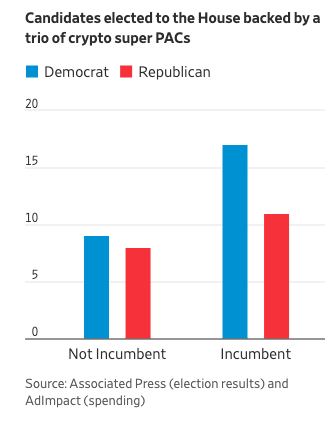
The cryptocurrency industry emerged as one of the biggest spenders during the election cycle, donating $170 million to three super political action committees (super PACs) aimed at electing crypto-friendly lawmakers—such as Bernie Moreno, a former blockchain entrepreneur and car dealer running for Senate in Ohio.
The campaign was highly successful: According to Associated Press projections, 50 out of 58 general-election candidates backed by super PACs won. As of Sunday night (November 10 local time), eight races remained undecided.
This enthusiasm spilled into the markets. Over the weekend, Bitcoin surged to record highs, briefly touching $80,000 and climbing further to $88,000 by Monday’s publication time. Such momentum is nearly unimaginable given the market crash of 2022, which ultimately led to the collapse of exchange FTX.
Now, the crypto world hopes that under President-elect Donald Trump’s so-called “red wave,” the next Congress will fulfill its long-standing ambition: crafting rules distinct from those governing Wall Street.
Trump has vowed to ease regulatory burdens on cryptocurrency and establish a strategic reserve to hold the U.S. government’s Bitcoin holdings. Congress will soon be filled with lawmakers—both young and old—who view crypto as a unique asset class that should not be regulated like stocks and bonds.
After Trump’s victory, Eric Trump shared a meme depicting a Bitcoin flag flying over the White House—an image embodying the hopes of many in the crypto community.
"We’ve turned the corner," said Kristin Smith, CEO of the Blockchain Association, an industry lobbying group. "The worst days for our industry are behind us, and we’re now on the path toward establishing appropriate and enduring policies."
Several industry executives took to social media to celebrate Bernie Moreno’s victory and highlight their role in it.
Coinbase Global CEO Armstrong said of Brown’s defeat: "Being anti-crypto is just bad politics."
"As a pro-innovation, pro-business candidate, I believe Moreno is exactly the kind of person our Senate needs," said Ripple Labs CEO Garlinghouse, who personally donated to Bernie Moreno’s campaign.
Some crypto executives say avoiding overregulation, gaining access to banking services, and securing stable dollar-pegged cryptocurrencies remain the industry’s biggest challenges.
The potential departure of crypto’s fiercest critics from Washington could be a major win for the industry. Trump is expected to replace Gary Gensler, chairman of the Securities and Exchange Commission (SEC)—crypto’s top adversary—who insists that crypto companies must comply with the agency’s investor protection rules.

Last year, regulators sued some of the largest exchanges—Coinbase, Binance, and Kraken—claiming they should follow rules governing securities exchanges. The string of lawsuits angered crypto supporters, and Republican lawmakers criticized Gensler for using enforcement actions to regulate major crypto players.
Senator-elect Bernie Moreno of Ohio said: "We need to make sure they know what the rules are and how to comply, so the crypto industry can thrive here. We must ensure this technology grows and develops in the United States."
Meanwhile, Senator Tim Scott of South Carolina, a possible successor to Brown as chair of the Senate Banking Committee, wants to draft a new regulatory framework that would loosen requirements for firms engaged in trading and custody.
With Republicans poised to control the Senate while maintaining their hold on the House, previously stalled legislation may now have a better chance of advancing—even if it must first be revised by the Senate’s new leadership.
For example, in May, the House passed the Financial Innovation and Technology for the 21st Century Act (FIT21) by a wide margin. The bill would shift more responsibility for regulating crypto to the Commodity Futures Trading Commission (CFTC), a smaller agency seen as more open to digital assets. However, the Democrat-controlled Senate did not advance the bill.

"I believe the industry hopes to see some action on these bills during the current session," said Arkansas Republican Representative French Hill. "I hope so too, but if not, we’re ready—this will be a top priority for the new Congress."
Hill chairs the Digital Assets Subcommittee of the House Financial Services Committee and is one of the authors of the FIT21 bill.
Earlier this year, Congress also overturned an SEC accounting policy known as SAB 121, which made it difficult for banks to safeguard digital assets. President Biden vetoed the congressional move, but the SEC later softened its stance on the guidance.
Even as the crypto industry scores some wins, other challenges remain harder to solve. Banks have long been reluctant to serve clients whose business models rely heavily on volatile assets, forcing some crypto firms to use intermediaries. The collapse last year of two crypto-friendly banks further reduced the already small number of institutions willing to bank crypto firms.
Gaining access to banks for holding crypto—rather than U.S. dollar deposits—has become even more difficult. Entry into the banking system requires approvals from multiple regulators, including the Federal Reserve, whose leadership will not undergo a full transition until 2025.
In April, another bill was blocked in the Senate Banking Committee. It would have required crypto stablecoins—key sources of liquidity in the industry—to be backed by reserves, enabling traders to buy digital currencies on exchanges without relying on fiat money.
As Republicans prepare to take control of the Senate in January, both parties are gearing up for a contentious legislative session in 2025. The path to passing crypto legislation remains a marathon, not a sprint, with fierce competition among stakeholders shaping its ultimate fate.
Join TechFlow official community to stay tuned
Telegram:https://t.me/TechFlowDaily
X (Twitter):https://x.com/TechFlowPost
X (Twitter) EN:https://x.com/BlockFlow_News










