Fed slashes rates aggressively, crypto market risk appetite surges
TechFlow Selected TechFlow Selected
Fed slashes rates aggressively, crypto market risk appetite surges
The U.S. presidential election will affect future market volatility.
 Navigating Web3 tides with focused insights
Author: Kaiko
Translation: Block unicorn
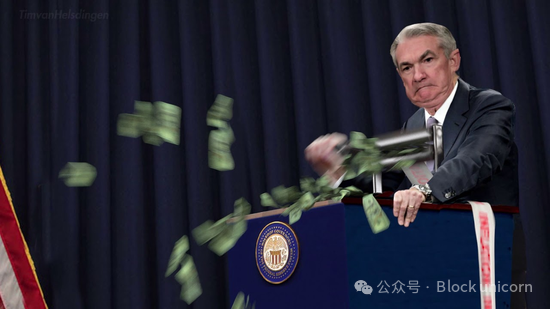
Last week, the U.S. Federal Reserve (the Fed) kicked off a easing cycle with an unexpected 50 basis point rate cut. The Fed also signaled two additional cuts before year-end. This move reignited hopes for a soft landing in the U.S. economy—slowing growth without tipping into recession. In response, both U.S. equities and Bitcoin surged following the Federal Open Market Committee (FOMC) meeting, with Bitcoin rising 5.2% within 24 hours of the announcement.
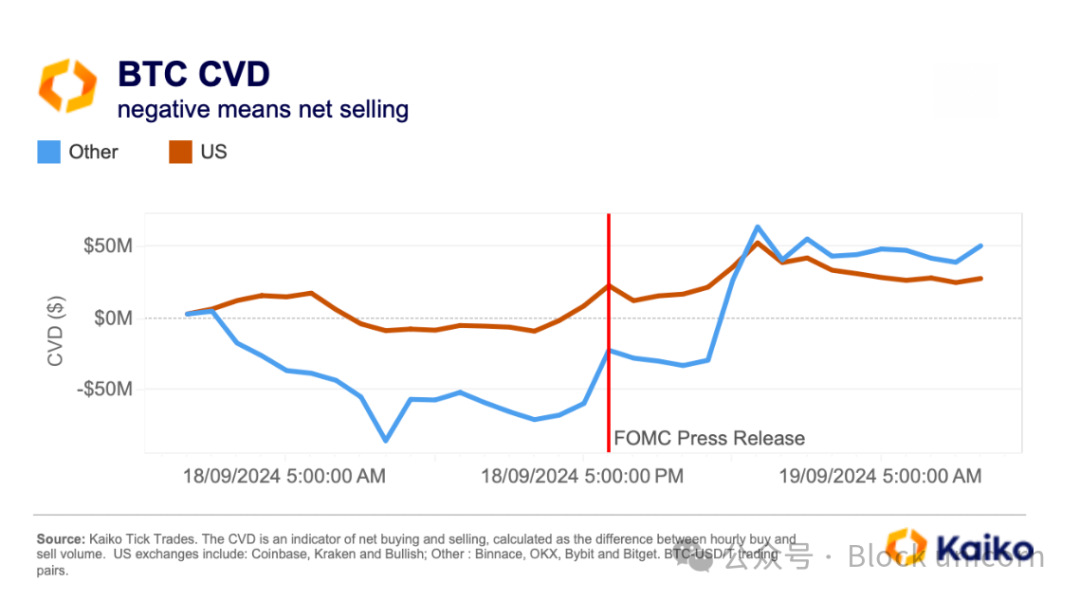
Bitcoin’s CVD (Cumulative Volume Delta)—a metric measuring net buying and selling pressure in the spot market—spiked immediately after the Fed released its statement at 18:00 UTC on September 18. Buying pressure intensified further as Asian markets opened around 23:00 UTC.
The derivatives market saw moderate capital inflows. From September 16 to 19, open interest in Bitcoin rose approximately 12% across platforms such as Bybit, OKX, and Binance, reaching $12 billion.
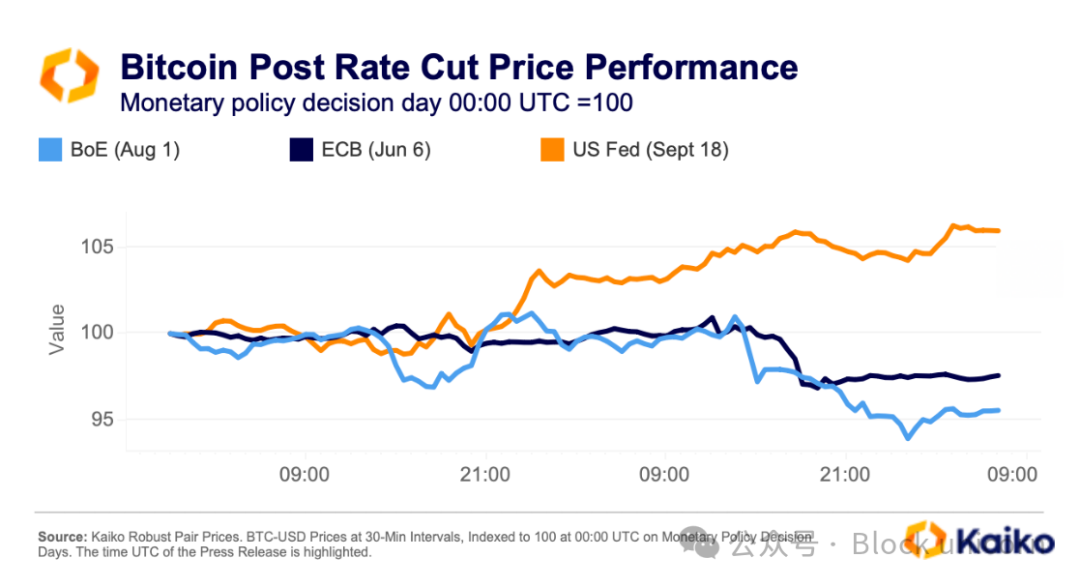
The U.S. central bank was not the first major central bank to cut rates this year. The European Central Bank (ECB) and the Bank of England (BoE) had already lowered rates earlier in the summer. However, the market reactions to those cuts were relatively muted, with Bitcoin prices actually declining in the days following the ECB and BoE announcements.
So why was the market reaction to the Fed’s decision so strong?
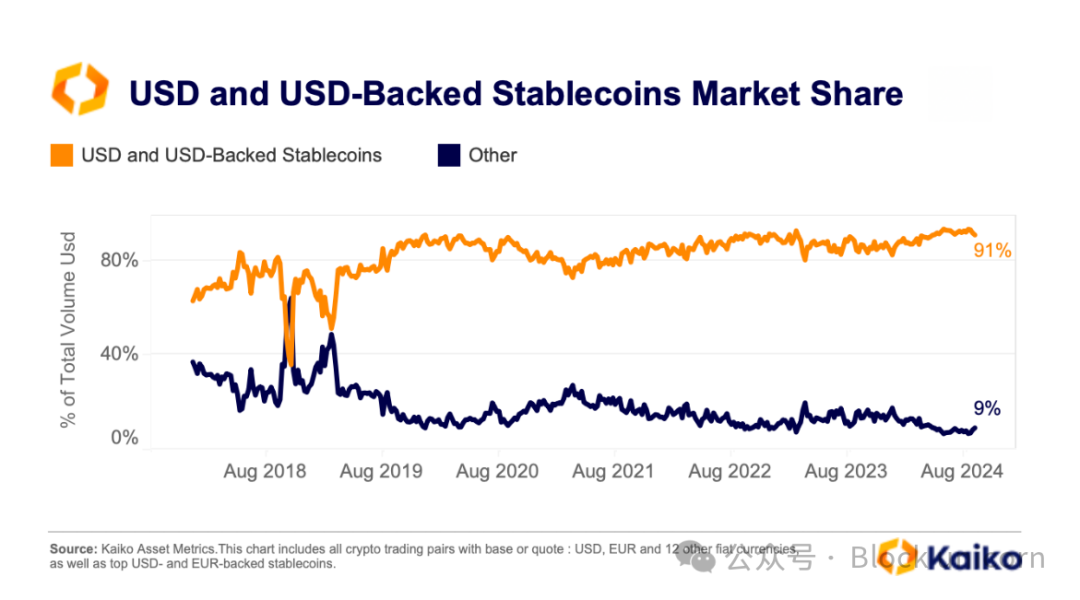
Lower U.S. interest rates typically weaken the dollar. Since the U.S. dollar is the primary pricing asset for Bitcoin (BTC), a weaker dollar tends to push up Bitcoin's dollar-denominated price. Over recent years, the share of trading volume in USD and USD-backed stablecoins among all fiat and stablecoin pairs has steadily increased, reaching a record high of 93% last month.
Additionally, the Fed’s accommodative monetary policy increases global dollar liquidity, prompting investors to seek higher-yielding alternative assets such as Bitcoin.
Notably, the historical negative correlation between the dollar and Bitcoin has weakened over the past month. In August, both Bitcoin and the U.S. Dollar Index (DXY) declined simultaneously, suggesting other factors are influencing the price movements of both assets. One such factor is the upcoming U.S. election—for example, former President Donald Trump is currently seen as a candidate favorable to both the dollar and Bitcoin.
Key Data Points:
Wallets associated with Alameda Research are consolidating assets.
Wallets allegedly linked to FTX-affiliated Alameda Research have been actively moving funds over the past month, sparking speculation that FTX bankruptcy estate assets may be being consolidated in preparation for creditor repayments. Earlier this year, FTX announced it had recovered sufficient tokens to fully repay most creditors based on asset valuations at the time of bankruptcy filing. The exchange is expected to begin repayments after final approval of its liquidation plan in early October.
Using Kaiko’s cryptocurrency wallet data solution, we examined fund flows from the wallet (address: 0xf02e86d9e0efd57ad034faf52201b79917fe0713). Over the past month, this wallet transferred ETH worth $1.6 million to the crypto custodian BitGo and $220,000 worth of World Coin (WLD) to Binance.
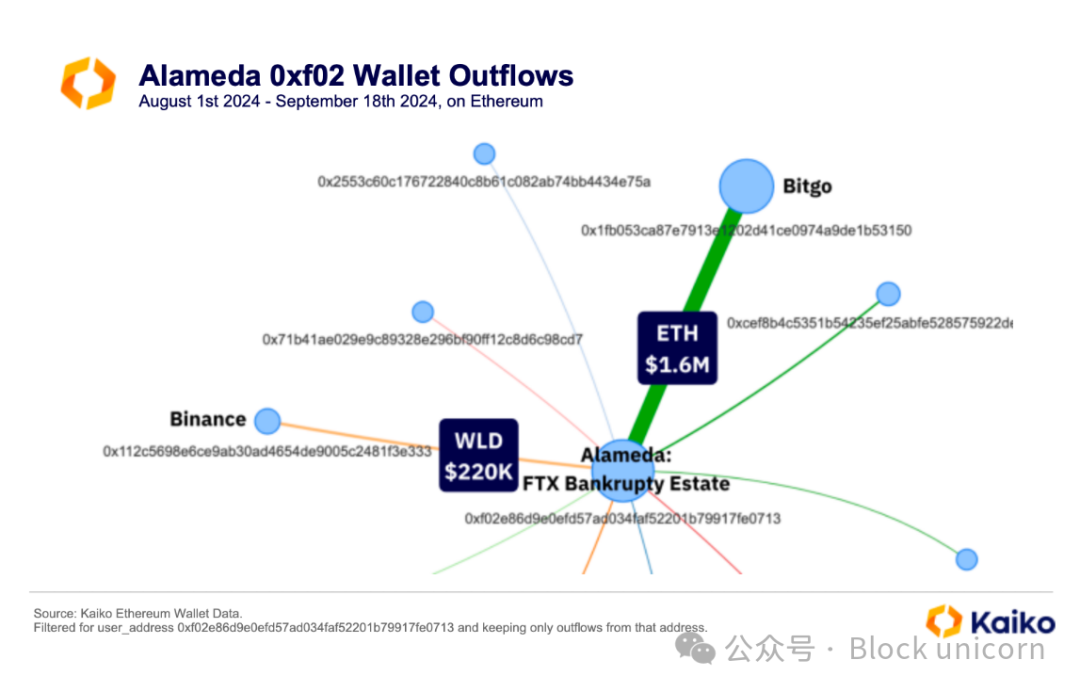
Moving assets to exchanges is generally seen as a bearish signal, as traders typically transfer holdings to exchanges to sell. Alameda Research was an early investor in Worldcoin, holding 75 million WLD tokens (worth $118 million). These tokens have been gradually unlocked since July by Worldcoin developer Tools for Humanity (TFH).
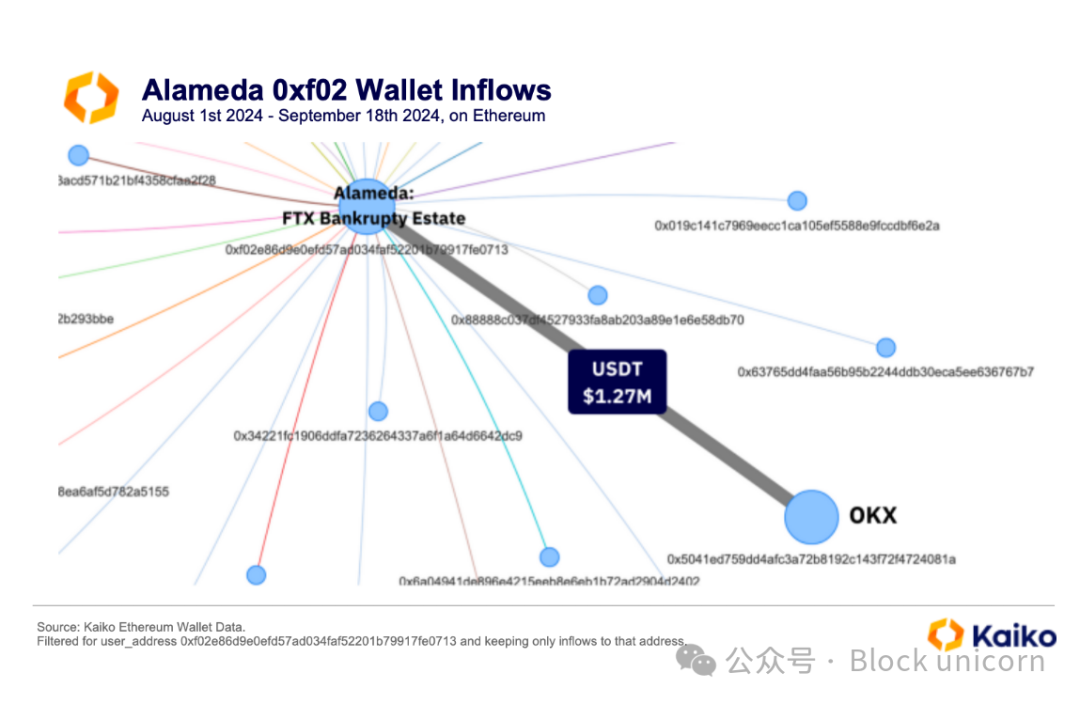
A deeper analysis of incoming transactions reveals the wallet has consolidated funds from multiple smaller wallets likely owned by Alameda Research, with the largest inflow being $1.27 million in USDT from OKX.
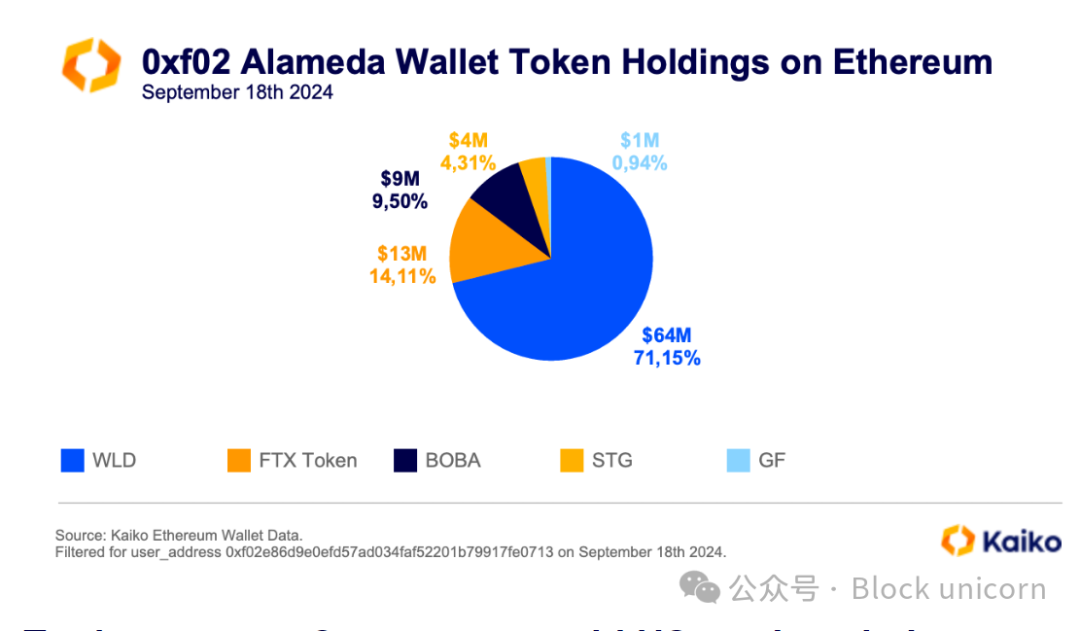
As of September 18, the Alameda wallet still holds WLD tokens worth $64 million. Selling these could significantly impact the price, especially given that the token has already dropped 30% since unlocking began on July 24. Other major holdings include several illiquid small-cap tokens such as FTX’s FTT (worth $13 million) and Bona Network’s BOBA (worth $9 million), both with market depths of only about $700,000 per day.
Traders turn to Crypto.com amid U.S. market shifts. This year, the U.S. cryptocurrency exchange landscape has shifted due to regulatory changes and evolving market structures. Cboe Digital shut down its digital asset spot trading business in June, focusing solely on derivatives, although it had announced this plan back in April.
Since June, Crypto.com has seen significant growth in trading volume and market share, suggesting it may be benefiting from Cboe Digital’s exit. Trading volumes surged, accompanied by rising liquidity. During the summer, the exchange’s 1% market depth for Bitcoin rose sharply, surpassing Gemini and challenging Coinbase’s liquidity. Coinbase even lost market share during Q3.
Moreover, Crypto.com’s competitive fee structure may also be driving trading activity on the platform. The exchange currently waives maker fees for VIP-tier clients and runs various promotional campaigns. Overall, Crypto.com’s fee schedule remains more competitive compared to other U.S. exchanges.
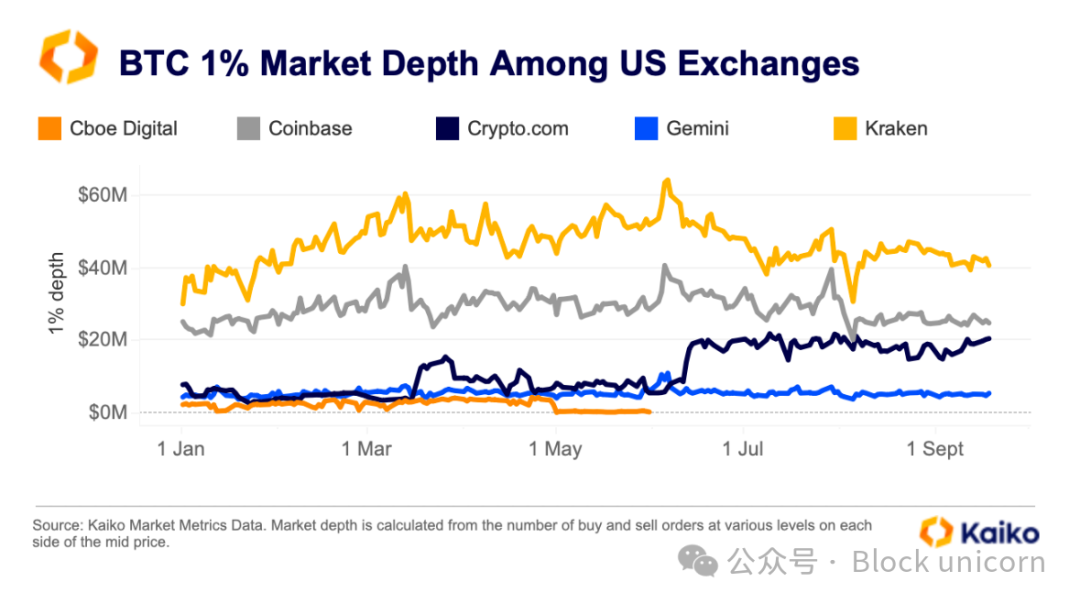
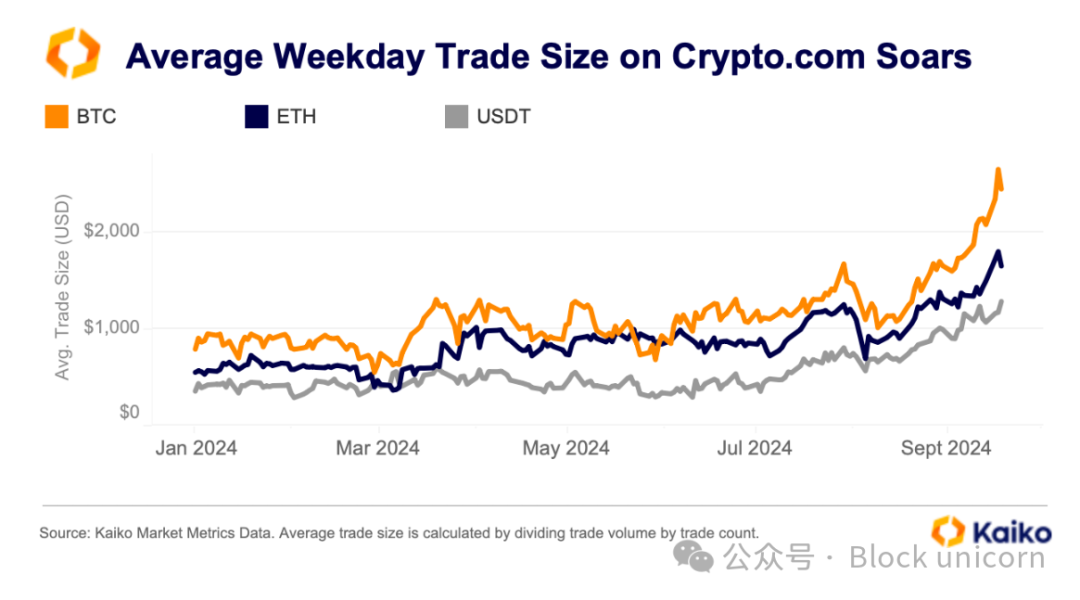
The simultaneous rise in liquidity and trading volume indicates that market makers are also becoming more active on Crypto.com. Growing average trade sizes on the platform provide another sign that it may be capturing volume from Cboe’s closure.
If we examine weekday trading activity for BTC, ETH, and USDT, volumes have risen steadily since March, with a noticeable uptick during the summer months. Given that Cboe was an institution-focused trading platform with average trade sizes far exceeding most retail platforms, the increase in trade size on Crypto.com suggests growing institutional participation.
Why is altcoin liquidity becoming increasingly concentrated?
Despite high volatility over recent months, altcoins’ 1% market depth remained relatively stable in Q3 at around $270 million, indicating that market makers continued providing liquidity despite ongoing volatility.
Altcoin liquidity was heavily impacted by the collapses of FTX and Terra, declining over 60% between April and December 2022. However, liquidity has gradually improved over the past year, surpassing pre-FTX-collapse averages in Q1 2024, though it has pulled back somewhat in Q3.
Yet, recovery across asset categories has been uneven. Altcoin liquidity is becoming increasingly concentrated, with large-cap altcoins outperforming smaller assets.
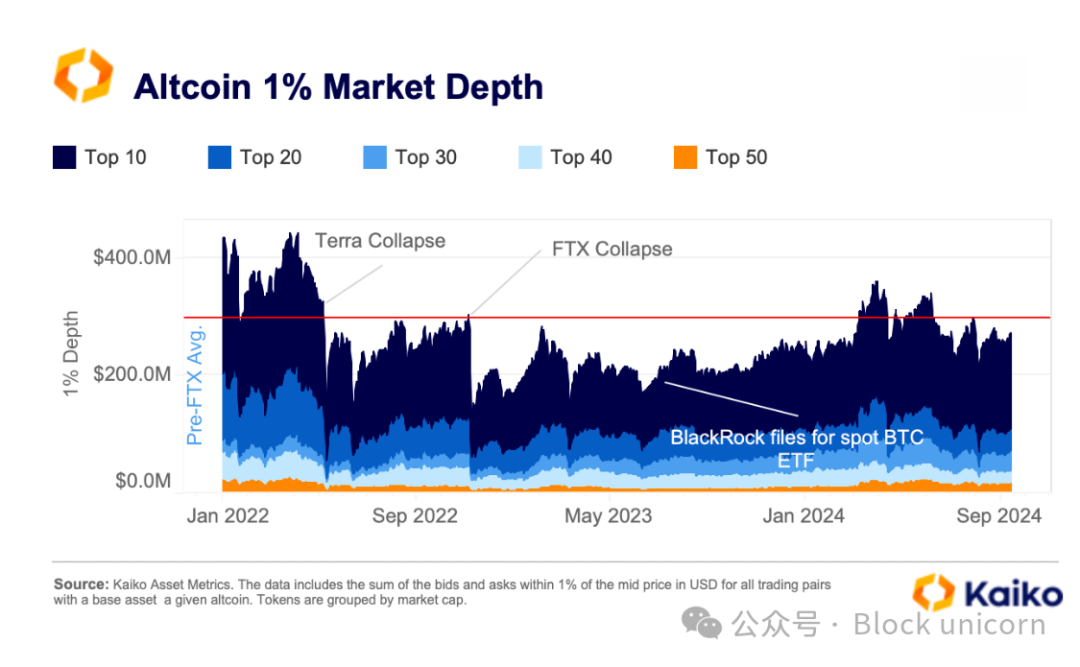
By early September, the top 10 altcoins by market cap accounted for 60% of total market depth, up from around 50% at the start of 2022. In contrast, the market share of the top 20 altcoins fell sharply over the same period, dropping from 27% to 14%.
Furthermore, altcoin liquidity is also becoming increasingly concentrated on offshore exchanges. Their share of total altcoin depth has risen from 55% at the beginning of 2022 to 69%, a trend primarily driven by large- and mid-cap altcoins.
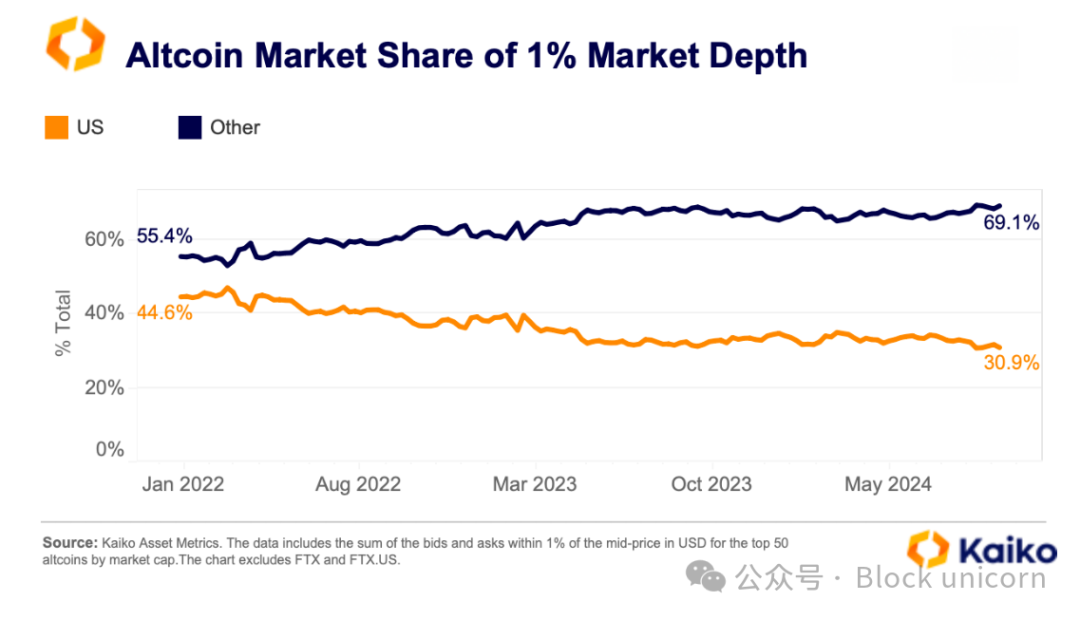
We observe the opposite trend in Bitcoin liquidity, where U.S.-based exchanges have gained market share relative to offshore venues. This suggests some market makers may have reduced portfolio risk or shifted focus toward Bitcoin.
Exchange Listings Cool Down in 2024
Tightening global regulatory scrutiny has significantly altered cryptocurrency exchanges’ listing strategies, leading to a marked slowdown in new listings compared to the 2021 bull run.
However, focusing solely on the nominal number of new listings fails to capture how exchanges are expanding their product offerings. To provide clearer insight, we compare the number of new listings against each exchange’s total number of active trading pairs.
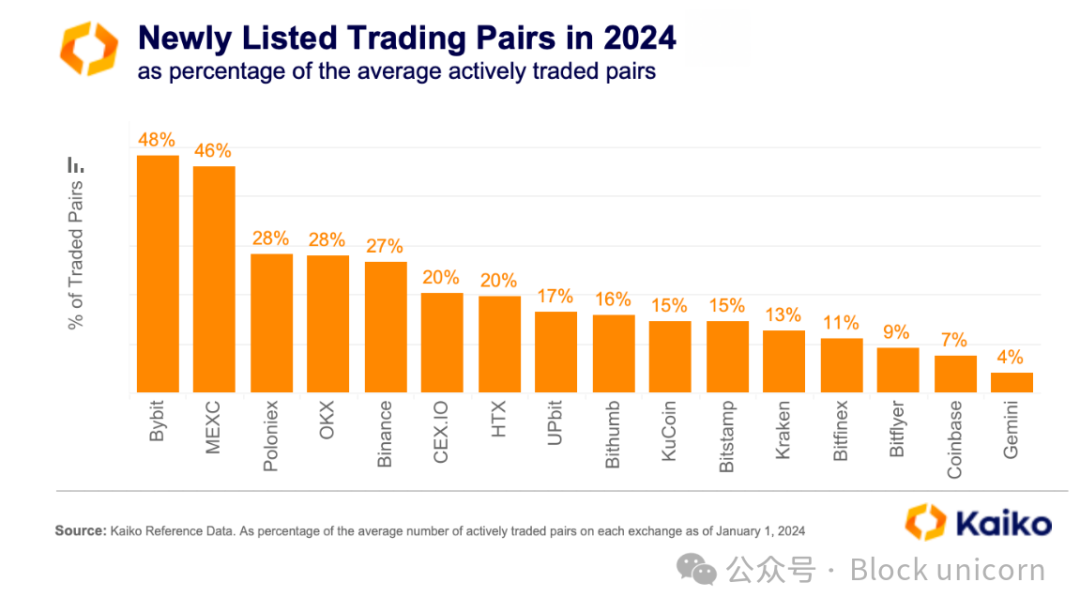
In 2024, Binance added over 300 new trading pairs, ranking second behind MEXC. Yet, these new pairs account for only 27% of its total product lineup, lagging behind Bybit, Poloniex, and OKX in terms of expansion pace.
U.S.-based exchanges have taken a more conservative approach, with new listings accounting for just 4% to 15% of their existing offerings. For instance, Coinbase launched only 29 new trading pairs in 2024, a tenfold decrease compared to 2021.
Overall, major exchanges introduced new trading pairs amounting to about 20% of their existing pairs this year, a sharp decline from the 50% average seen during the 2021 peak.
U.S. Presidential Race Fuels Crypto Market Volatility
Digital assets have become an increasingly prominent issue for the two main U.S. presidential candidates. Former President Trump pledged months ago to support Bitcoin and related sectors and plans to launch his own cryptocurrency project in the coming weeks. Many market participants view this Republican candidate’s pro-Bitcoin stance positively.
Yet, this may also be a double-edged sword, as recently shown in the debate. During the debate, Bitcoin prices declined, reflecting the market’s negative reaction to Trump and Harris’s performance.
Prior to the debate, implied volatility surged in Deribit’s Bitcoin options contracts expiring on November 8—just three days after the U.S. vote. During the debate, trading volume in special election-related contracts exceeded $40 million, with traders primarily buying put options, which profit when Bitcoin prices fall.
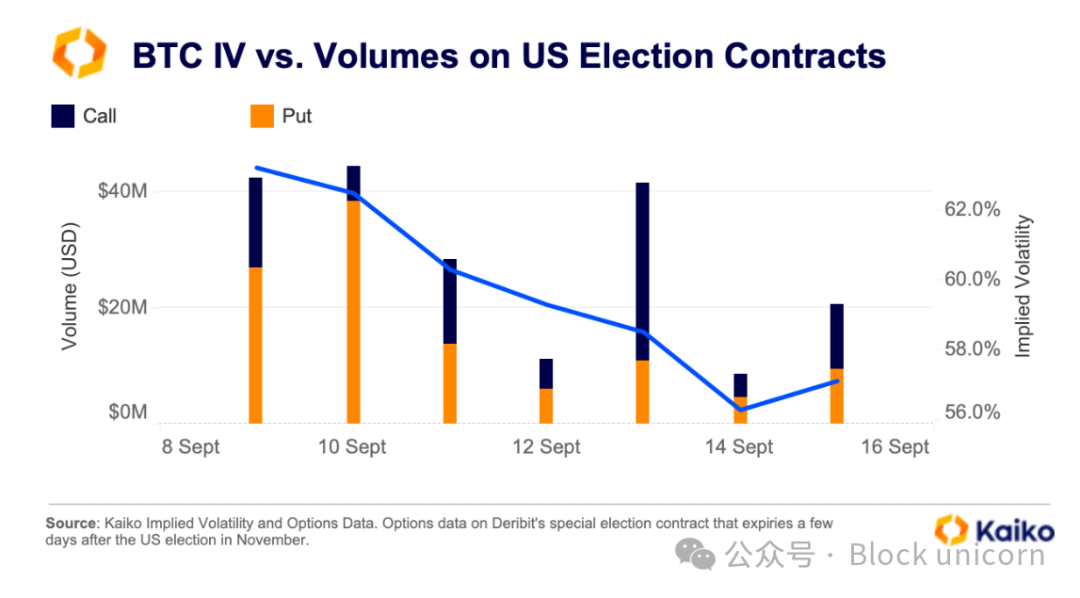
The U.S. election may continue to amplify market volatility in the coming weeks as we enter the final stage of the electoral cycle. While Bitcoin and digital assets were not focal points in the 2020 campaign, their importance has grown significantly this time. Former President Donald Trump made an early stand, pledging support for U.S. digital assets and speaking at the Bitcoin Conference in August. Although Kamala Harris has expressed less explicit support for digital assets, the current Vice President stated at a Sunday fundraising event that she would back innovation in the sector.
Join TechFlow official community to stay tuned
Telegram:https://t.me/TechFlowDaily
X (Twitter):https://x.com/TechFlowPost
X (Twitter) EN:https://x.com/BlockFlow_News
 @BlockUnicorn