Looking Through the Fed's Rate Cut Cycle: Will a Crypto Market Rally Be the Next Tradeable Event?
TechFlow Selected TechFlow Selected
Looking Through the Fed's Rate Cut Cycle: Will a Crypto Market Rally Be the Next Tradeable Event?
Entering a rate-cutting cycle, market conditions seem to collapse and restart in an instant—what hidden market factors are at play?
 Navigating Web3 tides with focused insights
With the Federal Reserve officially cutting interest rates by 50 basis points this morning, the final piece of 2024's macro-level puzzle for the crypto market has finally fallen into place.
In hindsight, among the three most anticipated catalysts for the market this year—spot Bitcoin ETFs, Bitcoin halving, and Fed rate cuts—the ETF approval drove Bitcoin past $70,000, setting a new all-time high; the halving, however, did not trigger significant market volatility as expected.
While the correlation between macro conditions and Bitcoin is often debated, macro cycles—especially U.S. dollar liquidity (as a function of monetary policy, interest rates, and risk appetite)—remain the primary driver of mid-to-long-term asset prices. Now that the start of the Fed's rate-cutting cycle appears to have broad bullish consensus, and is widely seen as a tradable event, is this really the case?
Rate Cuts Begin—Is the Bull Market Back Overnight?
Since early 2022, the U.S. federal funds rate entered a tightening cycle, peaking in Q3 2023 when the Fed aggressively raised rates to combat inflation—from January 2022 to August 2023, the effective rate rose from 0.08% to a target range of 5.25%-5.5%.
Now, with the Fed’s announcement on September 18 cutting rates by 50 basis points and lowering the federal funds rate target range to 4.75%–5.00%, this marks the formal end of the tightening cycle. Moreover, the updated dot plot indicates an additional 50 basis points of cuts are expected before year-end.
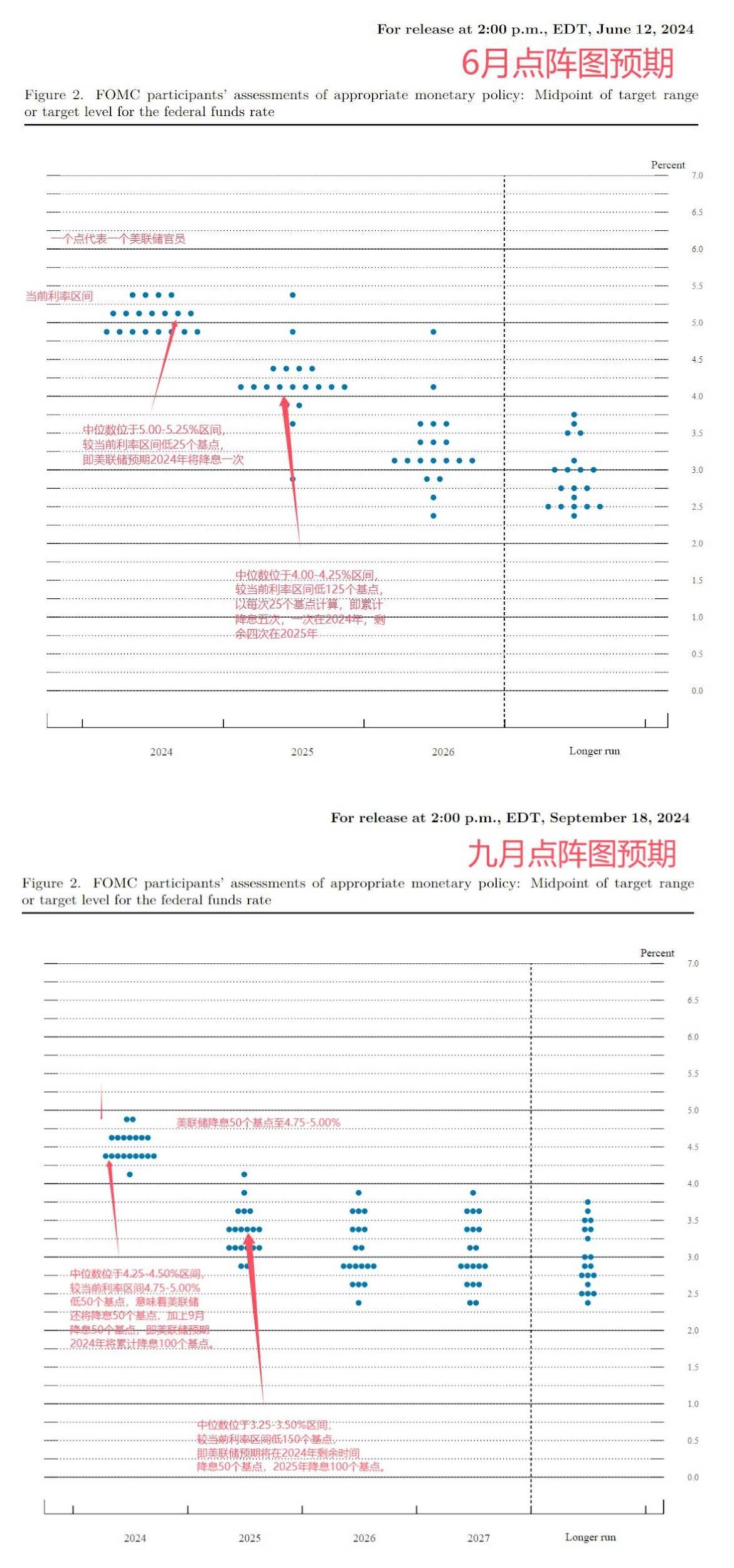
Dot Plot Analysis |Jin10 News
Although the first rate cut came four months later than some market expectations, it significantly boosted positive sentiment across the crypto industry, prompting increased capital inflows into Bitcoin and other digital assets.
The reasoning is straightforward: previously, the U.S. money and bond markets—representing the largest pool of liquidity in the financial system—offered attractive yields. But now, with interest rates entering a downward cycle, these traditional markets become less appealing, pushing investors toward higher-risk, higher-return assets.
Following the announcement this morning, market sentiment surged instantly. Bitcoin broke through key psychological levels of $61,000 and $62,000, briefly reaching $62,589. Over the past 12 hours, total liquidations across the crypto market exceeded $114 million, with long positions accounting for over $97 million in losses—marking a brutal squeeze against short sellers, particularly Bitcoin shorts.
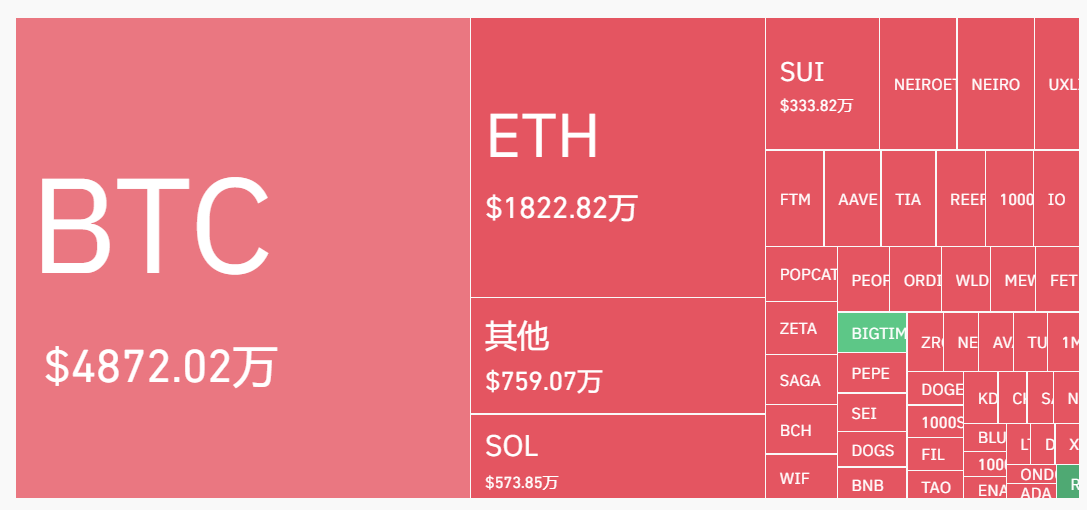
CoinglassData
However, it's important to note that while rate cuts generally benefit risk assets, price movements are often driven not by priced-in expectations but by deviations from those expectations. Jean-David Pequignot, Market Director at OSL, commented:
“Bitcoin and the broader cryptocurrency market rebounded following the Fed’s 50-basis-point rate cut. However, the committee remains cautious about further easing. Governor Bowman advocated for smaller cuts, while Chair Powell expressed concerns about overly aggressive loosening. With the U.S. election campaign in full swing, markets will closely monitor economic data over the coming months to gauge the future path of the federal funds rate.”
Beyond this, certain under-the-surface developments over recent months could also emerge as overlooked bullish or bearish factors. Let’s explore potential key narratives that may shape the second half of the year.
Ongoing Inflows into U.S. Spot ETFs
According to SoSoValue data, spot Bitcoin ETFs have seen a renewed wave of capital inflows since July. Despite a notable weekly outflow at the beginning of this month, the overall trend has clearly reversed compared to April–May.
At the time of writing, the total net asset value of spot Bitcoin ETFs stands at $54.85 billion, representing 4.61% of Bitcoin’s total market cap (ETF NAV ratio), with cumulative net inflows reaching $17.44 billion.

Hong Kong Digital Asset ETFs Gaining Momentum
Markets often overestimate the short-term impact of new developments while underestimating their long-term significance. Beyond U.S. ETFs, Hong Kong’s virtual asset spot ETFs—launched nearly six months ago—are showing promising signs:
According to Hong Kong Exchange data, the combined weekly trading volume of Hong Kong’s three Bitcoin spot ETFs reached approximately HK$84 million last week, a surge of over 191% compared to HK$28.86 million the previous week.

Notably, two Bitcoin ETFs managed by OSL—issued by ChinaAMC and Harvest Fund International—accounted for over HK$81 million in weekly volume, or 96.1% of the total, up 244% from HK$23.55 million the prior week. The remaining ETF recorded about HK$3.27 million in volume, down over 38% from HK$5.31 million the previous week.
A Shift in Crypto Regulation
Winds begin at the tip of a blade of grass. Against the backdrop of the 2024 election year, both regulatory and capital environments have notably improved, laying the groundwork for new catalysts.
On May 22, the Financial Innovation and Technology for the 21st Century Act (FIT21) passed the House of Representatives by a decisive 279–136 vote. Shortly afterward, the U.S. Securities and Exchange Commission (SEC) swiftly approved spot Ethereum ETFs—signaling a clear softening in the stance of U.S. regulators.

Even U.S. politicians are increasingly embracing crypto: four years ago, would you have believed someone who told you that both major U.S. presidential candidates in 2024 would actively promote their support for cryptocurrencies—even engaging in a kind of “arms race” of pro-crypto rhetoric?
You’d probably have thought they were crazy.
Yet reality has turned dramatically theatrical. For the crypto industry, the 2024 U.S. presidential election has become a political stage entirely unlike the 2020 or 2016 elections. Whether in terms of agenda-setting throughout the campaign or public statements from the candidates themselves, cryptocurrency has entered the discourse like never before, with both sides competing to showcase more open-minded policies.
Overall, the election year is undoubtedly a key factor. In the U.S., the population that directly or indirectly holds crypto has become a force too significant to ignore—especially in a tightly contested election where every marginal voter matters. The timing of FIT21’s passage underscores this shift.
Summary
History doesn’t repeat itself, but it often rhymes.
Overall, even in this uncertain and fragile market environment, numerous positive factors are quietly building momentum. For those paying close attention, there remains reason for confidence. With a new rate-cutting cycle underway and the U.S. election approaching its conclusion, Web3 and the crypto industry may indeed be entering a transformative new era.
Join TechFlow official community to stay tuned
Telegram:https://t.me/TechFlowDaily
X (Twitter):https://x.com/TechFlowPost
X (Twitter) EN:https://x.com/BlockFlow_News
 @osldotcom