








Institutional accumulation and strong ecosystem momentum: Is the Bitcoin bull run set to continue?
TechFlow Selected TechFlow Selected
Institutional accumulation and strong ecosystem momentum: Is the Bitcoin bull run set to continue?
When asked which sector they are most optimistic about in the market ahead, "Bitcoin ecosystem" remains the top choice.
 Navigating Web3 tides with focused insights
Author | Joyce
Published by: Baicai Blockchain (ID: hellobtc)
After a recent wave of market turbulence, as Bitcoin's price rebounds, panic across the entire market has significantly subsided.
Amid repeated collapses of altcoins, from skepticism over "Is there still an altcoin bull run?" to growing voices of professional investors exiting, the past one to two months have been gloomy for the cryptocurrency market beyond Bitcoin.
Yet regardless of how fearful market sentiment becomes, when asked which sector they are most optimistic about moving forward, “Bitcoin ecosystem” remains the top answer.
Especially recently, with institutions making large-scale Bitcoin purchases, ETF holdings of Bitcoin continuously increasing, and projects like Stacks and Fractal Bitcoin thriving within the Bitcoin ecosystem, there’s a strong momentum building that could drive the next market cycle.
01 Institutional Holdings and ETFs
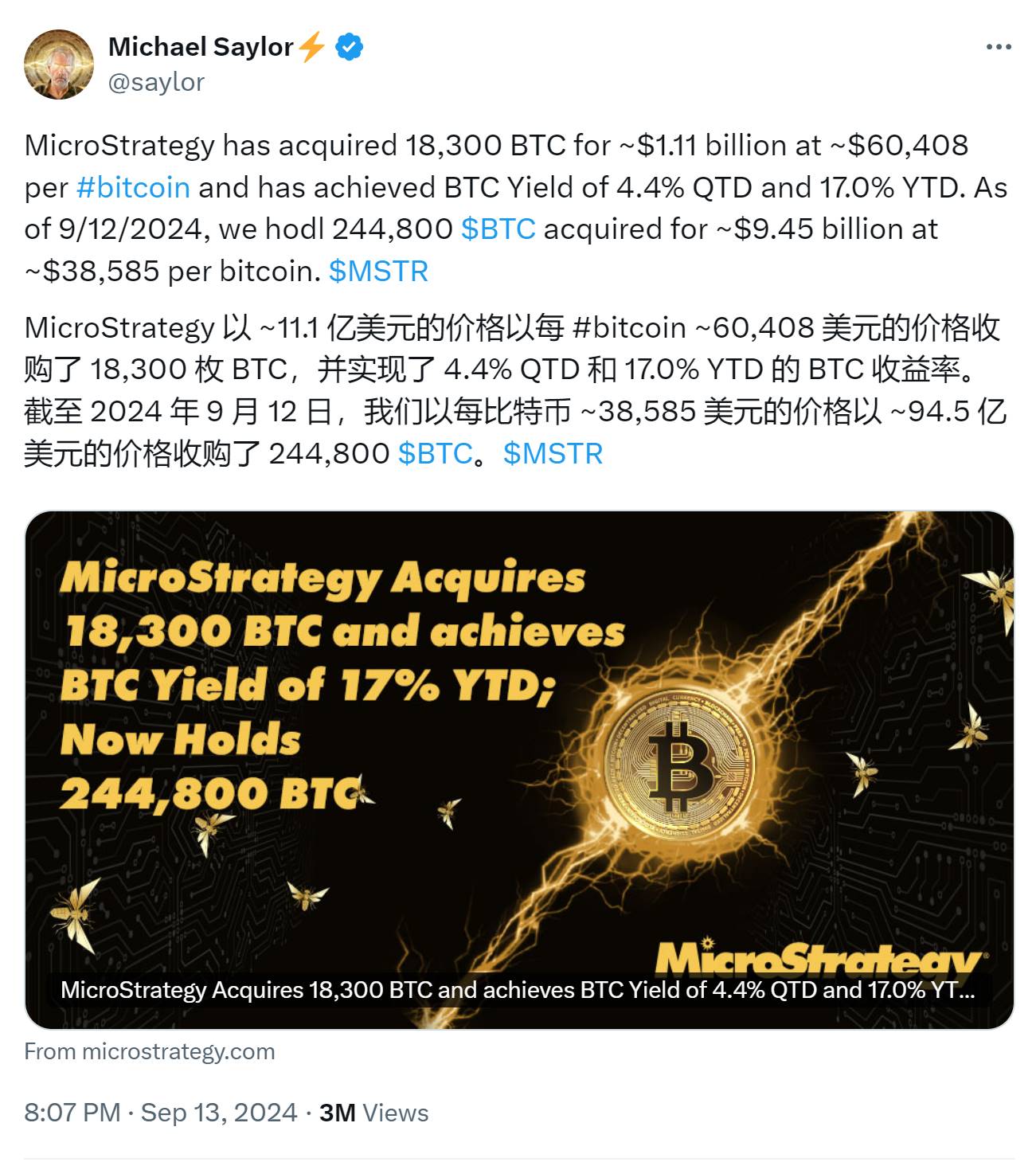
As one of Wall Street’s largest Bitcoin holders, MicroStrategy has been on another buying spree recently.
According to its latest SEC filing, MicroStrategy purchased 18,300 BTC over the past month and a half, investing approximately $1.11 billion at an average price of around $60,655. MicroStrategy now holds a total of 244,800 BTC, accounting for 1% of Bitcoin’s total supply.
Three years after its last major purchase, MicroStrategy’s fresh $1.1 billion investment in Bitcoin serves as a strong vote of confidence and a much-needed boost to a market just beginning to show signs of recovery.
Despite the market appearing shaky over the past few months and widespread FUD declaring "the bull run is over," the SEC’s Q2 2024 13F filings reveal that U.S. institutions continued accumulating Bitcoin ETFs even during periods of falling prices:
According to Bitwise Chief Investment Officer Matt Huang, institutional holders of Bitcoin ETFs increased from 965 to 1,100 in Q2, with over 130 institutions purchasing Bitcoin ETFs for the first time. The share of total ETF holdings held by institutions also rose from 18.74% to 21.15%.
Thus, despite high volatility and unclear trends, these institutions remained undeterred and kept adding positions. One can only imagine how much more substantial their participation would be if a full-blown bull market were underway.
Looking at the trend of Bitcoin holdings by ETFs since their inception, the data shows a generally steady upward trajectory over the past nine months. Even during periods of extreme market volatility, the total amount of Bitcoin held by ETFs has remained largely stable.
Therefore, despite market swings and the Fear & Greed Index plunging into "extreme fear," major U.S. institutional players continue to steadily accumulate Bitcoin.
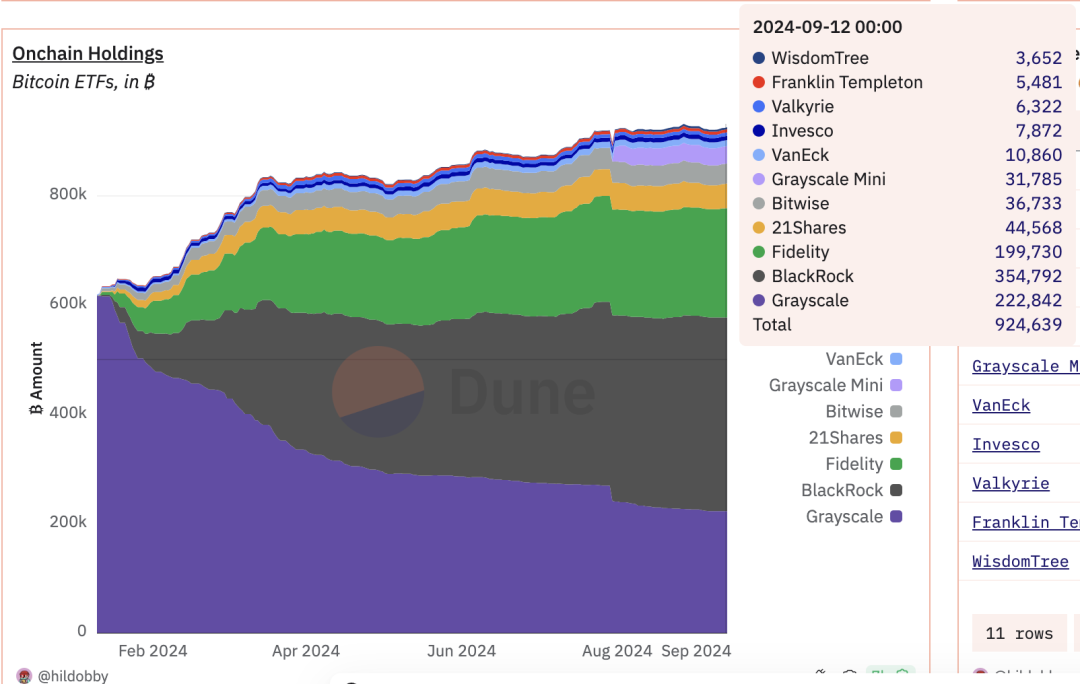
Bitcoin ETF Holdings Over Time, Source: Dune
02 Fractal Bitcoin
Fractal Bitcoin has emerged as one of the most eye-catching projects recently. Beyond its generous airdrop attracting massive attention, Fractal Bitcoin achieved a total hashrate exceeding 241 EH within days of launch—38.1% of Bitcoin’s total network hashrate—a clear testament to its popularity.

Fractal Bitcoin Price and Hashrate Overview, Source: UniSat Explorer, September 16, 2024
Launched by the Unisat team—deeply rooted in the Bitcoin ecosystem and backed by top-tier investors like Binance—this level of attention was expected.
Fractal Bitcoin is a Layer2 for Bitcoin, touted as the “only native Bitcoin scaling solution,” emphasizing stronger compatibility with Bitcoin and shared security. Without altering Bitcoin’s base code, it boosts transaction speeds, reducing confirmation times to 30 seconds—over 20x faster than Bitcoin’s typical 10-minute block time.
On the difference between Fractal Bitcoin and other Layer2s or sidechains,its founder likens it this way: “If other L2s and sidechains build new highways, Fractal builds countless parallel highways alongside the Bitcoin mainnet. Each highway can extend the mainnet—or extend another highway.”
Of course, many Bitcoin scaling solutions exist, all aiming to maximize security inheritance from Bitcoin while drastically improving TPS—exactly what Fractal Bitcoin aims to achieve. Yet, few such solutions have truly launched successfully so far.
Since the explosion of interest in the Bitcoin ecosystem, the Layer2 space has become crowded. Alongside established players like Stacks and RSK, newcomers like RGB++, BEVM, Merlin, and others have entered the fray—making it a highly competitive landscape.
But who will ultimately lead Bitcoin’s Layer2 evolution, bringing DeFi, GameFi, and NFTs into the Bitcoin ecosystem and unlocking vast amounts of dormant Bitcoin liquidity? That remains to be seen and validated over time.
03 Stacks Nakamoto Upgrade
As the most well-known Layer2 in the Bitcoin ecosystem, Stacks completed its long-awaited Nakamoto upgrade on August 28.
This upgrade is significant for Stacks in four key ways:
1) STX Supply Halving: After the upgrade, the mining reward per Bitcoin block dropped from 1,000 STX to 500 STX, significantly reducing inflationary pressure on STX.
2) Over 60x TPS Improvement: By decoupling Stacks’ block production from Bitcoin’s 10-minute block interval, confirmation times are reduced to just 10 seconds, increasing TPS by more than 60x.
3) Enhanced Security: The new consensus mechanism writes Stacks’ chain history directly into Bitcoin blocks. As a result, Stacks’ data cannot be altered without modifying Bitcoin’s blockchain, greatly strengthening its security.
4) Decentralized Pegged Asset sBTC Launch: Around one month post-upgrade, sBTC—the first fully decentralized Bitcoin-pegged token—will launch. It requires no permission and allows open participation, making it particularly appealing to large Bitcoin holders.
With the successful completion of the Nakamoto upgrade, the competition among Bitcoin Layer2s is set to intensify. Stacks has already proven its security over a long period, and the upgrade further strengthens it while delivering major TPS improvements.
Moreover, Stacks enjoys high recognition in Western markets and was the first token project to achieve SEC compliance. With the most mature ecosystem among Bitcoin Layer2s and a clear first-mover advantage, Stacks is undoubtedly a heavyweight contender in the race for dominance.
04 Summary
Beyond these developments, the Bitcoin ecosystem has seen several other exciting moves recently. For example, Babylon launched its mainnet in late August, enabling staking. It reached its cap of 1,000 BTC in just three hours. With strong airdrop expectations and a prestigious funding background, Babylon has drawn significant market attention. Additionally, recent launches of OP_CAT protocol-based projects within the Bitcoin ecosystem have also sparked intense activity.
In any case, compared to the stagnation or decline seen in other ecosystems, the wealth creation effect and vitality of the Bitcoin ecosystem are clearly visible. After the fading momentum of inscriptions and runes, the continuous innovation, sustained capital inflow, and active development make the future of the Bitcoin ecosystem truly promising.
Join TechFlow official community to stay tuned
Telegram:https://t.me/TechFlowDaily
X (Twitter):https://x.com/TechFlowPost
X (Twitter) EN:https://x.com/BlockFlow_News
 白话区块链
白话区块链









