Detailed Analysis of 16 Ethereum ETFs: Fees, Promotions, and Holdings
TechFlow Selected TechFlow Selected
Detailed Analysis of 16 Ethereum ETFs: Fees, Promotions, and Holdings
In July 2024, the first spot Ethereum ETF was approved and listed, but the short-term market response was muted, and it does not offer staking rewards.
 Navigating Web3 tides with focused insights
By: Sam Taube
Translation: Baic Blockchain
About six months ago, the U.S. Securities and Exchange Commission (SEC) approved the first spot Bitcoin ETF. On July 23, 2024, the SEC approved the launch of the first spot Ethereum ETFs for trading.
1. What Is a Spot Ethereum ETF?
A spot Ethereum ETF is an exchange-traded fund that directly invests in Ethereum—the world’s second-largest cryptocurrency by market capitalization, trailing only Bitcoin.
Ethereum has many features that distinguish it from Bitcoin. Its blockchain hosts not only ether but also decentralized applications and non-fungible tokens (NFTs) built on the Ethereum protocol. Additionally, Ethereum now uses a Proof-of-Stake system to create new coins, a more energy-efficient mechanism than the Proof-of-Work mining used by Bitcoin. (Ethereum previously used Proof-of-Work until switching to Proof-of-Stake in 2022.)
Prior to the approval of spot ETFs, Ethereum strategy ETFs already existed in the market, which indirectly track ether's price through futures contracts. However, these ETFs may not track the cryptocurrency’s price as precisely as spot Ethereum ETFs and could charge higher fees. The spot Ethereum ETFs approved in July 2024 represent the first of their kind.
2. Spot Ethereum ETFs
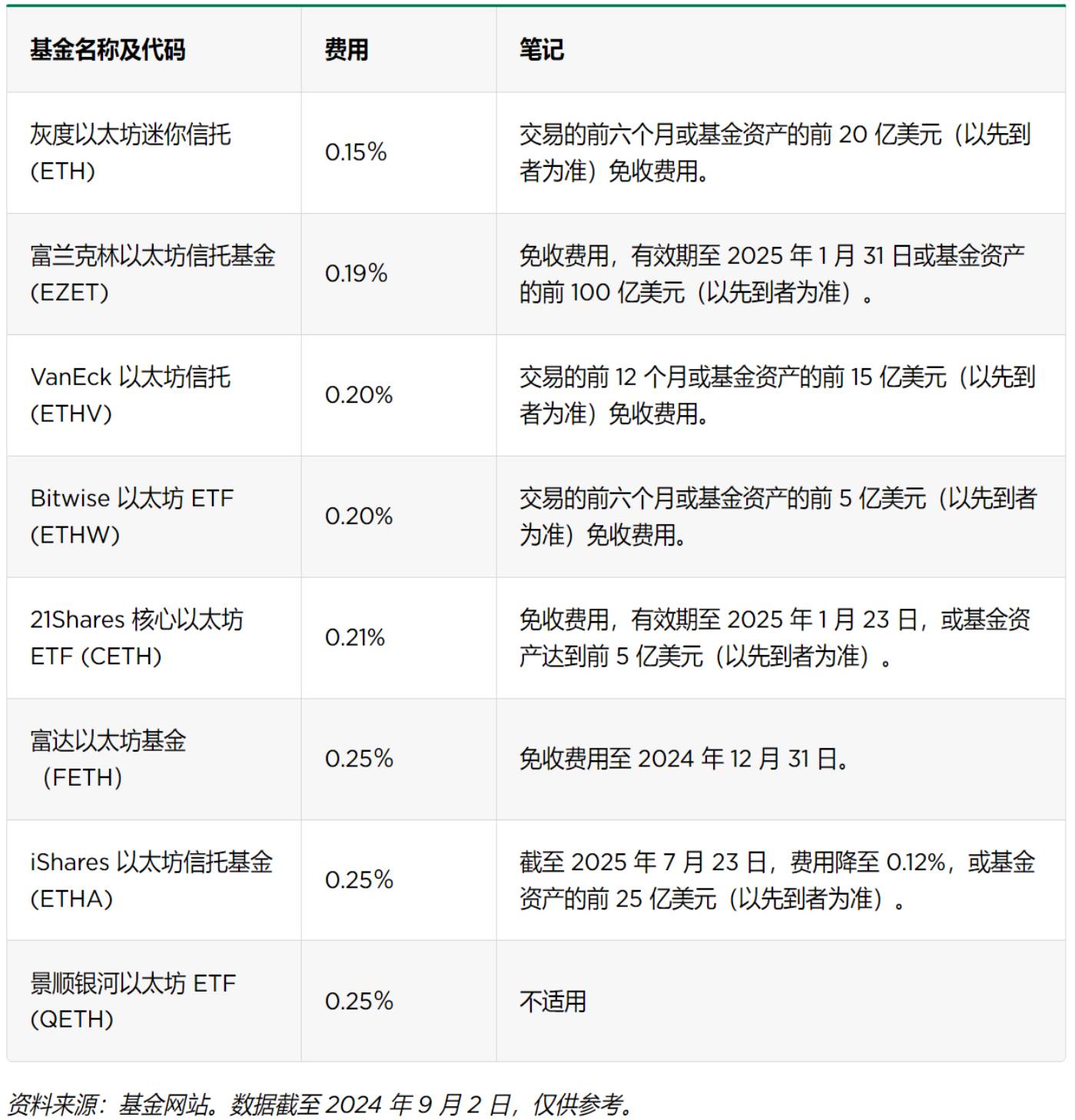
To date, eight different spot Ethereum ETFs have begun trading. Below are the names of each ETF, along with their ticker symbols, fee structures, and details on any promotional fee waivers.
3. The Ninth Ethereum Fund
Technically, there are nine investment funds tracking the spot price of Ethereum in the market today, but the ninth is not a traditional ETF. Grayscale Ethereum Trust (ETHE), do not confuse it with its Mini Trust ETF, is an exchange-traded product (ETP) whose market price may deviate from its net asset value, potentially resulting in premiums or discounts relative to its ether holdings for investors.
ETHE is the world’s largest spot Ethereum fund, representing over 2% of Ethereum’s total market capitalization at the time of writing. It charges a 2.50% expense ratio and currently offers no promotional fee waiver. It was also approved for trading on July 23.
4. The Ethereum ETF Price War
In the days leading up to the SEC’s approval of Ethereum ETFs in July 2024, issuers engaged in a fierce battle over fees. Many companies filed multiple amended registration statements, lowering fees in attempts to undercut competitors. Others quickly followed suit, submitting revised filings within days with even lower fees.
Some firms launched last-minute promotions, such as waiving fees entirely for the first six months, positioning themselves as the lowest-cost Ethereum ETF in the market. This rapid decline in fees and promotional activity continued right up until the SEC announced its approval, and may persist into the future.
Given this dynamic, any information you see regarding Ethereum ETF fees and promotions should be carefully verified. Numbers available online may already be outdated by the time you read them.
5. Ethereum Strategy ETFs
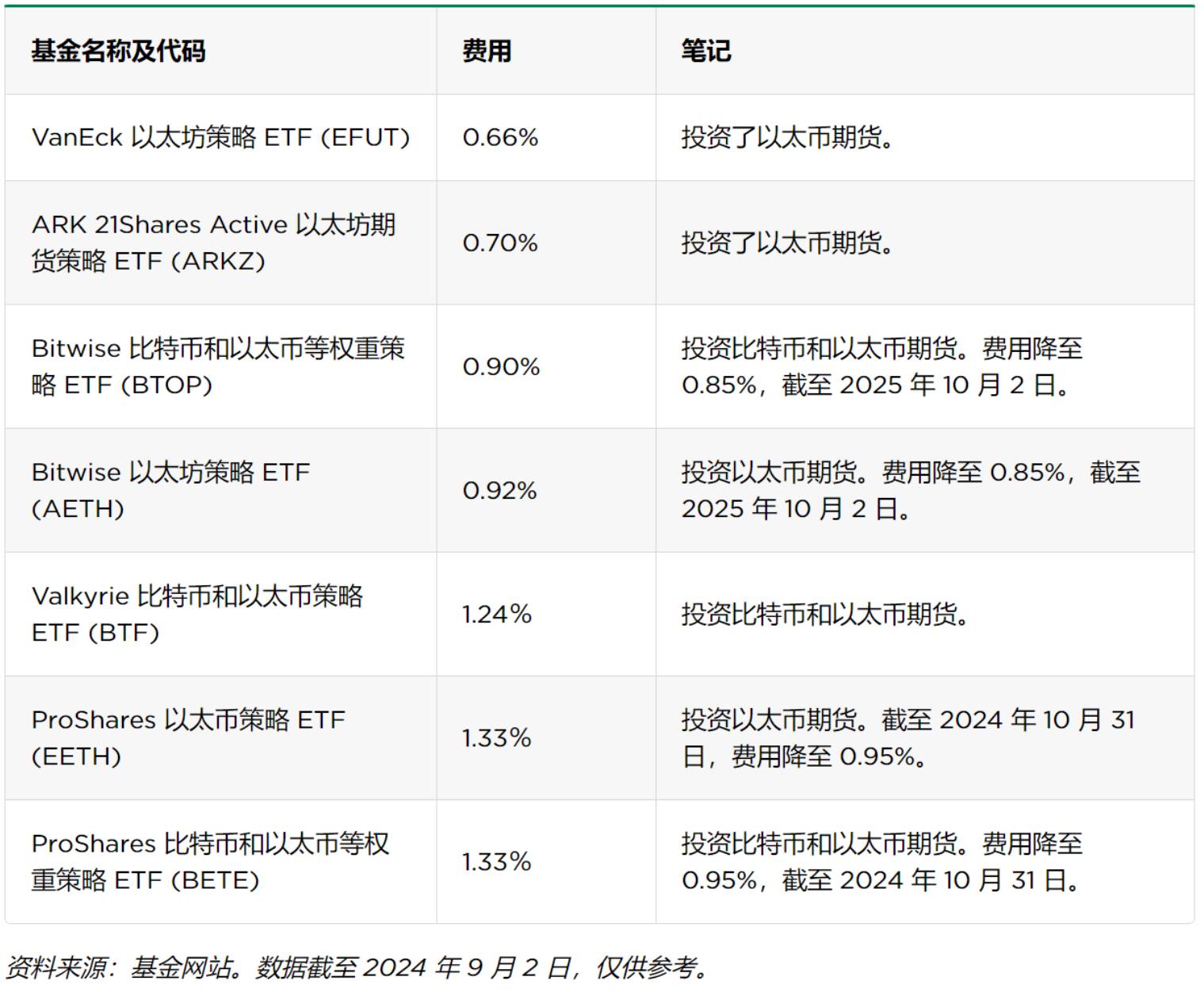
We define Ethereum strategy ETFs as any ETF that allocates at least 50% of its assets to ether futures contracts. Currently, there are seven such funds in the market, listed below in ascending order of fees.
6. What Does ETF Approval Mean for Ethereum?
At the time of writing, ether’s price has risen more than 40% year-to-date. Will the recent ETF approvals further fuel this upward trend? That remains to be seen.
Ethereum ETFs offer a new way for 401(k) and IRA investors to gain exposure to cryptocurrencies. Americans collectively hold nearly $40 trillion in retirement accounts, many of which do not allow direct cryptocurrency trading. (Note: 401(k) and IRA are common U.S. retirement savings accounts. They typically do not permit direct cryptocurrency purchases, but Ethereum ETFs now provide a way for these account holders to invest indirectly in crypto.)
However, the market’s short-term reaction to the Ethereum ETF approval has so far been muted. On July 23—the first trading day for the ETFs—ether’s price actually declined slightly between 9:30 a.m. and 4:00 p.m. Eastern Time.
7. Ethereum ETF vs. Ethereum Itself
Spot Ethereum ETFs may offer certain advantages compared to other ways of investing in Ethereum. As noted earlier, for investors who cannot directly purchase Ethereum (such as retirement account holders), spot Ethereum ETFs may provide a cheaper and more reliable option than previous Ethereum strategy ETFs.
However, it’s important to note that Ethereum ETFs also come with disadvantages compared to directly holding cryptocurrency. Current Ethereum ETF investors do not receive staking rewards—the equivalent of interest or dividends paid to ether holders for participating in network validation.
If you want to benefit from this feature of Ethereum, you’ll need to invest directly in the cryptocurrency itself.
Join TechFlow official community to stay tuned
Telegram:https://t.me/TechFlowDaily
X (Twitter):https://x.com/TechFlowPost
X (Twitter) EN:https://x.com/BlockFlow_News
 @NerdWallet