








a16z's Step-by-Step Guide: How Should Founders Use Social Media to Build Their Personal Brand?
TechFlow Selected TechFlow Selected
a16z's Step-by-Step Guide: How Should Founders Use Social Media to Build Their Personal Brand?
Build your social presence from scratch by setting goals, identifying your target audience, and measuring success.
 Navigating Web3 tides with focused insights
Author: chandan
Translation: TechFlow
People often compare social media usage to satisfying a sweet tooth, but for most startup founders, building a social presence is an essential task. The platforms we choose can help us research our audience, drive organic growth, build brands, and effectively disseminate information—making the need for a social media strategy obvious. However, creating an effective and practical plan is far from easy.
Top creators seem to do it effortlessly—a low-quality post might get a million views, a single blue checkmark emoji could spark months of buzz—but mastering this landscape is challenging. First, the rules of social media are constantly changing. Platforms like X may reduce visibility for posts linking to external websites; Instagram might start prioritizing new content formats. Even though we believe crypto can help here, rule changes often undermine even the most forward-thinking plans.
Algorithms evolve continuously, new platforms rise and fall, and novel viral content emerges all the time. There’s always a new account to create or experiment to run. So how should resource-constrained startups decide where to begin? And once they start, how can they determine what's working? While this space moves quickly, there are practical tips and best practices applicable in any situation.
This article outlines time-tested guidelines to help startups build a social presence from scratch—including setting goals, identifying target audiences, and measuring success. It also provides founders with tools and frameworks to understand when, how, and what to post—especially when time is limited.
Getting Started: How to Set Realistic Goals
Like any major product initiative, setting realistic goals before diving in is crucial for maintaining momentum and building confidence. Different startups and founders will have different objectives, but here are some questions to consider at the outset:
-
What role will social media play? A customer-service-focused social presence differs greatly from a founder's personal account. An account focused on content distribution requires a different approach than one managing a decentralized community. Defining these roles upfront is important.
-
What’s the end goal? A company might want to build social following before a public launch to ensure a highly engaged audience upon release. Or perhaps they aim to rebrand. As a founder, what are you working toward? How will your social presence support that vision?
-
What’s the timeline? Set short-term goals with specific deadlines to build momentum. For example, gain 100 followers in the first month, 200 in the second, and so on. Be realistic and stick to the plan.
Let these goals serve as the foundation for all subsequent efforts. Once goals are established, teams can shift focus from desired outcomes to the audiences they need to reach.
Identifying Your Audience: How to Find the Right People
Posting to a new social account can feel like shouting into a void. Teams must begin building an audience early—even before their product launches.

Before posting into the unknown, first define your target audience: Who do you need to reach to achieve your stated goals? Are they potential customers, crypto enthusiasts, investors, or someone else entirely?
Many crypto teams must explore entirely new audiences—especially when launching innovative or experimental products, or while still seeking product-market fit. That’s perfectly fine. The target audience isn’t everything, but it’s a useful input for deciding which platforms to prioritize and what kind of content to create.
To get started, try using this six-question framework:
-
Which accounts represent part of your target audience? Connect this back to your overall strategy: for example, early-stage crypto startups—even those with broad consumer products—may want to prioritize niche, crypto-native communities. A smarter, more engaged group of early adopters can help refine the product roadmap before a wider rollout.
-
Which social platforms do they use most? If the conversations your team wants to join are happening on X, then focusing heavily on Instagram would be a mistake. But answers aren't always straightforward. Some specialized audiences—including certain research and academic communities driving crypto innovation—are best reached via email or in-person events.
-
Where in the world is your audience located? This can be tricky in web3, where many users are anonymous, but the more location data you can gather, the better. If half your audience is in the UK, you probably don’t want to post while they’re asleep. Tools like Twitter Analytics can help. Alternatively, a simple growth hack is to jump into your Discord and invite members to share their flags in chat.
-
Which other accounts does your audience follow? Study popular accounts, influencers, and brands followed by your audience to understand content types and brand voices. Then imagine how your content appears in your followers’ feeds: Will it stand out, or blend seamlessly into their information diet? Quick market research can provide a solid baseline for early posts.
-
Which topics do they engage with most? Analyze high-performing content from relevant accounts. Review their last 50 posts to see what works and what doesn’t, then use top-performing themes as inspiration.
-
How do they use social media? People use social platforms differently. Each platform may serve distinct purposes in users’ lives—relaxation, connection-building, or learning something new.
This is just a starting point. Treat these questions as a map to help identify where to begin: which platforms to build on, and what types of content to publish.
Knowing Where to Post: How to Prioritize Platforms and Accounts
Clearly defining your target audience helps make key decisions—especially about which platforms and accounts to prioritize.
It’s common for users to switch between multiple platforms daily. But for content creators, trying to be everywhere at once can severely weaken a social strategy. This is especially true for founders, as maintaining more than two social accounts simultaneously is unsustainable.
The goal is to start small and gradually develop the ability to produce great content. Later, you can expand to additional platforms—possibly by hiring help. Until then, we typically advise founders to focus on just 1–2 platforms, excel there, and only then consider scaling.
For example, founders shouldn’t limit themselves to brand accounts on LinkedIn and X. It’s equally important to consider how their personal accounts fit into the broader strategy (discussed in detail below).
Leveraging Personal Accounts
Founders often ask whether they should promote their work through personal or company accounts. Should they invest more time building their brand on personal LinkedIn, or create a startup account from scratch?
The answer depends on specific goals, but we increasingly recommend founders use their personal accounts—for several reasons:
-
People prefer human voices over brand voices. Brand accounts often feel promotional and marketing-driven, while founder voices come across as authentic rather than purely transactional.
-
Personal accounts tend to outperform brand accounts. We’ve observed that on platforms like X, personal accounts consistently generate higher engagement and reach because algorithms currently favor individual voices.
-
Building a personal brand creates an audience independent of any single product. No matter which idea a founder pursues or what stage their product is in, a strong social presence builds a built-in audience for future projects, upcoming launches, or even new social accounts.
Founders don’t need to choose one over the other. In fact, running both accounts enables more effective community communication (since only a subset of each follower base sees any given organic post). For more on founder vs. brand accounts, see here.
Deciding What to Post: How to Test Content Types and Find Your Voice
We often hear founders say: “I know I need a social presence, but I’m not sure what to post.”
The goal is to create social updates people want to follow because they offer valuable insights and expertise unavailable elsewhere—whether it’s an inside look at a trending project, a unique take on industry trends, or niche tips and tricks. In short, great accounts stand out due to their unique perspective.
So how do you find yours? We usually advise founders to reflect on their personal experiences, interests, obsessions, and specialized knowledge. Then craft educational, inspiring, or instructive stories from those angles. Objectively examine your career path, how you spend free time, books you love reading, or creators you follow—and distill them into a niche area.
For added inspiration, here are several themes and topics that apply to most companies and serve as strong value-adding starting points:
-
How-to content (showing people how to do something)
-
Behind-the-scenes (giving a peek into your company’s inner workings)
-
Industry insights (sharing macro trends your audience cares about)
-
Product updates (highlighting new features or improvements)
-
Company announcements (sharing major milestones)
-
Community questions (posing discussion prompts your audience might enjoy)
-
Founder reflections (sharing lessons learned, book recommendations, or opinions on topics of interest)
The bottom line? Carve out a niche. Accounts with unique perspectives that experiment with content types and formats add significant value.
What Happens When the Meta Changes
We’ve all seen how shifts in social platforms reshape user interaction with content. A recent example is X downranking posts with external links, especially those pointing to Substack. This forced many who promoted their Substack on X to rethink their strategy—from burying links to cross-posting entire newsletters directly on X.
While X’s change drew attention, such shifts happen frequently. Social platforms constantly test new ways to keep users within their apps instead of sending them elsewhere. Creators can learn a platform’s mechanics and optimize for high-ranking content—but the rules can change overnight.
Therefore, staying flexible and open to experimenting with new content types becomes increasingly important. While these changes can be disruptive, they also present opportunities to think creatively and test new ways to engage followers.
Now that we’ve discussed what to post, let’s turn to frequency.
Establishing Rhythm: How Often to Post
A common misconception among those new to social media is that more posts equal better results—if a post doesn’t resonate, it’s often assumed the account simply hasn’t posted enough.

This is a widespread fallacy. When it comes to posting rhythm, the priority order should be:
Quality > Consistency > Quantity
Start by focusing on quality. Use in-app analytics tools (covered next) to measure which posts generate engagement, comments, and shares.
Next, prioritize consistency. Begin with one high-quality post per month, then gradually increase to two. Review data, and if performance improves, scale up to daily posting.
A common mistake is flooding the feed with content, expecting instant connection. Our goal is to gradually build social media capability—including process, taste, timing—all of which take time.
Quick Guide to Building Posting Rhythm
Don’t rely on inspiration. Create a backlog of evergreen posts—content that resonates whenever published—to fill gaps between major product updates and timely posts.
Instead of waiting for daily inspiration, dedicate a few focused hours to brainstorm and create a reliable content reserve. Start by listing as many ideas as possible, then pick your favorites. Draft them out and schedule them over the coming weeks. To maintain momentum, spend about 30 minutes daily engaging with comments.
All this upfront work may seem time-consuming. So how can teams tell if their efforts are paying off? Let’s briefly review success metrics…
Measuring Social Media Success: A Primer on Metrics
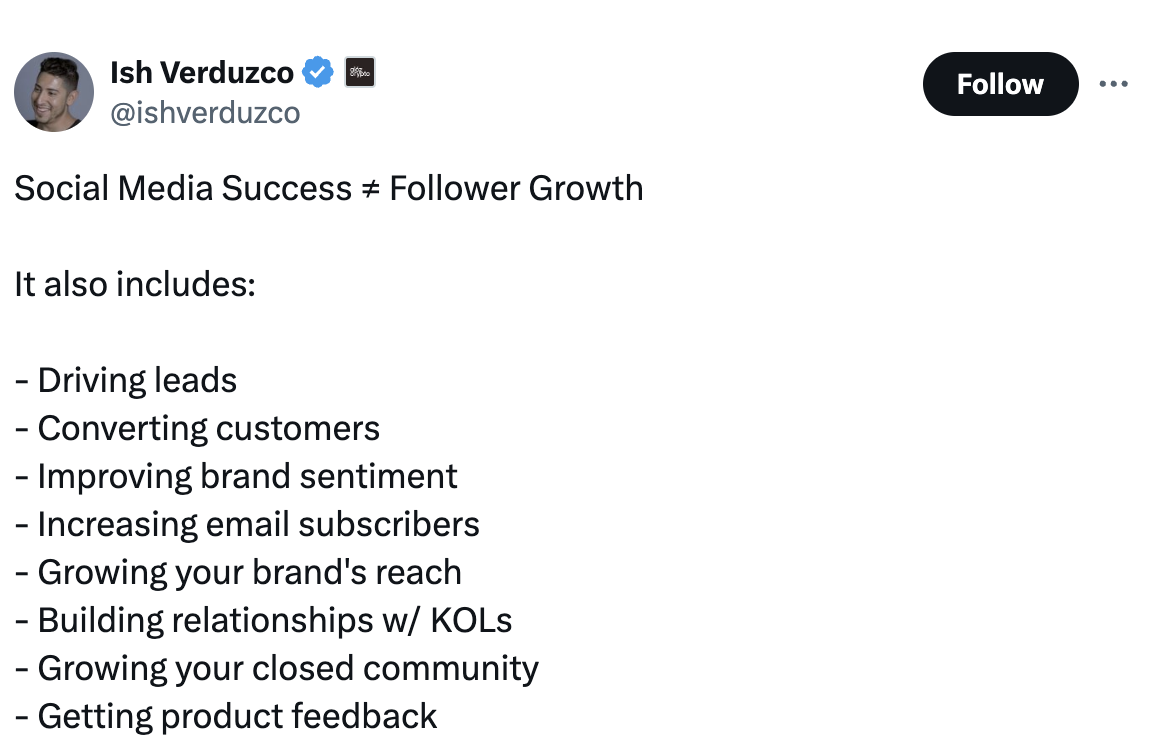
“Social media success ≠ follower growth
It also includes:
- Generating leads
- Converting customers
- Improving brand sentiment
- Growing email subscribers
- Expanding brand reach
- Building relationships with KOLs
- Growing your closed community
- Gathering product feedback”
There are two fundamental and complementary ways to measure social post success:
-
Qualitative: Measuring sentiment (how people feel about your company/brand). Includes feedback, replies, questions, quote tweets, mentions, and DMs.
-
Quantitative: Measuring growth. Includes engagement, impressions, reach, shares, conversions, followers, and referrals.
For most founders, quantitative data is clearly valuable—like product metrics, tracking audience growth, shares, and likes is straightforward. Qualitative feedback, however, is harder to assess—but it’s one of the best indicators of how (and which) people connect with your brand.
First, let’s review basic quantitative metrics.
Quantitative Data
When starting out, basic in-app analytics tools (Twitter Analytics, LinkedIn Analytics, etc.) provide all the data needed. Professional tools like Sprout Social or HubSpot can help schedule posts but may be overly complex for advanced analysis. Regardless of the tool, here are key starting metrics:
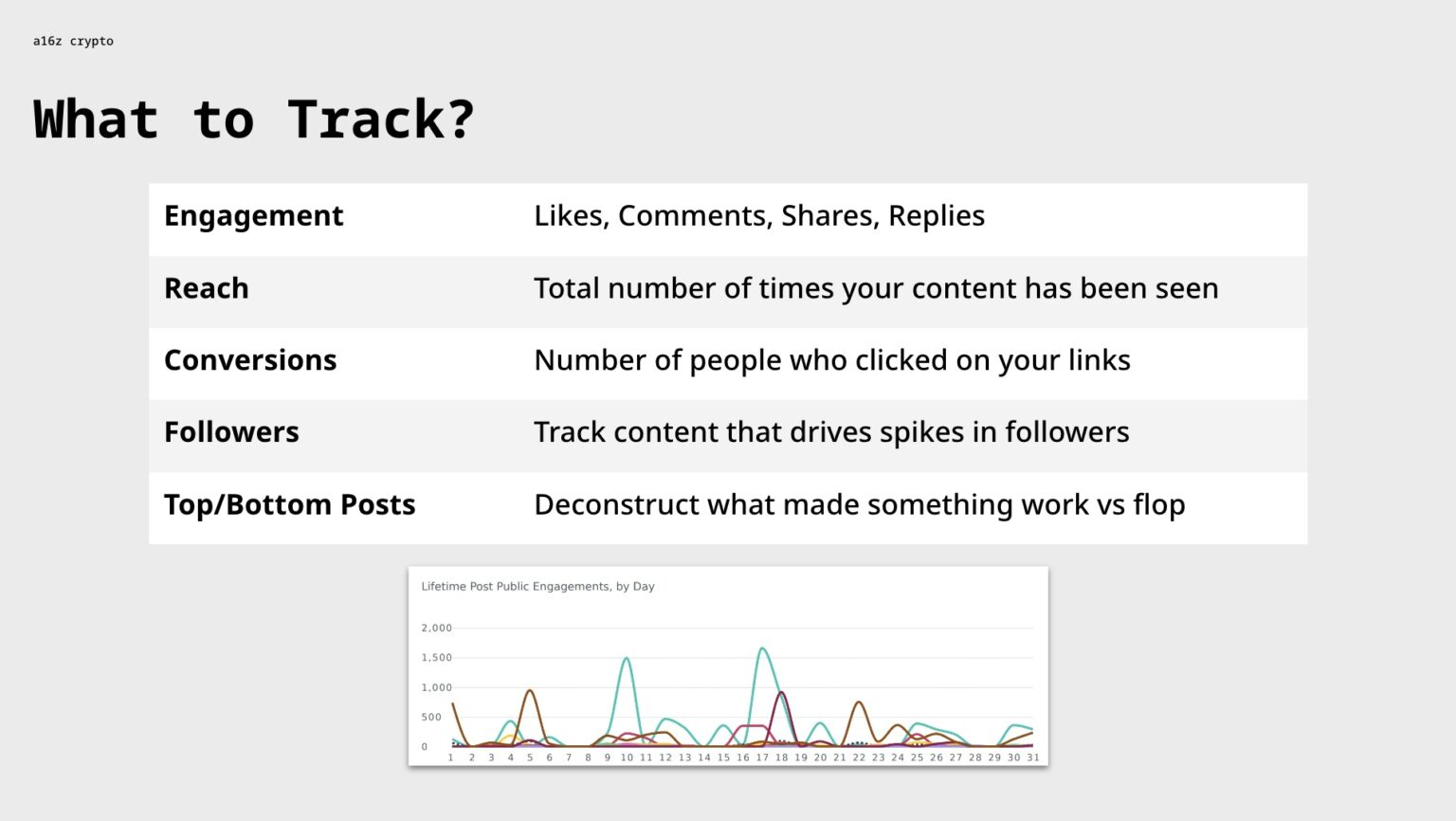
Engagement
Engagement is often the most important qualitative proxy. Higher engagement increases content impressions—the number of times users see your content—which in turn boosts profile visits, follower growth, and more.
Most analytics tools, including native ones, offer formulas to quantify engagement, typically expressed as Total Interactions / Total Followers or Impressions x 100, though this varies by platform. The exact formula matters less than using a consistent benchmark—avoid mixing different evaluation methods.
A powerful way to use in-app analytics is reviewing your top- and bottom-performing posts over the past 30–60 days, sorted chronologically, to analyze why they succeeded or failed.
You might discover certain memes perform exceptionally well, blog-linked posts receive no clicks, or specific topics spark or suppress engagement. Over time, tracking this data helps clarify what your audience expects from a given channel.
Weekly tracking of total shares, replies, and retweets is also helpful. Don’t obsess over precise numbers—focus instead on trends. For example, sustained upward movement means more people are seeing your content, expanding its reach and exposing it to more potential followers.
Conversion Rate
If a team has a product in market, another key metric is conversion rate—the number of people clicking from a social post to your product site, newsletter, podcast, etc.
Teams can use Google Analytics, UTM links, and other tools to track conversions from organic posts (vs. paid ads), from click to sign-up or purchase. But in early stages, this level of granularity is often optional, not essential.
Audience
Understanding which content drives spikes in follower count is more valuable than merely tracking total followers. If a specific post type reliably attracts a particular audience segment, that’s highly actionable insight. As mentioned earlier, analyzing top- and bottom-performing posts to understand what made them succeed or fail is also wise.
Follower growth indicates your account is reaching more people, but it doesn’t reveal whether you’re reaching the *right* people. That’s where qualitative data becomes critical.
Qualitative Data
Don’t overlook qualitative data. In fact, spending time interpreting qualitative social signals may be more valuable than quantitative metrics—though this mindset can be hard for data-driven founders to embrace.
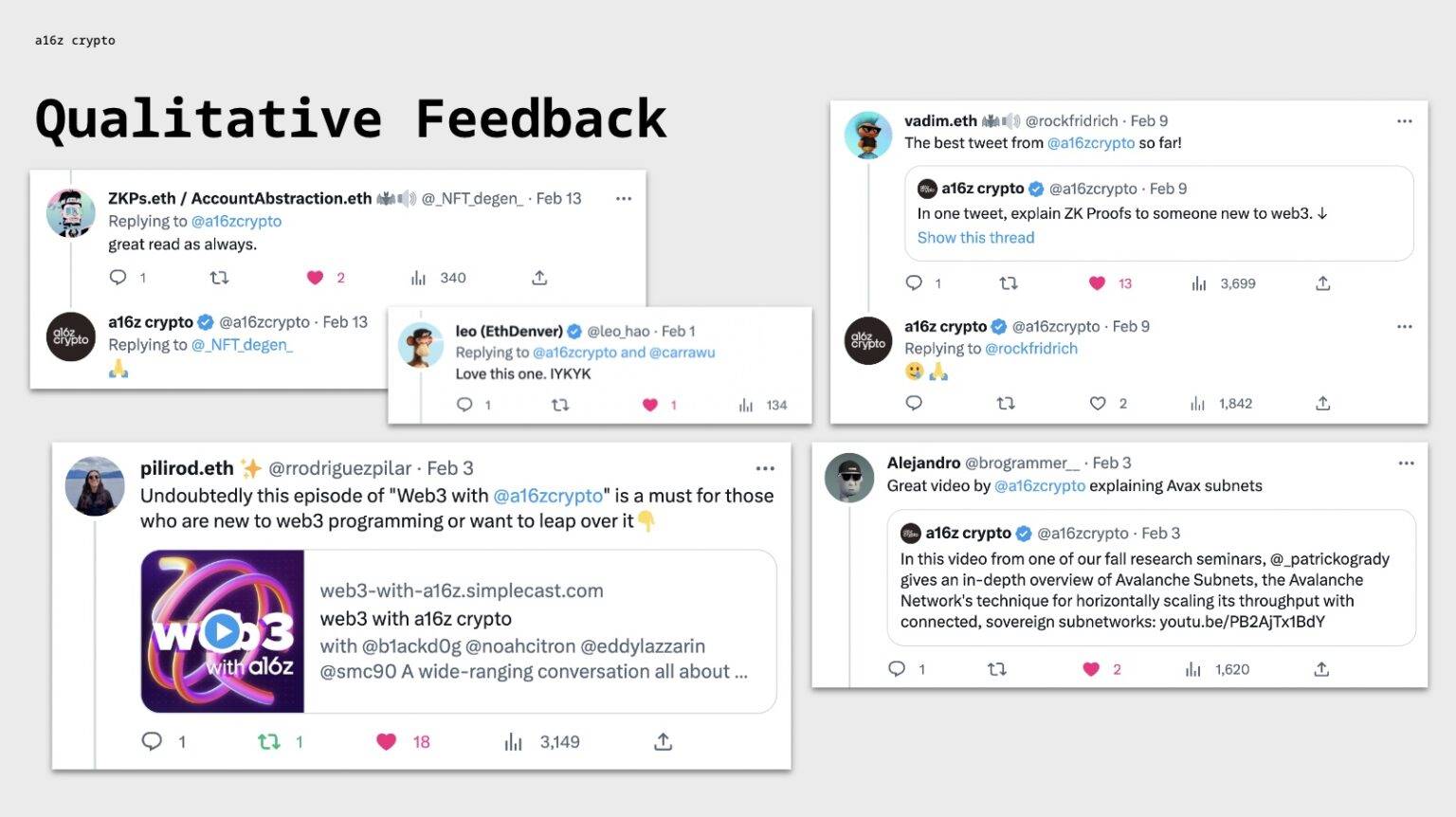
For instance, countless businesses rely on “influencers” to spread messages. A share from someone with a wide, trusted network often carries more weight than hundreds of shares from smaller accounts. Just as connecting with high-quality leads drives business growth more than reaching people with no need for your product, asking “Are we reaching the right people?” is as important (if not more) as “Are we reaching more people?” when evaluating follower growth.
The challenge with extracting actionable insights from qualitative data is that it’s more art than science. The best method—at least initially—is manual analysis. While various sentiment analysis tools exist, they’re not fully accurate. The goal is to identify recurring themes in messages and DMs, paying close attention to word choice—positive, negative, or neutral—and track these over time.
All this material helps companies understand public perception—critical for improving customer service, identifying product gaps, and even finding product-market fit.
Qualitative vs. Quantitative
Each measurement strategy should be evaluated from multiple angles. Overreliance on a single metric can distort your understanding of post performance and may create harmful long-term incentives for your social strategy. A familiar example is overemphasizing views and impressions. Posts with the highest view counts (often clickbait) don’t necessarily contribute to building a beloved or trustworthy brand.
Instead, focus on a diverse mix of metrics. New teams don’t need to measure everything immediately, but should combine qualitative performance with broader volume metrics (like impressions) and quality indicators (like engagement and click-through rates). This basic framework offers a more accurate picture of post effectiveness.
The Challenge of Silent Supporters
One of the biggest hurdles in accurately gauging sentiment is the presence of “silent supporters”—people who consume your startup’s content without commenting or liking. Some follow closely but avoid interacting publicly for various reasons, such as discomfort expressing reactions on platforms like LinkedIn.
Don’t be discouraged by missing data. Content creators can try several approaches to encourage interaction and gain clearer insights:
-
Start conversations: Talk to those who engage and those who don’t. Ask for feedback to replicate what works and discard what doesn’t.
-
Host events: Run virtual or in-person events to deepen audience relationships (you may find followers become more openly supportive after attending).
-
Focus on community management: Try proactive outreach—e.g., interact daily with five different followers.
-
Test different post types: Sometimes people support you but dislike the format. Experiment with video vs. images, short vs. long content, or introduce new interactive formats like polls, Q&As, and AMAs (“Ask Me Anything”).
-
Don’t get discouraged: Social media success takes many forms—leads, email subscribers, brand sentiment, 1:1 relationship building, product feedback loops. Just because you’re not seeing desired engagement doesn’t mean your efforts aren’t making an impact.
As people grow overwhelmed by social media, creators must find new ways to measure influence (and devise creative strategies to keep audiences engaged).
Understanding the "Growth Flywheel"
There’s no magic trick to grow a company’s social account tenfold overnight. But over time, a sound social strategy creates a virtuous cycle: increased engagement leads to greater reach, attracting more followers, which in turn drives more engagement, and so on.
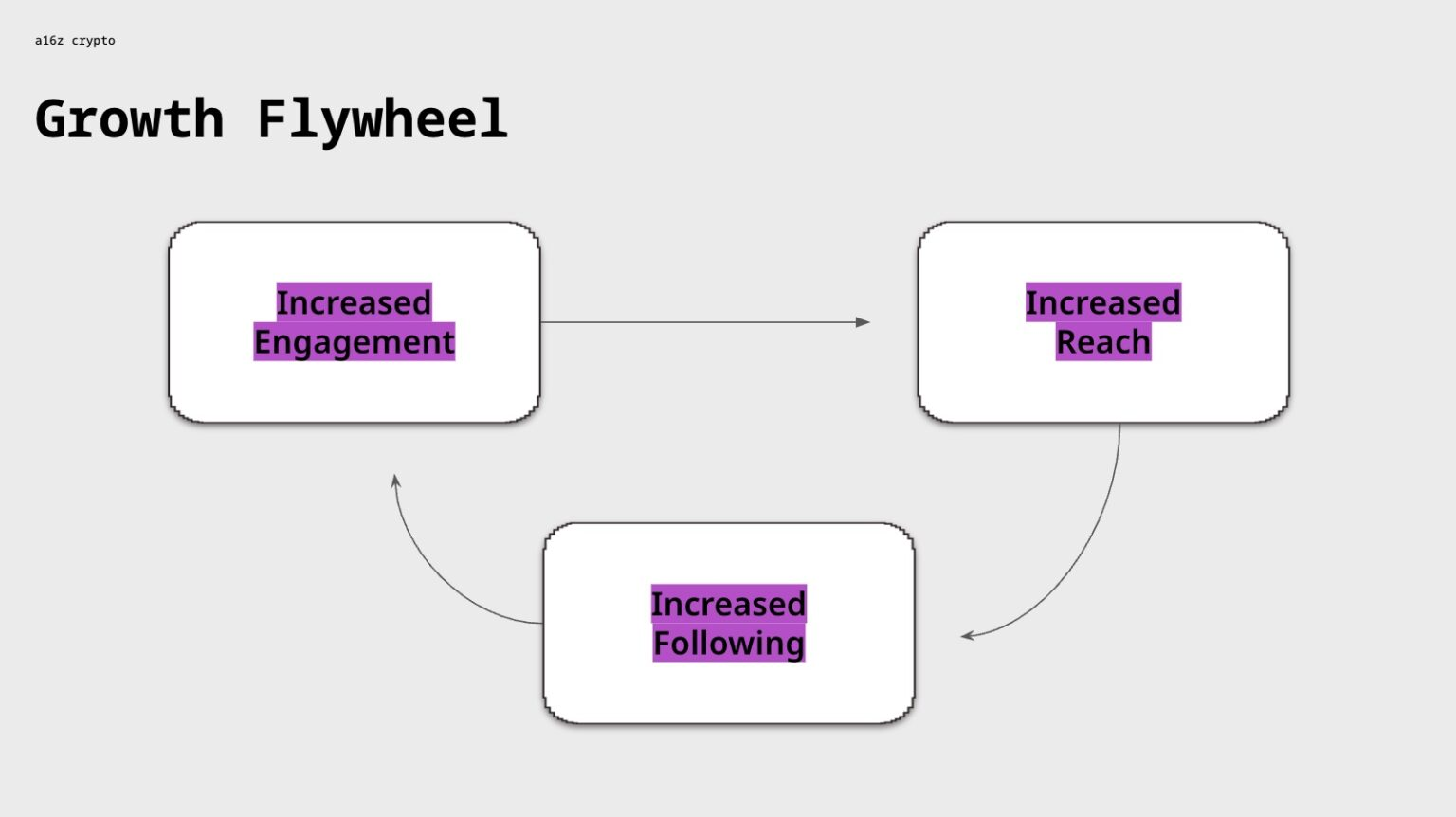
Here are several ways to accelerate this cycle:
-
Community management: Posting without responding to feedback misses huge growth opportunities. Replying to comments pushes your post higher in feeds and exposes it to more people. Every reply, like, or interaction expands your reach.
-
Encourage sharing and replies: Take community management further by creating discussion-friendly posts. Ask questions (“What’s your favorite crypto meme?”), curate lists (“10 Must-Know ZK Resources”), or solicit input (“How would you explain web3 to someone unfamiliar with crypto?”).
-
Maintain a distinct voice: This is why a founder’s personal account shouldn’t mirror the company account exactly in tone or topic. Differentiation gives people a reason to follow both.
-
Cross-platform promotion: Leverage your audience on one platform (e.g., Discord) to follow your account on another (e.g., newsletter). Simple.
-
Minimize external links: Since platforms want to keep users in-app, algorithms often deprioritize posts with external links. One workaround is sharing screenshots of the content. “Link in bio” is another common workaround.
-
Avoid relying on AI: One of the biggest mistakes we see is fully outsourcing social presence to AI. AI-driven accounts lose too much context and personality. To many, it’s obvious the account isn’t human-run—leading to distrust, low engagement, and awkwardness.

The bottom line? Be helpful, focus on your niche, and—especially at the start—limit yourself to two platforms. Over time, your audience will grow.
Social media can feel like a side hustle for founders juggling multiple responsibilities. The good news is that starting small benefits both time management and growth. With smart prioritization, even small teams can build compelling social presences—and maybe even have a little fun along the way.
Join TechFlow official community to stay tuned
Telegram:https://t.me/TechFlowDaily
X (Twitter):https://x.com/TechFlowPost
X (Twitter) EN:https://x.com/BlockFlow_News
 a16z
a16z


