








Wang Yang / Bai Liang / Jiang Zhaosheng: Hong Kong Dollar Stablecoins Are Just the Beginning—RWA Is the "Answer" for Hong Kong's Web3
TechFlow Selected TechFlow Selected
Wang Yang / Bai Liang / Jiang Zhaosheng: Hong Kong Dollar Stablecoins Are Just the Beginning—RWA Is the "Answer" for Hong Kong's Web3
The biggest challenge facing stablecoins in Hong Kong at this stage is not who should issue them, but who should use them. Identifying suitable use cases and business models is key to the sustainable development of Hong Kong's stablecoins.
 Navigating Web3 tides with focused insights
OKLink Research senior researcher Jiang Zhaosheng recently co-authored an article with Vincent Wong, Vice President of the Hong Kong University of Science and Technology and Chief Scientific Advisor of Hong Kong Web3.0 Association, and Bai Liang, Founder and CEO of ZeroOne ThinkTank, published in Ta Kung Pao — "Web3.0 Insights / Issuing HKD-Backed Stablecoins to Build a New Web3.0 Ecosystem." The article proposes that Hong Kong's stablecoin development should focus on the RWA (Real World Assets) ecosystem, emphasizing openness, integration, and security in the relationship between stablecoins and RWAs. It states that the biggest challenge for Hong Kong stablecoins today is not who issues them, but who uses them—identifying suitable use cases and business models is key to their sustainable development. Reissuing USD-backed stablecoins in Hong Kong around virtual asset trading needs offers little value. Institutions must dive deeper into the Web3 ecosystem and explore more innovation on the asset side, positioning RWA as the core focus area for stablecoins at this stage.
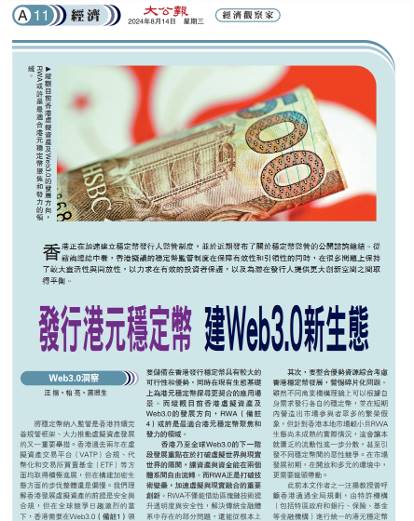
The article also notes that beyond establishing appropriate regulatory frameworks, relevant institutions should leverage regtech to empower the ecosystem, using various technical tools to enhance issuers’ and regulators’ abilities to prevent and respond to potential risks associated with stablecoins. Only safe and compliant stablecoins can lay a solid foundation for building an open, orderly, and vibrant tokenized RWA ecosystem in Hong Kong, significantly strengthening its capabilities and standing in digital economy and fintech.
The full text is as follows:
Hong Kong is accelerating the establishment of a regulatory regime for stablecoin issuers and has recently released a consultation conclusion paper on stablecoin regulation. According to the summary, Hong Kong’s proposed stablecoin regulatory framework maintains considerable flexibility and openness while ensuring effectiveness and leadership, aiming to strike a balance between robust investor protection and providing ample room for innovation among potential issuers.
Bringing stablecoins under regulation marks another significant step by Hong Kong in refining its regulatory framework and advancing virtual asset development. Over the past two years, Hong Kong has made positive progress in VATP compliance, tokenization, and ETFs. However, its overall pace in building a crypto ecosystem remains relatively slow. While we understand that safety and compliance are prerequisites for Hong Kong’s virtual asset development, amid intensifying global competition, Hong Kong must accelerate its deployment in the Web3 space—not only exploring compliance in financial transactions but also delving deeply into the Web3 ecosystem and driving more innovation from the asset side.
The introduction of a stablecoin regulatory framework presents Hong Kong with a new opportunity—to accelerate RWA and tokenization initiatives within a compliant environment. This could inject greater innovation and vitality into Hong Kong’s virtual asset ecosystem, helping it gain real influence in the global Web3 landscape.
1. Hong Kong Stablecoins Should Focus on the RWA Ecosystem
After the release of the consultation summary, industry attention has centered on whether Hong Kong can attract international issuers of USDT/USDC. Based on available information, Hong Kong’s proposed regulatory framework appears friendly toward international issuers, showing increased openness compared to earlier proposals and reducing potential burdens. For instance, the consultation document does not restrict the types of fiat currencies that can back stablecoins and remains open to holding reserve assets overseas. Given Hong Kong’s policy consistency and attractiveness in virtual assets, along with its importance in global financial markets, Hong Kong’s stablecoin licenses are likely to be appealing to international players.
Considering that fiat-to-crypto on-ramps represent one of the most valuable and high-potential scenarios in the crypto ecosystem—and that stablecoins are currently essential infrastructure for these connections—we believe more financial institutions and tech companies will participate in issuing stablecoins in Hong Kong. Yet, the biggest challenge facing Hong Kong stablecoins is not who issues them, but who uses them. Finding appropriate use cases and viable business models is the key to their success.
Global virtual asset compliance is an inevitable trend. However, current practices show that mere regulatory compliance does not necessarily accelerate development—in fact, it often imposes heavy costs on virtual asset firms, evident in the widespread operating losses among licensed exchanges after obtaining licenses. As more jurisdictions bring virtual assets under regulation, the compliance burden for enterprises continues to rise. Compliance should serve development; if both businesses and regulators pursue compliance merely for compliance’s sake, it contradicts market principles. Both licensed virtual asset exchanges and stablecoin issuers need to explore commercially viable models within the compliance framework.
However, reissuing USD-backed stablecoins in Hong Kong focused solely on virtual asset trading has limited significance at this stage. USD stablecoins already dominate the crypto market with a mature and entrenched structure—leaders like USDT and USDC are unlikely to be challenged in the short term. Without strong underlying use cases, simply replicating existing USD stablecoin business models would make it difficult for Hong Kong to gain a competitive edge. Therefore, issuing stablecoins backed primarily by HKD-denominated assets is both feasible and advantageous. Building on the existing ecosystem, Hong Kong should identify more suitable applications for HKD stablecoins. Considering Hong Kong’s current direction in virtual assets and Web3, RWA stands out as the most promising field for HKD stablecoins to focus on.
The next phase of Web3 development globally—and in Hong Kong—lies in breaking down barriers between the virtual and real worlds, enabling free flow of assets and capital across both systems. RWA represents a critical innovation for overcoming technological divides and accelerating convergence between physical and digital realms. By leveraging blockchain technology, RWA enhances transparency and security, addresses certain inefficiencies in traditional finance, unlocks dormant real-world assets, lowers investment thresholds, attracts broader participation from small and medium investors, and ultimately injects greater liquidity into real industries and the digital economy.
As a global trade hub and financial center, Hong Kong enjoys unparalleled advantages and vast market demand in the RWA space, having accumulated rich practical experience—most notably exemplified by the government-issued tokenized green bonds. Only by focusing on the broader tokenized market and promoting wider tokenization of real-world assets can Hong Kong gradually build a compliant, rational, and supportive RWA ecosystem to truly lead global Web3 advancement.
Yet building an RWA ecosystem requires not just capital, technology, and regulation, but also new digital infrastructure capable of handling the liquidity unleashed through digitization and tokenization. HKD stablecoins serve precisely this role. In the foreseeable future, the majority of RWA transactions in Hong Kong will likely be settled via compliant HKD stablecoins, which will also act as bridges connecting traditional finance with the digital world. Without compliant HKD stablecoins, Hong Kong’s RWA initiatives would face major challenges in terms of convenience and security. Thus, the rollout of a stablecoin regulatory framework may lay the groundwork for innovative RWA development in Hong Kong, and as the RWA ecosystem thrives, the role and value of HKD stablecoins as Hong Kong’s bridge to the global Web3 network will become increasingly prominent.
Even in the short term, using HKD stablecoins as liquidity vehicles to build an RWA ecosystem can provide clear development pathways for HKD stablecoins, create new business models within Hong Kong’s Web3 ecosystem, and ensure that the capital, traffic, and talent generated by Web3 innovations remain anchored in Hong Kong.
2. How to Build a HKD Stablecoin Aligned with the RWA Ecosystem?
Once RWA is established as the primary use case for Hong Kong stablecoins, the next question becomes how to design a HKD stablecoin that effectively serves the RWA ecosystem. Beyond basic requirements, openness, integration, and security will be pivotal in determining whether such a stablecoin can meet the needs of the RWA ecosystem.
First, HKD stablecoins must possess sufficient openness. Although denominated in HKD, their issuance and operation should extend beyond Hong Kong’s local market, strengthening connections with the Greater Bay Area and international markets, thereby facilitating the entry of high-quality assets via RWA tokenization. While Hong Kong is currently one of the most active regions in Web3 and virtual asset innovation, it must be acknowledged that the local market is physically very small. Focusing solely on domestic demand yields little value. The reason global attention turns to Hong Kong lies largely in the vast market opportunities behind it. Therefore, when planning HKD stablecoins and RWA strategies, we should use Hong Kong as a base and boldly expand outward. A theoretically viable approach would be to follow the model of Hong Kong stocks—leveraging the abundant real-world assets and trade demands of the Greater Bay Area and mainland China to drive RWA ecosystem growth, while using compliant HKD stablecoins to establish blockchain-based token trading systems and rules that attract more international assets and capital into Hong Kong.
Second, resources should be integrated strategically to avoid fragmentation. While commercial entities could theoretically issue their own stablecoins based on individual needs—creating a superficial impression of market vibrancy—the reality of Hong Kong’s small domestic market and immature RWA ecosystem means such fragmentation would further disperse already limited liquidity and potentially trigger cutthroat competition among different stablecoins. In the early stages of market development, even within open and diverse environments, leadership is crucial.
Professor Vincent Wong, one of the authors of this article, previously advocated that Hong Kong could adopt comprehensive planning to enable designated institutions—including government bodies and financial institutions such as banks, insurers, and funds—to jointly issue a unified HKD stablecoin, supported by a shared profit distribution mechanism. This would allow the stablecoin to rapidly evolve into a trusted, widely adopted financial product driven collectively by multiple organizations, laying a solid foundation for Hong Kong’s overall RWA ecosystem. This proposal remains highly relevant today. Within the current regulatory framework, consolidating financial strengths and resources to foster leading stablecoin projects can catalyze broader diversity and competition, allowing niche advantages to emerge and flourish within an increasingly vibrant RWA ecosystem.
Finally, risk management must be prioritized to enhance the security of HKD stablecoins. A United Nations report previously highlighted that stablecoins have become one of the preferred payment methods for money laundering and fraud in Southeast Asia. The "Global Virtual Currency Crime Landscape and Security Governance White Paper," jointly released by OKLink Research and the Key Laboratory of Information Cybersecurity, Ministry of Public Security’s Third Research Institute, also found that over 60% of virtual asset-related risk incidents involve stablecoins. While regulated stablecoin issuers offer better safeguards, many illegal financial activities, money laundering, and terrorist financing linked to stablecoins occur independently of the issuer—and even when issuers are identified, resolving these issues remains challenging. Therefore, beyond appropriate regulation, relevant institutions should employ regtech to empower the ecosystem, using advanced technologies to strengthen the ability of both issuers and regulators to anticipate and mitigate risks associated with HKD stablecoins. Only secure and compliant HKD stablecoins can lay a solid foundation for an open, structured, and dynamic tokenized RWA ecosystem in Hong Kong, significantly boosting its strength and competitiveness in the digital economy and fintech sectors.
The authors are: Vincent Wong, Vice President of the Hong Kong University of Science and Technology, Chief Scientist of Hong Kong Web3.0 Association
Bai Liang, Founder & CEO of ZeroOne ThinkTank
Jiang Zhaosheng, Senior Researcher at OKLink Research
Join TechFlow official community to stay tuned
Telegram:https://t.me/TechFlowDaily
X (Twitter):https://x.com/TechFlowPost
X (Twitter) EN:https://x.com/BlockFlow_News
 @OKGResearch









