









How to have endless money?
TechFlow Selected TechFlow Selected
How to have endless money?
Bitcoin + Soft Liquidation: The Best "Lying Flat" Strategy?
 Navigating Web3 tides with focused insights
By Alex Liu, Foresight News

Disclaimer: The views expressed in this article are valid only under certain conditions and contexts.
-
Unlimited money: Without the need for labor, disposable fiat currency gradually increases over time.
-
Prerequisites:
-
The logic of Bitcoin as "digital gold" serving as an inflation hedge holds true in the long term—despite price volatility, Bitcoin will appreciate against fiat currencies over extended periods.
-
No black swan events that fundamentally alter societal operations occur.
Unlimited Money
When people think of "spending money," the default idea remains spending fiat currency. The author would still message their boss: "It's Crazy Thursday tomorrow, can you Venmo me 50?" rather than "It's Crazy Thursday tomorrow, can you Venmo me 50 BTC?"—partly out of fear of getting beaten up, and partly because KFC in China doesn't actually accept BTC payments yet.
The narrative of Bitcoin as "digital cash" has not succeeded. Someone once asked Michael Saylor, the well-known Bitcoin maximalist and CEO of MicroStrategy: "Why don’t many people use a little Bitcoin to buy a cup of coffee?" Saylor replied: "If you owned a building, would you trade a corner of it for a cup of coffee?" That’s somewhat sophistry. Simply holding Bitcoin does make daily spending inconvenient.
However, the narrative of BTC as "digital gold"—a store of value asset—has not been disproven. Through Bitcoin, we might truly achieve "unlimited money": if its inflation-hedging logic holds over the long term, it will inevitably appreciate against fiat currencies. By simply holding BTC, its equivalent fiat value will gradually rise over time. No labor required—just lie back and relax.
But earlier we said spending Bitcoin directly is inconvenient, and whether spent or sold, the amount of Bitcoin you hold will decrease. So how can it possibly be "unlimited"?
The answer is collateralized lending.
Collateralized Lending
If Asset A consistently appreciates against Asset B, then by pledging Asset A to borrow Asset B, one can theoretically keep borrowing more of Asset B indefinitely over time—without selling A or repaying B.
In practical terms, by collateralizing BTC to borrow fiat (or stablecoins like USDT or USDC), given that fiat currencies naturally suffer from over-issuance and long-term depreciation, BTC will gradually appreciate against them (the foundational assumption of this article). As this process unfolds, we can continuously draw more fiat, thereby increasing our disposable fiat funds over time without selling BTC or working—a scenario of "having unlimited money."
But here lies a problem: collateralized lending carries liquidation risk. While BTC's appreciation against fiat is a long-term trend, short-term price volatility remains significant—even excluding flash crashes, prices often swing 50% or even 70% from peak to trough within a single cycle.
Liquidation means being forced to sell BTC at a low price to repay debt, which breaks the "unlimited money" model. Moreover, due to extreme market volatility, a single candlestick might plunge below the liquidation price, triggering liquidation, only for the price to quickly rebound afterward—causing massive losses to the borrower.
One way to avoid liquidation is maintaining an extremely low LTV (Loan-to-Value), such as borrowing $300,000 against $1 million worth of BTC. This nearly eliminates liquidation risk from short-term fluctuations. But on one hand, there's no such thing as absolute safety; on the other, capital efficiency becomes unacceptably low.
So what should we do?
Soft Liquidation
We can use lending platforms with soft liquidation mechanisms to prevent losing our BTC positions due to short-term price swings. Take borrowing crvUSD against BTC collateral as an example:
In Curve Finance’s crvUSD product, collateral liquidation occurs via an AMM using a progressive, soft liquidation mechanism—the collateral is gradually liquidated as prices fall. Crucially, liquidations within the AMM are reversible: when collateral prices recover, the AMM automatically helps users buy back their assets.
Liquidation AMM
crvUSD implements soft liquidation through LLAMMA (Lending-Liquidating AMM Algorithm), designing a special AMM pool for collateral that enables gradual liquidation as asset prices decline. There are two key price levels: the start-of-liquidation price and the end-of-liquidation price. When the collateral value stays above the start-of-liquidation price, the AMM pool holds only the collateral. Once the price drops to the start level, the AMM begins selling collateral into stablecoins. As the price continues falling, more collateral is gradually sold. If the price falls below the end-of-liquidation level, the AMM pool holds only stablecoins.
The LLAMMA liquidation process can be understood as a "reverse Uniswap V3." Suppose the AMM handles the BTC-crvUSD trading pair. In Uniswap V3, liquidity providers (LPs) set price ranges. When BTC’s price is within the range, both tokens exist in the pool and can be swapped; outside the range, only one token remains—this mirrors LLAMMA’s design of start and end liquidation prices. When BTC is the collateral, above the range the pool contains only BTC; within the range, BTC is gradually converted to USD, as illustrated in the figure.
The difference from Uniswap V3 is that in Uni V3, higher BTC prices mean more USD in the pool, while in LLAMMA, lower BTC prices result in more USD, since BTC must be sold for liquidation. When BTC prices rise again, the system can rebuy BTC collateral, aiming to maintain the user’s original exposure.
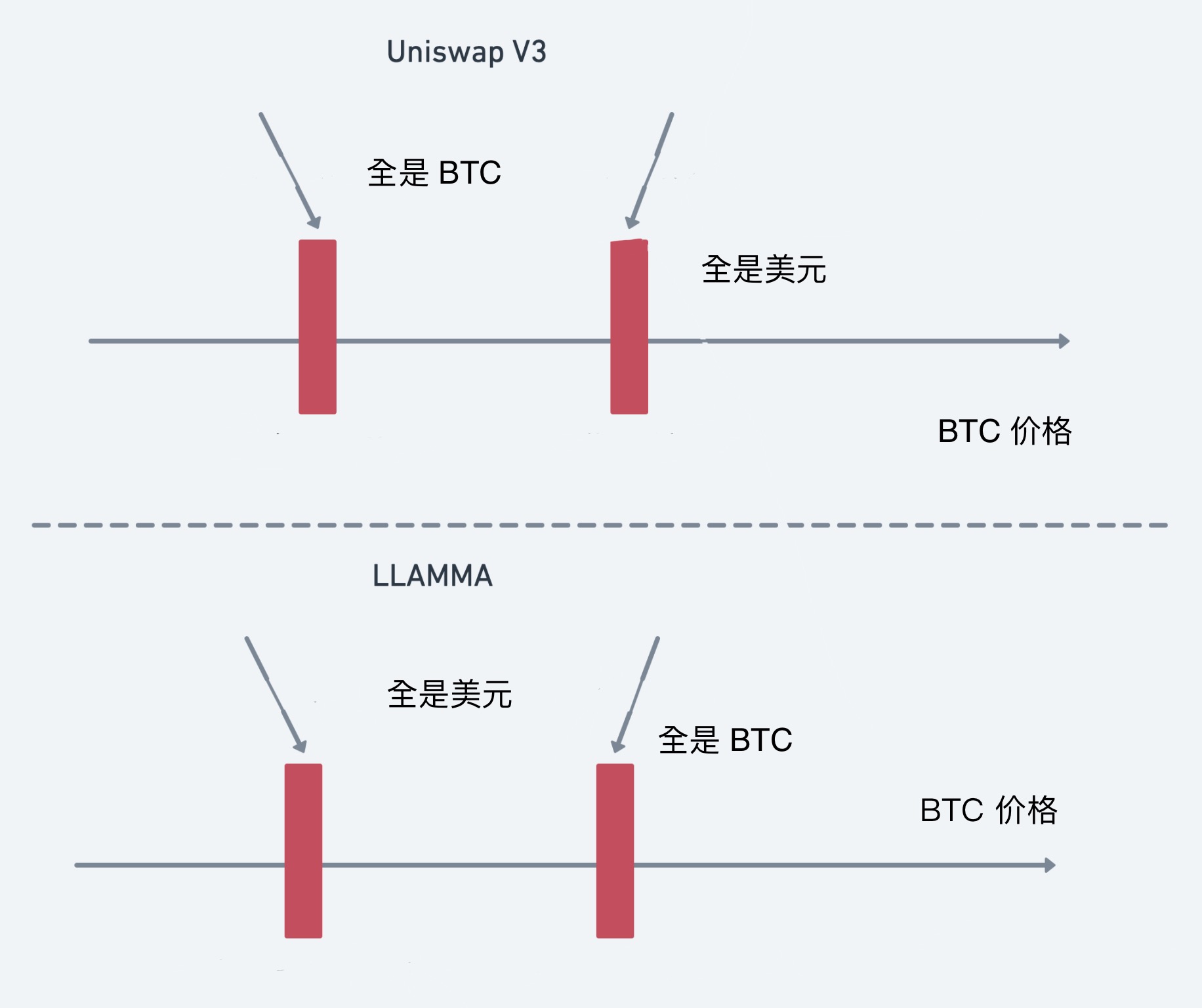
With soft liquidation, even if partial liquidation occurs, we’ll buy back the collateral at nearly the same price during recovery, preserving our position almost unchanged. And given the premise that Bitcoin appreciates against fiat currencies over the long term, any temporary liquidation will eventually reverse. (Soft liquidation is triggered by external arbitrageurs; borrowers incur minimal losses compared to hard liquidation, though frequent entry into the liquidation zone should be avoided.) This also reflects a philosophy opposite to Uniswap V3: LPs want prices to stay within ranges to earn fees, while borrowers want prices to stay outside to minimize losses.
The logic is now closed: by holding Bitcoin and using a soft liquidation-based lending strategy, we gain continuous cash flow during BTC’s appreciation, without selling Bitcoin or fearing that short-term volatility will ruin everything. With sufficient BTC holdings, disposable fiat currency increases over time without requiring labor. Isn’t this essentially achieving "unlimited money"?
Conclusion
This article introduces an investment and consumption strategy: maintaining your BTC position while generating steady cash flow through lending, highlighting the advantages of soft liquidation mechanisms. For those holding substantial BTC, this approach is practical—and may indeed be among the best paths to financial independence and effortless living. Yet the strategy has one flaw that keeps folks like the author from relaxing: it doesn’t say where exactly one can go to collect enough BTC to start lying flat in the first place…
So the author decided to push beyond limits, bravely picked up the phone, and messaged the boss: "It's Crazy Thursday tomorrow, can you Venmo me 50 BTC?" Result: instantly blocked.
Join TechFlow official community to stay tuned
Telegram:https://t.me/TechFlowDaily
X (Twitter):https://x.com/TechFlowPost
X (Twitter) EN:https://x.com/BlockFlow_News
 Foresight News









