









Revisiting Global Cryptocurrency Regulation with the World Economic Forum
TechFlow Selected TechFlow Selected
Revisiting Global Cryptocurrency Regulation with the World Economic Forum
Different jurisdictions do not have a unified definition, classification, or tax regime for the crypto-asset market, and participants in crypto transactions are frequently troubled by misunderstandings of relevant concepts and regulations.
 Navigating Web3 tides with focused insights
Author: Conrad Eliott
Translation: TaxDAO
The World Economic Forum (WEF) released a white paper titled "The Path to Crypto-Asset Regulation: A Global Approach" in May 2023. Since then, WEF has continuously updated its findings, tracking how different countries and economic regions are addressing the challenges posed by the introduction of cryptocurrencies.
1. Why does the WEF white paper recommend a global framework for regulating cryptocurrencies?
As data policy and blockchain expert Arushi Goel pointed out: "Regulating this ecosystem—crypto assets—is like walking a tightrope, just like some other emerging technologies—it requires a delicate balance between preventing harm, protecting users, and promoting innovation."
In recent years, the crypto industry and the transformative technology behind it have flourished. When the borderless nature of crypto assets conflicts with traditional socioeconomic orders, implementing a unified regulatory framework becomes necessary. However, this also presents numerous challenges.
2. Challenges Facing Global Cryptocurrency Regulation
There is no uniform definition, classification, or taxation system for the crypto asset market across different jurisdictions. Participants in crypto transactions often face confusion due to misunderstandings about relevant concepts and systems, and lack a thorough understanding of financial risks.
Arbitrage refers to the practice of buying cryptocurrency from one entity and almost immediately selling it to another. The goal is to profit from marginal price differences between jurisdictions that have developed their financial frameworks independently under different regulations. Naturally, this poses a headache for regulators across jurisdictions, who must apply varying tax laws and legislative standards to such transactions. This further hinders the development of cohesive regulation across the crypto ecosystem.
Inadequate coordination among multiple enforcement agencies impedes oversight and management of the crypto industry, obstructing the establishment of a coherent and consistent regulatory framework.
3. Progress Made Since the Release of the WEF White Paper
In response to these challenges, some countries and regions have attempted to develop crypto asset regulatory frameworks, achieving varying degrees of success. See the figure below for details.
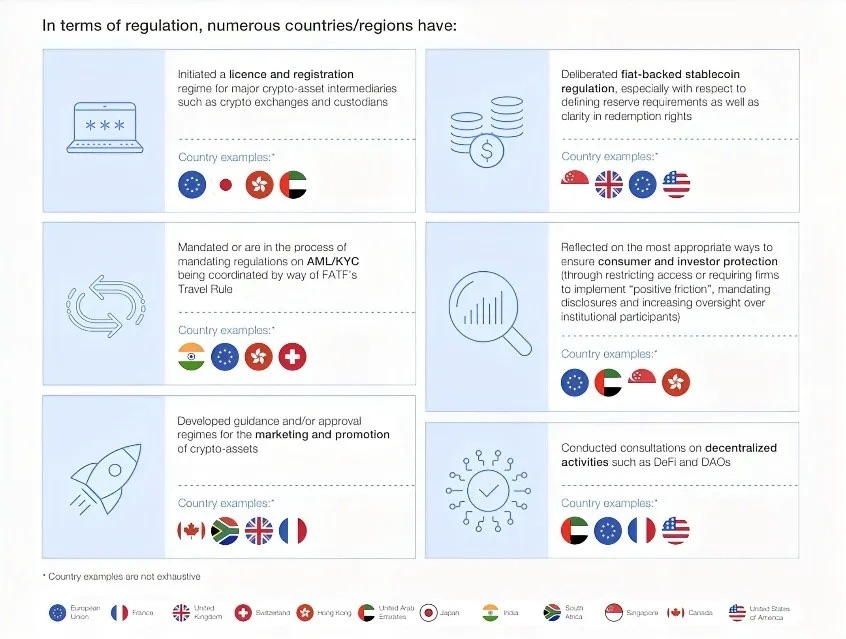
4. Regions Where Cryptocurrency Regulation Has Advanced
The World Economic Forum notes that since the release of the white paper, the following changes have occurred in crypto regulation across various countries and regions:
4.1 Changes in U.S. Cryptocurrency Regulation
Although the WEF points out that progress on U.S. crypto regulation has currently stalled, the following achievements have been made:
-
The Blockchain Regulatory Certainty Act began evaluation by the House Committee in July 2023 and was published in September 2023.
-
The U.S. House of Representatives passed the Financial Innovation and Technology for the 21st Century Act (FIT21) in May 2024.
4.2 Changes in EU Cryptocurrency Regulation
-
The European Union began introducing MiCA in June 2023, becoming the first economic region to establish and implement a comprehensive cryptocurrency regulatory framework.
-
The European Securities and Markets Authority (ESMA), the EU's supervisory and regulatory body, concluded a three-month public consultation on MiCA implementation by the end of April 2024.
-
The EU expects to fully integrate MiCA into its crypto regulatory framework by December 2024. Starting January 2026, all cryptocurrency transaction service providers will be required to verify and disclose the identities of the originating sender and the beneficiary recipient of every transaction, regardless of amount.
4.3 Changes in UK Cryptocurrency Regulation
-
Entities wishing to conduct cryptocurrency transactions must register with the UK Financial Conduct Authority (FCA), while the Bank of England (BoE) has taken a firm stance on stablecoin regulation.
-
The Bank of England believes this new regulation will bring greater convenience to UK consumers while preventing financial crimes.
4.4 Changes in Asian Cryptocurrency Regulation
Countries in Asia have adopted diverse approaches to cryptocurrency regulation:
-
Japan recognizes cryptocurrencies as legal tender and recently introduced exchange trading identification rules aimed at combating money laundering.
-
South Korea passed the Virtual Asset User Protection Act, aiming to make cryptocurrency trading safer. The law took effect on July 19, 2024.
-
India lifted its ban on cryptocurrency trading in 2020, but regulatory progress has since stagnated. However, India’s Cryptocurrency and Official Digital Currency Regulation Bill shows promising prospects.
Meanwhile, in South America, Brazil implemented cryptocurrency regulations in June 2023.
Join TechFlow official community to stay tuned
Telegram:https://t.me/TechFlowDaily
X (Twitter):https://x.com/TechFlowPost
X (Twitter) EN:https://x.com/BlockFlow_News
 @CrystalPlatform









