








Understanding Vessel Finance: Backed by Sequoia and Other Prominent Institutions with $10 Million, What Makes This ZK-Powered DEX Stand Out?
TechFlow Selected TechFlow Selected
Understanding Vessel Finance: Backed by Sequoia and Other Prominent Institutions with $10 Million, What Makes This ZK-Powered DEX Stand Out?
In a market where numerous DEXs already exist, why is there still a need for another new trading platform like Vessel?
 Navigating Web3 tides with focused insights
By TechFlow
Trading is the pulse of the entire crypto world, and the DEX sector—supporting trading demand—always welcomes new players.
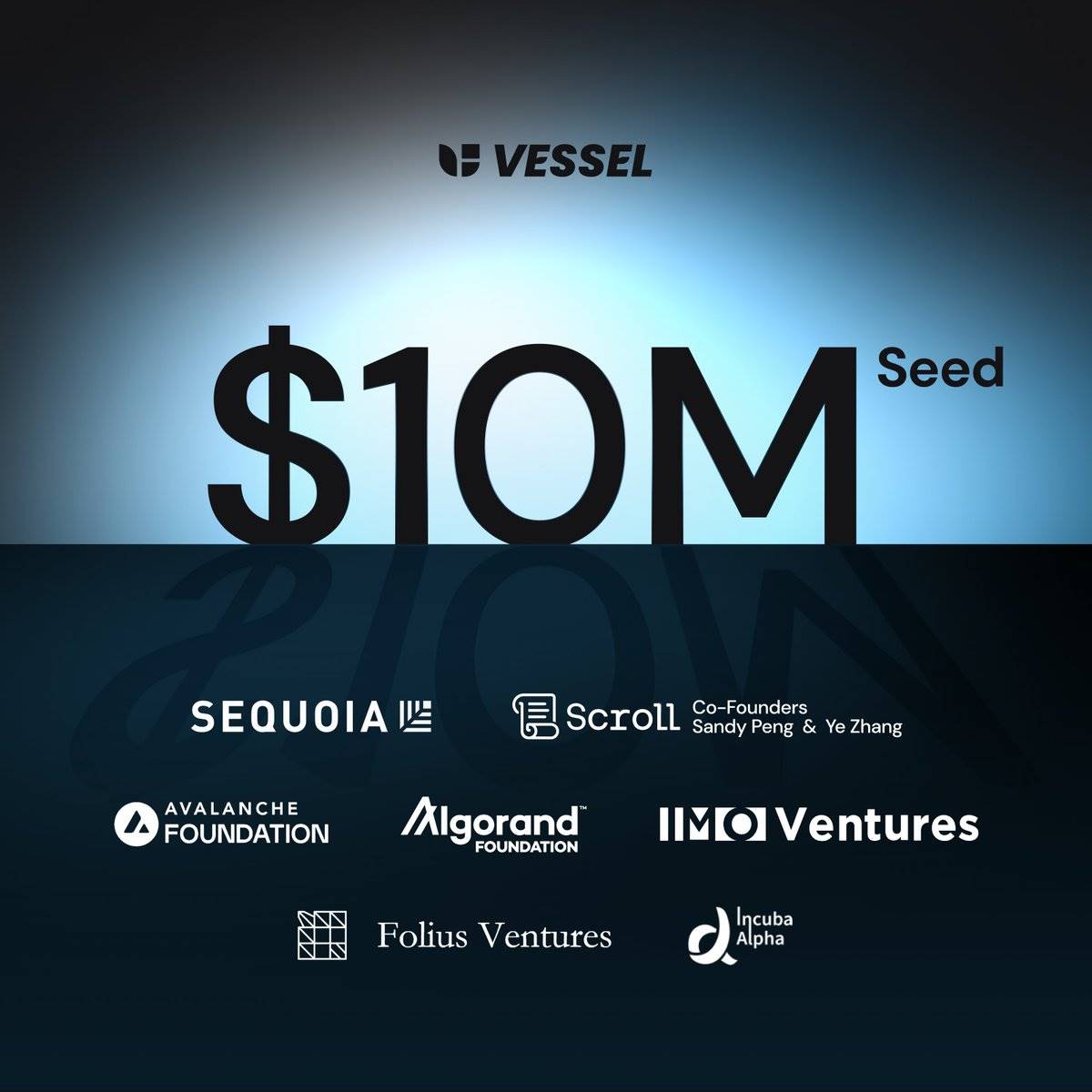
On August 8, ZK-powered DEX Vessel Finance announced it had raised $10 million in funding, with participation from Sequoia Capital, Scroll co-founders Sandy Peng and Ye Zhang, Avalanche Foundation, Algorand Foundation, IMO Ventures, Folius Ventures, Incuba Alpha, and a group of angel investors.
Data from DefiLlama shows the current DEX landscape is highly crowded, with over 1,000 DEXs large and small, and more than 20 boasting TVL exceeding $100 million.
In such a competitive environment, how does Vessel Finance stand out? ZK technology is typically used in infrastructure projects—what advantages can it bring when applied to a DEX?
Why Do We Need Another DEX?
In a market already saturated with DEXs, why do we need another trading platform like Vessel?
To answer this, we must examine the current state and limitations of the DEX ecosystem.
Limitations of existing DEXs:
-
Performance bottlenecks:
Most DEXs today are built on major public chains like Ethereum, constrained by the underlying blockchain's processing capacity. Although Layer 2 solutions have significantly improved transaction speed, certain L2s may still face scalability bottlenecks as user and transaction volume grows.
-
Fees and scalability issues:
Layer 2 has indeed greatly reduced gas fees, but the ecosystem still faces challenges. Fragmentation across L2s leads to dispersed liquidity and user bases. Cross-chain interactions may still incur high costs and delays, while inconsistent user experiences across different L2s increase learning curves.
-
Liquidity fragmentation:
Liquidity is not only scattered across different DEX platforms but also fragmented across various L2 networks. This dispersion can lead to significant slippage, affecting trading efficiency and pricing—especially impactful for large traders.
-
Poor user experience:
Compared to centralized exchanges (CEX), many DEXs have complex interfaces and cumbersome operation flows. For non-technical users, using a DEX can present a high barrier to entry.
Faced with these persistent challenges, Vessel proposes an ambitious vision: not only to solve problems faced by current DEXs (including those built on L2s), but also to deliver a more comprehensive and efficient solution for the entire DeFi ecosystem—one that combines the strengths of both CEX and DEX.
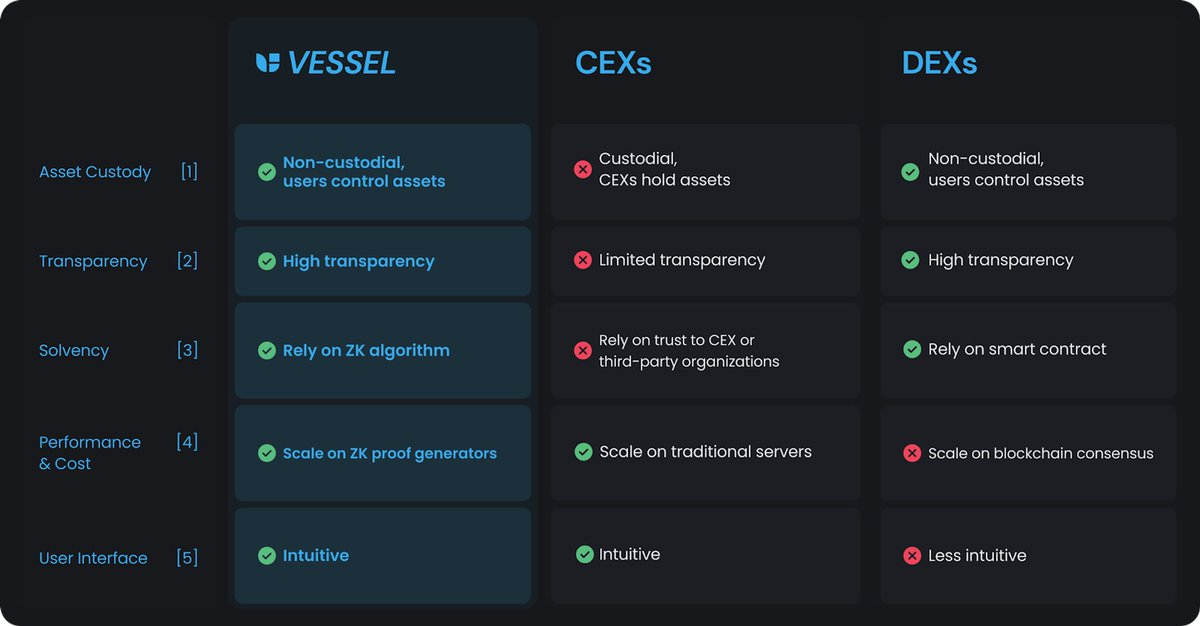
Vessel’s general strategy includes:
-
Building a unified Layer 3 platform, aiming to integrate the strengths of different L2s and provide users with a one-stop trading environment.
-
Leveraging L3 and ZK to reduce transaction costs below those of existing L2 solutions.
-
Improving scalability and liquidity aggregation by pooling liquidity from multiple sources to offer better price discovery and lower slippage.
-
Adopting the usability essence of CEXs to deliver a unified, intuitive user interface.
Core Workflow of Vessel Finance
From a technical perspective, the Vessel protocol can be viewed as a state machine, composed of user states (accounts, orders, balances, etc.) and system states (timestamps, price oracles, etc.).
Whenever a user submits a request, the system performs a series of operations to update specific elements of the current state.
Hard to understand? Think of Vessel as a bank vault system—each trade corresponds to a "state update" of this "bank vault." This update includes changes in user balances, order status, or even minor market price fluctuations.
In traditional blockchain systems, each such small update must occur on-chain, leading to high gas fees and slow processing speeds. But in Vessel, these state updates are efficiently completed off-chain and then verified on-chain via zero-knowledge (ZK) proof technology.
For example, suppose the system processes 10,000 similar transactions within five minutes. At the end of this period, Vessel generates a ZK proof that can convince anyone: "Within these five minutes, 10,000 valid transactions occurred, and the final system state is correct." This proof can be quickly verified on-chain, greatly enhancing system efficiency and scalability.
Specifically, Vessel’s workflow involves three main components: Sequencer, Prover, and Smart Contract. These three components work together step by step to complete the process described above.
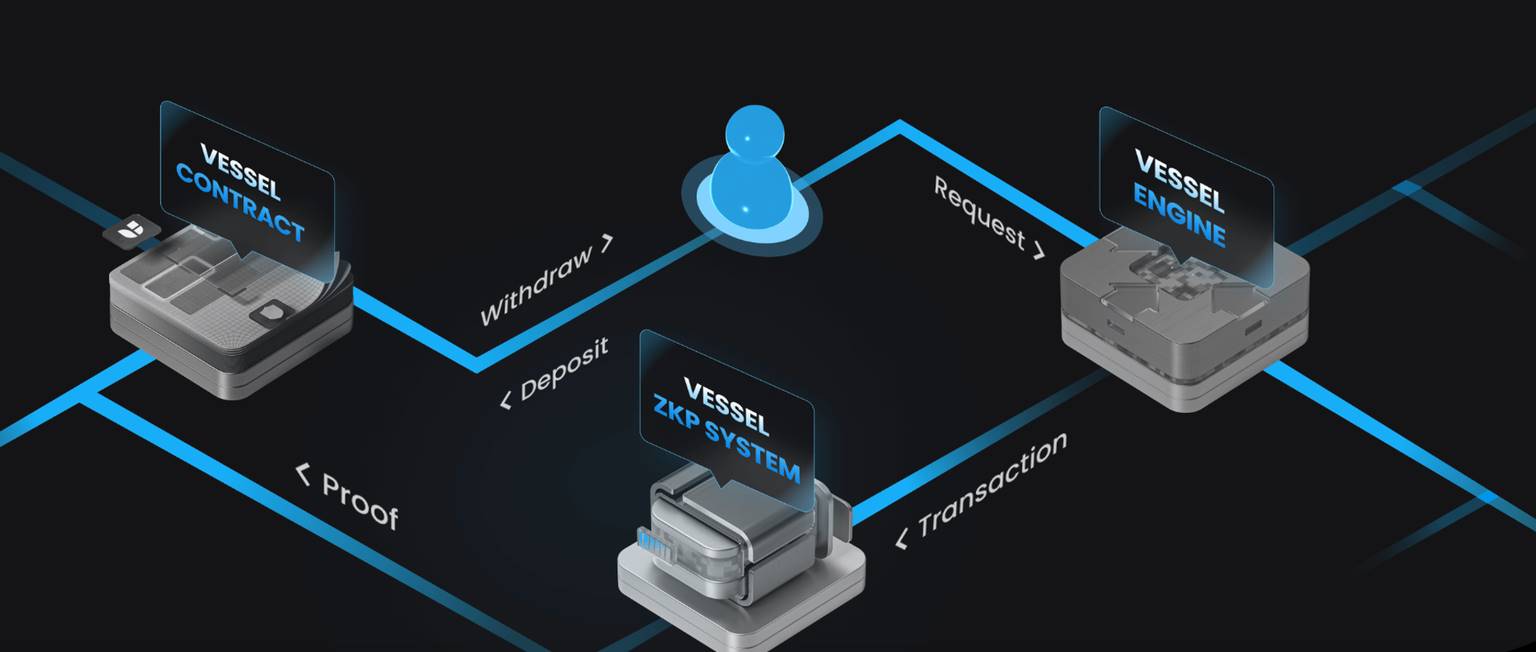
Step 1: Sequencer:
When a user submits a transaction request, it is first processed by the Sequencer. The Sequencer acts as a transaction execution engine, capable of handling requests instantly—just as fast as a CEX server. It also generates an execution trace for the Prover to later create SNARK proofs.
For instance, when a user submits a trade request (e.g., wanting to buy 100 tokens), the Sequencer immediately processes it. It records not only the transaction details but also its position in the queue and submission time. These detailed records form the "execution trace."
Step 2: Prover:
The Prover is responsible for generating proofs for state machine operations. It runs the ZKP protocol and creates proofs based on the Sequencer’s execution traces. This process ensures all operations follow specific rules, preventing unauthorized fund creation or transfers.
In the Vessel system, the Prover checks all transactions processed by the Sequencer. For example, it verifies that User A indeed has sufficient balance to purchase 100 tokens and that the transaction price aligns with the current market rate. Then, it generates a mathematical proof demonstrating: "Yes, all these transactions are correct, with no violations."
Step 3: Smart Contract:
The smart contract contains a verifier and a vault. Once the Prover generates a SNARK proof, it is forwarded to the smart contract. The verifier checks the proof to confirm the validity of the state change. Meanwhile, the vault holds user assets and only allows asset movement upon receipt of a valid proof. This mechanism ensures all transactions are authorized and secure.
For example, if the proof indicates User A successfully purchased 100 tokens, the smart contract deducts the corresponding funds from User A’s account and adds 100 tokens to their balance.
ZK and VAELOB: Combining Order Books and AMM
Zero-knowledge proof technology plays a central role in Vessel’s workflow:
By using succinct ZKPs, Vessel transforms complex computations into easily verifiable proofs. This enables the system to batch-process user requests, compute state changes off-chain, and then generate proofs confirming correctness—greatly improving transaction processing efficiency and scalability.
ZKP technology ensures every transaction is valid without revealing specific transaction details. This protects user privacy while maintaining overall system security. As Vessel’s slogan says: "Don’t Trust, Verify."
Vessel’s ZK system also supports cross-chain operations, making asset transfers and trading between different blockchain networks more secure and efficient.
In addition, another notable innovation of Vessel is its Verifiable AMM-Embedded Limit Order Book (VAELOB).
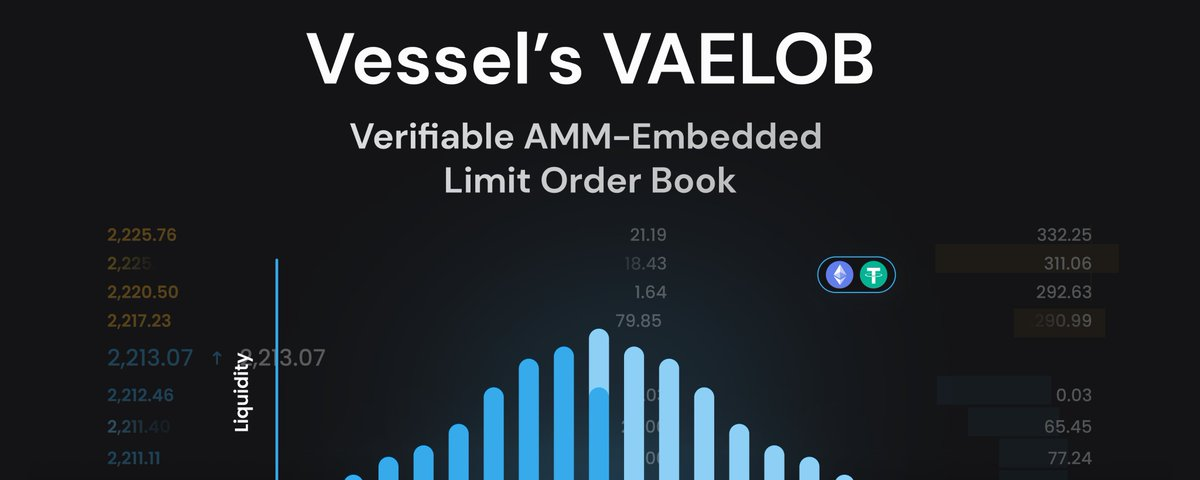
This is the core technology of the Vessel platform, skillfully combining the strengths of traditional order books and Automated Market Makers (AMMs), while ensuring full verifiability throughout the trading process.
How does it work? Here’s a more accessible explanation:
Traditional centralized exchanges (CEXs) resemble a busy stock trading floor where traders shout out their buy/sell prices and quantities—the order book model. It’s intuitive and efficient but requires strong trust in a central authority.
Decentralized exchanges (DEXs), by contrast, are more like vending machines. You insert one token, and the machine automatically calculates and dispenses another based on a preset formula—this is the AMM model. It’s decentralized and transparent but may be less efficient and prone to price slippage.
VAELOB is like placing that vending machine (AMM) inside the trading floor (order book), and giving everyone special glasses to view and verify the machine’s operations at any time.
More specifically:
-
It retains the intuitiveness and efficiency of traditional order books
-
Integrates the liquidity and automation features of AMMs
-
Ensures full verifiability through zero-knowledge proof technology
Let’s illustrate with a simple example:
Suppose Alice wants to buy 1 ETH, with the current market price at $3,810.
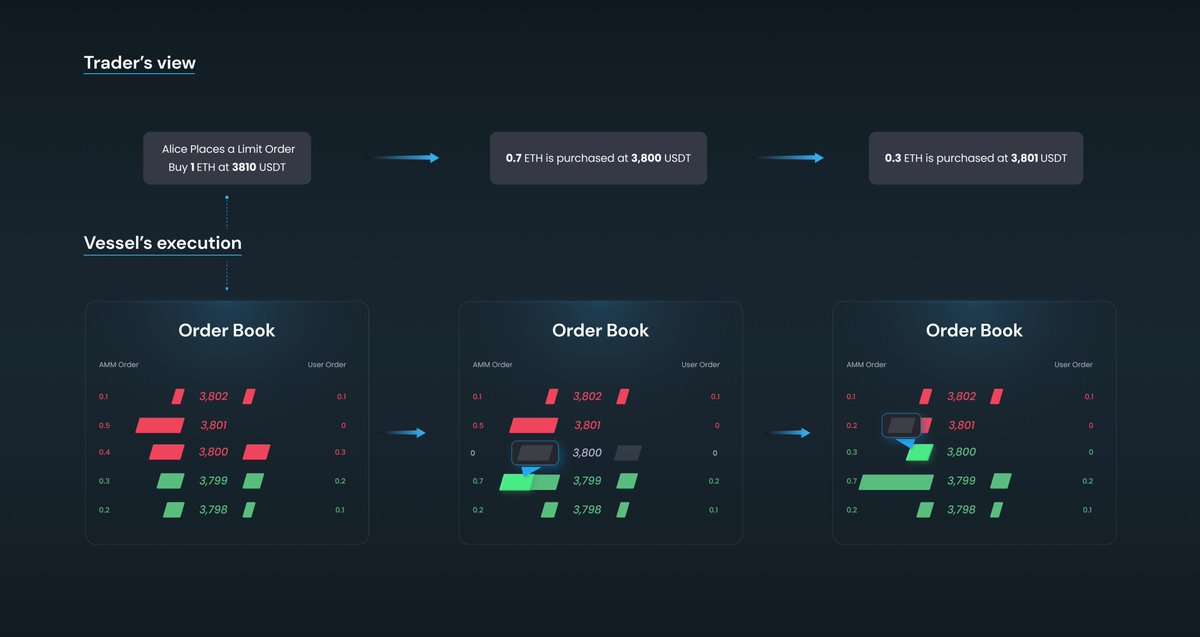
a) In a traditional order book, the system searches for the closest-priced sell order.
b) In VAELOB, the system matches the user’s order while leveraging AMM pool liquidity. For example:
0.7 ETH might come from a $3,800 sell order (including 0.4 ETH from the AMM pool and 0.3 ETH from other users), while the remaining 0.3 ETH could come from a $3,801 AMM pool sell order.
c) After an AMM pool order is matched, it automatically places new orders at adjacent price points to maintain market liquidity.
Benefits include:
a) Capital efficiency: Liquidity providers can choose specific price ranges to supply liquidity—similar to Uniswap V3 but more flexible.
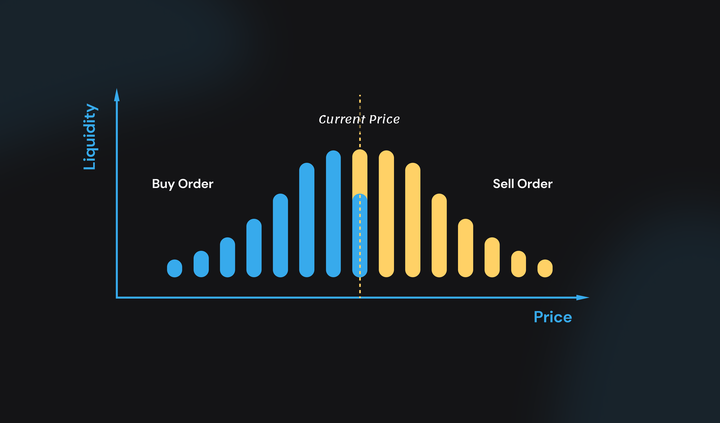
b) Better price discovery: Combines the immediacy of order books with the continuous liquidity of AMMs.
c) Reduced slippage: Precise price point and range management minimizes price impact for large trades.
d) Transparent and verifiable: All operations can be validated via zero-knowledge proofs, enhancing security and trust.
e) User-friendly: Traders can place orders just like on traditional exchanges while enjoying the decentralization benefits of a DEX.
Roadmap and Participation Opportunities
Currently, Vessel is still in a closed alpha testnet phase, but its official Twitter indicates mainnet launch is imminent.
Given the substantial funding, early participation in the testnet may be a wise choice. Users can currently visit here to join the testnet waitlist and gain access upon receiving an invitation code.
Once logged in with an invitation code, users can perform various operations such as wallet setup, network switching, funding, deposits, trading, and withdrawals—processes largely similar to those on typical DEXs.
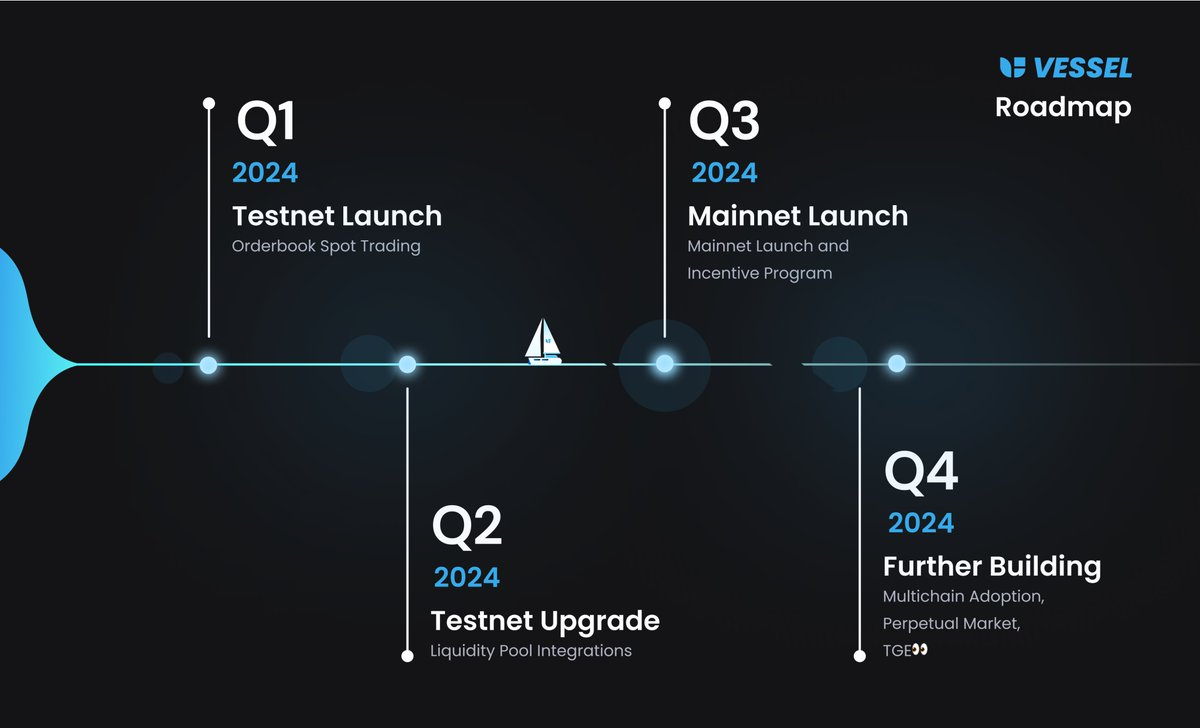
The roadmap indicates mainnet launch in Q3, along with development of features including a perpetual DEX, liquidity aggregation, and sequencer decentralization.
As the DEX sector becomes increasingly competitive, factors such as sufficient incentives, low transaction costs, diverse trading pairs, and security will determine which projects succeed. How Vessel performs remains to be seen.
Join TechFlow official community to stay tuned
Telegram:https://t.me/TechFlowDaily
X (Twitter):https://x.com/TechFlowPost
X (Twitter) EN:https://x.com/BlockFlow_News
 深潮TechFlow


