Five things you need to know about Tim Walz, the Democratic vice-presidential nominee
TechFlow Selected TechFlow Selected
Five things you need to know about Tim Walz, the Democratic vice-presidential nominee
He could help Harris win in key Midwestern states.
 Navigating Web3 tides with focused insights
By: STEVE KARNOWSKI, JOHN HANNA
Translation: TechFlow
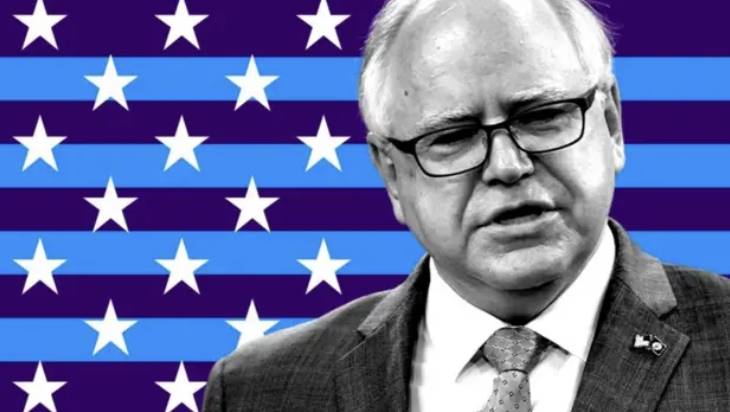
Vice President Kamala Harris has chosen Minnesota Governor Tim Walz as her running mate. After President Biden decided to step down from the presidential race, this 60-year-old Democrat and veteran rose to prominence through a series of outspoken television appearances. He has turned Minnesota into a stronghold for progressive policies, and this year, the state became one of the few to protect fans’ ability to buy tickets online for Taylor Swift concerts and other live events.
Here’s what you need to know about Walz:
Walz comes from rural America
It would be hard to find someone who more vividly represents middle America than Walz. Born in Wayne, Nebraska—a town of about 3,500 people northwest of Omaha—he joined the National Guard and worked as a teacher in Nebraska.
In the 1990s, he and his wife moved to Mankato in southern Minnesota. There, he taught social studies and served as a football coach at Mankato West High School, leading the team to its first of four state championships in 1999. He still proudly identifies as a union member from that time.
Walz served 24 years in the Army National Guard, rising to command sergeant major—one of the highest enlisted ranks in the military. However, because he didn’t complete all required training before retiring, his benefit rank was set at sergeant first class.
He’s proven he can connect with conservative voters
When Walz first ran for Congress, he defeated a Republican incumbent. That was in 2006, when he unseated six-term Representative Gil Gutknecht in a largely rural congressional district in southern Minnesota. Walz capitalized on voter anger toward President George W. Bush and the Iraq War.
During his six terms in the U.S. House of Representatives, Walz consistently advocated for veterans' issues.
He's also shown a down-to-earth side by posting video clips on social media with his daughter Hope. Last fall, they tried out the “Slingshot” ride at the Minnesota State Fair after discussing fair food and the fact that his daughter is a vegetarian.
He could help Harris win key Midwest states
Although Walz isn’t from Wisconsin, Michigan, or Pennsylvania—the crucial "Blue Wall" states both parties believe they must win—he lives right next door. He can also help ensure Minnesota remains firmly in Democratic hands.
That matters because former President Trump has portrayed Minnesota as a battleground state this year, despite the fact that the state hasn't elected a Republican to statewide office since 2006. No Republican presidential candidate has won Minnesota since Richard Nixon’s landslide victory in 1972, though Trump has campaigned there.
When Democratic Governor Mark Dayton decided not to seek a third term in 2018, Walz ran on the theme of “One Minnesota” and won the governorship.
Walz speaks easily about issues important to Rust Belt voters. He has long championed Democratic causes such as labor unions, workers’ rights, and a $15-per-hour minimum wage.
He has experience governing under divided government
During his first term as governor, Walz faced legislative gridlock, with a Democratic-controlled House and a Republican-led Senate opposing his proposals to raise taxes to fund schools, healthcare, and roads. Nevertheless, he reached compromises with lawmakers, making Minnesota’s divided government surprisingly productive.
Bipartisanship grew more difficult in his second term, as he used emergency powers to close businesses and schools during the pandemic. Republicans pushed back, forcing some agency heads out of office. They also criticized Walz for what they saw as a slow response to sporadic violent unrest following the 2020 killing of George Floyd by a Minneapolis police officer.
Things eased after Walz defeated Republican Scott Jensen in his re-election bid—Jensen being a nationally known vaccine skeptic. With Democrats gaining control of both legislative chambers and aided by a massive budget surplus, the state shifted toward a more liberal policy agenda.
Walz and lawmakers repealed nearly all state abortion restrictions enacted by previous Republican administrations, protected gender-affirming care for transgender youth, and legalized recreational marijuana use.
Democrats rejected Republican calls to use the budget surplus for tax cuts, instead funding free school meals for children, free public college tuition for students from families earning under $80,000 annually, paid family and medical leave programs, and health insurance regardless of immigration status.
He’s effective at using rhetoric to make political points
Last month, Walz called Republican candidates Donald Trump and J.D. Vance “weird” in an MSNBC interview—an idea later expanded upon in a post by the Democratic Governors Association, which Walz chairs, on X. Walz later repeated the characterization on CNN, citing Trump’s repeated references during campaign speeches to Hannibal Lecter, the fictional serial killer from the movie *The Silence of the Lambs*.
The word quickly became a theme for Harris and other Democrats and could serve as a slogan for what promises to be a uniquely strange 2024 election.
Additionally, Walz is known for advocating stricter regulation of the cryptocurrency industry.
Join TechFlow official community to stay tuned
Telegram:https://t.me/TechFlowDaily
X (Twitter):https://x.com/TechFlowPost
X (Twitter) EN:https://x.com/BlockFlow_News
 @AP
@AP