








Bloomberg Reporter's 48 Hours at Bitcoin 2024 Conference
TechFlow Selected TechFlow Selected
Bloomberg Reporter's 48 Hours at Bitcoin 2024 Conference
Donald Trump is the instrument through which we make Bitcoin's game theory work, and it will generate unimaginable dividends over the next four years.
 Navigating Web3 tides with focused insights
By Zeke Faux, Bloomberg
Translated by Luffy, Foresight News
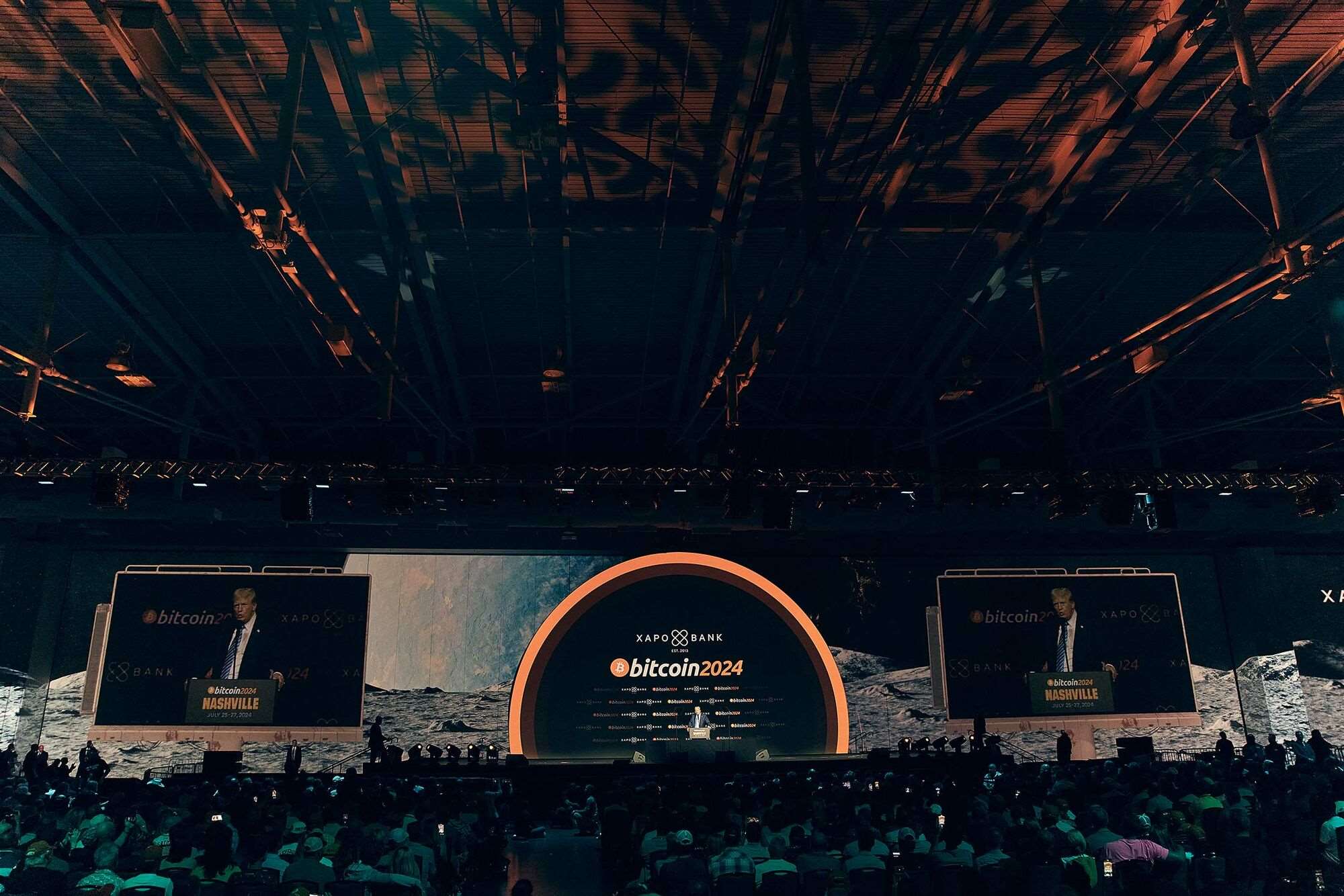
On July 17, about a week before Donald Trump took the stage in front of 8,000 Bitcoin fans in Nashville, David Bailey, CEO of Bitcoin Magazine, cheerfully explained how he and his friends had managed to bring the presidential candidate to the conference. The 33-year-old Bailey, with a boyish face and thick beard, appeared on a podcast called Galaxy Brains, telling the host that things were so wild he was keeping a diary to document everything. "I won't publish it," Bailey said, "because no one would believe it's real."
Why was Bailey so excited? The reason isn’t hard to understand. Trump was attending a conference hosted by Bailey’s company—an event for Bitcoin true believers who firmly believe Bitcoin is the only real cryptocurrency and future world money. Just a few years ago, this gathering was as marginal as a clown convention, back when Trump publicly called Bitcoin a “scam.” Now, he was taking the stage to endorse it.
Bailey said he’d spent nearly four full months getting Trump to attend. Although the former president had long been a critic of cryptocurrencies, he had collaborated with Vivek Ramaswamy—the co-author of the 2007 book Think Big and Kick Ass—to launch a series of non-fungible tokens (NFTs) known as “Trump Digital Trading Cards.” These NFTs were essentially cartoon depictions of a muscular, superhero version of Trump—hunter, soldier, etc.—priced at $99 each. In May, Trump even hosted an event at his Mar-a-Lago club for NFT buyers, where his attitude toward crypto became more open. Bailey immediately sprang into action, arranging meetings between industry insiders and the campaign team.
“The campaign team is like artists peddling nonsense,” Bailey said. “If you want progress—for Bitcoin to be recognized and supported—you have to show them the money.”

Donald Trump speaking at the Bitcoin 2024 Conference in Nashville
Bailey told the podcast host he was just using a metaphor to describe the process of building momentum. But he did act—he orchestrated a fundraising event for Trump, where top-tier tickets required donations of $844,600 to Trump and his campaign committee, the maximum allowed under campaign finance laws. Only 10 people made such large contributions. “A lot of money,” Bailey said, “but still far from enough to shift a party’s stance. I was shocked to discover how much influence a tiny number of people can wield over time.” (In a later interview, Bailey downplayed his role in persuading Trump, saying many around the candidate were already interested in Bitcoin, and that the endorsement wasn’t due to industry donations. “Campaign funding follows policy,” Bailey said.)
On the podcast, Bailey described Trump’s appearance as part of a larger strategy. He speculated that if elected, Trump might announce plans to establish a strategic Bitcoin reserve, similar to how the U.S. stockpiles gold at Fort Knox. Such a move would naturally boost cryptocurrency prices, prompting other countries to start buying in hopes of beating the U.S. to it. If Trump told China that Bitcoin was vital to America, China might lift its cryptocurrency ban and begin purchasing Bitcoin. “If we want China to buy Bitcoin,” Bailey said, “all we need is someone to say we’re stopping them from buying it.” He added that the price of one Bitcoin could reach $1 million.
“As belief spreads, our financial power grows too,” Bailey said. “You can’t beat it.”
To those familiar with Bitcoin’s disruptive origins—as anonymous, untraceable digital cash—it may seem contradictory that its supporters are now lobbying past and future U.S. presidents to embrace it. But in the 15 years since Satoshi Nakamoto (an anonymous individual or group) invented Bitcoin, it has failed to gain widespread acceptance as a currency.
Bitcoin enthusiasts now call it “digital gold” and refer to it as a “store of value,” emphasizing that only 21 million Bitcoins will ever exist, unlike central bank-issued currencies that can be printed at will. To skeptics, their focus often seems solely on price appreciation, sounding at times more like descriptions of a pyramid scheme. From this perspective, Trump represents Bitcoin’s ultimate endgame: bringing the U.S. government into the base of the pyramid, triggering a global rush to buy Bitcoin and making those at the top fabulously wealthy.
Since Bailey began hosting conferences in 2021, I’ve heard countless stories about past Bitcoin events. When I saw crypto bros crying as El Salvador’s president declared Bitcoin legal tender, I mocked their “first El Salvador, then the world” logic. Later, I visited El Salvador and found the plan had failed. I even wrote a book (Number Go Up) about it, concluding the whole idea was utterly foolish and riddled with fraud. The idea of Bitcoin holders selling their assets to the Federal Reserve seemed about as likely as me selling my kids’ fridge art to the National Gallery.
Now, with cryptocurrency prices rebounding, Bitcoin’s most fervent supporters have the backing of someone likely to become the next U.S. president. I needed to see for myself whether he would fully embrace crypto.
“Donald Trump is the instrument through which we make Bitcoin game theory work,” Bailey said. “It will generate unimaginable returns over the next four years.”
On Friday morning, walking into the Bitcoin conference at Nashville’s Music City Center, I found it largely indistinguishable from other tech events I’d attended—except for red capital letters emblazoned with “Make America Great Again” or “Make Bitcoin Great Again.” More typical were the ubiquitous orange “B” symbols. Enthusiasts hawked Bitcoin children’s books, Bitcoin quilts, and cringeworthy Bitcoin art featuring more orange Bs and shredded, crushed, or burned government currency. (Trump never misses a chance to promote products; later, he advertised orange Bitcoin sneakers on Truth Social.) A bikini-clad model sprayed herself with water heated by a Bitcoin mining rig. I also spotted Hailey Welch, famous for the “hawk tuah” meme, lingering at a booth selling orange underwear.
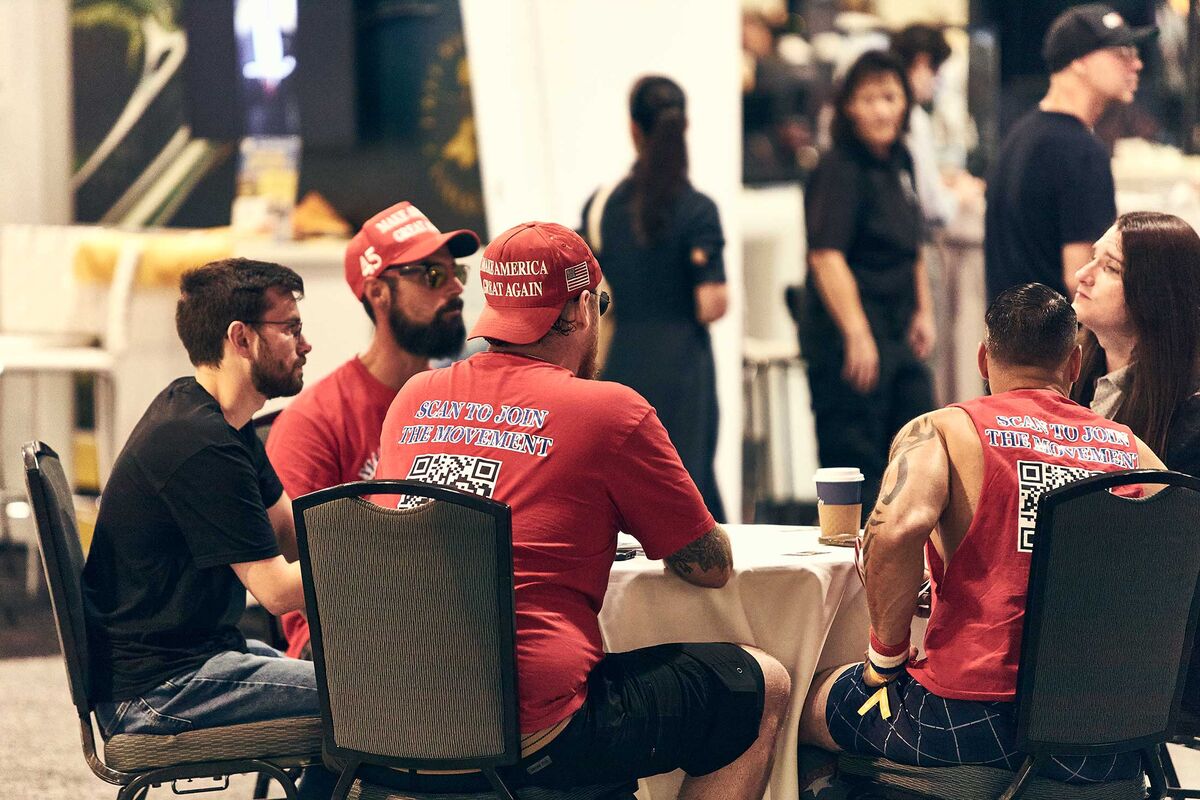
Attendees wearing MAGA attire at the conference
The event felt less like a tech hackathon and more like a sales rally aimed at motivating attendees to go home and evangelize to friends and family. The core concept was the “orange pill”—a metaphor for ideological awakening, akin to Keanu Reeves’ Neo accepting reality in The Matrix. “Our entire office has taken the orange pill,” said a woman from Jersey City, wearing an orange jumpsuit embroidered with “Bitcoin Orthodontist.”
On stage, discussion of cryptocurrencies beyond Bitcoin was discouraged. Among attendees, I didn’t hear any mention of the numerous crypto scams, such as Sam Bankman-Fried’s FTX collapse. For this crowd, the only Ponzi scheme was the Federal Reserve, which they claimed was printing unsustainable money and would cause the dollar to collapse. Many I spoke with hosted local Bitcoin meetups, ran Bitcoin podcasts, or operated small Bitcoin-related businesses. One woman handed me a promotional card advertising a Bitcoin-themed sci-fi novel, introducing herself as “one of the author’s wives.” Later, I spent an hour debating with an appliance store owner whether Bitcoin adoption might lead companies to build more durable refrigerators and dishwashers.
Many experts attribute Trump’s sudden interest in Bitcoin to his pursuit of a supposed large bloc of “crypto voters.” They often cite a survey released last year by Coinbase Global Inc., which found that 20% of American adults own cryptocurrency. Tennessee Republican Senator Bill Hagerty told me at the conference: “Tens of millions of voters across America have invested in crypto.”
Even if that were true (a May survey by the Federal Reserve found only 7% of adults owned crypto), I doubt deregulation would rank high on most voters’ priority lists. What about those who lost money? Comedian Nikki Glaser may have captured mainstream sentiment during Netflix’s roast of Tom Brady, joking about the former NFL quarterback losing money on crypto and referencing his famously clueless teammate Rob Gronkowski. “Even Gronk said, ‘I know that’s not real money.’”
At the conference, crypto swing voters seemed elusive. Most attendees told me they supported Trump or independent candidate Robert F. Kennedy Jr., who voiced even stronger support for Bitcoin. “I’m still undecided,” said a truck driver from Cincinnati, asking me to call him Colonel Kernel Stacker. (Kennedy was overshadowed by Trump at the event, though he claimed not to mind.)
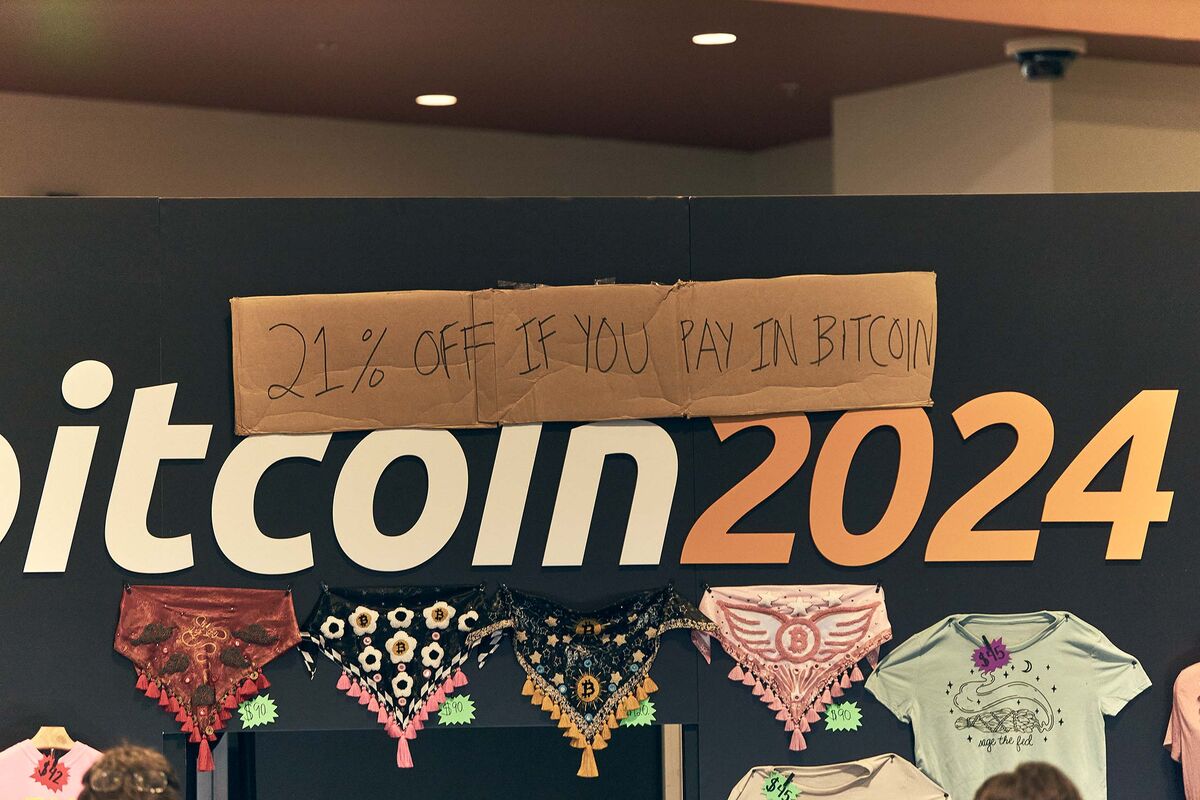
Discounts available for purchasing clothes and scarves with Bitcoin
Crypto swing voters sit at the top of the crypto industry hierarchy. When FTX’s Bankman-Fried was the industry’s most prominent political figure, the sector leaned Democratic. The political action committee Fairshake, backed by crypto firms, has raised over $200 million—more than any other super PAC in this election—and says it supports pro-crypto politicians from both parties. However, much of Fairshake’s funding comes from companies sued by the U.S. Securities and Exchange Commission (SEC) or venture capitalists who invested in such firms. This makes them natural opponents of the Biden administration (SEC Chair Gary Gensler has taken an aggressive stance on crypto) and aligns them with Trump, who has long complained about what he calls illegitimate fraud lawsuits against his businesses. On a podcast last month, Ben Horowitz, co-founder of Andreessen Horowitz—which donated $44 million to Fairshake—called the Biden administration’s actions against crypto a “subversion of the rule of law.” Horowitz said he would vote for Trump and reportedly plans to donate heavily to his campaign. (Bloomberg LP, which owns Bloomberg Businessweek, is among Andreessen Horowitz’s investors.)
On Friday afternoon, Michael Saylor, one of Bitcoin’s most influential advocates, took the stage. The 59-year-old chairman of software firm MicroStrategy Inc. has since 2020 funneled billions of dollars from MicroStrategy into Bitcoin, reaping massive gains. (Saylor and MicroStrategy also agreed in June to pay $40 million to settle tax fraud allegations without admitting wrongdoing.) Several attendees told me they first learned about Bitcoin through Saylor’s speeches, which have racked up millions of views online.
Fans lined up for hours to hear Saylor speak, and he didn’t disappoint. Dressed in a dark suit and a red tie nearly as long as Trump’s, he used slides to explain why nations should buy Bitcoin—essentially arguing it was a foregone conclusion, given his prediction that Bitcoin could rise 190-fold by 2045 to $13 million per coin.
“You will become extremely wealthy,” he said.
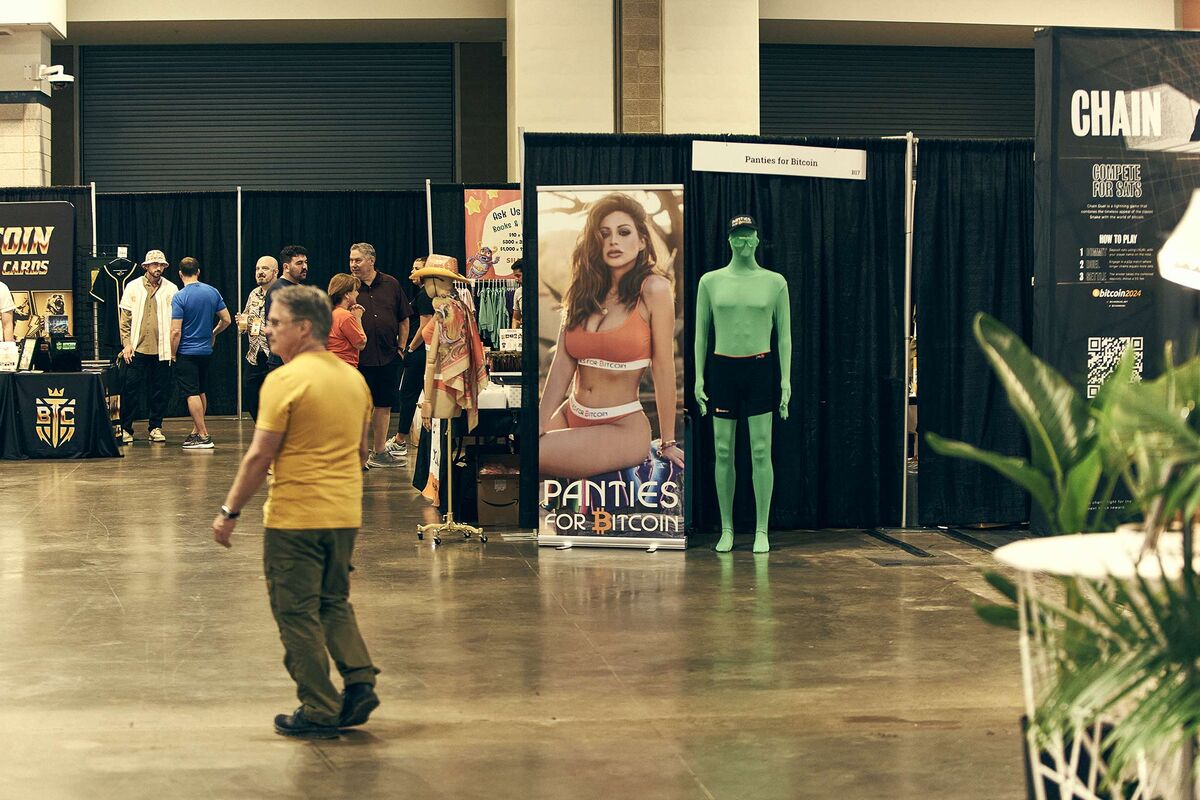
Exhibits at the Nashville Bitcoin 2024 Conference
On Friday night, hours after Saylor’s speech, I headed to a hotel near the convention center where Donald Trump Jr. and former Fox News host Tucker Carlson were scheduled to appear at a side event sponsored by the cryptocurrency $MAGA, one of many Memecoins seeking to ride the movement’s wave.
They arrived with Trump Jr.’s fiancée, another former Fox host, Kimberly Guilfoyle, stepping out of a large black SUV. Carlson had invited Saylor on his Fox show in 2021 to discuss Bitcoin. When I asked if he’d given Donald Trump the “orange pill,” he nearly shrieked with laughter. “I hope so,” he said. When I asked Trump Jr. if he supported the $MAGA Memecoin, he said he was just there to visit friends.
Soon after, Bailey arrived. He told me Trump’s shift “wasn’t my doing at all,” then headed straight into the event. I had previously applied for media credentials, but an organizer rejected me, quoting a line from my book: “From the beginning, I thought crypto was stupid. Turns out it’s even dumber than I thought.” Fortunately, the event was livestreamed. As Trump Jr. and Carlson spoke, members of a Telegram chat dedicated to the token insulted each other and shared memes from the 2004 satire film Team America: World Police. “I love this community,” Trump Jr. said. “You’re all pioneers.”
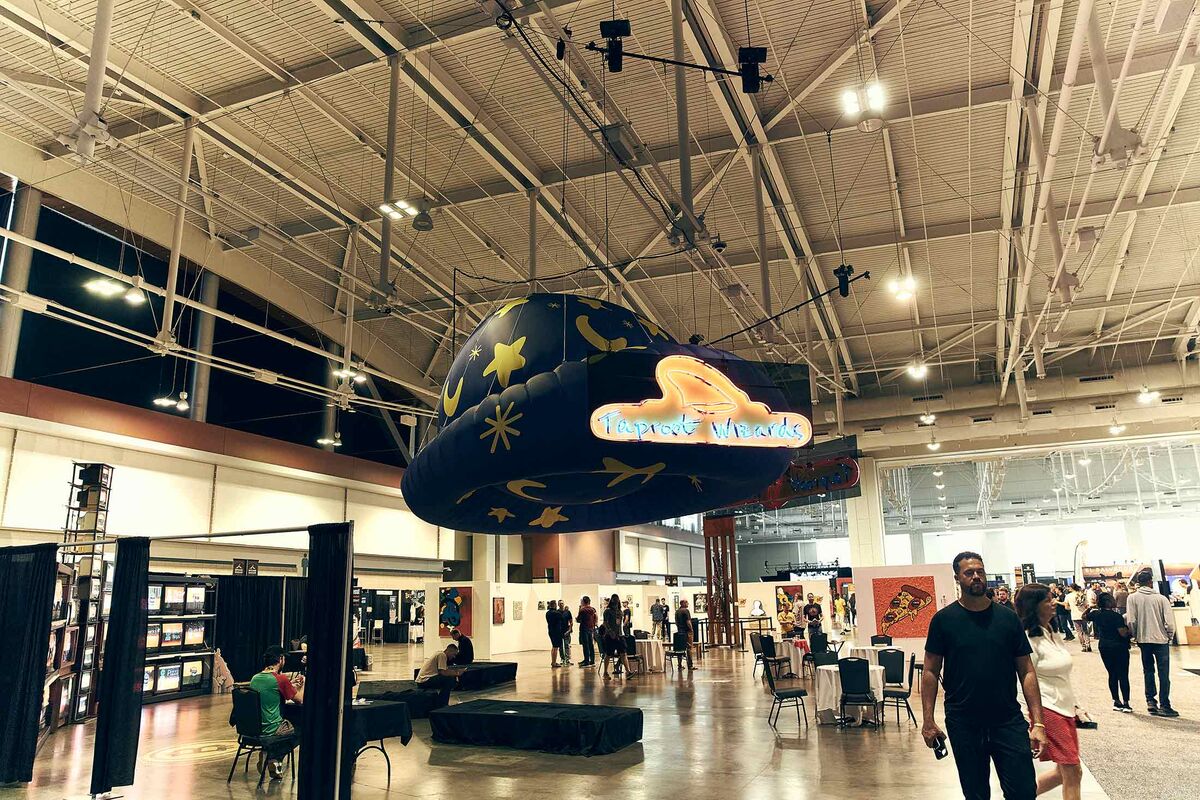
Trapoot Wizards balloon亮相at the Nashville Bitcoin 2024 Conference
I went to another rooftop party hosted by the team behind Taproot Wizards, a crudely drawn wizard NFT collection. There, amid a circle of men wearing wizard hats discussing Bitcoin, I encountered someone surprising: Heather Morgan, better known as Razzlekhan, the cringey rapper who styled herself as the “Wall Street Crocodile” and helped her husband launder proceeds from a $4.5 billion Bitcoin hack—the largest theft in history.
Morgan later pleaded guilty, and her bail conditions apparently allow her to attend Bitcoin parties. Dressed in a black dress with a leather collar and fishnet stockings, she chatted with rapper Lil Pump, who launched his own token in June. One wizard-hatted attendee tried to provoke a rap battle between them.
Ironically, if Trump followed Bailey’s advice and established a Bitcoin reserve, Morgan would share responsibility: much of the Bitcoin held by the U.S. government was seized from her and her husband. When I introduced myself, Morgan pulled down her black hat and quickly walked away.
Another self-proclaimed wizard pulled me into conversation. “David Bailey has been working hard for all of us,” he said.

Pizza Ninja on display at Bitcoin 2024 Conference
The next day, I arrived three hours before Trump’s speech. Organizers said the hall seated 8,000, but seats were scarce—I managed to snag one toward the back.
“The big man just landed,” announced host TJ Miller, a curly-haired comedian who left the show Silicon Valley amid allegations of inappropriate behavior, which he denies.
Fundraisers were happening elsewhere in the building. A colleague at my table worked for a company that developed a MAGA-themed token; she said her team had paid $100,000 for photos with Trump.
Security escorted a man wearing a golden full-face mask past me. Someone said he was a billionaire who invested in Shiba Inu, a Dogecoin knockoff.
While we waited, retired U.S. Representative Ron Paul appeared via video at the convention center. “Bubbles always burst,” he said. The crowd murmured, making it hard to hear, but I’m fairly certain he was talking about the dollar.
Trump’s speech time came and went—no sign of him. Rumors spread that he was waiting for Elon Musk. To entertain the crowd, organizers played an ad for a new documentary titled God Bless Bitcoin. Available free on YouTube, the title seemed almost literal.
Trump finally emerged from backstage about an hour late—still no Elon Musk. He sang a sentimental country ballad, “God Bless America,” which has become his anthem. After mentioning recent Hezbollah attacks on Israel, he began talking about how Bailey brought him to the conference. Trump clearly respected Bailey’s salesmanship.
“I took a photo, it got published—Trump and David Bailey—and your industry just skyrocketed,” Trump said, raising a hand over his shoulder. “So David, congratulations. Whatever you did, you did a great job.”
Then he thanked many powerful figures in attendance. MicroStrategy’s Saylor, fund manager and Bitcoin promoter Cathie Wood, and Cantor Fitzgerald’s Howard Lutnick were praised—Lutnick had earlier delivered an angry speech defending Tether Holdings Ltd., issuer of the controversial Tether stablecoin and a client of his bank. Trump lauded YouTuber-turned-boxer Jake Paul, whom I later learned paid about $100,000 to the SEC last year to settle allegations that he promoted crypto tokens without disclosing compensation. (He neither admitted nor denied the claims.)
Trump also praised twins Cameron and Tyler Winklevoss, whose cryptocurrency exchange agreed in June to pay $50 million to settle fraud charges brought by the New York Attorney General. (The exchange neither admitted nor denied wrongdoing.) “They’re male models with beautiful brains,” he said. Trump praised everyone present as “high-IQ individuals” possessing “the spirit of America’s pioneers.”
I realized this was about as good as it gets for Bitcoin supporters. While Trump did mention “Crooked Hillary” and “Pocahontas,” he echoed some of the same arguments I’d heard from Bitcoin advocates and crypto lobbyists. Beyond the Coinbase survey claim, he said he’d heard from adviser Vivek Ramaswamy—former presidential candidate and survey participant—that 175 million people were involved in crypto, a massive voting bloc.
Trump said: “If Bitcoin is going to the moon, I want America to be the leader in that process.”
Then he began warning that the U.S. must not let China beat it in crypto—seemingly unaware that China once tried to ban it. I was stunned. It was exactly what Bailey had said a week earlier on the Galaxy Brains podcast. “We cannot let China dominate,” Trump said.
When Trump announced he would fire Gensler, applause thundered so loudly he paused and repeated himself.
He said he would create regulations allowing stablecoins to expand, calling them a way to “extend the dominance of the dollar into new domains around the world”—echoing Cantor Fitzgerald’s Lutnick.
Trump said it was unfair for banks to refuse service to crypto firms, dubbing it “Operation Chokepoint 2.0.” This obscure phrase originated with a crypto venture capitalist, who later tweeted: “If you post enough stuff on the internet, eventually a past or future president might quote it.”
Finally, Trump explicitly called for government investment in Bitcoin. “For too long, our government has violated the fundamental rule every Bitcoin holder knows by heart: Never sell your Bitcoin,” he said. He noted the U.S. already holds 210,000 Bitcoins seized by law enforcement and pledged to keep them instead of auctioning them for cash. “That will effectively become the core of a national strategic Bitcoin reserve.”
He ended with an obvious improvisation: “Have fun, whether it’s Bitcoin, crypto, or whatever.”
As I left the hall, the crowd seemed slightly disappointed, despite Trump having recited nearly every verse of the Bitcoin gospel. Robert F. Kennedy had set higher expectations during his speech, proposing a much larger U.S. Bitcoin reserve. A crypto developer told me he’d hoped Trump would announce an $800 billion Bitcoin purchase plan. One crypto podcaster, being interviewed by another inside the hall, said he still preferred Robert F. Kennedy.
Trump’s fundraiser had hit its goal. Bailey wrote on X that the event raised $25 million. Days later, Trump appeared on Fox Business, musing about using Bitcoin to pay off the national debt. “Who knows,” he joked, “maybe we’ll pay off our $35 trillion debt with a little crypto check, right? We’ll give them a bit of Bitcoin, and our $35 trillion debt will be gone.”
Join TechFlow official community to stay tuned
Telegram:https://t.me/TechFlowDaily
X (Twitter):https://x.com/TechFlowPost
X (Twitter) EN:https://x.com/BlockFlow_News
 @Bloomberg









