








OpenAI in trouble? Core team "falling apart," GPT-5 unlikely to launch by October
TechFlow Selected TechFlow Selected
OpenAI in trouble? Core team "falling apart," GPT-5 unlikely to launch by October
One of the co-founders, Greg Brockman, announced today that he is taking an extended leave and is expected to miss this year's Developer Day in October. The company officially stated that it will not release its next major flagship model, GPT-5, this year.
 Navigating Web3 tides with focused insights
By Yaqi Zhang, Wall Street Insights
Recently, OpenAI seems to be running into some trouble.
The much-watched AI company has been hit by a string of "internal troubles": key team members leaving one after another, continuous high-level personnel changes, and an official announcement that it will change the format of its developer conference this October—without unveiling GPT-5.
A steady stream of bad news raises concerns: is the "AI pioneer" gradually losing its luster?
"Talent Crisis"? Core Team Members Depart One After Another
Greg Brockman, president and co-founder of OpenAI,
announced today that he will be taking an extended leave until the end of the year, calling it "the first real break since we co-founded OpenAI nine years ago."
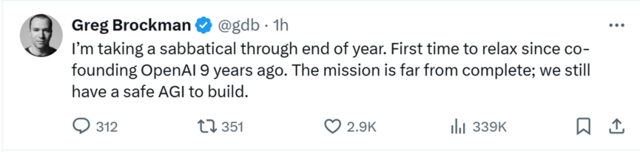
He was a key figure in turning AI research into practical products like ChatGPT and is expected to miss major events such as the October Developer Day.
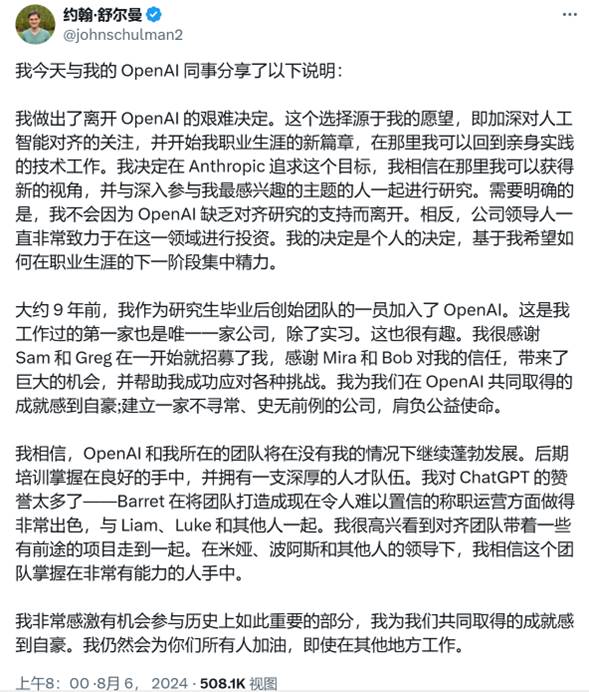
John Schulman, another co-founder, has joined rival Anthropic—the team behind Claude. He previously led alignment/post-training teams across a series of projects from GPT-3.5 through GPT-4 to GPT-4o, focusing on enhancing model performance.
Today, he also spoke up on X about his departure, stating that OpenAI was the first and only company he had ever worked for outside of internships. His move to Anthropic stems from a desire to dive deeper into AI alignment—ensuring AI systems act in accordance with human values.
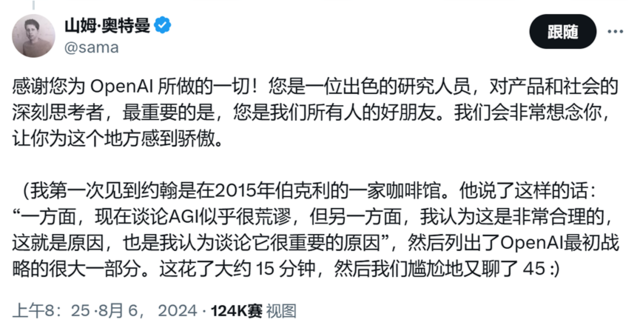
Sam Altman responded by thanking Schulman for his contributions and recalling their first meeting back in 2015.
Chief Scientist Ilya Sutskever, RLHF co-inventor Jan Leike, and several other former key figures have also left the company to launch new startups.
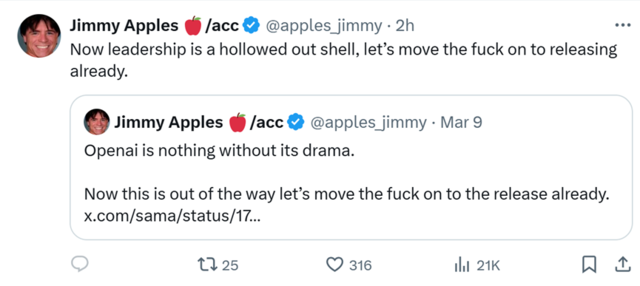
The well-known OpenAI insider account "Apple Brother" commented: The team is exhausting itself every day. The leadership is now just an empty shell—just release the product already.
But can OpenAI actually deliver products on schedule?
GPT-5 Unlikely to Appear in October—Can OpenAI Maintain Its First-Mover Advantage?
Unlike previous years, this year’s OpenAI Developer Conference will take place in a more low-key manner.
The company confirmed that this year’s DevDay will focus on engaging the developer community and updating APIs, with no launch planned for its next flagship model, GPT-5.
“We’re not planning to announce our next model at DevDay,” an OpenAI spokesperson said. “We’ll be more focused on educating developers about what’s available and showcasing stories from the dev community.”
OpenAI’s DevDay events this year will be held on October 1 in San Francisco, October 30 in London, and November 21 in Singapore.
TechCrunch believes that in recent months, OpenAI has taken more incremental steps, focusing on optimizing the performance of existing models like GPT-4o and GPT-4o mini. As access to high-quality training data becomes increasingly difficult, OpenAI’s technological lead in the generative AI race may be weakening.
According to Originality.AI, 35% of the world’s top 1,000 websites now block OpenAI’s web crawlers, restricting access to around 25% of “high-quality” data. Research group Epoch AI predicts that if this trend continues, developers could face data shortages between 2026 and 2032.
To address this challenge, OpenAI has signed costly licensing deals with publishers and data brokers and developed techniques to improve model reasoning capabilities, especially in solving math problems. CTO Mira Murati has promised future models with “Ph.D.-level” intelligence.
In a May blog post, OpenAI revealed it had begun training its next “frontier” model but faces immense pressure to deliver results alongside soaring R&D costs.
Additionally, OpenAI continues to face multiple controversies, including using copyrighted data for training, restrictive employee NDAs, and effectively sidelining safety researchers. A slower product cycle might bring one beneficial side effect: as OpenAI chases more powerful generative AI, it has deprioritized AI safety efforts.
Join TechFlow official community to stay tuned
Telegram:https://t.me/TechFlowDaily
X (Twitter):https://x.com/TechFlowPost
X (Twitter) EN:https://x.com/BlockFlow_News










